My last live cultural experience before lockdown was introduced in the UK was on February 11th. I saw Isabel Allende in conversation with Jeanette Winterson at The Dancehouse in Manchester as part of the Manchester Literature Festival. The evenings were still dark and the weather was cold. The excited spectators queued on the stairs, we sat next to strangers and laughed out loud, a microphone was passed around the audience. Nobody was wearing a face mask nor using hand sanitiser and the Coronavirus seemed like a thing that was happening far away and not at all like a real threat. A few weeks later and it would have been cancelled. Isabel Allende probably would not even have embarked on an international promotional tour. Only 6 months ago, and yet it feels like a lifetime.
 A Long Petal of the Sea is Isabel Allende’s twentieth novel and, as with many of her works, is based on the true story of a close friend of hers. It concerns refugees from the Spanish Civil War who escape the fascist regime in September 1939 and flee to Chile via France on a ship called the Winnipeg, in an operation organised by the legendary Chilean poet Pablo Neruda, who felt his nation had a duty to support those fleeing the terror in Spain.
Victor Dalmau is one of these refugees, a young medic who escapes the country with his heavily pregnant sister-in-law Roser, a pianist who was engaged to be married to Victor’s brother Guillem. Guillem was a fighter, a passionate revolutionary, and lost his life to the cause. Victor and Roser are forced to leave behind Victor’s elderly mother, Carme Dalmau. She says she is too old for the journey and wishes to die in her country. Victor persuades Roser to marry him, believing it will be safest for them both and give them the best chance of being accepted into Chile.
The couple settle in Chile and Roser gives birth to a son, Marcel, whom Victor cares for as if he were his own child. Although theirs is a marriage of convenience, Victor and Roser grow fond of one another and whilst, initially, they intend to return to Spain one day, it becomes clear, as the years pass, and world war two rages in Europe, that this is unlikely to happen. They therefore set about making a decent life for themselves: they set up a business, a small bar, Victor completes his studies and qualifies as a doctor, eventually becoming one of the leading cardiac surgeons in the country (a fact which will later save his own life). Roser, meanwhile, develops her own career; she was a pianist in Spain (she was rescued by Victor’s parents who spotted her talent and rescued her from a life of poverty) and begins teaching music.
They seem to be thriving, until the military coup in 1973, when General Pinochet led the overthrow of the president Salvador Allende. This, of course, is closely linked to the author’s own story, President Allende having been her father’s cousin. Here, Victor’s past catches up with him; he is known as a former anti-fascist activist and had become a friend of the President, playing chess with him regularly. The couple’s fortunes take a turn for the worse.
I won’t give away any more of the details as it is a cracking story which doesn’t end quite as you’d expect. In the talk I attended, Isabel Allende described this book as a straight love story, and indeed it is, a tale of the kinds of lives on which the world turns. It is what Allende does best, story-telling and this book will keep you gripped. There is no shortage of action or plot and I suspect she has stayed very close to the facts of the original true story. If you are an Allende fan you will love it, as it would be hard not to love anything she has written. It is not The House of the Spirits though, nor does it have the breadth or power of a story such as Portrait in Sepia. I think the canvas here is a bit smaller and I suspect the author has constrained her imagination a little in order to be loyal to the real-life story. That said, it is clearly a book full of love for its characters and their story and it feels very authentic.
Recommended.
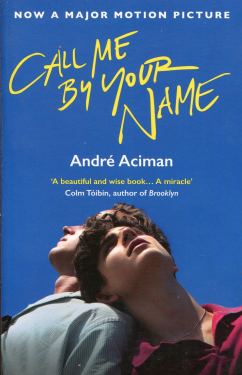 I had been thinking about some of the classic love stories – Jane Eyre, Anna Karenina, Gone with the Wind, The Remains of the Day – but none of these felt much like ‘holiday reading’. But then a bit of online research threw up the perfect suggestion – Call Me By Your Name by Andre Aciman. First published in 2007, this novel was made into a very successful film in 2018 starring Timothee Chalemet and Armie Hammer. It is set in the 1980s on the Italian Riviera (perfect!) and concerns a romance between Italian-American Elio (Chalemet), spending the long hot summer at his parents’ holiday home, and visiting academic Oliver (Hammer). It is apparently quite steamy (perfect!). I have not yet seen the film, so I am delighted to read the book first.
 At the start of this novel Nurit is divorced, ghost-writing money-spinner books for celebrities and somewhat directionless. Her affair with Rinaldi is long over, but he contacts her and asks her to write some columns on Chazarreta’s murder. He arranges for her to stay at the home of his newspaper’s proprietor at La Maravillosa so that she can get close to the scene of the crime and the people who live there. It was Rinaldi who called Nurit ‘Betty Boo’, because of her dark eyes and dark curly hair. As Nurit gradually becomes immersed in the crime, her relationship develops with two other journalists at El Tribuno, which her ex-lover edits: Jaime Brena, the disillusioned middle-aged hack, former crime journalist, now reduced to the lifestyle section of the paper, and ‘Crime Boy’ the young upstart, now the lead crime writer on the paper, who, with his limited experience, turns increasingly to Brena for help on the Chazarreta case.
 It therefore seems timely that I recently read the memoir Unorthodox by Deborah Feldman. Deborah is in her mid-thirties and lives in Berlin, with her young son. However, she grew up in Williamsburg, Brooklyn as a member of the Satmar sect of Hasidic Jews. She was brought up by her grandparents; her parents separated when she was very young. Her father was a man with sub-normal intelligence, though the precise nature of his disability or illness was never identified. Deborah’s mother was English, the daughter of poor divorced Jewish parents (though not Hasidic), who was unlikely ever to be able to marry well. The marriage was effectively one of convenience for both of them and Deborah was born soon after. The marriage broke down quite quickly, however, and Deborah’s mother was compelled to leave. The community put enough pressure on to ensure she left her child behind.
 Julia's books