A couple of weeks ago I posted about some of the books I had been reading during my unintended blogging sabbatical, three fiction titles I had enjoyed. I’ve also been reading quite a bit of non-fiction and here are three I’d like to share with you.
When the Dust Settles by Lucy Easthope

This was one of my book club reads. Published in 2022 it is a memoir from one of the country’s foremost disaster experts. This was a profession that I confess I had never really thought about or even knew existed, although after reading this book, that feels like a stupid thing to say. Easthope and her colleagues manage the clear-up after natural and man-made catastrophe, their primary focus being the retrieval, preservation, cataloguing and retention of human remains, from tiny fragments, such as pieces of bone where DNA testing can help to establish identity and ownership, to items of clothing or belongings. Easthope cares passionately about her work and empathises deeply with the loved ones of victims, for whom she sees her role as being part of the grieving process. Easthope writes candidly (and at times this can be challenging) about her role in many significant disasters such as 9/11 in New York city in 2001, to the Lac-Megantic rail disaster in Canada in 2013. She also has much to say about disaster planning in the UK, drawing from her experiences of working with flood victims in Yorkshire and the Covid-19 pandemic. It is fascinating reading. Easthope is a talented writer and also weaves in her personal story, the smaller tragedies in her own life, such as her husband’s near-death and her recurrent miscarriages. This is both a highly personal memoir but also a reflective piece of work about the lessons she has learned (and the many lessons governments fail to learn) about handling disaster. Whilst this is not a book for the faint-hearted, it is a highly-engaging and important read.
How They Broke Britain by James O’Brien
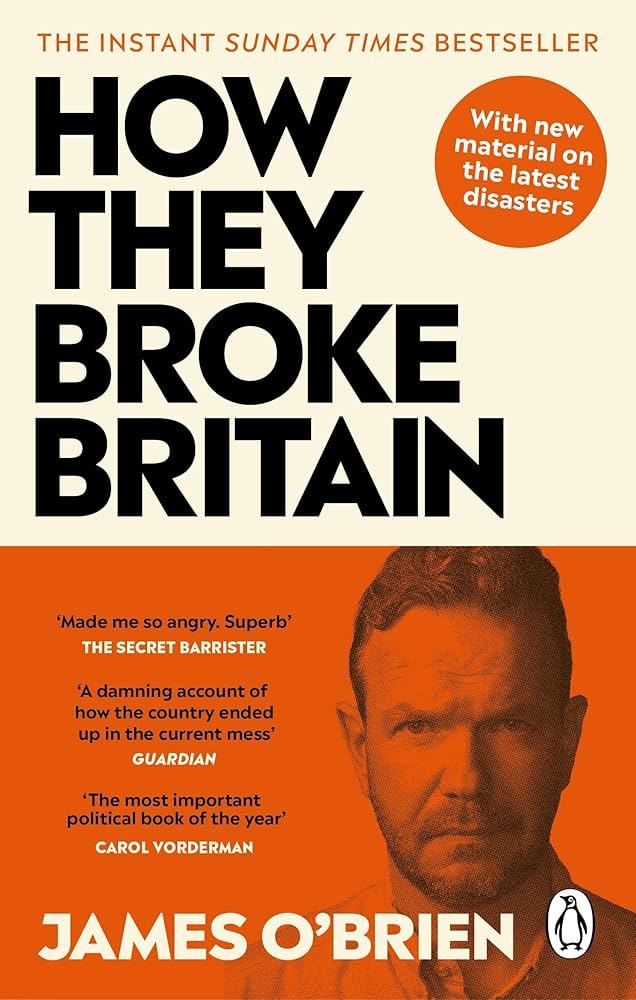
To say I enjoyed this book immensely is probably to come out about my political leanings (for which I make no apology, by the way, but not something I make a big deal about on this blog). I saw James O’Brien give a talk at this year’s Hay Festival (alongside the Financial Times journalist Peter Foster, who was also promoting his own book What Went Wrong with Brexit and What We Can Do About It) and bought both books. It is written in O’Brien’s trademark discursive style and each of the culprits in the tragi-comedy gets a chapter of their own. There are all the faces you would expect to see – Boris Johnson, Dominic Cummings, Nigel Farage and Liz Truss – plus a few you might not, and may not even have heard of such as Paul Dacre, Matthew Elliott (who?) and Jeremy Corbyn. O’Brien is excoriating about the role of each of his culprits in the dumbing-down of public discourse, on the commercialisation of thought, and how each has in their own unique way (sometimes wittingly, sometimes not) corrupted public life. His central thesis is “Shame on you!” which regardless of your politics, is hard to disagree with. I found one or two of his points stretched credulity for me, but only a little. When you see it all written down, page after page of it, it is deeply troubling and it is clear that a lot of painstaking cleaning-up work needs to be done (Lucy Easthope?)
Strong Female Character by Fern Brady

This was another of my book club reads and one that I had mixed feelings about. I should also say that I listened to it on audio, and it was read by the author and this may have affected my view. Fern Brady is a comedian and she is autistic. She did not receive a diagnosis until she was well into adulthood and this memoir is her account of growing up in Scotland with the condition. She writes about her difficult time at various schools, her struggles with her parents (who seem to have found her behaviour difficult to cope with) and the challenges of going to university. It is at times laugh out loud funny and at others deeply upsetting; she has clearly had some rough times. Her accounts of finding herself homeless, experiencing abuse and unable to navigate social relationships well are heartbreaking. This is hard to write but there were also parts where I found my sympathies did not lie with her. For example, her parents come out pretty badly and that felt unfair, especially when I did some research afterwards about her background and upbringing – it does not seem to have been as bleak as it came across to me. Also, the reading was sometimes vulnerable, sometimes bombastic, even boastful. It drew some general conclusions about ‘people with autism’ from the standpoint of her personal experience. From my own experience of the condition I don’t think it was always right.
All three were very good reads that I recommend highly. I’d love to hear what you thought if you have read any of them.

 Julia's books
I really enjoyed reading these thoughtful nonfiction books reviews. Posts like this are a great way to discover meaningful reads and different perspectives. Recently, I also came across the nonfiction book about mental health and humor, MENTAL HEALTH & BELLY LAUGHS WHO KNEW by Author Deano Young, which shows how we can truly laugh through the pain. It’s always refreshing to see nonfiction books that combine insight with relatable life experiences.
LikeLiked by 1 person