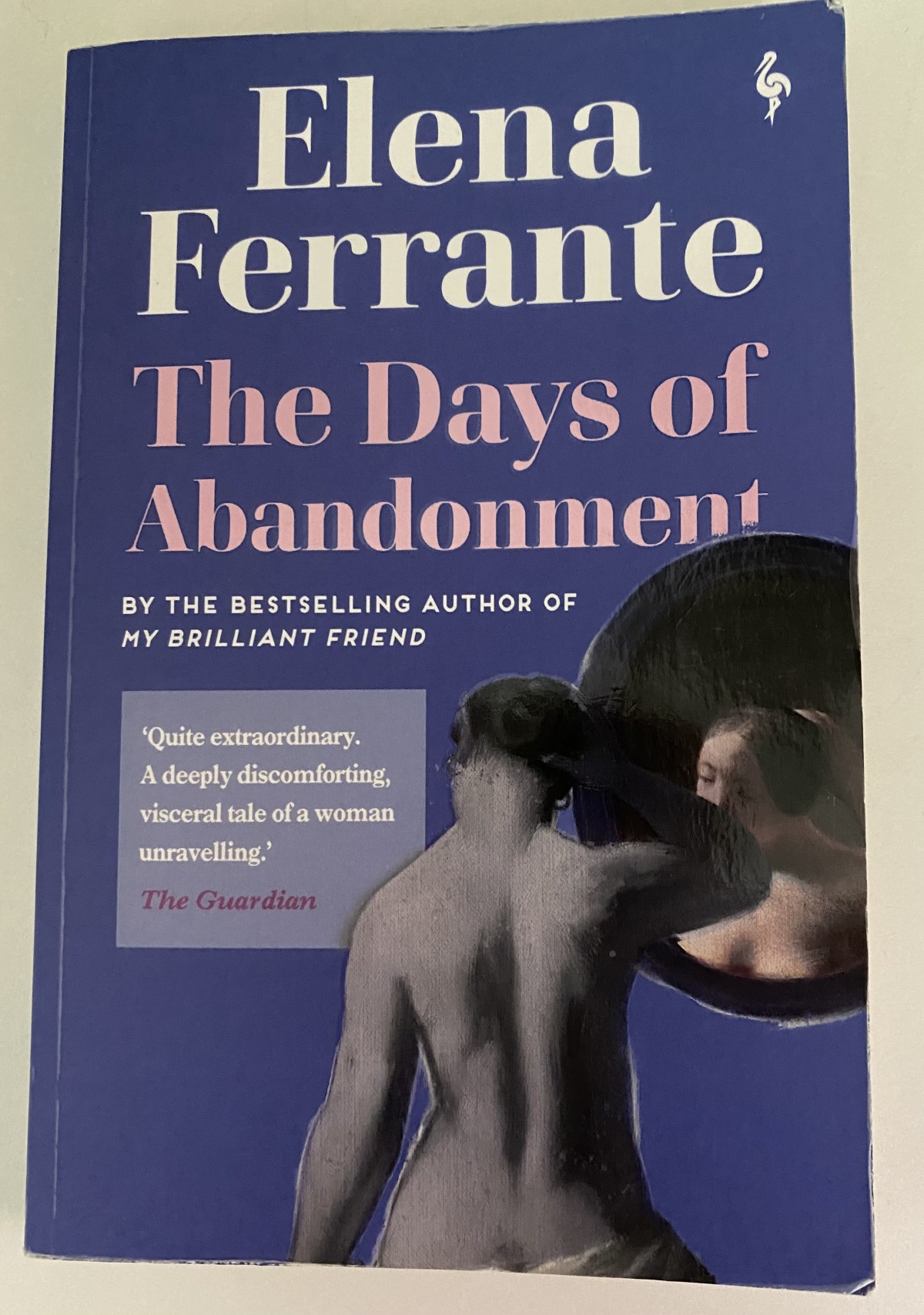
Last week I posted a blog reviewing two powerful books about new motherhood that I had read over the summer. During the holidays I also read The Days of Abandonment which I picked up at the Oxfam secondhand bookstall at the Hay Festival earlier this year. Ferrante’s Neapolitan novels (My Brilliant Friend, The Story of a New Name, Those Who Leave and Those Who Stay, and The Story of the Lost Child) are world-renowned, deservedly so, and I have reviewed most of them on this blog. They were published between 2011-15 so this novel, published in 2002 (first English translation by Europa Editions in 2005) is a good decade earlier in her writing career, and was only her second novel, her first having been published much earlier in 1992 (though the English translation actually came later, in 2006).
The Days of Abandonment covers another life-changing event in the life of a woman, a mother of young children – in the very first sentence of the book, the narrator announces “One April afternoon, right after lunch, my husband announced that he wanted to leave me.” The line is devastating in its simplicity and the juxtaposition of the routine domestic scene (“we were clearing the table; the children were quarreling as usual in the next room, the dog was dreaming, growling beside the radiator.”) with a piece of news so catastrophic and yet delivered so casually, sets the scene brilliantly and foretells the rest of the novel. One must not forget of course, that this is a translation from the original Italian and it is clear here that Ferrante had not only found her powerful authorial voice, but also a brilliant translator who would go on to translate her other works, Ann Goldstein.
Olga, the narrator, is a woman in her mid to late thirties and she has been married to Mario for 15 years. When he first gives her the news, she has difficulty taking it seriously and thinks he just needs reminders of how good their home life is, but then he admits that there is another woman and Olga is horrified to learn that she is the daughter of a friend and is very young, barely an adult. As realisation of the ending comes to her, the downward spiral begins.
When Mario leaves, Olga’s mental state becomes increasingly precarious and her behaviour erratic. She is barely able to care for her young family, her two children and the family dog, and not at all able to support the children emotionally through this dramatic change in their circumstances. Olga must seek work to support them, she must attend to matters that were previously Mario’s responsibility, basic domestic tasks like walking the dog, paying utility bills and arranging household repairs. She is a capable and intelligent woman and yet she seems incompetent at basic tasks in her state of mental and emotional breakdown.
Olga’s interior world is fertile ground for Ferrante who explores themes of women’s place in marriage and their vulnerability, male fecklessness, and social expectations of the sexes even in modern society. At times the novel is a very hard read, inexorably bleak, and I felt intensely the injustice of Olga’s situation, her helplessness and her trauma. I found I needed to read it in small episodes. Like Soldier Sailor and Matrescence, which I reviewed last week, it is visceral and it is deeply feminine.
This book might need a trigger warning – it took me right back to break ups I’d had in my twenties (pre-children and before I’d met my husband!), a long time ago, and I recognised Olga’s pain – this is not a book for the broken-hearted! For Ferrante admirers, however, it is a must-read.
My 500th post!
I discovered last week by chance that this is my 500th blog post! I have been blogging since June 2016 – goodness hasn’t the world changed a lot in the that time? In my eight years of blogging I have read and reviewed over 300 books – not bad I think. This blog has probably made me read more than I ever have since university and that is reason enough to do it. It’s fitting that this milestone should be represented by Elena Ferrante, one of my favourite authors of the last few years, whose work really speaks to me. I only wish I could read it in the original Italian.
I am not the most prolific blogger and I have learned that it is much harder to cultivate a following than you would think, but I also feel the bookblogging world is a generous space and I get to have some bookish conversations with like-minded folk about books I have loved. So thank you to anyone who reads this or has read and commented on any previous post of mine.
So, forgive me for allowing myself a little bit of self-pride at this point and thanks to all of the other book lovers out there for helping to create this lovely corner of the blogosphere!

 Julia's books
I’m a bit late to this post but congratulations on your milestone! I am so amazed by how you’ve stayed consistent with this blog over the years. As someone who is just starting out, this is inspiring. On a separate note, this is one of the books I want to read the most from Ferrante and this post was a great push towards finally committing to it. Thank you~
LikeLiked by 1 person
That is very kind of you, thank you! I’m not sure I’m as consistent as I would like to be, but I’m happy you have made that observation. 🙂 Ferrante is just brilliant – I recommend her to everyone!
LikeLike