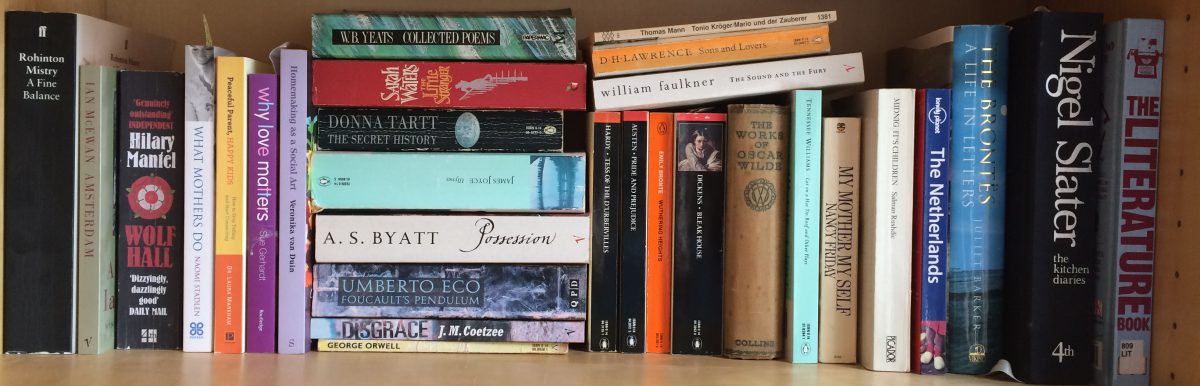

I think I’m in what they call a real reading and writing funk at the moment – definitely no flow going on here. I’ve been writing this blog for nine years and I am finding it hard at the moment to motivate myself to put fingers to keyboard and write reviews. I have had a handful of unkind comments on my blog posts – really only a very small number, but sadly my skin is thin. I don’t mind people disagreeing with me (I like debate about books), but unkindness sucks. But I’m not sure that’s the sole reason. Real life has been super-busy and some parts of it quite challenging of late and I just don’t think I have been in the right headspace.
Reading has always been my sanctuary, but it hasn’t entirely been that for me recently. It was with great joy that I picked up Marcel Proust’s Remembrance of Things Past (Vol 1) a few weeks ago. A long-neglected volume that has sat unloved on my bookshelves for many years (a gift from my husband back in the days before we had children!). And whilst I am enjoying the experience of reading it, it is, I’m afraid, very very slow, and only really rewards long spells of reading (like a train or plane journey). Precious few periods like that recently so it feels like hard going. And a couple of books I have read recently, I am afraid I did not particularly enjoy. So, a reading funk it is. Let’s hope I get out of it soon.
One book I did enjoy though, was on the Women’s Prize shortlist, Sanam Mahloudji’s The Persians. I think I am right in saying it is one of three debut novels that made the shortlist and it is an impressive achievement with a cast of strong and distinctive characters and covering the lives of several generations of the same family. It is particularly appropriate for the Women’s Prize shortlist because it is primarily a book about women, about mothers, daughters and sisters and family dynamics.
The novel opens in Aspen, Colorado where Shirin, the high-flying, flamboyant, sophisticated, Iranian immigrant who left her home country and made a life, a business and a name for herself in her adopted United States, finds herself in trouble with the law after allegedly assaulting a police officer, a charge she does not take very seriously. In these opening, energy-filled scenes we get a strong sense of who Shirin is and what she represents in the family – resentment at being treated merely as an immigrant, harking back to the wealth and status her family enjoyed in Iran (they brought much of the wealth with them, it has to be said) and an arrogance which we will later learn hides some vulnerabilities. Her husband, like most of the men in the family, is rather insipid, seems merely to want a quiet life. Shirin’s niece Bita, daughter of her late sister Seema, who also fled to the US with her but who subsequently died, loathes her aunt, but is forced to engage with the embarrassment of the case because she is a law student and has connections that may help Shirin.
The parallel story is that of Shirin’s (and Seema’s) mother, Elizabeth, the matriarch of the family, who did not leave Iran after the revolution, but stayed behind in Tehran with Shirin’s daughter Niaz, who was a child at the time. Through flashbacks we will learn the history of these women and how they have developed their world view, and we also learn about the Valiat family history, in particular the source of its wealth and status and its mythology. The author skilfully peels away the layers to reveal the lies and deceits that have been perpetrated on them all, whilst also exposing the hypocrisy in attitudes towards class, race and gender. Both in Iran and in the US. All the women in the book are on a journey of self-discovery.
I thoroughly enjoyed this book and recommend it highly. I listened to it on audio and the narration, by four different actors, was mostly excellent.

 Julia's books
just found your blog while looking for a review for ‘the bell jar’ looking through your book suggestions now and just read your post above… hope you find the right headspace again!
LikeLiked by 1 person
Thank you!
LikeLike