
This is my final review of all the titles on the Women’s Prize shortlist, the winner of which was announced weeks ago! It has taken me ages to get through them all, I can’t believe it. Have I suddenly become very slow at reading? I have been working a lot of evenings which means prepping in the afternoon and then getting home late, crossing over with my usual reading times, so guess what has been put to one side? I’ve also been reading multiple books at once and am still slogging my way through Proust! Doesn’t matter, I suppose. There are no prizes for most books read, although the nagging notifications on my Goodreads account, telling me I’m behind on this year’s reading goals, make me feel like a bit of a reading failure, which is ridiculous!
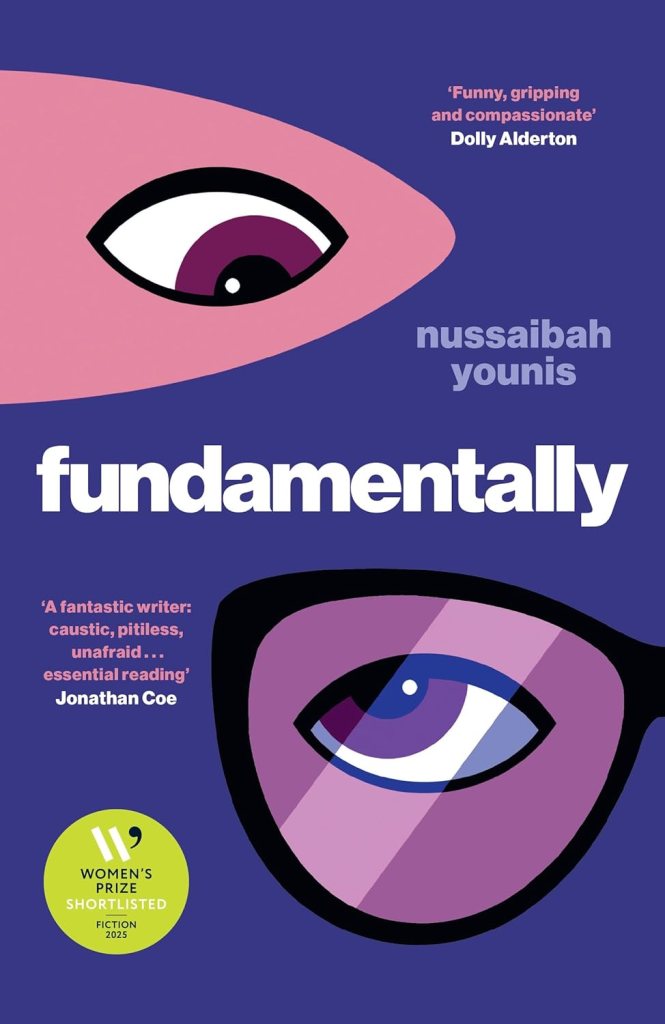
Fundamentally is another debut novel, and I learn from Wikipedia that the author Nussaibah Younis went to a grammar school in the town where I live – small world! She went on to university in Oxford and is now based in London, but had a career in international relations, specialising in Iraq. She was brought up Muslim but describes herself as no longer religious. I am recounting this because there are significant autobiographical elements in Fundamentally, something which seems fairly obvious even if you did not know the author’s background. Similar, in that respect to Aria Aber’s Good Girl. That does not make the novel less good, or less worthy of being shortlisted, of course, but you wonder if the author has a limited range or if they are simply honing their craft by writing about what they know. Apparently, Younis is working on her second novel, so we will find out.
The central character and first person narrator in Fundamentally is Nadia Amin, a young British Asian woman who was brought up a Muslim but has rejected her faith, following, among other things, a complicated relationship with her overbearing mother. As a young adult she pursued a hedonistic lifestyle in London alongside her university studies. She gained a PhD which led to a prized lectureship. She also had an open relationship with another woman Rosie, but when this breaks down, she decides to escape by applying for a United Nations special posting running a rehabilitation programme for former ISIS brides in Iraq. Nadia is running away and she knows it, all the while hoping that Rosie will change her mind.
Arriving in Iraq, Nadia realises quickly how naive she has been – the scale of the task is huge. The women she is working with in the camp are not the group of malleable, self-effacing, grateful subjects she envisaged. Rather they are complex, varied, traumatised and with ideas of their own. One young woman has a particular impact on Nadia: Sara, a Londoner who was lured to ISIS at the age of 15. In her, Nadia sees shadows of herself. Despite warnings from her colleagues, Nadia involves herself closely with Sara’s case, perhaps too closely, until events spiral out of her control. This is the central plot of the novel – how the relationship between Nadia and Sara resolves and the journeys that both women go on as a result of what they learn from each other.
The other aspect of the novel is exploring the role of the UN and other agencies in former war zones and developing countries. With her background, the author is highly qualified to write about this. There is a mixture of fondness and criticism – the people working in the field are largely very dedicated but operating in highly complex environments, trying to square the needs and aspirations of governments (good and bad), officials, and those they are meant to be helping. There is both comedy (the bureaucratic somersaults that have to be performed to get anything done), sadness (at the inevitable waste, duplication and corruption) and nuance – not every person in need is objectively “good” all of the time. Rather like democracy, the UN comes across in this novel as far from ideal but perhaps better than the alternatives.
I really enjoyed Fundamentally – there are a few cliches and some characters are inadequate and two dimensional (Geordie ex-soldier Tom was one I found particularly grating) but it is a great story. The ‘ISIS brides problem’ is difficult and complicated at every level but it deserves to be seen in all its complexity rather than in the lazy homogenised way it is often portrayed. I listened to it on audio and the actor, Sarah Slemani, handles the wide range of voices (and accents) remarkably well.
Recommended

 Julia's books