
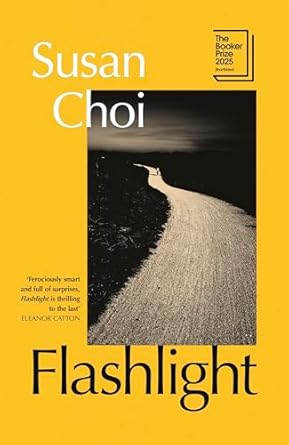
This is my last review from last year’s Booker Prize shortlist and comes from American novelist Susan Choi. This is her sixth novel and her other works have been highly acclaimed although she had not crossed my radar before now. Flashlight is a novel with a wide scope, spanning several decades to tell the story of one family. That family comprises Serk, his wife Anne and their daughter Louisa. Seek was born in Korea. His family moved to Japan when he was young but were then lured back to the new Democratic People’s Republic of Korea (North Korea). Serk refused to go and later moved to the United States where he became an academic. In the US he meets and marries Anne and they have Louisa. Anne’s son from an earlier relationship, Tobias, is also significant. She was largely estranged from him until his teenage years, kept apart by the boy’s father. There are a handful of other minor characters.
The story begins with a drowning – Serk and 10 year old Louisa are walking on a beach in Japan; Serk is undertaking an academic secondment there and has taken his family with him. Water and swimming are recurring motifs in the book and Serk cannot swim. The pair do not return home after their evening walk and Louisa is found on the beach the next morning, alive but unconscious. She has no recollection about what has happened to her father and he is presumed drowned. This is a monumental event in the young girl’s life. She is precocious and intelligent and has a difficult relationship with her mother, Anne. Serk and Anne had a difficult relationship and there was tension in the household which Louisa seems to have imbibed. It does not help that Anne has a mysterious chronic illness which limits her mobility and leaves her constantly fatigued.
The plot looks backwards then, to Serk’s childhood in Japan and his family’s move to North Korea; they are outsiders in Japan, not welcomed, and are attracted by the offer of employment, housing and a good lifestyle in the new state, where they will feel more secure in their identity. Serk cannot think of going to North Korea and will instead move to the United States where he becomes an academic, though he will always feel somewhat on the outside.
We also learn of Anne’s back story, how she had a child as a young woman, fathered by an older man, who then prevents her from seeing him. When she meets and marries Serk it seems like a match of convenience for both of them. Anne’s first child, Tobias, comes back into the story later on, when as a young man he seeks to develop a relationship with his mother and half-sister Louisa.
Louisa is a somewhat troubled child and, like her father, seems always to feel like she does not quite fit in. When the family moves to Japan she works hard to learn the language and blend in, but her father’s disappearance puts paid to her sense of belonging. We learn how she struggles at university and has mixed feelings towards her mother, from whom she seems remote and different.
There is a plot twist which I will obviously not share here, which gave the book some interest and purpose, but overall I found I did not love this novel. It is long, not a problem in itself, but I felt there was a great deal here that felt superfluous, for example, the lengthy accounts of Anne’s life and routines in the retirement village where she lives in her older age felt to me like they added very little to the story. The author writes a great character, but I really did not like any of them! Apart from Tobias, perhaps, and Walt, Anne’s friend, although both are quite marginal characters. There were also parts of the plot that I felt lacked credibility – for example, Louisa’s experience at the hands of border police in England made me cringe! The editor really should have got a British reader to look at this – we just don’t speak like that! This was a shame because for me it detracted from the really important story at the heart of the novel, the reach and cruelty of the North Korean regime, something I knew very little about.
I listened to the novel on audio and I feel the narration was not the best. That did not help. I feel this novel could have been somewhat better.
I don’t think the 2025 Booker Prize shortlist was a particularly strong one – the winning book (Flesh by David Szalay) was one of the top two for me, but I did prefer Andrew Miller’s The Land in Winter. The fact of two very long books slowed my reading right down. I love a long novel but both this novel, Flashlight, and Kiran Desai’s The Loneliness of Sonia and Sunny felt like something of a slog.
I would find this a difficult novel to recommend.


 Julia's books