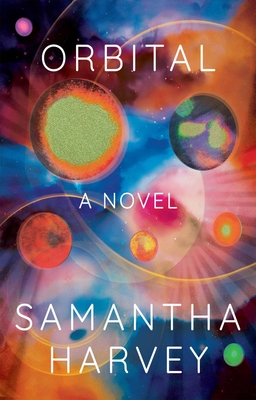
Booker shortlist book review #3 – “Orbital” by Samantha Harvey

I have to confess that I wasn’t looking forward to reading this book. I find I have zero interest in space. Super-telescopes, yes okay, but rockets and astronauts? No. I feel it’s all a colossal waste of money, pure hubris. Sometimes, blurbs don’t give much away in terms of what a book is about and I tend to avoid reading reviews of books I plan to review myself, lest I be influenced, so coming to this book has been a very pleasant surprise.

The book is set in an international space station, with six astronauts of varying nationalities, on a single day where their craft makes sixteen circumnavigations of the earth. The group is there primarily for research purposes but their days are curiously languid; they have mice and plants in laboratories, but they too are lab animals, their body’s responses to the conditions of space being monitored. To what end? The novel explores the minute details of their everyday life: eating, hygiene, games they play to pass the time, their waking thoughts and their dreams whilst asleep, and the routine is made poetic. The prosaic details give us an insight into what aspects of life make our existence special and meaningful. What is the point of food if it is only nutrition? What about taste and texture? I think this gets to the heart of my problem with the ambition of some of those currently engaged in space exploration – who wants to live on a spaceship or another planet if it means we lose the pleasures of a beautiful meal, or fresh fruit, breaking bread with loved ones, a hot bath?

And I think that is where this novel is coming from; setting it in space means the author can take a step back and provide a panoramic view of the earth and our lives on this fragile and beautiful planet. The astronauts admire the earth from a distance and express a child-like wonder at the oceans, mountain ranges, weather systems and natural phenomena, echoing their own childhood ambitions about going into space.

This novel is also about what it means to be human and in that sense is deeply political and speaks to our time. Borders are not visible from space. The authorities attempt to create borders in space – the Russians have their own toilet – but away from earthly politics, none of the astronauts take this too seriously. They share stories and find they have much in common. One of the astronauts, a Japanese woman, loses her mother while she is on her tour of duty on the space station. There is no question of her returning for the funeral or other rituals that follow death. And it is the absence of that connection to what makes us human that is the most painful.

I loved this book. It is very short, less than 150 pages, but every word seems deliberately and carefully chosen. The prose is beautiful and spare and in its conciseness packs an incredible punch.

Highly recommended and must be a contender for the winner.

Books about new motherhood – 2 reviews

In my ‘day job’ I work with new parents and parents-to-be, mostly new mothers, supporting them both as they approach birth and in the transition to their new lives with a baby. It is work that I love and have been doing for quite a while now. I also believe it is a role that is increasingly necessary as maternity services and parent support services in the UK are at the lowest ebb I can remember and much worse than when my children were born. Coupled with the mental ill-health epidemic that we seem to be facing, I rather feel that new parents, and new mothers in particular, are having a very tough time.

One of the reasons I have blogged so little in the last few months is that I have been doing additional studying for my work and I came across the first of the two books reviewed below (Matrescence) in the course of this study. It had been on my radar anyway, since it was longlisted for the Women’s Prize for Non-fiction earlier this year, but was on our course reading list. The second book is a novel and was shortlisted for the Women’s Prize for Fiction, but it was coincidence that I happened to read both around the same time.

Matrescence by Lucy Jones

Jones has been a writer and journalist for most of her working life, mostly in the fields of science and nature; her second book, Losing Eden: why our minds need the wild, published in 2020, was longlisted for the Wainwright Prize. But it is this account of her parenting journey that has really captured mainstream attention. ‘Matrescence’ is a beautiful word that Jones seems on a mission to bring to the forefront of public attention since it captures the physical, emotional and spiritual transformation that people undergo when they give birth to children. Yes, fathers and co-parents change too, but not nearly as much as mothers. There has been some fascinating research published recently in the US that has looked at the actual way the human brain changes during pregnancy and in the early months of motherhood. The brain seems to stand-down certain areas and functions that it is assumed will be less necessary such as the bits that do tasks, remember things and organise, and boosts the emotional centres, the bits that will make us fall in love with our infant and therefore help assure its survival. Fascinating. But hard in the modern world. 

The author’s journey is a very personal one and there were bits that made me bristle (she is critical of pretty much everyone) and I felt a bit personally attacked, having worked in this field for more than 10 years. But there is no doubting that it is meticulously researched and powerfully written. She bemoans the lack of ceremony around the ‘passing into’ motherhood which is particularly the case in western industrial society, and about the failure to both understand what the role really entails and the lack of support. I cannot agree more with this. Where I had more of a problem is where the author seems to believe there is a conspiracy of silence around what it’s really like to give birth and to mother a baby. I don’t think I do agree entirely; I am not sure most people are really ready to hear it plus it is deeply personal and subjective. I do think there is a case for a more open discussion but this would be inconvenient in a western capitalist society where we need to (quite literally) buy into a fantasy, so it probably won’t happen.

Whether you are a parent or not, this book bears reading not least because of how the author brings her knowledge and expertise about the natural world into her writing. Each chapter is prefaced with a snapshot of a reproductive or young-rearing phenomenon from nature, that reminds us we are just creatures on this earth.  And that is pretty thought-provoking. 

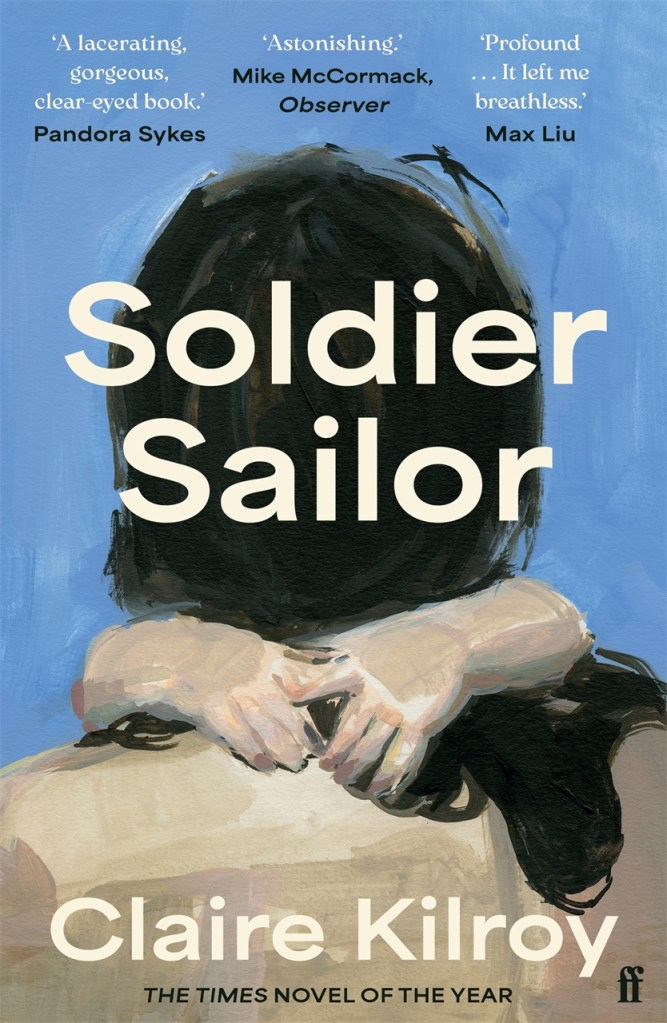
Soldier, Sailor by Claire Kilroy

Matrescence might be the notes that accompany Soldier Sailor so it is fascinating that they should have come out at around the same time. Where Jones is research, science, rage and manifesto, Kilroy is visceral. It is a first-person narrative which is rambling, confused, devoted, passionate and lost. There are no names here, they are unimportant; all that exists is the mother (Soldier) and her baby (Sailor), practically one, almost interchangeable. It’s her and him against the world, and particularly against the husband, who has no clue what is going on. He is a man who at times she loves and hates in equal measure, because her life (the mother life) is changed beyond recognition, and his has not. She cannot hate the child who has caused this transformation so she must rail against the child’s father, a person she no longer recognises and with whom she finds she must learn a new way of being if their relationship is to endure.

There are times when this book is almost unbearable. There are times when it is hard to tell what is real and what is not, distorted by her fevered state of mind. Things that seem real are turned on their head later on. Like the meeting with an old friend from student days in a playground, now a father of four whose wife, who has the greater earning power, works full-time. His experience is the same but different, the flip side of hers, and his balance and calm represent a degree of hope to her that things might one day become normal. Or was the encounter just the work of her imagination, giving her the strength to continue when she has not an ounce of mental or physical energy left and her whole world seems to be falling apart?

There are parts of this book that most mothers would recognise – I certainly felt a frisson at some of the emotions Soldier expressed, they were familiar. But there are other parts, rather like the personal parts of Jones’s account of her mothering journey, that are not universal and it would not be right to think that they are. 

It is a powerful read that has garnered a great deal of attention and whilst this book did not win the Women’s Prize this year it has achieved many other accolades, including The Times novel of the year.

Both of these books offer perspectives on motherhood and parenting that are long overdue and both have affected me deeply. Working with people on the transition to parenthood, these books provide a rich resource on the themes of changing identity and how society needs to change to support people on this journey. It is a journey that most of us go through but which many of us are poorly prepared for. That needs to change.

3 non-fiction book reviews

A couple of weeks ago I posted about some of the books I had been reading during my unintended blogging sabbatical, three fiction titles I had enjoyed. I’ve also been reading quite a bit of non-fiction and here are three I’d like to share with you.

When the Dust Settles by Lucy Easthope

This was one of my book club reads. Published in 2022 it is a memoir from one of the country’s foremost disaster experts. This was a profession that I confess I had never really thought about or even knew existed, although after reading this book, that feels like a stupid thing to say. Easthope and her colleagues manage the clear-up after natural and man-made catastrophe, their primary focus being the retrieval, preservation, cataloguing and retention of human remains, from tiny fragments, such as pieces of bone where DNA testing can help to establish identity and ownership, to items of clothing or belongings. Easthope cares passionately about her work and empathises deeply with the loved ones of victims, for whom she sees her role as being part of the grieving process. Easthope writes candidly (and at times this can be challenging) about her role in many significant disasters such as 9/11 in New York city in 2001, to the Lac-Megantic rail disaster in Canada in 2013. She also has much to say about disaster planning in the UK, drawing from her experiences of working with flood victims in Yorkshire and the Covid-19 pandemic. It is fascinating reading. Easthope is a talented writer and also weaves in her personal story, the smaller tragedies in her own life, such as her husband’s near-death and her recurrent miscarriages. This is both a highly personal memoir but also a reflective piece of work about the lessons she has learned (and the many lessons governments fail to learn) about handling disaster. Whilst this is not a book for the faint-hearted, it is a highly-engaging and important read.

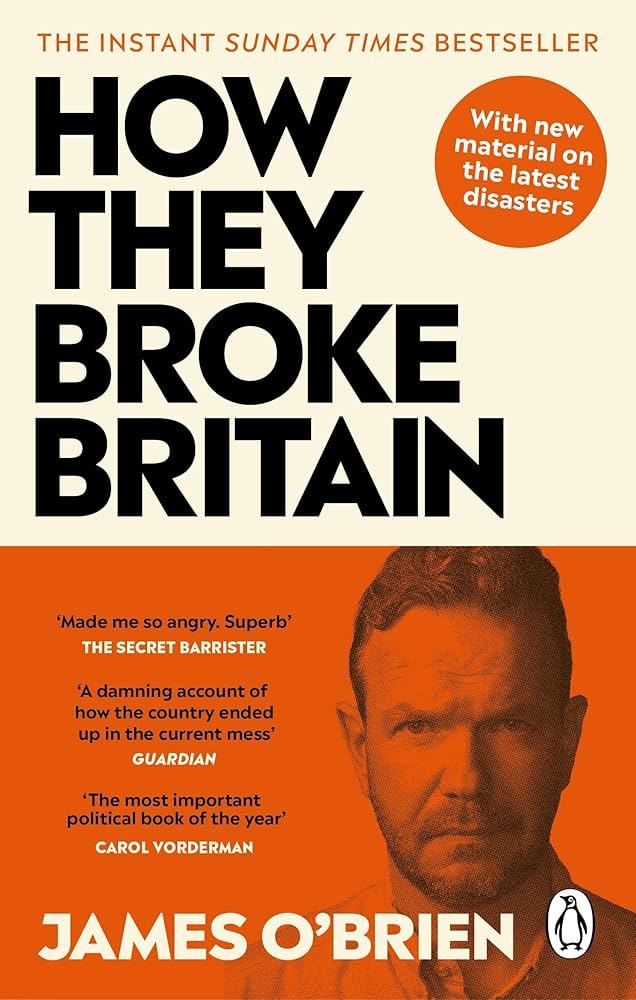
How They Broke Britain by James O’Brien

To say I enjoyed this book immensely is probably to come out about my political leanings (for which I make no apology, by the way, but not something I make a big deal about on this blog). I saw James O’Brien give a talk at this year’s Hay Festival (alongside the Financial Times journalist Peter Foster, who was also promoting his own book What Went Wrong with Brexit and What We Can Do About It) and bought both books. It is written in O’Brien’s trademark discursive style and each of the culprits in the tragi-comedy gets a chapter of their own. There are all the faces you would expect to see – Boris Johnson, Dominic Cummings, Nigel Farage and Liz Truss – plus a few you might not, and may not even have heard of such as Paul Dacre, Matthew Elliott (who?) and Jeremy Corbyn. O’Brien is excoriating about the role of each of his culprits in the dumbing-down of public discourse, on the commercialisation of thought, and how each has in their own unique way (sometimes wittingly, sometimes not) corrupted public life. His central thesis is “Shame on you!” which regardless of your politics, is hard to disagree with. I found one or two of his points stretched credulity for me, but only a little. When you see it all written down, page after page of it, it is deeply troubling and it is clear that a lot of painstaking cleaning-up work needs to be done (Lucy Easthope?)

Strong Female Character by Fern Brady

This was another of my book club reads and one that I had mixed feelings about. I should also say that I listened to it on audio, and it was read by the author and this may have affected my view. Fern Brady is a comedian and she is autistic. She did not receive a diagnosis until she was well into adulthood and this memoir is her account of growing up in Scotland with the condition. She writes about her difficult time at various schools, her struggles with her parents (who seem to have found her behaviour difficult to cope with) and the challenges of going to university. It is at times laugh out loud funny and at others deeply upsetting; she has clearly had some rough times. Her accounts of finding herself homeless, experiencing abuse and unable to navigate social relationships well are heartbreaking. This is hard to write but there were also parts where I found my sympathies did not lie with her. For example, her parents come out pretty badly and that felt unfair, especially when I did some research afterwards about her background and upbringing – it does not seem to have been as bleak as it came across to me. Also, the reading was sometimes vulnerable, sometimes bombastic, even boastful. It drew some general conclusions about ‘people with autism’ from the standpoint of her personal experience. From my own experience of the condition I don’t think it was always right.

All three were very good reads that I recommend highly. I’d love to hear what you thought if you have read any of them.

Booker shortlist book review #2 – “Stone Yard Devotional” by Charlotte Wood

This is my second read from the Booker shortlist and it’s one of the shorter ones, but, quietly and unobtrusively, it plumbs the great depths of the human experience, exploring life, death, grief, the meaning of existence, forgiveness and plague. For a relatively small novel it packs a great deal in! Set in Australia in contemporary times (before, during and a little after the global Covid-19 pandemic), it is narrated in the first person by a woman, perhaps in late middle age, who has chosen to retreat from her life and live within a community of nuns. Initially, this is as a short-term guest, but her stay becomes indefinite. Whilst the narrator does not become a nun (curiously, she describes herself as an atheist and writes of the horrors of Catholicism growing up, at school, and in the world at large) she participates fully in the life of the community, eventually taking charge of the food, growing, foraging, buying and preparing it.

Our narrator initially went to the community on a form of retreat; she was separating from her husband and grieving for her mother who had died of cancer. The timing of events is not clear, echoing the timelessness, the absence of a life ruled by clocks, of living in the abbey. Amongst the nuns, the shape of the day is determined by the rising and setting of the sun, birdsong and the daily prayer rituals. There is comfort in both its order and in the absence of strict commercially-driven time structures. 

Life in the abbey provides the narrator with space to reflect, on her childhood, her family and in particular her relationship with her mother. The mother is perhaps the nearest thing to a saint that the narrator will ever worship, despite the availability of so many in the church. The pain of her loss seeps out of the pages and she describes a gentleness, a goodness and a generosity that is unmatched by any of the religious figures in the novel. 

The nature of belief and Christianity are also explored and the lifestyle chosen by the nuns in the abbey is contrasted with other nuns who go out and work with the poor and the abused. Two nuns in particular are given as examples – sisters Jenny (formerly of the abbey and known to the other nuns) and Helen, who set up a refuge for abused women in Thailand. Sister Jenny was murdered and when her body is later recovered it is returned to the abbey by her colleague, sister Helen, who, by chance, is a former school mate of the narrator. Helen was bullied because she was poor, and the narrator revisits the harms that were done to her and the part she herself played in them. 

Covid is a presence in the novel but this is not about Covid – the community is after all, largely separate from mainstream society. The plague that does permeate, however, is the infestation of mice that occurs periodically in Australia – I recall hearing about this in the news. The abbey and the local town are overrun and the author writes graphically of how the creatures invade every detail of life and what the sisters do to combat them. It conveys a sense of a world out of control, that even where a life of solitude is chosen, destructive phenomena cannot be escaped. 

This is a powerful novel. It took me a little while to get into after James because it has a totally different pace and perspective, but I found it a rich and rewarding read. Since I finished it I find myself reflecting on it often and new insights keep cropping up in my mind. It is an extremely well-crafted piece of work.

Highly recommended. 

Booker shortlist book review #1 – “James” by Percival Everett

This is my first read from the Booker shortlist. I chose it for two reasons: firstly, I thoroughly enjoyed Everett’s previous novel The Trees, which was shortlisted for the Booker in 2022 (it did not win; Shehan Karunitilaka’s The Seven Moons of Maali Almeida took the honours that year); secondly, I was invited to ask the author a question on the BBC’s World Book Club radio show a few months ago. I entered into a (very small, but huge to me!) dialogue with the author and came away a bit starstruck! I suspect our brief little conversation was edited out of the final show, I haven’t listened back to it. I also read quite a few pieces about the book and the author since and he is without doubt an impressive and accomplished man. 

James has caught a lot of attention because it tampers with an American icon, Huckleberry Finn. I recall reading the Adventures of Huckleberry Finn, first published in 1884, on a road trip around the United States when I was 21. I spent a summer working in New Hampshire and then spent my earnings travelling round for a few weeks. I spent quite a bit of time in the south and the racial divides were still very clear to see in the late 1980s. To my shame, however, I cannot say that I was particularly aware of the racism implicit in the novel (or in its companion volume, which I also read, The Adventures of Tom Sawyer, Huck’s friend) apart from the widespread use of the n-word, which I think I probably saw simply as the vernacular of the era in which the book was written and therefore somehow being less offensive?

In Twain’s novel, Huck is an innocent, a child who runs away from home and his abusive father, and who meets the runaway slave Jim en route. The two work together, but it is clear that Jim is merely secondary, meant to highlight Huck’s naivety and essential goodness. Twain was a staunch supporter of the movement to abolish slavery but he fails to challenge racial stereotypes and Jim is merely a bit-player with neither agency or intellect. Everett turns that Great American novel on its head (which will no doubt have infuriated some), makes Jim the eponymous central character and rather than call him by the three-word handle bestowed on him by his “owner” gives him back his full and rightful title, James. 

Jim/James, it matters here. The novel begins, somewhat comically, with the children in the community being taught “slave talk”; how to speak in a way that will not threaten their white masters and will therefore help to keep them safe. There is a quiet resistance here. Whilst the slaves are, yes, forced to dumb-down, privately they exercise their right to use the English language to its full extent, and to use their minds. It is almost as if they are in waiting. The theme of words, their power, and the power of speech, prevails throughout the novel.

In the first half of the novel, James spends a lot of time with Huckleberry and the author reprises many of the same scenes as characters as Twain, follows the same picaresque journey, but giving the reader, as it were, the inside track on what is really going on with ‘Jim’ and between him and Huck. Huck remains the innocent, as in Twain’s original, but we also see his internalised racism, his own victimhood, but, ultimately, his confidence in the security bestowed upon him by being white. There are no major consequences for Huck in being a runaway or getting into scrapes. Here though, it is Huck who is the secondary character, the foil to illustrate James’s character. The second half of the novel takes some darker turns and Huck is less prominent. The events in James’s life take on a certain inevitability and whereas white skinned Huck can have adventures largely without consequence, for James there will always be consequences. The author puts very much in James’s shoes and invites us to consider whether any of us would have done anything differently. 

This novel is brilliantly conceived and executed with aplomb. It is better than The Trees, more sophisticated and subtle, and so must be a strong contender for the prize. If it wins it will be richly deserved. 

A must-read. 

3 fiction book reviews

Having done so little blogging over the last few months I’ve built up quite a backlog of reviews, even though my reading rate has not been that impressive, if I’m honest. I’ve been listening to more audiobooks than I have been reading actual books and I’ve worked through quite a few on my travels and whilst running, so I’d like to tell you about three that I have particularly enjoyed.

The Shadows of London by Andrew Taylor

I love Andrew Taylor’s Marwood and Lovett books and have reviewed them all on here, from the very first Ashes of London to the most recent The Royal Secret. I get very excited each time I see there is a new one out and I listened to this, the sixth instalment, in the spring. For fans of the series, it has all the things you want and love – the courtly intrigue, the meticulous historical research, the same lovable and not so lovable characters, and a thread of continuity that makes you feel you are back with an old friend. This latest novel steps up to deal with sexual exploitation, by cruel and powerful men using powerless women to achieve their ambitions. In an afterword the author writes of how current scandals (referencing Harvey Weinstein, Jeffrey Epstein and others) gave him the inspiration to look back and explore the issue from a historical perspective. It is sobering to realise how little has changed. For fans of this series, the chemistry between the two leading characters is one of the main draws, and in this novel, the author rewards our patience!

Anxious People by Frederik Backman

This was another audiobook I thoroughly enjoyed. It is hard to say too much about it because the joy of it is in the twisty plot, the serial revelations and the about-turns that catch the reader on the hop. This is a book which is not at all what it seems. The novel opens with the police trying to solve a hostage drama. Six strangers who have all come to view an apartment are thrown together when a failed bank robber holds them captive. We first encounter them when the police are interviewing each of them to ascertain the sequence of events that led to the robber evading capture, despite the building being surrounded. Each of the hostages appears unhelpful, irritating and deeply frustrating and I must admit that in the first few chapters I fell into the trap of thinking that the book was going to be long-winded with poorly-drawn characters. Oh how wrong I was! As well as having a fiendishly clever plot the book is a wonderful study of six (plus!) fragile adults, none of whom is quite what they seem. Brilliant! And I will definitely be going back to this author for more.

Lessons in Chemistry by Bonnie Garmus

This book was heavily marketed when it was published in 2022 – it had a profile in almost every bookshop I entered and was widely advertised in the print media. Its author also gained a lot of attention for publishing her first novel in middle age. She deserves credit – it’s a good read and has been made into a film starring Brie Larson. Set in the 1960s its central character is Elizabeth Zott, mother to Madeline and presenter of a popular television cookery show, Supper at Six. The show is unusual in that it emphasises the chemistry involved in cooking and the labour and skills required in running a home. This soon gets Elizabeth into trouble, however, as the last thing TV executives want is a show that inspires female viewers to self-actualise! The novel tells us how Elizabeth got to this point. Highly intelligent and driven she was denied the chance to do a PhD, exploited by her male colleagues at the research institute where she worked and sexually assaulted. She falls in love with her colleague Calvin Evans, a brilliant and highly-regarded academic, despite herself and her life looks to be heading in a certain direction. But then events turn her world upside down. This is a great read, sure it’s cliched in parts, but it’s fantastic entertainment and exposes some of the very real hardships talented women faced not so very long ago.

Looking at the above reviews I am struck at how my reading seems to have involved some escapism – perhaps the challenges of my work and domestic life meant that I fell back onto modern popular fiction as a bit of nourishment for the soul! And if that’s not what reading is for, then I don’t know what is.

I’d love to hear if you have read any of the above and if so what you thought of them.

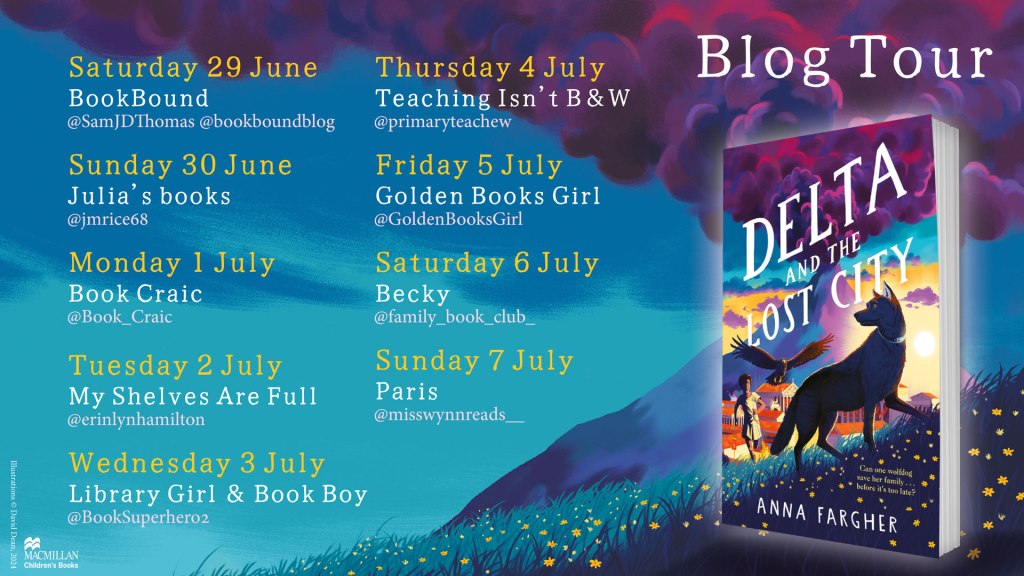
Book review – “Delta and the Lost City” by Anna Fargher

It has been a very long time since I last posted. I was chatting with my youngest the other day, newly out of exam purdah having just finished her A levels, and we were discussing how crazy life has been recently. We started off thinking of “recently” as the last few weeks, but in reality, it feels as if it has been at least a few months! And that is evidenced by my very erratic posting. I’ve been studying this last year, which has now come to an end – enjoyable but hard work – and I am now at the end of my association with school, so I am hoping life is about to get a bit easier and more manageable.

What has prompted me back into my blogging groove was being contacted by a lovely person at Macmillan Children’s Books, offering me a copy of Anna Fargher’s newest book, Delta and the Lost City, and the opportunity to participate in a blog tour. I am a fan of Anna Fargher’s books, and have reviewed on here two of her earlier books, The Umbrella Mouse and The Fire Cats of London. Fargher’s books are ‘middle-grade’, aimed at 8-12 years old, but I am a firm believer in adults reading to and with children, so this could also suit six and seven year olds with some supervision. 

In Delta and the Lost City, Fargher deploys her usual style and technique, so it will thrill children who are already her fans. The setting is historic, as usual, although she is going much further back than ever before, this time to Pompeii in AD 79 at the time of the eruption of Mount Vesuvius. So readers get a helpful history lesson as well as a great story!

Also, as usual, her main characters are animals; Delta is a wonderful central figure, daughter of a placid white house dog, but fathered by a wolf and therefore with almost black fur, unlike her mother. Delta strikes fear into many who don’t know her and she can use her wolf genes to her advantage at times, to protect those whom she loves. But Delta has a kind and loving heart and is an intelligent and resourceful creature. 

[The rest of this review contains some spoilers.]

Delta lives in a house in the country, at the home of kindly nobleman Lucius. Her animal friends in the household include her mother Luna and the eagle Bellona. The humans they care for are Herminia, Lucius’s daughter, who is pregnant, and the slaves Gaia and her son Neo. Lucius was a progressive and treated his slaves well, decreeing also that they should be given their freedom after his death. Herminia is married to Marcus, a sly and cruel buisnessman. Delta sees Marcus secretly murdering the elderly Lucius and concealing his will, but there is little she can do about it. When Marcus decides to take Herminia and the household back to Rome and sell the household slaves, Delta flees with the help of Bellona.

On the run, Delta goes on a desperate search. She finds Neo and Gaia in Pompeii, in their new households. All the residents of the city know that Vesuvius is active, feeling the daily tremors in the earth beneath their feet. They make gifts to the god Vulcan to try and placate him to save themselves and their city. But, as we know, this is futile and Vesuvius eventually erupts. As in The Fire Cats of London, we know the outcome, but Fargher keeps us on the edge of our seats, as we follow our heroine and her human and animal friends, trying to escape the terror as well as do the right thing.

Like Fargher’s other animal heroines and heroes, Delta is a brave and clever dog, worthy of her central place in the book. Children will love Delta and the other characters and be able to identify with the child characters, their emotions, and their ability to empathise and develop close relationships with the animals. Importantly, Fargher never patronises with her animal characters; they take centre-stage unashamedly

This is a charming book with well-defined characters, a powerful story and a fascinating historical insight and I recommend it highly.

The book will be published on 4th July. There are one or two other things going on that day, but if you are in the UK, make a detour to the bookshop on the way back from the polling station with your children and pick up a copy!

Book review – “The Making of the Modern Middle East” by Jeremy Bowen

It’s been the busiest of times for me and I feel very out of touch with my blogging. But as I support the youngest of my three children as they embark upon the exam season, inwardly I am exclaiming “the last time!” I know it will feel weird when we are out the other side, of course, knowing that I will not be doing the journey to school any more and shortly afterwards waving another one off to university (fingers crossed). So, as I find myself saying frequently to new parents in  my day job, this too shall pass. Much of it is self-inflicted too, I must add; I decided to do a course of academic study last autumn and that is actually what has consumed much of my time. Truly I am a glutton for punishment!

I have had little time for reading, and it’s mostly been audiobooks so far this year, which I can listen to while out walking or running. So, I haven’t exactly had too many reviews to post! I’ve really felt the absence too. Reading for me is not only about being well-read and making connections with fellow book-lovers, it is also grounding. Nothing says self-care as strongly as: “I am taking 10/15/20 minutes out of my busy day, disconnecting from the family/the dishes/the smartphone, just for me, for pure pleasure.” It has to become a habit though, and it is one that seems to have slipped out of my grasp in the last couple of months, and which I now need to squeeze back in. 

The book I want to tell you about today is one that has been on my TBR pile for some time. Coincidentally, I am currently making my arrangements to go to the Hay Festival, filling my online basket with events, and this book was one I bought there last year. The BBC’s International Editor, Jeremy Bowen, has been working in the Middle East for many years and is now a renowned journalistic expert on the region. This book arose out of a podcast he did for BBC radio a few years ago called Our Man in the Middle East. This book is an insightful and informative look at the region, setting out the historical context for many of the disputes and tensions whilst also telling stories and anecdotes of his own experiences, the relationships he has forged with people, famous and not, giving an often very intimate perspective on some of the very big issues we all know about.

The Middle East is not homogenous and the history is complex. Usually, the causes of tensions and conflicts there are far more complex than can be conveyed in a single news bulletin. The region is also a lightning rod, a proxy, for much bigger confrontations. Looking at a traditional map of the world, it is very nearly the geographical centre. Politically and culturally it is where east meets west, where north meets south, where tradition meets modernism, and religion meets secularism, quite unlike anywhere else on the planet. It is quite clear, from reading this book, that the author is captivated.

Bowen takes a thematic approach in the book, but manages also to set out the historical context of each of the major countries in the region: Israel and Palestine (obviously), Syria, Iraq, Iran, Egypt, Saudi Arabia, but drawing in also Lebanon, Yemen and Libya. I came away from this book with a powerful new understanding of the motivations and perspectives of people living in the Middle East, and also of the largely malign influence “the west”, and in particular the colonial powers have had over decades, if not centuries. 

I have visited this part of the world only once in my life, about 25 years ago when I went to Lebanon. I found it a stunning and fascinating country and am saddened that it has been brought to its knees both economically and politically in recent years. When I attended the event at Hay in which Jeremy Bowen was interviewed by his BBC colleague Frank Gardner, I remember how pessimistic he was about the Israel-Palestine situation, describing it as more dangerous than he had seen it in many years. How poignant that observation seems when just a few months later the current crisis we see so vividly every day on our television screens was set in motion. 

This is a powerful and gripping book, written with the author’s characteristic style, thoroughly researched and grounded in first-hand knowledge. Highly recommended.

Audiobook review – “Misery” by Stephen King

Whether or not you have read any of his work, most people will have heard of Stephen King and could probably name one or two of his books. And anyone who dabbles in writing, whether or not they have actually read any of his books, will have some admiration for the American author, a man committed to his craft, who shares his insights humbly and widely, and who is both prolific and highly regarded. Surely a giant of American letters.

In a writing career spanning half a century, King has published more than sixty-five novels (that’s more than one a year!), several non-fiction books, hundreds of short stories, screenplays, and even graphic novels. His first novel, Carrie (published in 1974), sold a million copies in paperback and became a bestseller when it was adapted for the screen in 1976, launching the career of Sissy Spacek in the title role. His next two novels, published in 1975 and 1977 are also seminal works – Salem’s Lot and The Shining. Both won awards and both were made into highly successful screen adaptations, the latter starring Jack Nicholson, of course, in what is arguably one of his finest performances. 

All of this and I have never picked up a Stephen King book. My first boyfriend when I was a teenager was a huge Stephen King fan and I never much cared for his literary tastes, being much more into the classics at that stage in my life! I’ve also largely avoided the horror genre, disliking the films (I can barely watch most of them) and therefore assuming the books would not be for me. There is however, horror, and there is horror. So, I was open-minded when I suggested to my book club that we tackle a Stephen King. We picked Misery because we could watch the film as well, and it secured an Oscar in 1990 for Kathy Bates in the role of Annie Wilkes – its funny how I have a memory of her acceptance speech. We listened on audio, because that is our thing, and we all agreed it was read brilliantly by Lindsay Crouse. 

The plot of the novel is simple: Paul Sheldon is a successful author who, after completing the draft of his latest, and what he believes to be his best, novel, Fast Cars, decides to drive from the remote hotel where he normally likes to write, to Los Angeles. It is winter, the weather is poor and he has a serious accident, crashing his car in Colorado near the small town of Sidewinder. His upturned vehicle is discovered by local woman Annie Wilkes, who lives alone on her small isolated farm. Annie retrieves the badly injured Paul from the wreckage of his car and takes him to her house. She is a qualified nurse and keeps a wide range of medications at home. Paul wakes up to find himself in her spare bedroom, his broken legs splinted and his wounds treated. He is initially grateful to her for saving his life, a fact which she reminds him of frequently, and is only slightly curious as to why she has not taken him to hospital or brought in a doctor.

During his unconscious phase, it is clear that Annie searched his belongings and discovered his identity. She knows him well because she is his “number one fan” – an avid reader of the historical novels featuring a Victorian orphan Misery Chastain, which have been responsible for bringing Paul fame and fortune, but which he has grown to loathe because of their lack of literary merit. The latest novel in the series is about to be published, which means Annie is in an excited frenzy, and it will be the last because Misery dies, although Annie does not yet know this.

As the days pass and Paul’s condition improves he becomes increasingly concerned as to why Annie will not let him notify his friends and family and his agent of his whereabouts, or why she will not let him see a doctor. He begins to doubt her excuses about the severity of the weather. Things take a dramatic turn for the worse when Annie gets hold of the newly-published book Misery’s Child. She is enraged to find that her heroine dies, accusing Paul of murdering her. To make matters worse, she reads the manuscript of Fast Cars and considers it worthless filth. Her reaction finally convinces Paul that he is her prisoner and Annie’s behaviour becomes increasingly unpredictable and violent. Annie acquires an ancient typewriter from the thrift shop in town and sets Paul the task of writing another manuscript in which Misery is restored to life, though she insists that the story must be “fair” – credible and not by magic. Most distressingly, she also makes Paul burn the manuscript (the only one) of Fast Cars, page by page on a barbecue. 

The rest of the novel concerns the psychological battle of wills going on between Annie and Paul. He is vulnerable, weak and disabled and she exercises power over him, not least actually locking him up. She also gets him hooked on opiate painkillers, effectively enslaving him. Annie is prone to bouts of deep depression, perhaps she is bipolar, and occasionally disappears for days at a time, sometimes leaving him without food or pain relief. Paul plots escape and sabotage but his efforts are mostly unsuccessful and simply make Annie worse. There are moments of extreme violence in the book, but not as much as you would expect for a horror novel – the horror here is mainly psychological. But the threat of horror is ever-present. King gets us into the mind of the prisoner, not knowing from one day to the next whether his captor will kill or torture him, or whether today she might be nice and bring him ice cream. The reader is kept in a constant state of alert. In some ways it is exhausting, but is definitely utterly compelling. 

I was surprised at just how much I enjoyed this book. We enjoyed the film less, although it is a very good effort and well-acted, mainly I think because it is just too short, leaves out too much, and brings in additional characters who do not feature in the novel. I fear I might have started with the best of King by reading Misery, but I will definitely read more. 

Highly recommended. 

Finish a book challenge #3 – “Burning Questions” by Margaret Atwood

This might just be the book I am proudest to have finished in my ‘finish a book’ challenge! I am ashamed to say that I bought it when it was first published in summer 2022 (a signed hardback copy no less!), began reading it almost immediately, when I went on holiday I think, set it to one side when life got a bit busy again and then never seemed to get around to finishing it, despite a second and third wind each time I went on holiday thereafter. It’s not even a difficult book to read; it’s divided up into highly readable chunks (the sub-title of the book is “Essays and occasional pieces 2004-21”), the kind you can read in ten to fifteen minutes between chores and deadlines, so I have no absolutely no excuse or explanation.

I determined to finish this one though, not least because it is big and is taking up a substantial amount of the space on my bedside pile, and I have loved it. I’ve read just over half of it in the last couple of weeks and it has been a joy. Margaret Atwood is truly an international treasure. She must surely be one of the world’s finest living writers. I cannot believe she hasn’t won a Nobel Prize for The Handmaid’s Tale at the very least. Many of the pieces in this book are speeches she has given at various conferences, symposia or charitable events. Her wit is sharp and acerbic and she has an eye for the absurd that is unmatched in my opinion. Reflecting in 2015 on the tepid reception of The Handmaid’s Tale when it was first published, she writes of one New York Times reviewer:

Being dissed in the Times invariably causes your publishers to cross to the other side of the street when they see you and then run away very fast and hide under a rock. The reviewer was the eminent American novelist and essayist Mary McCarthy, and she was not amused. (She was not amused in general, so I was not alone in failing to amuse her.)

(From “Reflections on The Handmaid’s Tale”, 2015, pp 245-258

She is profoundly intellectual, awesomely clever and well-read, and yet she has a kind of down to earth common sense that must have come from her unremarkable upbringing, much of which was spent in the deeply rural settings in Canada where her scientist father worked. She is as comfortable writing about Shakespeare, the classics and the ancients, philosophy, as she is about day to day life and can be laugh-out-loud funny about both. Have a look at the following two excerpts. The first is a comment on the English syllabus she studied at school, the second on the battles of the sexes:

There was a set curriculum for all five years of all high schools in the province of Ontario, Canada. We Canadians are residing within the mindset of the British Empire – to which we had belonged for a couple of centuries –  and thus, for English Literature, the curriculum featured some things you most likely wouldn’t be able to drag the kids through today. Two novels by Thomas Hardy in five years? Good luck with that! And The Mill on the Floss, a serious-business novel by George Eliot. There was a lot of nineteenth century literature because there was no sex in it, or not right there on the page, though some of the books had some hot action in the margins.

(From “Shakespeare and Me: a tempestuous love story”, 2016, pp 293-305)

And that is why men do not pick up their socks from the floor once they have taken them off: men simply do not see these socks, having evolved to notice only animals that are moving. Whereas women can easily distinguish the socks from the background of floor carpet, having evolved to gather mushrooms – which the discarded socks closely resemble in form, and sometimes in texture and aroma…..If the socks could be equipped with tiny solar lights that would flash on and off, the men would be able to see them, and of course – being unselfish and altruistic – would scoop them off the floor and put them into the laundry basket, and one more major cause of human unhappiness would be eliminated!

(From “Greetings Earthlings! What Are These Human Rights of Which You Speak”, 2018, pp368-379)

Two of her major preoccupations, particularly towards the end of the book concern the rise of misogyny and hate, and particularly in America at the time of the 2016 election, and the speeding up of climate change and the threat to life on earth as we know it. In a speech given just before the 2016 election entitled “We Hang by a Thread” she said:

During the campaign we have seen an outpouring of misogyny not witnessed since the witchcraft trials of the seventeenth century…..This is a reminder to us that the hard-won rights for women and girls that many of us now take for granted could be snatched away at any moment. Culturally, those rights are very shallowly embedded – by which I mean they haven’t been around that long, historically, and that they are not fervently believed in by everyone in the culture. It seems that the male candidate for president of the United States, for one, does not believe in them. That’s a pretty interesting role model for boys and men.

Some of the most moving pieces in the final years covered by the book are about her late husband Graeme Gibson who died from vascular dementia in 2019. They clearly had a very happy marriage and shared many passions, mainly art, literature and the natural world, and her fond tributes to his work and acknowledgement of the impact he had on hers are both loving and generous. 

Part of me is sorry that it took me so long to finish this book, but I have enjoyed it so much these last few weeks that I am also glad to have come back to it. The reflections on the election of Donald Trump and the precariousness of human and particularly women’s rights, seem particularly prescient right now as we face another US election in which he seems likely to be a candidate, and the world faces what must surely be a tipping point. It is not a book that will leave you feeling optimistic, but it is definitely one that will make you smile and laugh at a time when things do seem rather bleak.