
This was the March choice for my Facebook Reading Challenge, the theme of which was a book from Asia. I hadn’t realised the coincidence, that, of course, Mother’s Day is in March in the UK, so it was an even more appropriate choice than I planned! If you were looking for some sentimental celebration of the joys of maternal love, this was not it, however. It was, in its own way, though, a celebration of mothering.
 The premise of the story is very simple: So-nyo is a wife and mother to five children, all of whom are now grown-up and living their lives in different parts of the country (South Korea). So-nyo lives a very simple fairly rural life with her husband at the family home, where there are many privations. The place is almost a throwback to a bygone era. So-nyo’s eldest son, Hyong-chol, lives in Seoul with his wife and family and it is while his parents are on their way to visit him (to celebrate the father’s birthday) that his mother goes missing; she was holding her husband’s hand on the busy underground station platform one moment, then she seemed to slip from his grasp and just disappeared into the crowd.
We meet Song-nyo’s family one week after the disappearance. They are gathered at Hyong-chol’s house, trying frantically to come up with a strategy to find their missing mother. Police searches have so far turned up nothing and although there have been a couple of random sightings, when one or other of the siblings goes to investigate, they find the trail has gone cold. There is tension in the group, all of them, in their anxiety blaming the other for some oversight that has led to their mother’s disappearance. The following chapters are told from a number of different perspectives. Firstly, there is Chi-hon, the third of the five children, a successful novelist and So-nyo’s eldest daughter. Chi-hon is the first of the family members to begin to reflect on how she has taken her mother for granted all her life (as they all have) and is only just now realising this, now that mother has gone. She tries to recall when it was that she discovered her mother could not read, a fact she managed to conceal from the world because she was so ashamed.
Through Hyon-chol’s recollections we learn of how ambitious So-nyo was for her children and of how much she sacrificed for them, particularly her eldest son, traditionally the most prized child according to her culture, a fact resented by the others, particularly Chi-hon, who never understood it fully.
There is also the reflection and sense of regret from So-nyo’s husband, who, for a time, left his wife for another woman, but who came back eventually, though on somewhat different terms. Returning to the home they shared after leaving Seoul, some weeks after his wife’s disappearance, he is visited by a stranger who runs a nearby orphanage, and who is looking for So-nyo, the woman who was a frequent visitor to the home, who gave her time and money generously to the orphanage. So-nyo’s husband realises he barely knew the woman he was married to.
I don’t think it is giving too much away to say that So-nyo herself makes appearances in the novel, particularly in the later stages. She narrates a chapter about her younger daughter, now a woman married with three young children, a bright girl who went to college, but who is now a stay-at-home mother, much like So-nyo, and yet not like So-nyo at all. So-nyo regrets how she did not give her youngest daughter the support and encouragement she deserved, either when she was a young girl or when she became a mother herself.
Through their regrets and reflections we learn about So-nyo, about her commitment to the culture of her ancestors and of how for her children she was the only bridge to that past, which is now, it would seem, gone. As they consider that they may well have lost their mother forever, each of the main characters goes on their own journey, not just rethinking their attitude to their mother, realising the part she has played in their lives, but also learning much about themselves in the process.
This book was at times very difficult for me as it is only a few months since I lost my own mother. The first Mothering Sunday without her did not affect me too much as I was somewhat distracted by the lockdown that had only just been implemented, but it would have been her 77th birthday last Easter Monday, while this book was still fresh in my mind, and that was quite hard. I spent most of the day gardening, something she would have appreciated, I think. In the last few months, rather like the characters in this book, I have spent a lot of time reflecting on what my mother did for me. Perhaps we only truly grow up when we lose our parents.
Not the easiest read, but a powerful one and certainly one of the most unusual books I have read in a while.
Recommended.
If you have enjoyed this post, I would love for you to follow my blog.
 I’ve just finished a lovely little book The Umbrella Mouse by Anna Fargher. When I was browsing in my local bookshop a few months ago, one of the assistants recommended it to me and said it had had her in tears. I knew then it was a ‘must-read’! I got my copy secondhand online and it’s signed!
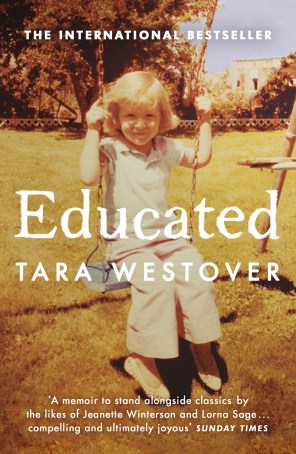 This book caused something of a sensation when it was published last year. It is the extraordinary memoir of a young woman who grew up in rural Idaho, as part of a large Mormon family. Nothing too outlandish there until the author begins telling you about the father’s survivalist beliefs (he hoards supplies of food and fuel in their bunker for when catastrophe strikes, as he believes it inevitably will), his Christian fundamentalism (quite extreme beliefs about, for example, what women should wear, that even their fellow Church members find uncomfortable) and the obsessive control he exerts over the rest of the family. The unconventional nature of the family would be enough to make this a fascinating read, but what makes it shocking is the level of violence, of almost sadistic cruelty. Some of is quite hard to read and at times I found myself gasping out loud.
 This third book picks up precisely where volume two left off, at a small book launch for Elena’s first book, a mildly sexual novel which has caused a stir, and where she is being questioned in a patronising way by an obnoxious critic. A familiar face from Naples walks into the room – Nino Sarratore – and Elena’s confidence is restored. Nino has been a friend since childhood, and there is a complicated triangular relationship between him, Elena and Lila, the main but elusive protagonist of all the books. Elena has been in love with Nino since they were young, but this has not been reciprocated. Like Elena, Nino proved to be a successful student, despite the disadvantages of background and upbringing, and would go on to achieve great things academically, though both know that neither is as brilliant as their mutual friend Lila, with whom Nino was once in a relationship, but who would never reach the academic heights of the other two.


 We are staying in Cancale, a smallish coastal town in Northern Brittany, arriving here on the overnight ferry from Cork to Roscoff, which was very pleasant indeed – good, reasonably-priced food, decent cabins and plenty to do.
 I’ve been unusually restrained with my holiday library this year, just the three books: Harvesting by Lisa Harding, a harrowing account of child prostitution, child trafficking, abuse and neglect, Death on the Nile, by Agatha Christie, the August choice for my Facebook Reading Challenge, and The Last Runaway by Tracy Chevalier, one of my book club’s summer reading titles.
 I am a firm believer that all reading material is good, just keep them at it, and adults should not judge if their kids want to read comics and picture books when they might think they ‘should’ be reading something more mature. If this sounds like a child you know, I’ve found a great little series they might find interesting. Hamish and the Baby Boom by Danny Wallace and illustrated by Jamie Littler is the fourth book in a series. Hamish Ellerby is the central character, a 12 year-old boy and leader of the Pause Defence Force in the town of Starkley. Hamish’s father is some sort of secret agent, ever engaged in defending earth against the evil Scarmash. Hamish has inherited some of his father’s abilities and leads his small group of friends in the PDF against strange and hostile happenings in the town of Starkley.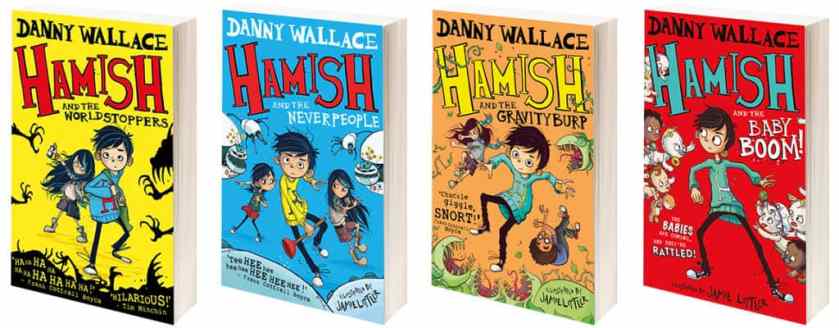
 I am a passionate supporter of public libraries, it’s where my reading journey started as child and I have never lost my fascination with them. With so much pressure on local council budgets, our libraries are under constant threat of closure. Many have already succumbed. Those that have survived have had to innovate, and this is great to see, becoming information and community hubs, putting on more and more events even becoming tourist information centres as well, but for me, their role as first-line guardians of our reading lives is foremost.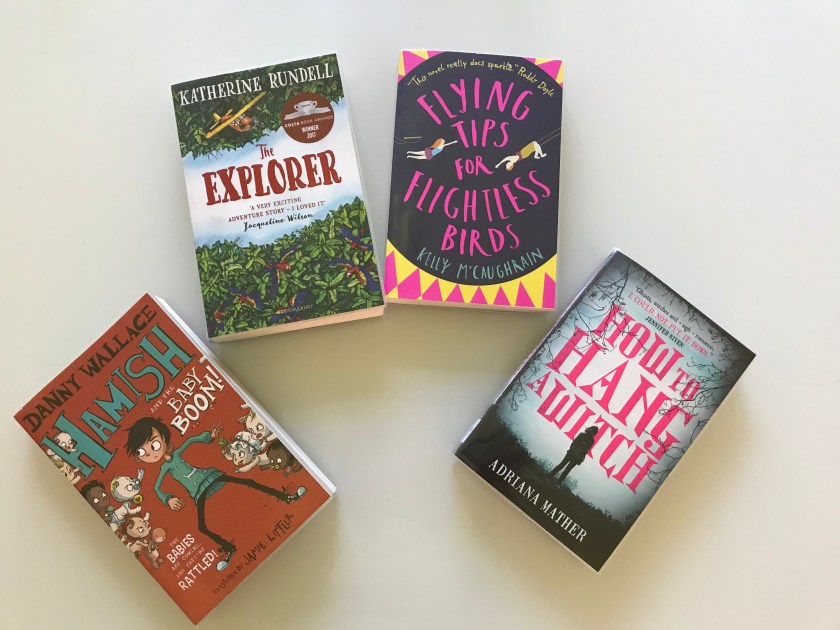
 The story begins near Aylesbury where the spivvy disgraced engineer Dr Absolom is trying to sell ‘mechanicals’. These are child robots which were initially created to perform tasks that society no longer wanted humans to do. We learn some vague details about how the experiment got out of hand when some rogue scientists tried to instil their creations with a soul. This was considered a step too far and laws were put in place to limit the capabilities of these creations, and, in particular, to forbid the building of adult-sized mechanicals. The environment we are observing, however, appears somewhat lawless, and it is clear that Absolom is operating on the margins and that there is a black market in mechanicals.
 I really liked this little book and it’s the third in the Invincibles series. The central characters are two friends, Nell and Freddie, and Mr Fluffy, a cat. Nell’s teenage brother Lucas, has a sleepover camping with his friends in the garden, which, of course, the younger ones want to be involved with. Through ‘Pester Power’ Nell manages to persuade her parents to let her and Freddie participate for a few hours. Noises in the woods (the waste ground next to the garden) terrify them all, but, of course, it turns out to be nothing more sinister than Mr Fluffy! It’s a great little story, with nice illustrations and a level of humour which children will love and adults will also identify with. Recommended.
 Similar in style to The Invincibles, this book is along the lines of The Addams Family – set in Nocturnia, a land of comic creatures, ghouls, vampires, mummies, etc. The central story is that Amelia’s parents are to throw their annual Barbaric Ball. They are keen for King Vladimir to come, but he has not been seen in public for years. The king decides he will attend with his son Prince Tangine, and, in preparation for getting to know the people, the Prince will attend the local school. He is of course, very haughty and unkind, and Amelia is particularly cross when he demands, and gets, her pet pumpkin Squashy. It turns out that Prince Tangine hides a devastating secret – he is half-fairy (terrifying creature of the light!), though his mother disappeared when he was young, leaving his father bereft. Amelia discovers this as she tries to rescue Squashy from the palace, and, when the truth is revealed, Tangine owns up to his faults and they all become friends. It’s a fun little story, and the toilet humour will appeal very much to the irreverent side of children. Lovely illustrations and plenty of contemporary references. It is basically about friendship, inclusiveness and being nice to people. Recommended though less in this one to keep parent readers interested.
 Julia's books