
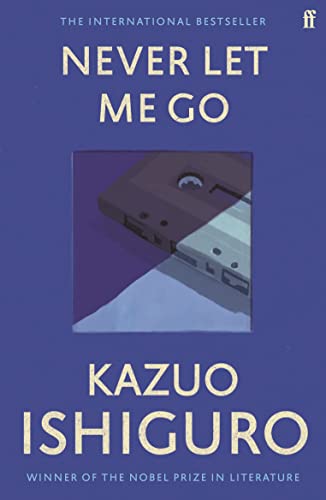
Book review – “Never Let Me Go” by Kazuo Ishiguro

I am very happy to be at the stage in life where I read books that have been recommended to me by my children (all now adults). This is one which my elder daughter enjoyed reading over the summer last year and which she thought I would too. She was not wrong; it is hard not to be a fan of Kazuo Ishiguro, one of our finest living writers, internationally acclaimed, winner of the Booker Prize in 1989 (for The Remains of the Day) and the Nobel Prize for Literature in 2017. The Remains of the Day was adapted for screen in 1993 and turned into a highly-acclaimed film starring Emma Thompson and Anthony Hopkins. Never Let Me Go was also made into a film in 2010 (though I did not know this) with a stellar cast which included Keira Knightley, Carey Mulligan and Andrew Garfield. Ishiguro has quite the pedigree and from what I have seen seems a very nice and down to earth chap. (And a British ‘Sir’ to boot.)

[This review contains some spoilers.]

I read and reviewed Klara and the Sun when it came out  in 2021, a novel about some of the potential repercussions of our obsession with technology and AI in particular (I posted about my own sense of alarm about this last month). It looked ahead to some future date when the advance was seemingly beyond our ability to arrest. The world it portrayed was at once familiar and extremely strange. Never Let Me Go bears some similarities in that it explores human cloning. Some readers may recall ‘Dolly the Sheep’ the first successfully cloned mammal who was born in Scotland in 1996 and died in 2003. At the time, there was a lot of fear-mongering about the consequences of this extraordinary achievement and some justified debate about how we as a human race should manage and control the inevitable advance of this particular field of science. In Never Let Me Go, Ishiguro imagines a world where this science is normalised into everyday life and what that means for the people involved.

The narrator of the story is Kathy, a woman still quite young when she is looking back on her life, and in particular at her childhood, from the perspective of one whose living purpose is to care for her peers, the others who share the same destiny as her. Kathy was brought up in an English boarding school (‘Hailsham’) where the staff are known to the young people as “the guardians”. This was in the late 1990s (when Dolly the sheep was all over the news?). Kathy tells us all about her life there, about the daily life of the children, about their relationships and petty differences, about the trivial things that were important to them. At first it is not clear to the reader exactly what is going on at Hailsham, but part way through, when reference is made to their future status as “donors” or “carers” it becomes increasingly and terrifyingly clear what these young people are for – their purpose is organ harvesting. They are all clones of someone on the outside (who they refer to as ‘models’ or ‘possibles’). 

When we think about clones we might think about robots (rather like Klara in Klara and the Sun), but the children at Hailsham have been created and have all the usual aspects of human personality. This presents challenges to how they are raised and ‘Hailsham’ was originally conceived as a place where their lives could be made rich, where they could develop relationships with one another (including sexual relationships) and be given some purpose in life until they would be required as donors. But of course, their lives are completely pointless, as Ishiguro shows us, their future is bleak; at some point they will donate, once, twice, perhaps more, after which they will weaken and die. By showing us the human frailty of the young people (petty squabbles, jealousies and meanness) he shows how they are just like us, how we could be just like them, just a few steps away from being nothing but an organ incubator. It would be easier if they were dehumanised (like Dolly). 

I found this a powerful novel that I have thought about much since I finished it a few months ago. As I have been thinking about it for this review, I have dipped back into sections of the book and seen things I did not see first time around, the pathos in Kathy, Ruth and Tommy’s trip to Norfolk for example, to search for Ruth’s “possible”, like a search for a mother, an origin story, but of course, the search is fruitless and deeply disspiriting to them all. It is a moment of realisation for them all – there is no-one out there for them. 

This book has to be on a list of must-read books of the twenty-first century.

Book review – “Klara and the Sun” by Kazuo Ishiguro

I don’t buy very many hardback books, hardly ever in fact until I started this blog, tending to find them cumbersome and too heavy for a handbag. Most of my reading now, however, is done at home rather than on the fly and I find I enjoy the weight and feel of a hardback and the better quality paper. Perhaps that is also down to my age! There are just some books that are more of an event though – Hamnet, The Mirror and the Light and The Testaments come to mind – and simply deserve the gravitas of the hardback format. Klara and the Sun by literary giant Kazuo Ishiguro is one such book. Plus I just couldn’t wait for the paperback! There was great fanfare about its release on 2 March; a whole episode of Alan Yentob’s BBC arts programme Imagine was devoted to the author, and I was delighted to watch a Manchester International Festival online event where Ishiguro was interviewed by fellow writer and poet Jackie Kay. Kazuo Ishiguro comes across as such a lovely man – confident but humble, respectful and measured, subtly charming. And someone who it would not be too scary to meet, I suspect.

Klara and the Sun is Ishiguro’s eighth novel (in a forty year career), proving that you don’t have to be prolific to be great; he has won just about every major literary award going, including the Nobel Prize for Literature in 2017. I knew that Artificial Intelligence was the subject of the novel and knowing that Ishiguro is never afraid to try out new things, I feared this would be a ‘dystopian future’ book – not the kind of book I tend to enjoy. It is not such a book, however. Rather, it is an exploration of what it means to be human.

Klara is an “AF” – Ishiguro leaves us to work out what this stands for – an AI robot produced for the specific purpose of acting as a companion to young people. The pre-supposition here is that human beings have reached a point of evolution where teenagers need a robot to accompany them at this stage in her life. We first meet Klara when she is in a shop window, waiting to be purchased. Poor Klara always seems to be overlooked in favour of newer models, despite the special qualities that the shop’s manager believes she possesses. From her vantage point in the shop, Klara watches the sun each day, its rising and setting and computes that it has special powers. For Klara the sun is almost god-like; a futuristic AI robot that sees the sun in a similar way to some of our ancient ancestors. Klara is also given energy by the sun – her batteries are solar.

Klara is eventually chosen by a young girl, Josie. Josie and her mother take Klara away to their home outside the city in an isolated rural setting and Klara is at last given her task. It is interesting how the reader gets drawn into having feelings about Klara. Klara is the narrator and we see the world through her rather childlike eyes, except she is not childlike; there are just some bits of data she has not processed and stored yet. But it is hard not to feel for Klara when, for example, the maid at Josie’s house is suspicious and a little hostile towards her, perhaps because she fears for her own job. And when Klara stands silently in the corner with her back to the room because her presence is not required we cannot help but see her like the child who has been left out. Klara is not human and yet she is the closest thing to it.

It soon becomes apparent that Josie has special needs. She has a kind of ‘elevated’ academic status which seems to mean that her parents have given her some sort of treatment which means that she receives a different kind of education to children who have not had this done to them. One such child is Rick, Josie’s nearest neighbour and childhood best friend. It is clear that Rick’s mother would never be able to afford the special status that Josie and her peers have and so his chances of succeeding academically and professionally are slim. The reader can see that there is a very short hop between this world and the selective nature of modern education we have in real life (both as a matter of policy and a matter of social determinism), and indeed between this world and Huxley’s Brave New World. A warning has been fired across our bows here.

In order to attain this special status, however, something had to be done to Josie (we are not told exactly what) and this has put her in some danger – for parents, the decision whether to give their child an academic leg-up is not risk-free. Hmm. Klara is capable of some rudimentary feelings and feels protective and fond of Josie. When she realises that Josie’s life may be in danger, she sets about trying to save her, utilising the sun’s enrgy. What Klara has not worked out, however, is how this AF is being groomed for something very different altogether.

The plot of this novel is pure genius and Ishiguro has conjured some contemporary themes out of a futuristic premise. What he has also done, very cleverly, is create a world that does not seem very different to our own and yet presents some prospects that we should take care we don’t stumble into. AI is a fact of our present life and will be a fact of our future. Stephen Hawking believed we should be careful as it had the potential to be the “worst event” in human civilisation. It is not clear which side Ishiguro comes down on, indeed, Klara is one of the most likeable characters in the book, but perhaps that is the point; it is not necessarily what AI will become that is the threat, but what it will cost us in human terms to get there.

A brilliant, engaging, complex novel, I recommend this highly.