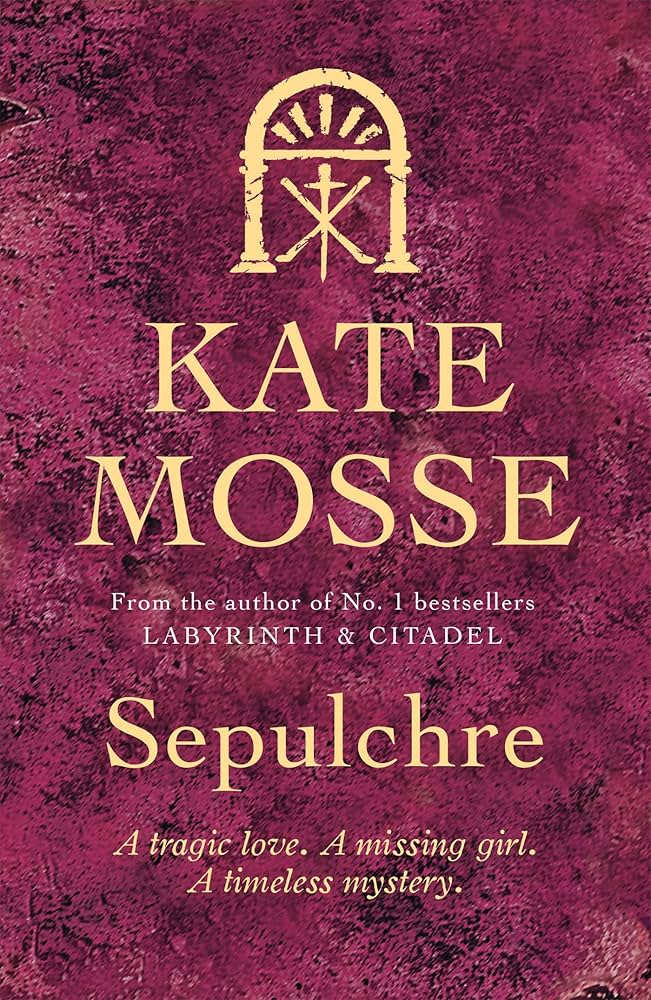
I read this book over the New Year holiday and I thought it would be fitting to publish my review today as the 2025 Women’s Prize for Fiction longlist has just been published. Only a handful of the books on the list have crossed my radar – Elizabeth Strout seems to be a regular on prize shortlists at the moment and her latest book Tell Me Everything has made the longlist. Yael van der Wouden’s book The Safekeep, which I reviewed after it was shortlisted for the 2024 Booker Prize is also there. But perhaps most interestingly, Chimamanda Ngozi Adichie’s long-anticipated new novel Dream Count has made the longlist – the book was only published today – that’s timing!
Kate Mosse was of course the founder of the Women’s Prize (formerly the Orange Prize) which is now in its 30th year. She is an extraordinary woman. Labyrinth, the first book in the Languedoc trilogy, of which this book, Sepulchre, is also a part, was published twenty years ago and Mosse is currently touring with a one-woman show, sharing her secrets about the book.
So, what of Sepulchre? I was eager to get to this novel having so thoroughly enjoyed Labyrinth. The third instalment, Citadel, is on my TBR list. Labyrinth has been an international bestseller, translated into more than forty languages. Sepulchre is a little less well known, I think, and the novels can be read and enjoyed in isolation, although for me, having read Labyrinth, deepened my understanding of the themes explored in the second novel.
Sepulchre follows a similar structural premise to Labyrinth – two women whose lives are intertwined in ways that we as readers do not know about but which will emerge as the narrative progresses. The author tells their stories in parallel, using the technique of the contemporary character uncovering details about the life of her distant predecessor. In this novel, the two women are Leonie Vernier, from the late 19th century, and Meredith Martin from the present day.
Leonie is a young woman living in Paris with her mother and brother. There is a sense of threat in the air, both from social and political upheavals of the time (one of the opening scenes is of a violent uprising in a theatre) and because of some mysterious business that Anatole, Leonie’s brother, is involved in. A shady character, Victor Constant, enters their lives and it is clear that he bears some ill will towards the family, particularly Anatole. When it is suggested that the siblings go to Rennes-le-Bains (a town about 50km south of Carcassonne, which is where the connections with Labyrinth begin) to visit their widowed aunt, a young woman who was married to their late uncle, it is in large part to enable Anatole to evade the attention of Victor Constant.
In Rennes-le-Bains, at the remote mansion the Domaine de la Cade, the siblings enjoy a relaxed time with Isolde their aunt and begin to experience a quieter life away from Paris. Leonie explores the grounds of the Domaine although she experiences a disturbing supernatural event in an abandoned chapel in a densely wooded area in the grounds (further links to Labyrinth). She paints, sews, explores the town and makes friends with some of the local gentry, including Audric Baillard, an intellectual and someone to whom Leonie is curiously drawn. Audric, of course, appeared in both time periods in Labyrinth.
The modern-day character is Meredith Martin, an American writer, teacher and musician, who arrives in France ostensibly on a research trip for a book she is writing about Claude Debussy (whom we meet earlier in the novel as he is a neighbour of the Vernier family in Paris), but also in search of information about a French musician ancestor, about whom she knows very little. She was adopted after her young and troubled mother died. Whilst in Paris she has a tarot reading which takes her to Rennes-le-Bains. She stays at a country house hotel (the former Domaine de la Cade) and becomes enmeshed in the personal family difficulties of Hal, whose father has recently died in mysterious circumstances, and whose uncle now stands to control the entire business of the hotel where the two brothers were partners.
The plot of the novel is complex and clever. Mosse manages to draw out the connections between the two womens’ stories whilst making each one uniquely interesting and separately gripping. The scenes of denouement in both stories are powerfully told without melodrama or sentimentality and I found myself gripped by events, eager to read ‘just one more page’ to find out what happens next! Her control of the story is masterful. There is a wide range of characters although I’m afraid I did not think that some of these were as complex or as well-drawn as those in Labyrinth. Victor Constant, for example, felt like a pantomime villain at times. This does not detract from the overall effect, however, which is of a talented writer with a passion and feel for her subject, completely in command of the narrative.
I am looking forward to picking up the final instalment of the trilogy, Citadel and devouring that one too!

 Julia's books