Do you ever find yourself seemingly out of step with the general consensus and wondering “is it me?”, thinking you must have missed something? I have had that experience twice recently. Last week my husband and I went to see the newly released film Black Bag, a spy thriller set in London, and starring Cate Blanchett and Michael Fassbender as a married couple working for the British secret service. Now, I love both these actors and was excited to see the movie, especially as Fassbender seems to be very selective about what he does these days (his last movie, The Killer, released two years ago was superb). But, honestly, it was quite mediocre. Disappointing. It was short, poorly edited, the characters were two dimensional, the plot opaque and the script weak. I read one lukewarm newspaper review but, apparently, reception by critics has been largely positive – according to Rotten Tomatoes it received an average rating of 8.2/10. I’m baffled.
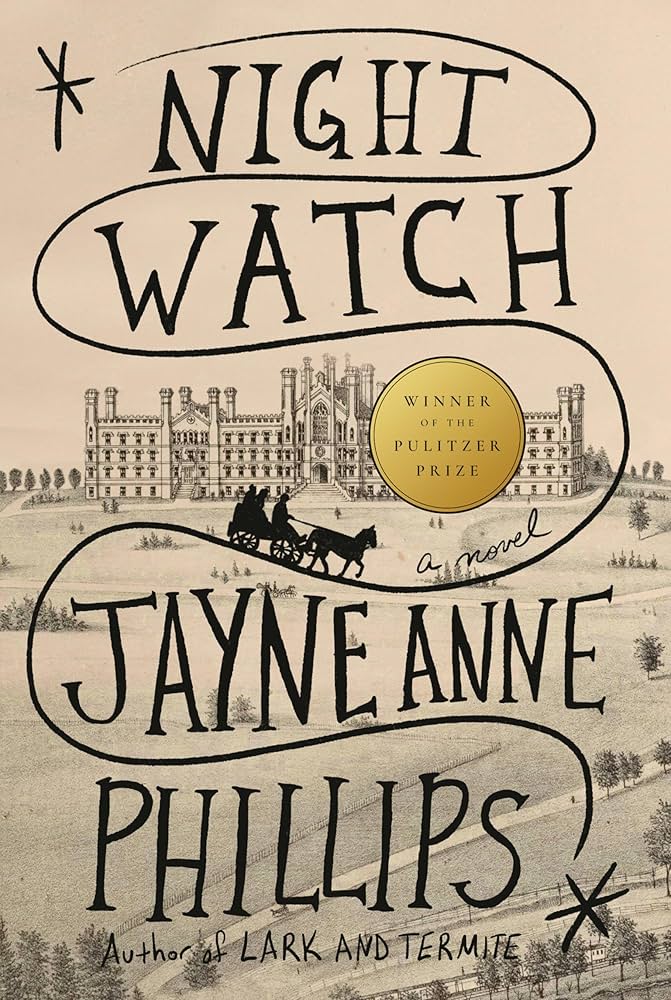
I have a similar feeling about Night Watch, the Pulitzer Prize winning novel by Jayne Anne Phillips. It was my book club choice for last month and I had not completed it by the time we met. I just found it quite slow and never felt motivated to read it. I almost gave up but my friends convinced me it was worth finishing. Set in the 1870s in the United States it follows the fortunes of a twelve year old girl ConaLee and her mother Eliza, a woman who has been deeply traumatised by sexual abuse and has been mute for many months. Eliza has born three children by her abuser, a boy and further boy and girl twins. ‘Papa’ is a former civil war soldier, who fought on the Confederate side, and has been brutalised by his experience. When Eliza is living alone with ConaLee he and a fellow runaway come across their small homestead and he rapes Eliza for the first time. She fights back as best she can and he goes away but he returns and this time makes the homestead, and Eliza, his own.
ConaLee’s father is a man who grew up with Eliza in her family home. He was a servant, an orphan taken under the wing of another servant, mother figure Dearbhla, an Irish immigrant and a strong and resourceful woman who will become vital to Eliza and ConaLee. Eliza and the boy fall in love, for which he will be severely punished, but eventually run away together and Eliza gives birth to their daughter ConaLee. He then goes off to fight for the union side in the civil war and is lost to them.
When we meet ConaLee and her mother, Papa is taking them to the Trans-Allegheny Lunatic Asylum in West Virginia. Having grown tired of the family he now has and Eliza’s state of mind, he plans to abandon them there. The asylum is a forward thinking institution run by Dr Story, nephew of the founder, who, based on his Methodist religion, had very specific ideas about how to treat the mentally ill – with exercise, routine, fresh air, good food and talking therapy.
The book then sets out the back stories of each of the characters and the plot of the novel becomes clearer. It explores the terrible effects of the war, particularly on the women and is detailed and graphic in some of the scenes. A large part of the novel also explores Dr Story’s philosophy behind the methods used at the asylum. It is a place of peace and tranquility where inmates and staff are treated with respect and kindness, and where Eliza finally might be able to recover from her trauma in a place of safety.
I did find the book lacked momentum, however. I usually like non-linear time frames, but I found the jumping back and forth between characters and life stages, not so much confusing as frustrating because it meant the pace was constantly shifting. I also found there was very little connection between outside and inside the asylum. I did not really see the point of knowing so much about the methods in the asylum. I’m not sure what that setting added to the story other than that it was a plot device. Yes, it was a place of safety for people who were damaged and previously unsafe, but it also had its vulnerabilities, as will become clear. I liked the character of Dearbhla, but, again, she seemed under-used – I’m not really sure what she was for. And, for me, the story was just not strong enough. And I was really annoyed by the omission of quotation marks to indicate dialogue – why? It made it tricky to read sometimes.
The critics loved this book, mostly, and in addition to winning the Pulitzer Prize, it was shortlisted for a number of other awards, so, as with Black Bag, I am left wondering what I am missing. I note that the New York Times took a less positive view which makes me feel less of an outsider! I’d love to know what others thought of this book. I would struggle to recommend it, if I’m honest.
 Julia's books