I consider fortunate to live in Manchester with its wonderful theatres. I grew up in and spent many years working in central London where you are spoilt for choice for theatre and the Arts, but, reality check, with a family it’s not so easy to exploit all those opportunities. The great thing about Manchester and the Royal Exchange Theatre in particular, is that whatever you see there you can pretty much guarantee it’s going to be good. And now that Maxine Peake seems to have made it her creative home, with so many productions in which she stars or directs, you know you are going to get something special.
I can’t say I’m that familiar with Beckett’s work; apart from Waiting for Godot, I’ve not seen any of his other plays. My husband is quite a fan though so we went along to Happy Days last week. It runs until 23 June, so if you have an opportunity to go and see it – DO! It is pretty special.
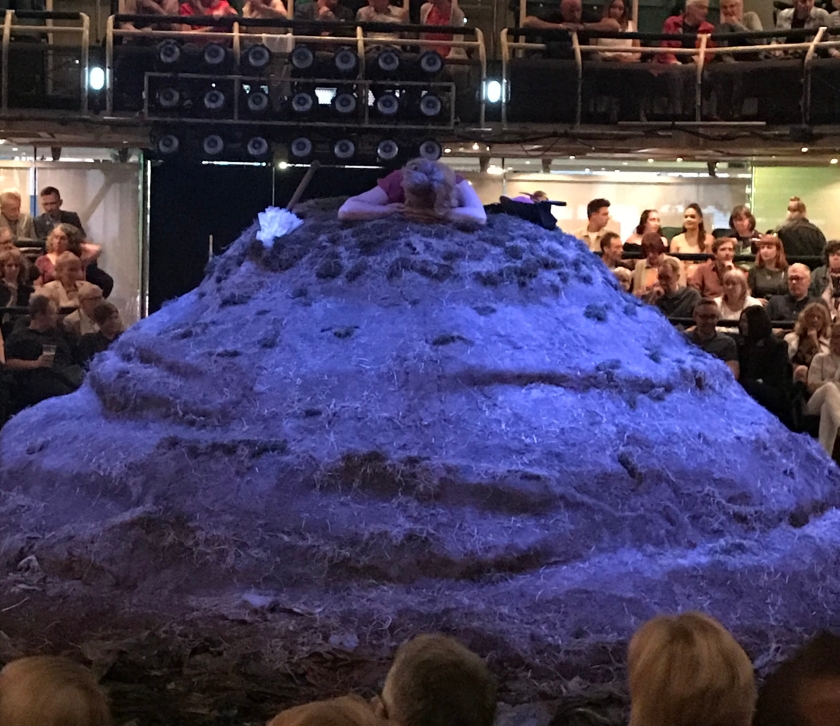
The play is basically a monologue, with Maxine as Winnie, middle-aged, lonely and trapped in an unfulfilling marriage, disconnected from wider society. This is represented quite literally with her up to her waist in a mound of earth, unable to move. Her husband, Willie, lies below, and speaks only very occasionally when addressed by the increasingly desperate Winnie. He is more mobile, but chooses not to be, spending his days lying in the sun, or in his hole, while Winnie chatters endlessly above him about nothing. The skill of the actor here, though, is conveying Winnie’s loneliness and her increasingly desperate mental state with meaningless dialogue and constrained physical movement. This is where the intimacy of the Royal Exchange works so well; the mound of earth rotates so that everyone in this round auditorium can see the lines of anxiety on Winnie’s face, the cracks in her mask. Her daily routine, the morning bell, the evening bell and all the little grooming and time-killing rituals in between, means she is just about holding it together. But for how long?
Spoiler Alert!
The second act gets a shade or two darker still and is quite shocking. By this stage Winnie is buried neck-deep and Willie is nowhere to be seen; he appears briefly at one point, encircling the mound in a morning suit. He has clearly moved on. Winnie is alone. At the start of act two Winnie is hanging on to her sanity by her fingernails. Despite the audience only being able to see her head (there are a number of screens so you can see her up close), Maxine Peake still manages to connect intensely via her facial movements, the interpretation of the words and her raw emotions. It is quite extraordinary.
The next production in the Royal Exchange’s main auditorium is The Queens of the Coal Age, written by Maxine Peake and directed by her long-time collaborator Sarah Frankcom. It promises to be another must-see. It can’t be long, surely, before Maxine attains national treasure status, but for the moment she is definitely regional treasure and we are very lucky to have her.
Go and see this play if you have the chance.
If you have seen this production, what did you think?
If you have enjoyed this post, do subscribe to my blog by clicking on the ‘Follow’ button and follow me on social media.
 It is extraordinary to think that this remarkable novel, still as popular and as shocking today as ever, was written when Mary was just 19 years old. The fact that she was such a literary talent is not surprising given that she was the offspring of the two famous intellectuals, Mary Wollstonecraft, philosopher and author of the seminal feminist work A Vindication of the Rights of Woman, and William Godwin, the radical political philosopher. In her lifetime, she was highly regarded as a radical writer and intellectual, as well as being the wife of the poet Percy Bysshe Shelley, whom she met and fell passionately in love with at the age of 17. Her reputation since her death, however, has been overshadowed by that of her husband’s, with whom she bore four children (three died in infancy), whose affairs and financial troubles she endured, and whose poems she edited both before and after his death. Percy Bysshe Shelley drowned at sea in 1822, just six years into their marriage when she was 25. She died at the age of 53 in London from a suspected brain tumour.
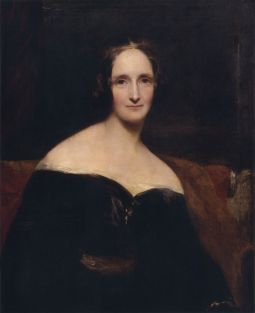 By any standards her life was remarkable and in the last few years her reputation has been revived and she has begun to be more widely considered as a formidable talent in her own right, rather than just a ‘one-book author’. Frankenstein has been a staple of English literature GCSE and A level syllabuses for years, but most of her other works have fallen out of print. A new biography, In Search of Mary Shelley: The girl who wrote Frankenstein, by Fiona Sampson was published earlier this year, some of which I caught when it was serialised in Radio 4 recently. What I heard sounded fascinating. Sadly it is not available on the BBC iPlayer at the moment.
 Julia's books