You will no doubt have picked up that it’s the Oscars this weekend; they start somewhere in the middle of the night (UK time) on Sunday 26th. I’m not a huge film buff so I’ve never stayed up for them, but I’ve become interested in recent years as an increasing number of the top movies, it seems to me, have been based on works of literature. The ones that spring to mind are Life of Pi (2013), 12 Years A Slave (2014), No Country for Old Men (2007) and Slumdog Millionaire (2008). Last year was particularly rich in literary reference with The Danish Girl, Carol, The Revenant and Room all big winners based on books. (I was so struck by this that I read three of the books and posted about it not long after I started this blog. You can read my post here)
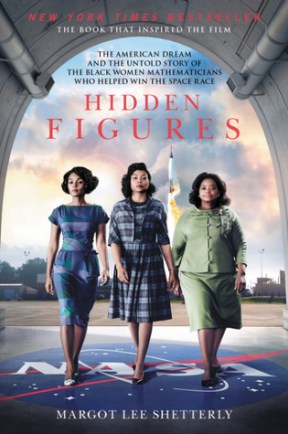 This year, literary references are a little thinner on the ground, but I want to tell you about a couple that have caught my eye. My children were on their half term holiday last week and I took my youngest daughter (aged 10) to see Hidden Figures. It is based on a true story, but the film was inspired by a book of the same name by Margot Lee Shetterly. You will no doubt have seen the trailers, but, to summarise, it tells the story of three exceptionally talented mathematical minds whose contribution to the US space programme in the 1960s went largely unacknowledged…because they were African-American women working at a time when racial segregation was still in place. It is a remarkable story, very moving and very well told.
I am proud to say that my young daughter was incredulous at the level of discrimination that prevailed – why didn’t these very clever women get the credit for the work they did? Without them, John Glenn may not have made it into space, let alone come back in one piece! I’d be interested to read the book, if only because the film is at times a little sentimental (though this takes nothing away from the achievement of the central characters) and I’d like to understand which facts have been sugar-coated for pictorial effect and which are true. And which bits they left out! I would highly recommend the film though, so take your daughters. And your sons!

The other film I’m desperate to see this year is Lion, which has been nominated for six Oscars, and is based on the book A Long Way Home by Saroo Brierley. This book is also a true story and is a personal account by the author of how he became separated from his dirt-poor family in India at the age of five. He found himself on the streets in Calcutta and then ended up in Tasmania. At the age of 30 he set out to try and find his family and the book (and the film) is the story of that journey.
I’m starting to build-up a long ‘to watch’ list, alongside my ‘to read’ list, but at least the ‘to watch’ list is merely a page of notes at the back of my diary and doesn’t haunt me every time I walk into a room in my house and am confronted by a very real large pile of books! (Yes, there is one in every room!) Roll on the March reading challenge, which is to tackle a book from the ‘to read’ pile.
Have you seen any films recently that you would recommend?
If you have enjoyed reading this blog post and would like to receive notification of future posts direct to your email inbox, please subscribe by clicking on the link below or to the right, depending on your device.
 Now, dear reader, this blog is rather like the proverbial swan – whilst it may look smooth and effortless to you on the surface, the planning (reading, idea generation, social media, writing, etc) that goes on behind the scenes is like a military operation! Well, not exactly, but, you know, I do plan my reading, aim to bring you a book a week and try to blog twice a week. And this book has totally blown my schedule! You know what it’s like when you’ve got a busy day planned either at home or at work…and you hear the words “Mum, I’ve just been sick!” and you know your day is irretrievably banjaxed. Well, that’s how I feel.
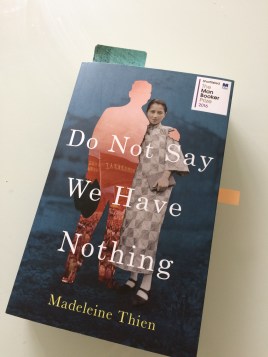 Do Not Say We Have Nothing, broadly speaking, is about China after the revolution, what it was like living under the dictatorship of Mao Tse Tung and about the hardships endured by the population, particularly by artists and intellectuals, in an era when culture was heavily proscribed. I have had a lifelong fascination with China, have read very widely about this enormously diverse and culturally rich nation, so I should be loving it. But I’m not! And I’m barely halfway through! I took a break from it this week and read Love, Nina by Nina Stibbe (which I’ll be reviewing soon), and that book is at the very opposite end of the literary spectrum – light, fun, quick to read. Many people probably would have given up by now. After all, a book, particularly a long one, is a huge investment is it not? I rarely give up on a book – I gave up on White Teeth by Zadie Smith a few years ago after a couple of false starts, but I have always planned to go back to it. My rationale for continuing with Do Not Say We Have Nothing is as follows:
 I’m not knocking either of these genres, I’m simply saying that literary non-fiction is a very tough genre to sell in. I read recently that the average non-fiction title in the US sells 250 copies a year (one for roughly every million people), or 2,000 copies over its lifetime. It makes you wonder why on earth you would write one! Many seem to be written by academics, journalists or people who have already established themselves in a chosen field and know they are writing for a particular niche. One striking thing about the genre, though, is that authors have a real passion for the topic, and the authenticity of the work is palpable.
 This is a novel about race in modern America where the white population seems to feel it has solved the problem of racism. Firstly, it abolished slavery and then set in place several pieces of legislation to reinforce racial equality. Unfortunately, this has not addressed a fundamental problem of disparity of outcomes between whites and blacks (or people of colour more widely), in academic achievement, income, social status, crime, you name it, the statistics paint a troublesome picture. The thesis of the novel is that, whilst white America is slightly uncomfortable with the facts as they stand, they can point to a number of black high achievers (not least the first African-American President) as evidence that they have done all they could. The under-achievement of the rest can be put down to, for example, their own fecklessness or problems of character.
 Julia's books