Once again this year, I have set myself the goal of reading the Man Booker shortlist. The shortlist of six was announced on 13 September and the winner will be named on 17 October. The title and description of this book did not appeal immediately and it would probably not have been the book I started with, but the others took a few days to arrive and this was the one that was available in the library, so by default it became my starting point.
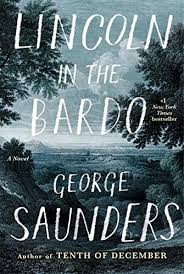
George Saunders is a well-established American writer, winner of the Folio Prize in 2014 (for Tenth of December, a collection of short stories) and on the back of my copy of this book are some impressive quotes from literary heavyweights: “A writer of arresting brilliance and originality” Tobias Wolff, “A morally passionate, serious writer…He will be read long after these times have passed.” Zadie Smith. High praise indeed. But this book? I just don’t get it.
The premise of the book is the untimely death of Willie Lincoln, eleven year old son of US President Abraham Lincoln in February 1862, whilst the American Civil War is raging. The Bardo is, according to Tibetan tradition, a kind of interim state that the dead enter prior to their admission to the final place where they will spend the afterlife. The Bardo, as imagined in this book, is a riotous place where the spirits, from different ages and social strata, mingle and squabble. Specifically, here, they argue over Willie’s soul and are fascinated by the vigil that Abraham Lincoln undertakes beside his son’s coffin. The cemetery (or perhaps more accurately the Bardo) is populated by a cast of characters who could easily have stepped out of a Victorian travelling circus; a mixture of grotesques and rogues, troubled souls and tragic misfits. Some are more fully realised than others; Hans Vollman. Roger Bevins iii and the Reverend Everly Thomas are our primary narrators, whose background stories are revealed in some detail, but many others make only brief appearances and are more like caricatures.
The structure of the book is very unusual, like nothing I’ve ever read before. There is no coherent narrative, as such, the story is told from the multiple perspectives. These not only include the restless spirits, but for the events that precede Willie’s death, or outside the cemetery, they are told in short paragraphs by third party observers, reporters and historians. What was most interesting to me, was how different some of these accounts were, despite the writers all seeming to have been present at the event described.
This book has left me feeling like I’m missing something. I know that it has been highly praised, but I’m afraid I just am not seeing anything particularly innovative here. To me it’s all just a muddle, with no story, where nothing really happens. There is one central theme, which seems to be that the dead do not rest easily until the living let them go, allow them to realise their ‘deadness’, but I’m not sure that single point is worthy of a whole book. And I didn’t really find the cast of spirits very entertaining or enlightening. I’ve read many books which have challenged form, which have taken some re-reading to fully appreciate. But for me, this book offers nothing that I want to delve back into. If it wins the ManBooker, I may need to go back to Literature School!
I dislike being critical. Did you find something of value in this book? What is it I’m missing?!
If you have enjoyed this post, please follow my blog and let’s connect on social media.

 Just Fly Away is the debut novel from 1980s brat-pack actor, turned award-winning director and author Andrew McCarthy. It tells the story of fifteen year old Lucy who discovers that she has a half-brother, the result of an affair her father had, living in the same town. Like No Filter it is a novel about secrets and lies, as Lucy escapes to Maine to live with her grandfather, himself estranged from the family, and to work through the confusion and torment her discovery has left her with.
 Finally, on a different topic, there is All the Things that Could Go Wrong by Stewart Foster which concerns the relationship between two boys, initially at loggerheads, who find common cause when they are forced to spend time together. Alex suffers from OCD and worries about everything. His condition is so severe that he rarely leaves home. Dan is angry, because his older brother Alex has left home and he feels lost. Initially, he takes it out on Alex, whom he perceives as weak and ineffectual, but the boys’ mothers force them together on a garden building project and the understanding that develops between is healing for both.
 Eleanor communicates poorly with others, being rather too literal and pedantic for most people to tolerate and is therefore unable to form effective relationships. At first, she is not an easy character to love, except that we as readers know a couple of things about her that her workmates do not, and which make us more sympathetic to her. Firstly, we know she drinks herself into oblivion at the weekends: as a reader we are bound to ask what she is trying to escape from. Second, there is Eleanor’s mother, with whom she speaks every Wednesday evening; “Mummy” is controlling, manipulative, cruel, nasty. Eleanor is an adult and yet there is something disturbing about the way she always refers to her parent as a child would (never ‘Mum’ or ‘my mother’). The fact that Eleanor also receives regular monitoring visits from social workers tells us that there is something dark in Eleanor’s past that has contributed to her present quirkiness, but we are not told what.
 This is Gail Honeyman’s first novel and it is a stunning achievement. A thoroughly enjoyable read. In an era where poor mental health, social isolation and dysfunctional relationships seem to have reached epidemic proportions, this novel is both an examination of one person’s particular circumstances and an antidote. Highly recommended.
 If you are finding it hard to motivate your children to read you may find this little book helpful – Alison David’s


 The novel begins more or less where The Glorious Heresies left off with the central character, Ryan Cusack, embroiled ever more deeply in the Cork city underworld of drugs, money laundering and violence. McInerney has managed to keep Ryan’s character consistent – he has evolved in an entirely credible way – although, unlike in the first novel, there now seems almost no hope of the more refined, gentler side of his personality prevailing to choose a different lifestyle. He is more embedded in the criminal fraternity than ever but remains an engaging and attractive central character. If anything, his charisma grows as he matures; true, he does some pretty unpleasant things, and not always at the behest of his criminal masters, but you can see that McInerney, if this turns out to be part of a series of novels, is building him up to be the tormented gangster.
 However, The Power is a prize-winner and seems to have been universally lauded, most notably by Margaret Atwood (Alderman’s literary mentor) whose ground-breaking novel The Handmaid’s Tale has just enjoyed a very successful television adaptation. The premise of The Power is a subversion of current social norms where men dominate, to one where women discover that they have a physical superiority, an ability to electrocute and disable, even kill, men. The novel begins (presumably in the current time) when women begin to discover they have this power and start to use it in ways that enable them to dominate. The story is told through the experiences of a number of women and a male. First there is Roxy, the young daughter of a London gangster who, once she discovers her power, undertakes a purge of all her male foes, her father’s enemies, and her half-brothers who threaten her, to become the top gangster in her field. Then there is Margot a small-time US politician who discovers she has the power and uses it, over a period of years to eliminate her political enemies and rise to great things. Initially, Margot has to hide her power; society is initially hostile to it, and therefore those who have it, seeing at as a threat which could upset order and stability (yes, much of the novel has to be read as a deep irony). Margot, as a politician is also connected with a number of corporations who would no longer support her if they knew she was a carrier of the power. Third, there is Allie, a teenager adopted into a right-wing southern American Christian family (more irony). She is abused by her adoptive father and in one of his assaults she electrocutes and kills him. She then escapes to a convent from where she morphs into Mother Eve, the head of the cult which spreads the power worldwide. One of the followers of the cult is Tatiana Moskolev, the estranged wife of the President of Moldova, who sets up her own republic in the north of the country and establishes a brutal regime where men are mere playthings, sexually abused and murdered at will. Finally, there is Tunde, a young Nigerian, who when we first meet him is trying to seduce a young woman, unsuccessfully as it turns out, because she gives him a small but still very humiliating electric shock when he makes his move on her. It is clear the power dynamic has shifted! Tunde senses that change is about to come to the world and so he sets about travelling the globe, posting his obervations on the internet and thereby becomes an international journalistic sensation.



 So, September is my month of choice for resolutions. My
  Before the summer break I also read


 Julia's books