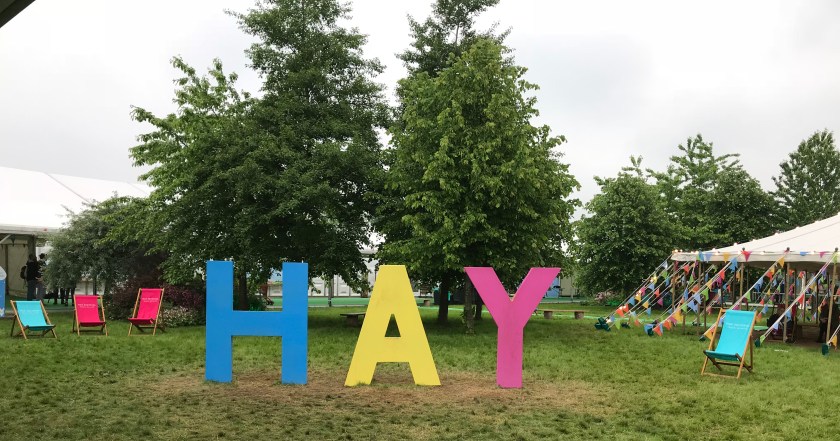
This weekend I fulfilled a long-held ambition and visited the Hay Festival. First established in 1988, this foremost of literary events is celebrating its 30th anniversary this year and has spawned a number of copycat events worldwide – including in Mexico, Spain, Denmark and India. Bill Clinton famously referred to Hay as ‘the Woodstock of the Mind’. I’ve been meaning to go for years, but it never seems to have been the right time. This year, circumstances were in my favour and I realised, only last week, that I could actually go! Hay-on-Wye, is in Powys mid-Wales, and although it was a long trip I decided to drive there and back in a day (mainly on country roads through beautiful Welsh and English villages incidentally). It was the most amazing and stimulating day and I’m already blocking out my diary for next year – I’m staying in one of those yurts!
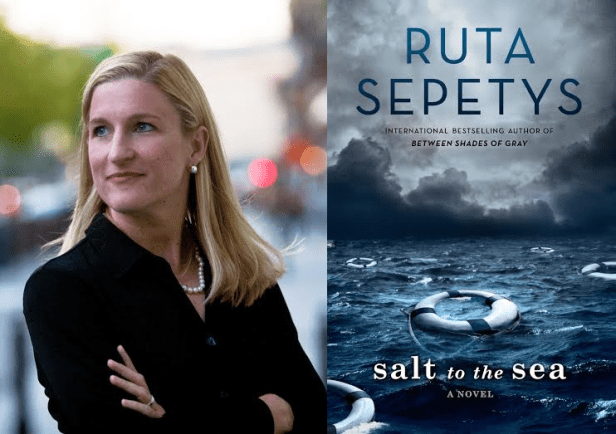
My day started with a talk from the wonderful American-Lithuanian YA author Ruta Sepetys, who was discussing her latest book Salt to the Sea. It’s a book about the sinking of the ship Wilhelm Gustloff in 1945, by a Soviet torpedo, with the loss of 9,000 lives, mostly Lithuanian refugees, who were trying to escape the advancing Red Army. I can’t wait to read it, so look out for my review.
 I then saw Rupert Everett (with whom I fell in love years ago after his appearances in films Another Country and Dance with a Stranger in the mid-1980s) in conversation with Alan Yentob. Everett has just completed his film about Oscar Wilde, a passion project which it has taken over ten years to bring to fruition. There was a BBC4 Imagine documentary about it a couple of weeks ago.
In the afternoon, I watched Cambridge academic Terri Apter give a talk about her new book Passing Judgement: Praise and Blame in Everyday Life which made me reflect on how I interact with my children, my partner and others around me, and how my responses to praise/blame may have been shaped by my early life experience. Fascinating stuff.
 Finally, my last event of the day was hearing Turkish author Elif Shafak speaking about her new book The Forty Rules of Love. I reviewed her novel The Bastard of Istanbul on this blog a few months ago. I wasn’t made about it, but hearing her speak, I must say, was inspiring. She is a remarkable woman of deep learning, great sensitivity, multilingual and came across as a very nice person to boot. Stunning talk.
I lingered for some time, even when I knew I ought to be heading home to make sure my teenager had got out of bed. Though there was heavy rain and thunderstorms in the morning, the sun blazed all afternoon. It is a magnificent setting, the town, which I did not get to explore, is delightful, and there are so many events to choose from, many of them free. The Haydays festival within a festival, aimed at children and young people, offers a packed schedule for the little ones. There is a marvellous on-site bookshop, Oxfam bookshop, food outlets and a few retail stalls. But this is primarily a festival to make you think, not make you spend, and I heartily recommend it.


Next year’s festival takes place 23 May – 2 June. You can also subscribe to the Hay Player for £10 which enables you to watch or listen to the archive of thousands of events from Hay over the years.
Have you been to the Hay Festival? What were your impressions?
If you have enjoyed this post, do subscribe to my blog to receive future posts and reviews.
 The central character of the novel is Florence Claybourne, elderly resident at the Cherry Tree sheltered housing development. Each of the residents has their own apartment, but the block is warden-controlled by Miss Bissell and Miss Ambrose, and there is a Day Room where communal activities are held. Some of the residents are frailer than others and there is the sense that this is the feeder facility for the local residential care home, Greenbank. The eponymous Elsie is Florence’s best friend, that’s the first ‘thing’ about Elsie; they have known each other since they were at school. The second ‘thing’ is that Elsie ‘always knows what to say to make me feel better’; Elsie always sounds a note of calm and reassurance whenever Florence becomes tense or upset, as she does frequently when the events of the novel unfold. Elsie and Florence are constant companions.
 I am a passionate supporter of public libraries, it’s where my reading journey started as child and I have never lost my fascination with them. With so much pressure on local council budgets, our libraries are under constant threat of closure. Many have already succumbed. Those that have survived have had to innovate, and this is great to see, becoming information and community hubs, putting on more and more events even becoming tourist information centres as well, but for me, their role as first-line guardians of our reading lives is foremost.
 Former home of Beatrix Potter, now in the care of the National Trust. A must for lovers of Peter Rabbit, which may now have added resonance after the release of the film earlier this year.
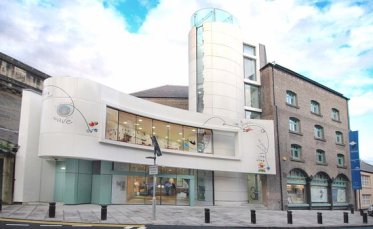 I was living in Newcastle when this place opened and I’m thrilled to see its thriving. They have a fantastic programme of events. Take a look
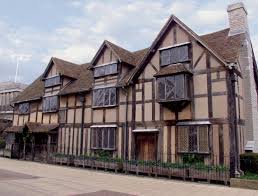 Stratford upon Avon
 I’m a big fan of audiobooks as a way of passing otherwise dead time in a more constructive way – for me it’s car journeys, or whilst exercising. It might also be while you’re waiting for swimming lessons to finish or at the supermarket. You have to choose your titles carefully though, because it’s not just about what you listen to, but the narrator is really key to the enjoyment. For example, audiobooks I have enjoyed have been Holding, narrated brilliantly by the author Graham Norton, Frankenstein, narrated by Derek Jacobi and 1984, narrated by Andrew Wincott (Adam from The Archers). Their reading styles enhanced my enjoyment. A title I enjoyed less because of the narration was The Girl on the Train, where I felt the male voices were not done well.
 I have recently finished listening to The Story of a New Name by Elena Ferrante, Book Two in her Neapolitan Novels series. I have listened to and reviewed here, Book One,
 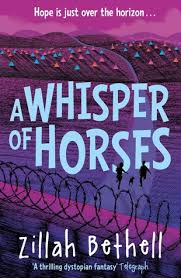 The novel is set in Lahn Dan, you’ll recognise the pun, but the place described in the book will be unfamiliar; it is practically a separate city-state within England, encircled by the ‘Emm Twenty-Five Wall’ that none of the inhabitants dare cross (told that there is only a deserted wilderness on the other side anyway). This is a time after ‘the Gases’ (a reference to climate change), the ‘Tems’ has deteriorated to a muddy flat and only the rich are able to live in the ‘crystal towers’ that afford them some natural light and allow them to live above the pollution layer. In a nod to Aldous Huxley’s Brave New World there is a strict hierarchy in the society: at the bottom are the Pbs, who do most of the work, then slightly higher up are the Cus, the professional classes, but true power lies only with the Aus. Give the child a prize who spots that these are chemical symbols and what this says about the social order! Lahn Dan is run by ‘the Minister’ a distant and slightly mythical figure, not unlike Big Brother, whose orders are carried out by Mordecai and his Secret Police. It all has echoes of 1984.


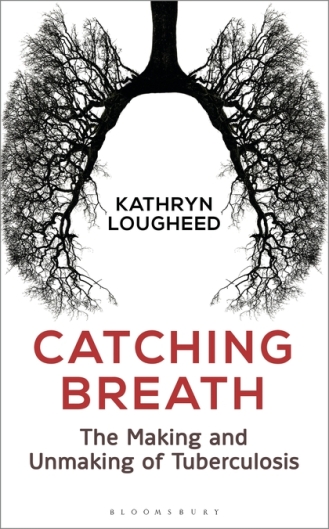 One of the books I consulted as part of my research into understanding more about the disease, its symptoms and its effects, was published very recently, in 2017. It’s called Catching Breath: the making and unmaking of tuberculosis by Kathryn Lougheed. The author is a former scientific researcher and is now a journalist and science writer. The book is excellent. It is fantastically well-written, even funny in parts (the author has an interesting sense of humour – her Twitter handle is @ilovebacteria!). She is out to make some serious points, however, about this, one of the oldest diseases known to humanity, which has so successfully mutated, crossed species and diversified and which just keeps on winning. Her main argument is that TB remains a disease of poverty and inequality. Globally, it affects the weakest – the young, the old, the poor or those who are already sick. She argues that, although it is a complex disease, if there was sufficient political will, many more lives could be saved. If there was as much resource and international effort put into tackling TB as there has been, say, to addressing AIDS, there would have been far greater success to date. In 2015 the World Health Organisation (WHO) announced its ‘

 The story begins near Aylesbury where the spivvy disgraced engineer Dr Absolom is trying to sell ‘mechanicals’. These are child robots which were initially created to perform tasks that society no longer wanted humans to do. We learn some vague details about how the experiment got out of hand when some rogue scientists tried to instil their creations with a soul. This was considered a step too far and laws were put in place to limit the capabilities of these creations, and, in particular, to forbid the building of adult-sized mechanicals. The environment we are observing, however, appears somewhat lawless, and it is clear that Absolom is operating on the margins and that there is a black market in mechanicals.
 Julia's books