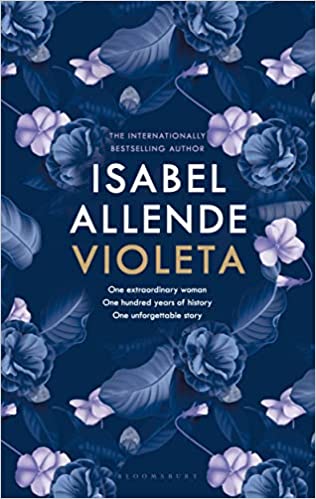
I have a particular fondness for Isabel Allende. She is an icon of world literature, of global feminism, of how to embrace ageing and of the joy, beauty and depth of south American culture. In a week when the world said its goodbyes to one female icon (Queen Elizabeth II, regardless of what you think about monarchy, it was quite a moment) and were shocked to learn of the sudden death of another, this time from the world of literature (the terribly sad news of Hilary Mantel’s untimely passing), it seems appropriate to praise Allende and value her for all that she has given us.
The last arts event I attended before most of the world went into lockdown on the brink of the Coronavirus pandemic, was a talk in Manchester between Allende and Jeanette Winterson on the publication of her last but one novel The Long Petal of the Sea. I enjoyed that book though I felt it was not among her best. Allende’s latest novel, Violeta, published earlier this year and written, one assumes, during the pandemic feels like that to me too.
The central character, Violeta, is an elderly woman (almost 100 years old we will learn) writing a letter, memoir, for another character Camilo. We don’t know the connection between Violeta and Camilo until about halfway through the book and I’m not going to give any spoilers here, though we do know that she loves him “more than anyone else in this world”. The story begins with Violeta’s birth in 1920 at the time of the Spanish ‘flu outbreak in Chile. Her father committed suicide, after a series of failed business ventures brought him and his family to a situation of near penury, and it was Violeta who found his body.
Her childhood was spent mostly in a rural setting on a smallholding where she was educated in the school of life. The family was forced to flee there after they lost everything in the Depression. She grew up with her brother in the care of a poor family who showered her with love and protection. She married a man who was the son of affluent European hoteliers, but the marriage was largely sexless and doomed. When Violeta met the dashing Julian Bravo, a pilot, and a passionate lothario, she was immediately swept off her feet and left her husband. This brought disgrace upon her head, particularly as Julian refused to marry her, even when she bore him a son and a daughter.
Julian lived life on the edge, having lots of money one minute and none the next, so although their relationship was initially a fulfilling one, it lacked stability. As a young woman it was clear that Violeta had business acumen so she set up a company with her brother in the construction industry and was very successful, able to support herself and her family without being dependent on her wayward lover.
That is as much as I will say about the plot. The book is basically the story of a life so to tell you any more would be to give you a full synopsis! The life story it tells is an interesting one and Violeta certainly has an interesting life. She is also telling the story from the perspective of a person of a great age, so she is able to reflect on her mistakes as well as celebrate her life’s achievements. It is a pretty linear first-person narrative and that, for me, is where it disappoints. I have come to expect more of such a great writer and the book for me never really delivers. Throughout I was just wanting more. There is no doubt that Allende is a great storyteller and the interweaving of history into the narrative, the politics of south America in the twentieth century, the dictatorships, the terrors, the corruption and the sheltering of Nazis fleeing Europe, is fascinating and deftly done, but I just felt she was capable of more. Some parts of it are clumsy (for example the love scenes which made me squirm a little!) and some parts of it feel autobiographical (for example, Violeta’s views on feminism), almost as if Allende herself is writing a letter to her readers.
I hope there is more to come from this wonderful author, and fans of Allende (and I count myself as one) will of course treasure every word she writes, but I do rather feel this book lacks some of her usual creative energy. Perhaps that is a result of its having been written during a lockdown. My fellow book club members enjoyed it, and found its uncomplicated approach quite refreshing, especially as we read it over the summer. It also does have a rather neat symmetry, which you will see if you read it.
Recommended if you like a good story that does not ask too much of a reader.

 Julia's books
Violeta, by Isabel Allende, is a straightforward tale of an elderly woman who writes a long letter to Camilo, whose identity I will not divulge, but is easy to surmise from the beginning. Unlike the reader who was disappointed by what she calls a “lack of creative energy” in the book, I appreciated that it didn’t jump around from one era to another, which seems to be popular in contemporary writing and doesn’t improve the story, in my opinion. I’ve always liked the way Allende brings historical events into her novels. It makes her stories feel more believable and easier to relate to. Having grown up about a decade after Allende, I have lived through most of the world events that she includes in her novels. As a college student, I majored in Spanish, then lived in four Latin American countries for a total of six years, and later taught Spanish for 32 years. Allende’s novels bring back many memories of my own life experiences. Isabel Allende is a treasured author and I look forward every year to what she will publish next.
LikeLiked by 1 person
Hi Cindy, thank you for your comment. I too think of Isabel Allende as an international treasure. It is interesting what you say about liking books that do not jump around in time (gratuitously) – a friend of mine made a similar comment. I think for me, Violeta just felt less brilliant than many of Allende’s other books. 🙂
LikeLike
I would agree with both of you.. It is a good book, but not a great one, if I may say. The topics are eternal and women-bound, but somehow the story and the writing are a litlle bit too flat, with some inconsistencies and omissions, characters sometimes one-dimensional, not well-drawn (better to say not perfectly – carved).. Maybe I expected too much. However, I really enjoyed the book and jumped eagerly into the Latin-American world Allende involved us into.
LikeLike
Yes I agree. You have to admire her though – I believe she has just published another book? Her work is of such a high standard that you are right you do expect her to just keep it up all of the time, and perhaps that is just too much to expect. I do love her though.
LikeLike