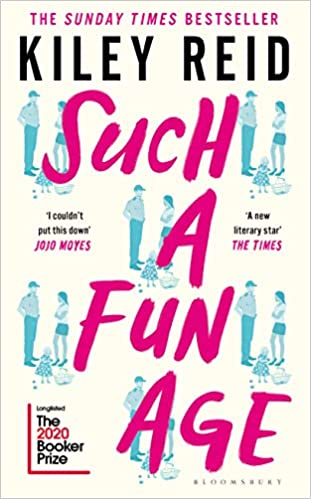
And thus begins my annual attempt to read my way through the Booker Prize shortlist before the winner is announced. Customarily, the shortlist is announced in mid-September and the winner announced at the beginning of November, giving about six weeks to read six novels. I have never yet managed all six. I think the closest I have come is about four. I am optimistic this year as I have a strategy – a mixture of audiobook, e-reader and actual book – and a plan. So far I have completed one (the shortest), am part-way through another (the longest) and I am the proud owner of a signed copy of a third. With just over four weeks to go I am, if not optimistic, then at least hopeful. I expect kitchen renovations at the end of the month to disrupt all my plans!

The first book I am ticking off the list is Patricia Lockwood’s No One Is Talking About This, which has become one of the most talked about books of the year since it was first published in February. This is Lockwood’s first novel; she is better known as a poet and published a memoir in 2017 entitled Priestdaddy which was highly acclaimed. No One Is Talking About This has been compared variously to William Faulkner’s The Sound and the Fury, Virginia Woolf’s To The Lighthouse, and James Joyce’s Ulysses. I count all three of those among my all-time favourite reads so I should have loved this book.
It is a really difficult book to describe (for me, that’s where the comparison with Ulysses ends). I should also add, by way of a caveat, that I listened to this on audio and may well have been affected by the slightly manic reading of it. It is narrated in the first person by an unnamed character who has an unnamed family but who lives, we can assume, in New York City. The first half of the book is pure stream of consciousness, a portrayal of the wildness of modern life, particularly those parts conducted through ‘the portal’, which is pretty much everything. We see the ridiculousness of life lived out online, where only appearances matter, where substance and empathy and humanity appear to have vanished. Where photographing and documenting your food is more important than eating it. Where how your relationships look is more important than the relationships themselves. I think most of us can recognise this as the way we might all actually be heading if we are not careful. If indeed, we are not already there.
The second half of the book, described by the author herself as ‘autofictional’ centres around a devastating family event. The narrator’s sister becomes pregnant and the journey is duly recorded on the portal, until a scan reveals an irregularity in the baby’s head measurement. The pregnancy and the baby are no longer as photogenic or fit for the portal, but the event will have a seismic impact on the family and on our narrator in particular. She is completely unprepared for the immense love she feels for the severely disabled baby girl her sister delivers, a child whose life expectancy is limited and whose quality of life would usually be described as poor. And yet, the baby, with her rudimentary abilities, her dependency on her loved ones and her complete helplessness, draws out the humanity in those around her, that, because of the evils of the portal, they had forgotten they had.
This second half of the book is based on an event in Lockwood’s own family – her sister gave birth to a child with Proteus syndrome – and knowing there is truth in it, makes it a powerful read indeed. For me, it is not Ulysses, and Lockwood is not yet Woolf or Faulkner. I wasn’t awed or stunned by the book, but it is innovative. Her instincts as a poet serve her well. It reminded me a little of the 2018-shortlisted book Ducks, Newburyport by Lucy Ellman, which I have recently finished. I have to say I found that book better, but Lockwood has a good chance of winning with this novel.
So, recommended. I’m looking forward to what the rest of the shortlist has to offer.
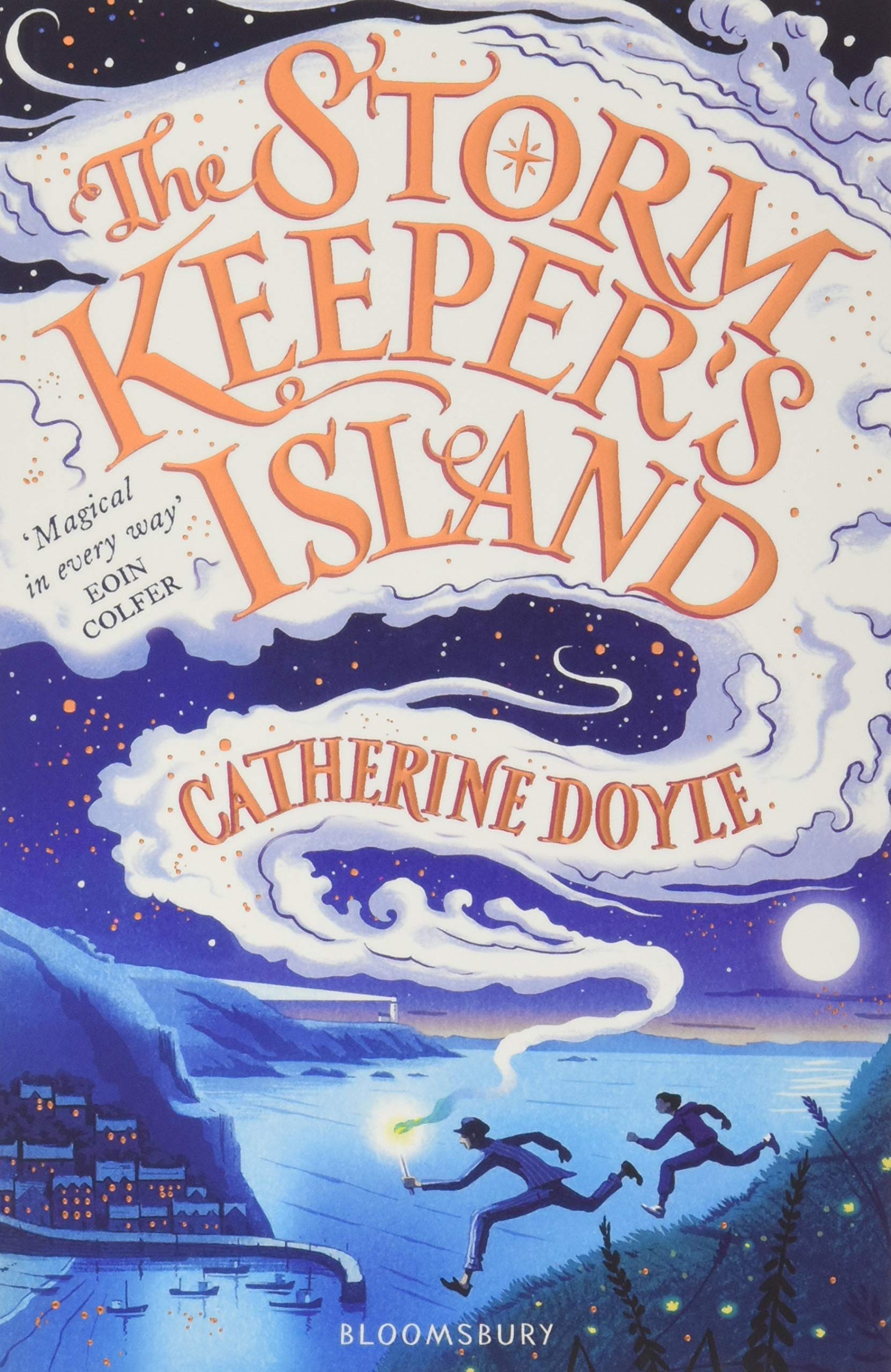 This month, I would like to recommend Catherine Doyle’s The Storm Keeper’s Island, published last year by Bloomsbury, as a fantastic choice for any young people you know who like modern adventure stories where the good guy wins. Catherine Doyle is a young writer (just 29 years old) and has published several YA novels already; The Storm Keeper’s Island is her first novel for what is called the “middle grade”, ie about 9-12 years, and it was a barn-storming debut, winning several prizes and accolades from established authors in this genre. A second novel, following the further adventures of the main character Fionn Boyle, is planned for this summer and I would expect it to feature heavily in recommended holiday reading lists in advance of the Summer Reading Challenge.
 The novel is set in Lahn Dan, you’ll recognise the pun, but the place described in the book will be unfamiliar; it is practically a separate city-state within England, encircled by the ‘Emm Twenty-Five Wall’ that none of the inhabitants dare cross (told that there is only a deserted wilderness on the other side anyway). This is a time after ‘the Gases’ (a reference to climate change), the ‘Tems’ has deteriorated to a muddy flat and only the rich are able to live in the ‘crystal towers’ that afford them some natural light and allow them to live above the pollution layer. In a nod to Aldous Huxley’s Brave New World there is a strict hierarchy in the society: at the bottom are the Pbs, who do most of the work, then slightly higher up are the Cus, the professional classes, but true power lies only with the Aus. Give the child a prize who spots that these are chemical symbols and what this says about the social order! Lahn Dan is run by ‘the Minister’ a distant and slightly mythical figure, not unlike Big Brother, whose orders are carried out by Mordecai and his Secret Police. It all has echoes of 1984.


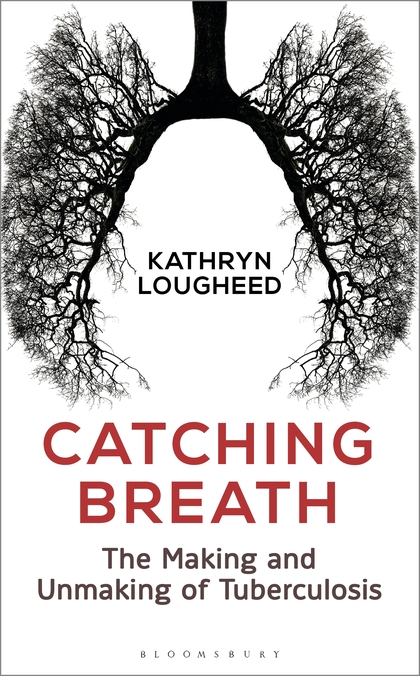 One of the books I consulted as part of my research into understanding more about the disease, its symptoms and its effects, was published very recently, in 2017. It’s called Catching Breath: the making and unmaking of tuberculosis by Kathryn Lougheed. The author is a former scientific researcher and is now a journalist and science writer. The book is excellent. It is fantastically well-written, even funny in parts (the author has an interesting sense of humour – her Twitter handle is @ilovebacteria!). She is out to make some serious points, however, about this, one of the oldest diseases known to humanity, which has so successfully mutated, crossed species and diversified and which just keeps on winning. Her main argument is that TB remains a disease of poverty and inequality. Globally, it affects the weakest – the young, the old, the poor or those who are already sick. She argues that, although it is a complex disease, if there was sufficient political will, many more lives could be saved. If there was as much resource and international effort put into tackling TB as there has been, say, to addressing AIDS, there would have been far greater success to date. In 2015 the World Health Organisation (WHO) announced its ‘
 Julia's books