I first knew Sarah Dunant as a broadcaster on late-night arts shows in the late 1990s. It’s funny how you remember some people – she always had very distinctive glasses. I was conscious that she seemed to disappear off the scene and for a while there I got her mixed up with Sarah Waters…until I saw Sarah W speak at the Manchester Literature Festival a few years ago and realised they were not the same! But Sarah D had in fact reinvented herself as an author, as I was to discover a year or so ago when I saw her speak at a writer’s conference. (I should add that 2000-2012 were lean reading years for me – I was knee-deep in children and totally out of the literary loop).
I’ve read a few historical novels, notably Deborah Moggach and Tracy Chevalier, and loved them, though it’s not a genre I often choose. I decided on this as a theme for my Facebook Reading Challenge 2018, and when I saw The Birth of Venus in my local Oxfam bookshop it seemed an obvious choice. It’s wonderful, I loved it, and it seems to have gone down pretty well with the other participants on the Reading Challenge.
 The novel is set in Renaissance Florence; the sense of time and place is profound. You can almost smell the streets wafting from the pages! Dunant is a meticulous researcher and the novel feels very authentic. The central character is Alessandra, the fifteen year-old daughter of a wealthy cloth merchant. Much to the frustration of her family Alessandra is a precociously intelligent young woman, a talented artist, a strong personality and has a deep desire to be out in the world. These are all traits which are highly inconvenient for the family and not compatible with the kind of life she will be expected to lead.
As a mark of their wealth, Alessandro’s parents commission a Flemish artist to paint the chapel in their home, incorporating the family’s portraits. Though she has very limited opportunity to communicate with him, his presence produces a stirring effect in Alessandra. She is attracted both by his artistic ability and his mysterious nocturnal wanderings into the city.
Alessandra is destined to be married off as soon as she starts menstruating and the husband selected for her is an older man, a long-standing family acquaintance. At first it seems the marriage will set Alessandra on the same path that her mother and sister before her have followed – moving from one zone of subjugation to another and endless child-bearing. In fact, Alessandra’s husband, Cristoforo, is the lover of her brother Tomaso and the marriage is merely one of convenience to provide him with the cover of a wife and child. At first, Alessandra is distraught and feels betrayed, but it soon becomes apparent that this frees her more than she could ever have imagined, to pursue some of her own dreams, to be more sexually liberated, and to be mistress of her own time and activity. In the background to the domestic tumult is the political upheaval in the city; first, the invasion of the French, then the rule of Savonarola, a fierce reactionary monk who preaches a severe brand of Christianity. The old certainties of corruption, sleaze and vice in the Church and politics are being brutally flushed out in favour of a strict religious fervour, and a new atmosphere of fear, surveillance, severe torture and punishment for misdemeanours has replaced it.
I will say no more as it’s a cracking story and events unfold dramatically. The plot is so well thought-through and maintains momentum right to the end. The characters are well-rounded and believable, not just Alessandra, but her mother and husband, her brother and sister, the painter and her loyal maid, African slave Erila.
The book is ambitious in scope, in its portrayal of the period and the way it weaves the political upheavals and realities of the era into what is essentially one young woman’s story of coming of age, of emotional and sexual maturing and of finding fulfilment in the most constrained of circumstances.
Highly recommended, great for any holidays you might have coming up and I’ll certainly be looking out for more Sarah Dunant for future reads.
Do you enjoy historical fiction? What are your recommendations?
If you have enjoyed this post, please subscribe to my blog by clicking the ‘Follow’ button. You can also follow me on social media.


 I am a passionate supporter of public libraries, it’s where my reading journey started as child and I have never lost my fascination with them. With so much pressure on local council budgets, our libraries are under constant threat of closure. Many have already succumbed. Those that have survived have had to innovate, and this is great to see, becoming information and community hubs, putting on more and more events even becoming tourist information centres as well, but for me, their role as first-line guardians of our reading lives is foremost.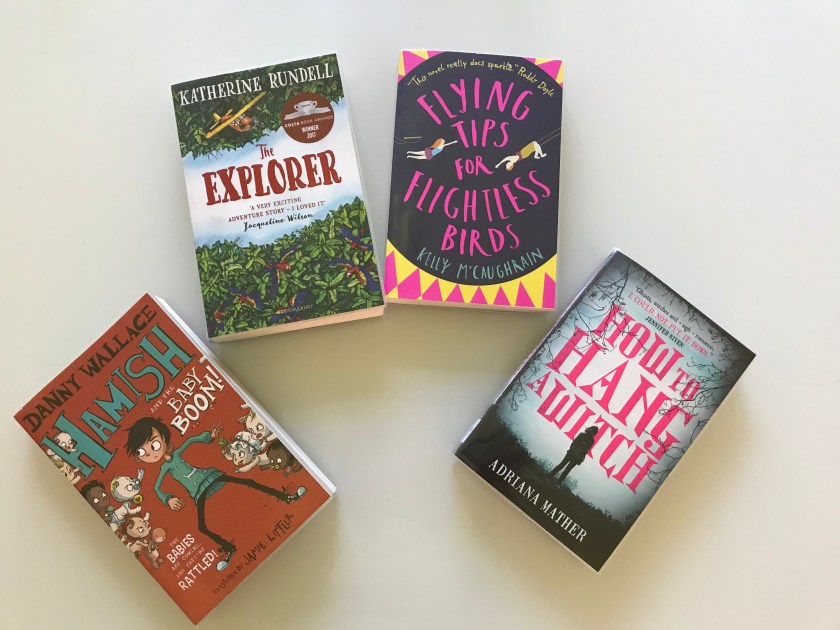


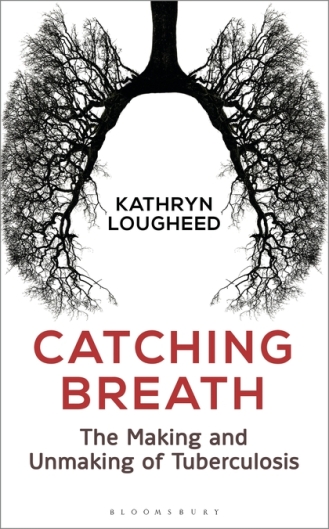 One of the books I consulted as part of my research into understanding more about the disease, its symptoms and its effects, was published very recently, in 2017. It’s called Catching Breath: the making and unmaking of tuberculosis by Kathryn Lougheed. The author is a former scientific researcher and is now a journalist and science writer. The book is excellent. It is fantastically well-written, even funny in parts (the author has an interesting sense of humour – her Twitter handle is @ilovebacteria!). She is out to make some serious points, however, about this, one of the oldest diseases known to humanity, which has so successfully mutated, crossed species and diversified and which just keeps on winning. Her main argument is that TB remains a disease of poverty and inequality. Globally, it affects the weakest – the young, the old, the poor or those who are already sick. She argues that, although it is a complex disease, if there was sufficient political will, many more lives could be saved. If there was as much resource and international effort put into tackling TB as there has been, say, to addressing AIDS, there would have been far greater success to date. In 2015 the World Health Organisation (WHO) announced its ‘

 I had read this book previously, but many years ago as an undergraduate, so whilst I had remembered the basic story, I had forgotten much of the detail. I had forgotten for example just how brilliant the writing is and how very like Jane Austen Flaubert can be in his use of irony. By all accounts, Flaubert was a perfectionist and spent years on this book; it is certainly masterful and for me the writing was sublime. I had also forgotten how unlikeable all the characters are! Even Emma, our supposed “heroine”, is at times unpleasant, childish, selfish, superficial and self-obsessed. When I discussed it with my husband (who speaks fluent French and read it in the original) he was surprised that I did not find Charles Bovary, Emma’s husband, sympathetic. Interesting that he felt affection for the long-suffering, betrayed husband who loved his wife to the death, despite her many faults, whereas I found him ineffectual and basically unable to connect with his wife on any level, and that was part of the problem in their marriage.
 It is extraordinary to think that this remarkable novel, still as popular and as shocking today as ever, was written when Mary was just 19 years old. The fact that she was such a literary talent is not surprising given that she was the offspring of the two famous intellectuals, Mary Wollstonecraft, philosopher and author of the seminal feminist work A Vindication of the Rights of Woman, and William Godwin, the radical political philosopher. In her lifetime, she was highly regarded as a radical writer and intellectual, as well as being the wife of the poet Percy Bysshe Shelley, whom she met and fell passionately in love with at the age of 17. Her reputation since her death, however, has been overshadowed by that of her husband’s, with whom she bore four children (three died in infancy), whose affairs and financial troubles she endured, and whose poems she edited both before and after his death. Percy Bysshe Shelley drowned at sea in 1822, just six years into their marriage when she was 25. She died at the age of 53 in London from a suspected brain tumour.
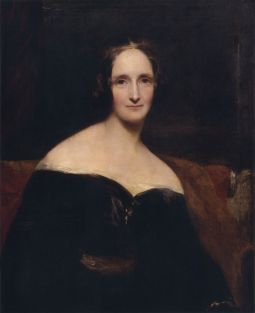 By any standards her life was remarkable and in the last few years her reputation has been revived and she has begun to be more widely considered as a formidable talent in her own right, rather than just a ‘one-book author’. Frankenstein has been a staple of English literature GCSE and A level syllabuses for years, but most of her other works have fallen out of print. A new biography, In Search of Mary Shelley: The girl who wrote Frankenstein, by Fiona Sampson was published earlier this year, some of which I caught when it was serialised in Radio 4 recently. What I heard sounded fascinating. Sadly it is not available on the BBC iPlayer at the moment.
 Last month, we battled our way through Madame Bovary, some enjoying it more than others, it has to be said. Our theme was a classic novel, and this can be a challenging genre. It can take you right back to schooldays and unhappy memories of working line by line through a text that had no relevance to your teenage life. And if you are out of the habit of reading classic, usually older, novels, the language can feel outdated, and hard work.
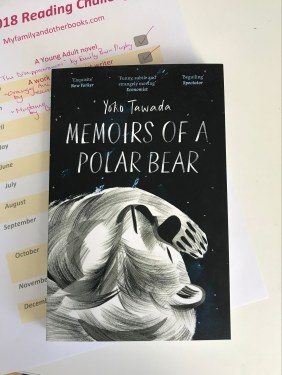 This months’s challenge is something altogether different – a children’s novel and I have chosen Memoirs of a Polar Bear by Yoko Tawada. This book first came to my attention before Christmas and I have been keen to read it ever since. It is written from the perspective of three different polar bears: the first , a female, who flees her homeland in Soviet Russia, the second, her daughter, a dancing bear in a Berlin circus, and the third, the most recent, born in captivity in Germany.
 The central character, Hildy, is a slightly quirky, slightly awkward 17 year-old. She has two close friends – her best friend is Max, who is gay and fairly camp with it, and her other good friend, Xiu is much more astute, confident and successful in affairs of the heart. She confides in them extensively about her feelings and worries. Hildy has not had a boyfriend for some time and so, out of a degree of desperation signs up for a research programme which is exploring whether it is possible to facilitate a romantic relationship between two people by making them ask and answer a specific set of (36) questions. Hildy’s ‘partner’ in the programme is Paul, who, from the outset, makes it quite clear that he is only in it for the $40 fee and who is a nonchalant and frustrating participant to begin with; where Hildy makes an effort to answer the questions truthfully and fully, Paul is uninterested and uncooperative, and obfuscates throughout. Their first session ends with Hildy throwing a tropical fish at Paul that she had bought for her younger brother on the way to the meeting.
 Julia's books