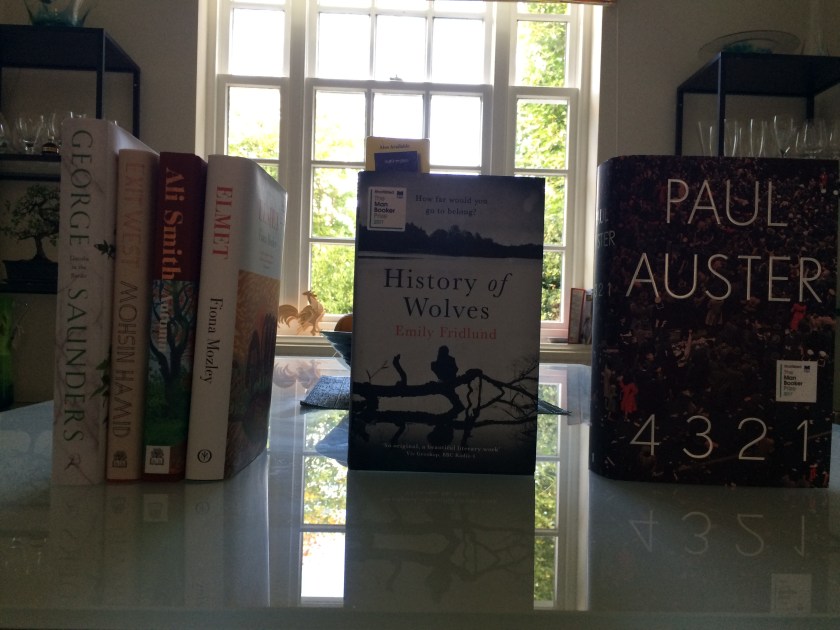
Well, I’ve improved on my performance of last year; I only managed to read 3.5 out of six of the books on the shortlist in 2016, but in 2017 I now have four under my belt with a week still to go! Book number four was Elmet by Fiona Mozley and, my goodness, it’s dark! I’m not sure when I last read anything like it, to be honest, although it reminds me very much of the Red Riding drama series which was aired on television in 2009 (I checked this fact and if you’d asked me to guess I probably would have said 2013/14 – tempus fugit!). That resonance could be down to the fact that it is set in the same part of the country (the Ridings of Yorkshire), but the book does have that same ‘Yorkshire noir’ feel to it, the hallmarks of which seem to be violence, corruption, poverty juxtaposed with crude wealth, and the bleak rural setting. Dialogue is mostly sparse, much is conveyed by a common understanding of the rules of social engagement, and by actions.
 The narrator and central character is Daniel, who lives with his father (always “Daddy”) and his sister Cathy (a nod to Wuthering Heights, I wonder?) somewhat on the margins of society. Initially, they live with Granny Morley somewhere in the north east, and seem to attend school regularry, though not particularly successfully; it is clear they are ‘different’ and considered outsiders, rather akin to travellers. Cathy and Daniel’s mother has been mostly absent, seemingly a troubled soul with mental health problems and probably addiction, but who then disappears completely, assumed dead. Daddy is a more reliable carer, though he too is frequently absent as he tours the country competing in illegal boxing bouts. He is at the top of his game, however, unvanquished wherever he goes, and seems to make enough of a living from this activity, as well as making plenty of money for those with sufficient funds to gamble heavily on his success.
When Granny Morley dies suddenly, leaving the children alone in the house with her body for several days, Daddy vows on his return never to abandon them again, and is determined that they will live together as a family. They move back to Yorkshire and set up home in a copse outside a village, land that is said to belong to Daniel and Cathy’s mother. Initially, they camp, while Daddy sets about building a house with nothing but his bare hands and materials they gather from the woods and cast off items. Daniel and Cathy no longer go to school, but after a time Daddy decides that the children need some sort of educating so he sends them to Vivien in the village, who appears to share some intimacy with Daddy, although the nature of this is never made clear. She too is a bit of a loner and although she never seems particularly enthusiastic about her role as educator she reaches a kind of understanding and accommodation with the children. Cathy never really takes to her lessons, preferring to spend her time outside in the woods, but for Daniel this time comes to be precious and he enjoys the cosy domestic setting and this gentler side of life. Daniel, we increasingly see, is softer, more fragile, physically and emotionally, than either his father or sister, and prefers more feminine company. While Cathy shares the outlook and preferences of her father, Daniel is said to be more like their mother; perhaps this is why Daddy and Cathy love him so much and feel the need to protect him so fiercely.
Thus the scene is set, and the first third of the book is spent getting to know the characters and the setting. The plot thickens when Mr Price enters the novel. He is a wealthy local landowner who owns the land on which the family has settled. He claims that it was signed over to him by the children’s mother in payment of a debt when she ran into financial difficulties, there is clearly some history with the mother, but, again, this is never made clear. Price presents a real and present danger to the family; he clearly is set upon a battle with Daddy, it seems likely that he feels threatened by this bigger stronger man and wishes to emasculate him through his power and authority. There are also Price’s sons, privately educated at some distant boarding school where they learn to play rugby and cricket. They have all the arrogance of their father but their Yorkshire grit seems to have withered. They are particularly interested in picking on the children, especially Cathy, who seems to them to be easy meat, although always out of sight of their father.
Daddy teams up with some of the local villagers and becomes involved in a dispute with a number of the landowners, who are said to exploit poorly paid workers and their poorly treated tenants. They gain some success, but at a cost. Price clearly feels he has leverage over Daddy and says he will sign over the land to the family on the condition that he fights one last bout. Clearly, Price has nothing to lose – he will gain financially from the event, has no interest in the small parcel of land at stake, so it means nothing if he has to give it to the family, and if Daddy loses, well, that’s a problem solved.
The last third of the book moves at a rapid pace, and events unfold dramatically. This final part of the book is a real page-turner. I read the last 100 pages in one sitting and I was almost breathless by the end! The characterisation is superb, I felt I really knew who these people were by the end. The evocation of the setting is also brilliantly done; Fiona Mozley is a fine writer and it is hard to believe this is a debut novel. The time in which the novel is set is not specified, deliberately so, I suspect, since there is a certain timelessness about it; Cathy, Daniel and their father (and to some extent, their mother) represent those people who will always live on the margins, never quite prospering, always struggling, even if they were to play by all the rules society sets. The world is simply stacked against them, their type, their way of life. But what is also timeless is the profound love between father and children, and Daddy’s instinct to protect is felt powerfully throughout.
This is a dramatic and powerful novel, which I thoroughly enjoyed. It’s bleak though! Recommended, but don’t expect a traditional happy ending or all loose ends to be neatly tied. But that’s not life either, is it?
Are you ploughing throught the Man Booker shortlist? How are you getting on?
If you have enjoyed this post, I would love for you to follow my blog. You can do so by clicking on the ‘Follow’ button. Let’s also connect on social media (various buttons to the right)

 Just Fly Away is the debut novel from 1980s brat-pack actor, turned award-winning director and author Andrew McCarthy. It tells the story of fifteen year old Lucy who discovers that she has a half-brother, the result of an affair her father had, living in the same town. Like No Filter it is a novel about secrets and lies, as Lucy escapes to Maine to live with her grandfather, himself estranged from the family, and to work through the confusion and torment her discovery has left her with.
 Finally, on a different topic, there is All the Things that Could Go Wrong by Stewart Foster which concerns the relationship between two boys, initially at loggerheads, who find common cause when they are forced to spend time together. Alex suffers from OCD and worries about everything. His condition is so severe that he rarely leaves home. Dan is angry, because his older brother Alex has left home and he feels lost. Initially, he takes it out on Alex, whom he perceives as weak and ineffectual, but the boys’ mothers force them together on a garden building project and the understanding that develops between is healing for both.
 Eleanor communicates poorly with others, being rather too literal and pedantic for most people to tolerate and is therefore unable to form effective relationships. At first, she is not an easy character to love, except that we as readers know a couple of things about her that her workmates do not, and which make us more sympathetic to her. Firstly, we know she drinks herself into oblivion at the weekends: as a reader we are bound to ask what she is trying to escape from. Second, there is Eleanor’s mother, with whom she speaks every Wednesday evening; “Mummy” is controlling, manipulative, cruel, nasty. Eleanor is an adult and yet there is something disturbing about the way she always refers to her parent as a child would (never ‘Mum’ or ‘my mother’). The fact that Eleanor also receives regular monitoring visits from social workers tells us that there is something dark in Eleanor’s past that has contributed to her present quirkiness, but we are not told what.
 This is Gail Honeyman’s first novel and it is a stunning achievement. A thoroughly enjoyable read. In an era where poor mental health, social isolation and dysfunctional relationships seem to have reached epidemic proportions, this novel is both an examination of one person’s particular circumstances and an antidote. Highly recommended.
 The novel begins more or less where The Glorious Heresies left off with the central character, Ryan Cusack, embroiled ever more deeply in the Cork city underworld of drugs, money laundering and violence. McInerney has managed to keep Ryan’s character consistent – he has evolved in an entirely credible way – although, unlike in the first novel, there now seems almost no hope of the more refined, gentler side of his personality prevailing to choose a different lifestyle. He is more embedded in the criminal fraternity than ever but remains an engaging and attractive central character. If anything, his charisma grows as he matures; true, he does some pretty unpleasant things, and not always at the behest of his criminal masters, but you can see that McInerney, if this turns out to be part of a series of novels, is building him up to be the tormented gangster.
 However, The Power is a prize-winner and seems to have been universally lauded, most notably by Margaret Atwood (Alderman’s literary mentor) whose ground-breaking novel The Handmaid’s Tale has just enjoyed a very successful television adaptation. The premise of The Power is a subversion of current social norms where men dominate, to one where women discover that they have a physical superiority, an ability to electrocute and disable, even kill, men. The novel begins (presumably in the current time) when women begin to discover they have this power and start to use it in ways that enable them to dominate. The story is told through the experiences of a number of women and a male. First there is Roxy, the young daughter of a London gangster who, once she discovers her power, undertakes a purge of all her male foes, her father’s enemies, and her half-brothers who threaten her, to become the top gangster in her field. Then there is Margot a small-time US politician who discovers she has the power and uses it, over a period of years to eliminate her political enemies and rise to great things. Initially, Margot has to hide her power; society is initially hostile to it, and therefore those who have it, seeing at as a threat which could upset order and stability (yes, much of the novel has to be read as a deep irony). Margot, as a politician is also connected with a number of corporations who would no longer support her if they knew she was a carrier of the power. Third, there is Allie, a teenager adopted into a right-wing southern American Christian family (more irony). She is abused by her adoptive father and in one of his assaults she electrocutes and kills him. She then escapes to a convent from where she morphs into Mother Eve, the head of the cult which spreads the power worldwide. One of the followers of the cult is Tatiana Moskolev, the estranged wife of the President of Moldova, who sets up her own republic in the north of the country and establishes a brutal regime where men are mere playthings, sexually abused and murdered at will. Finally, there is Tunde, a young Nigerian, who when we first meet him is trying to seduce a young woman, unsuccessfully as it turns out, because she gives him a small but still very humiliating electric shock when he makes his move on her. It is clear the power dynamic has shifted! Tunde senses that change is about to come to the world and so he sets about travelling the globe, posting his obervations on the internet and thereby becomes an international journalistic sensation.


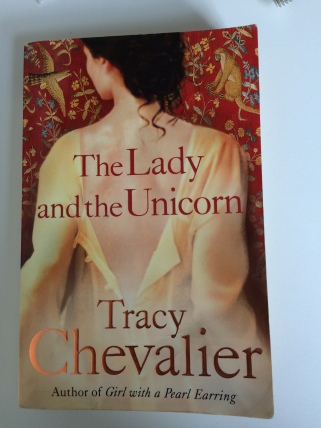 I picked up The Lady and the Unicorn at the secondhand book stall at my youngest daughter’s school summer fair and read a large chunk of it whilst there. It would not normally have caught my eye on a bookshelf as the cover is more suggestive of a cheap sexy romance (nothing wrong with that if that’s your thing!), but I was very quickly drawn into the world that Chevalier evokes, as she also did so brilliantly in Girl with a Pearl Earring.
 I have chosen On Chesil Beach by Ian McEwan, which was published in 2007. I suspect it has been languishing unread on my shelf for a number of years! The cover is, arguably, not particularly summery, showing a young woman walking along Chesil Beach in Dorset, at what looks like dawn, but could possibly be twilight. For those of you unfamiliar with Dorset, Chesil beach is a unique natural feature of the area. Geographically, it is known, I believe, as a tombolo. It is a 20 mile stretch of shingle beach that lies in a long, fairly straight line from Abbotsbury (near the swan sanctuary) to the Isle of Portland in Dorset. Whilst it is connected to the land at each end, it sits apart from the main beach along its length, creating a kind of lagoon which is a haven for bird life.
 Julia's books