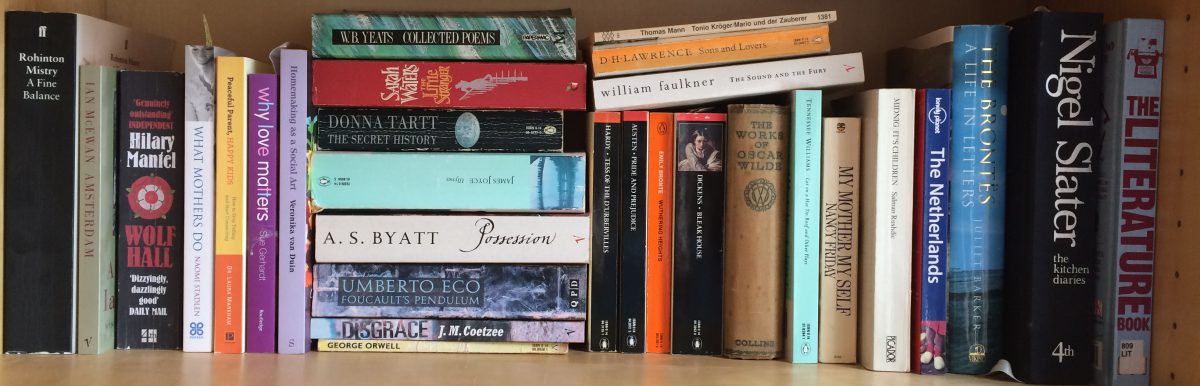
To conclude this series of posts on my #KeepKidsReading theme I would like to tell you about two moments of joy I had last week, one of the head and one of the heart. Last weekend, I sat and read a little book that has been on my TBR shelf for a few months, Why you should read children’s books, even though you are so old and wise by “children’s” author Katherine Rundell. This is a little number that was sitting on the counter when I was in my local bookshop a while back – the literary equivalent of chocolate bars at the checkout! Given my interest in children’s literature I was bound to pick it up, plus I had not long read Katherine Rundell’s wonderful book The Explorer about a group of children stranded in the rainforest when the light plane they are travelling in crashes.

Rundell makes the grown-up case for reading children’s literature not just as a child (or perhaps because of a child) but for its own sake. I have to say that reading it in the middle of the current pandemic and after, frankly, the drama and protracted uncertainty of the US Presidential election, children’s books offer us not so much escapism, as a way of dealing with challenges. Good children’s characters discover a resourcefulness they usually didn’t know they had and develop a resilience which can give all of us an idea of how to ‘be’ in the world. It may not offer us the perfect happy ending but it can show us how to come to terms with reality; in the book review I posted earlier this week of Michelle Magorian’s Goodnight Mister Tom, yes it has a happy ending, but let’s not forget there was carnage along the way – a war, child abuse, a dead mother and baby, a friend killed, and a lost wife and child. But somehow, William, and indeed Tom, learn how to accept and grow from their experiences. Tragedy and loss will, at some point, befall all of us and somehow we need to learn how to cope with it. The best of children’s literature can show us some ways.
So, now for the heart moment. A few months ago I bought a copy of The Boy, The Mole, The Fox and The Horse by Charlie Mackesy, which was heavily promoted in bookshops after it was named Waterstones Book of the Year in 2019. I bought a copy because I’d heard such good things about it and liked the illustration style and the quotes I’d read. Somehow, though, I never got around to reading it, which is a terrible shame because it is magical and wondrous. It’s a gentle and moving tribute to the values of kindness and compassion, and an exhortation to embrace the differences between us. At its heart lies a belief in the magical power of love to lift us out of any darkness. And I can’t think of a sentiment more appropriate to our times than that. It has the power to induce a kind of inner silence, you will smile, and your heart rate will drop. It is also very beautiful to look at and to touch.

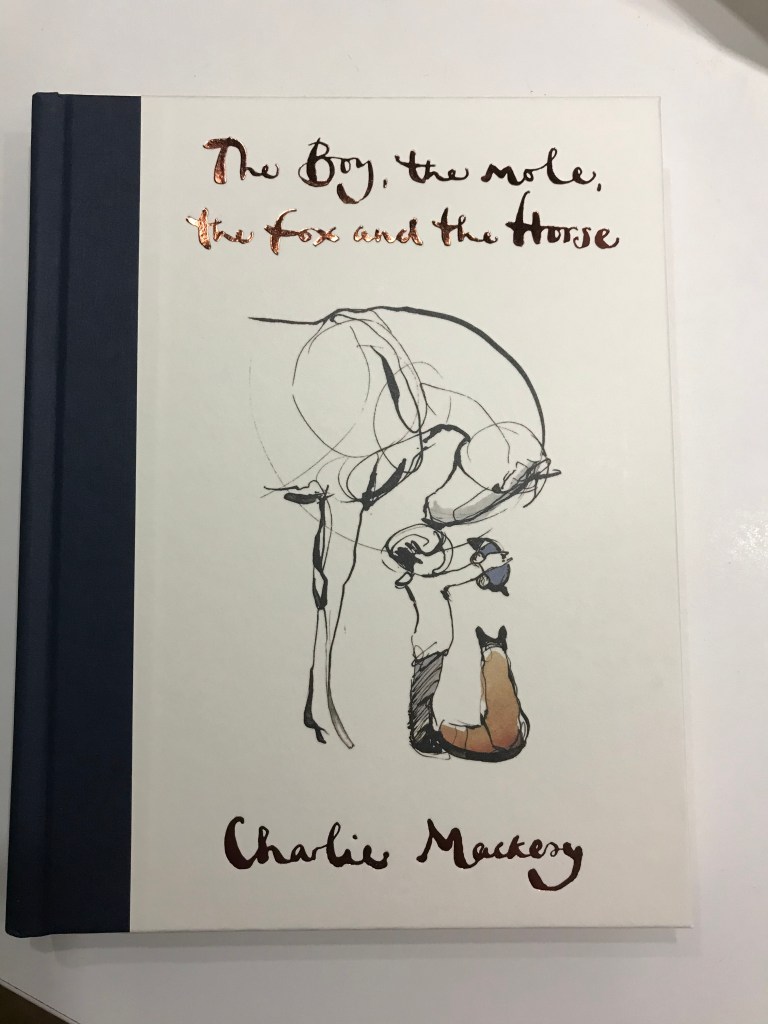
If you haven’t already got a copy, please get one and read this extraordinary book. It will take no more than half an hour of your time, although you may find, like me, that it keeps drawing you back. Please give copies of it as gifts this Christmas. We associate this time of year with peace and joy, and this book embodies it.
I can think of no finer book than The Boy, The Mole, The Fox and The Horse to endorse Katherine Rundell’s thesis. We should all be reading more children’s books.
 The novel begins with a dramatic event: four children are travelling in a light aircraft across the Amazon jungle, which then crashes. The pilot dies (this is quite gently done, it is not frightening), which means the four children, five year-old Max, his older sister Lila, both Brazilian, and Con and Fred, two Brits, aged about 11-12, find themselves alone. Each of the children has their own back-story and their characters are carefully-drawn: Fred is resourceful, a natural leader who the others look to, but he is also a troubled soul, his mother is dead and he longs for the approval of his remote and uptight father. I should add at this point that the story is set, I would guess, in the 1950s. Con is a feisty and assertive girl, who is also often angry and finding herself in conflict or impatient with the others. She comes across as something of a spoiled brat, but she too is hiding a deeper insecurity. Her secret will be revealed much later. Lila and Max are siblings. Max is very young, vulnerable and afraid. Lila is fiercely protective of him, acts as a mother-figure in the absence of their own family, and has the maturity to bring the group together at times of great stress.
 Julia's books