It has come to my notice in the last couple of years that I really enjoy historical fiction, yet if you’d asked me that ten years ago I might have been quite sniffy about it, thinking of it as a more poular rather than literary genre. Perhaps it’s because the book I have been birthing over the last year or so (almost ready to send out, yay!) is largely historical, so I’ve grown acutely aware of the additional challenges of research, of picturing a scene in my mind’s eye that doesn’t include all the day to day contemporary things we take for granted, as well as trying to create an authentic narrative voice, even getting the language right. It’s also something more basic than that though – many historical novels have really touched something quite deep in me. I’m thinking Sarah Dunant’s The Birth of Venus, Tracy Chevalier’s The Last Runaway, even Agatha Christie. And many of the books that I think of as my all-time favourites are also historical – Deborah Moggach’s Tulip Fever, Hilary Mantel’s A Place of Greater Safety and Andrea Levy’s Small Island all look back as a way of making sense of the now. History can teach us a great deal.
 A dear friend gave me Helen Dunmore’s final novel, published posthumously, Birdcage Walk, for my birthday last year and I have only just got around to reading it. I had read some quite mixed reactions, some feeling it wasn’t her best or that it had not been as well edited as it might have been, which is understandable. I am not familiar with Dunmore’s other novels so don’t have a view on how it compares. It meant I approached it with some trepidation, however.
The novel is set in 1792 in Bristol, with the aftermath of the French Revolution playing out across the Channel, and its effects beginning to be felt in England. The central character Lizzie is married to a builder John Diner Tredevant, known as Diner, who has invested heavily (financially and emotionally) in the construction of a grand terrace in the city. The couple’s future depends on the success of the project, but political unrest has created economic uncertainty and the half-built, never-to-be-completed terrace is a motif for the couple’s relationship. As financial pressure builds, stress begins to expose the fragile foundation of Diner’s personality, cracks are revealed in their marriage and questions begin to arise about the mysterious circumstances of Diner’s first wife who died suddenly in France.
Lizzie comes from a more middle-class intellectual background; her mother is a Radical writer and supporter of the insurgency against the monarchy in France, as is Lizzie’s stepfather Augustus. They were not fully in support of Lizzie’s marriage, and it is hinted that they feared Diner was her intellectual inferior, and that she would not thrive with him, as well as being of a different mind to them politically. It seems that Lizzie married him because he represented a solidity and security that she never had growing up; she clearly holds Augustus in some contempt at times, his intellectual pursuit seems ineffectual to her. When Lizzie’s mother dies in childbirth, becoming pregnant at a dangerously late stage in her life, everything in Lizzie’s world begins to break down.
I can see why some regard the novel as somehow ‘incomplete’ – some of the characters are not fully drawn, Diner, for example. For me, his behaviour was not entirely coherent and I did not fully ‘get’ what drew him and Lizzie together, they seem so un-alike, and this is slightly problematic as the entire plot turns on the dynamics of their relationship. A quote from the Daily Mail on the jacket describes it as a “psychological thriller”, but that’s not quite how it felt to me. If anything, it’s more a book about character than plot.
Like the book I am working on, it is also about a journey of discovery, of uncovering the past and of the fleeting part we all play in history and how individual stories are so easily lost.
Whether or not Birdcage Walk is Dunmore’s best (if I could write this well, I’d be happy!) it has made me want to explore her other work as I thoroughly enjoyed it.
Recommended reading.
How do you feel Birdcage Walk compares with Dunmore’s other novels?
If you have enjoyed this post, I would love for you to follow my blog – you can do so by clicking on the Follow button.
 Roll of Thunder, Hear My Cry is the first of three novels by Mildred D Taylor about the Logan family, black farmers in Mississippi, set in the 1930s. They are poor, but they own their own small piece of land, Grandfather Logan having bought it in the 1880s from local landowner Harlan Granger, much to the chagrin of some of the white locals who still cannot accept the social changes giving black people greater autonomy and rights. Grandfather Logan is now dead and the central character, Cassie, lives on the farm with her parents, her grandmother and three brothers. Despite owning 400 acres, the family still struggles to make ends meet, which is why Cassie’s father works away much of the year, on the railroad construction, and her mother works as a teacher at the local (black) school. All the family contributes to the running of the farm and the income it generates.
 This third book picks up precisely where volume two left off, at a small book launch for Elena’s first book, a mildly sexual novel which has caused a stir, and where she is being questioned in a patronising way by an obnoxious critic. A familiar face from Naples walks into the room – Nino Sarratore – and Elena’s confidence is restored. Nino has been a friend since childhood, and there is a complicated triangular relationship between him, Elena and Lila, the main but elusive protagonist of all the books. Elena has been in love with Nino since they were young, but this has not been reciprocated. Like Elena, Nino proved to be a successful student, despite the disadvantages of background and upbringing, and would go on to achieve great things academically, though both know that neither is as brilliant as their mutual friend Lila, with whom Nino was once in a relationship, but who would never reach the academic heights of the other two.


 The story concerns Romy Hall, a young woman whom we first meet in a prison van en route to Stanville Women’s Correctional Facility, somewhere in California. Romy was convicted of a brutal murder and has been given two life sentences plus six years. Romy worked as a lap dancer at The Mars Room nightclub in San Francisco and it was a former customer at the nightclub that she killed. Romy is at once similar but different to her fellow convicts. For one thing she has a seven year old child, Jackson, whose welfare she becomes increasingly concerned about during her incarceration, and she also completed high school, so she is considerably more educated than many of those around her.
 So much so that I had to have a break from all the heaviness to read something a little more uplifting and which didn’t tax my brain quite so much. I wasn’t very well last week and simply couldn’t face into The Mars Room (next on my Man Booker list) – if you have heard it is bleak, well it is! So far (not quite finished it yet). So, with my blanket, hot water bottle and cups of tea to hand I settled onto the sofa and read Rachel Joyce’s The Music Shop cover to cover in one day. I simply could not put it down.
 This book came to my attention last year. I really liked the sound of it and recommended it in one of my ‘what to look our for this season’ blogs, so it was on my TBR list. Then I saw Rachel speak at a Writers & Artists Conference I was at in September. She was such a wonderful speaker, really warm, authentic and engaging, that I had to get a copy of this book and have been eager to start it. It was a joy and just what I needed, when I was feeling unwell and when my brain was starting to hurt from the Man Booker. Look out for my review of The Music Shop next week.
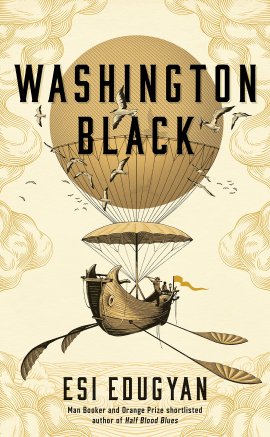 Washington Black’s life is turned around, however, when Erasmus’s younger brother, Christopher, or ‘Titch’, arrives at the plantation. He is an inventor, a man of science like his father, who does not share his brother’s views on slavery. Titch has come to Barbados in order to work on a flying machine he has designed and asks his brother for a helper. Erasmus loans him Washington Black and the boy goes to live in Titch’s quarters, helping him with drawings and experiments as well as practical household tasks. Titch discovers that Washington has considerable artistic talent as well as abilities which will be useful in his science projects and he teaches him to read. This change in Wash’s circumstances means he can probably never go back to being with the other slaves and the question is posed whether Titch has served his protégé well.
 Gretel is a 32 year old woman living alone in Oxford. She works as a lexicographer, a natural career for her as her life has been dominated by words – their invention, their use, and, perhaps also, their lack. She had an unconventional upbringing with an eccentric mother on a canal boat. In her early years, Gretel and her mother developed their own language, a succession of private words for things for which a single expressive term did not exist, for example “sheesh time” refers to a desire to spend time alone, and “Bonak” will come to mean something to be afraid of, something threatening.
 The central character is Walker, a man from rural Nova Scotia, who fought with the Allied forces in the D-Day landings. He has seen and experienced terrible events, death and injury that most of us can barely even imagine, and he survived. After the end of the war, he goes back to the United States and finds himself living among the homeless in New York City. The book is divided into four sections: 1946, 1948, 1951 and 1953 each set in a different US city (though Los Angeles is the setting for both 1948 and 1953). As he reflects on his experiences, it becomes clear that it was impossible for him to return home to Canada. He reminisces about the quiet, gentle life he led there, where the rhythms of the seasons, the dependence on the harvests of the seas, and community events (such as village hall dances) dominate everyone’s existence. It’s as if the contrast between that life and the brutality he witnessed in the war means he fears contaminating the innocence of those he has left behind. He can never go back, never unsee what he has seen, and those he once loved will never be able to understand how he has been changed.
 Julia's books