As I write this, it is being announced on the radio news that Ratko Mladic has been convicted of genocide and crimes against humanity at the International Criminal Court in the The Hague, for his orchestration of the Srebrenica massacre in 1995 where as many as 8,000 Bosnian muslims were killed. It is ironic then that my book review this week concerns a novel, at the heart of which lies the Armenian genocide of 1915. It is believed that up to 1.2 million ethnic Armenians were systematically killed by the Ottoman Turks in 1915-16. A few thousand managed to escape, mostly to America. This atrocity is considered to be the first genocide of the twentieth century and led ultimately to the establishment of the concept of ‘genocide’ in international law after World War II, which was considered at length by Philippe Sands in his book East West Street, which I reviewed here last year after it won the Baillie Gifford Prize for non-fiction.
 The Bastard of Istanbul is a curious book, which my fellow book club members found disappointing. At the heart of the novel is the Kazanci family, living in Istanbul. The household is exclusively female and comprises Asya, (the eponymous ‘Bastard’) her three aunts and her mother (whom she also calls ‘Auntie’), her grandmother and ‘Petite-Ma’ who I think is her great-grandmother (more of that later, it’s part of the problem with the book). There is an uncle, who moved to America as a young man and has never returned. All the men in the family are afflicted by early death. Mustafa, the prodigal son, is in his 30s.
There is a second family to get to grips with, living in Arizona. Teenager Armanoush is the product of Rose (a southern gal) and Barsam Tchakhmakhchian, the son of an Armenian family, part of the Armenian diaspora. Rose and Barsam separated when Armanoush (also called ‘Amy’) was a toddler, and Rose then bumped into and married Mustafa (the prodigal Kazanci son). Still with me? Armanoush, curious to learn about her Armenian forebears’ early life in Istanbul, contrives to travel to the city and stay with her stepfather Mustafa’s family (the Kazanci women) without her parents knowing (they would not have approved.)
The novel opens with a bang – Zeliha, the most flamboyant and wayward of the quirky Kazanci sisters, arrives at a clinic demanding an abortion. At the very last minute, however, she does not go through with it. Enter Asya. The first half of the book is setting the scene of both Asya’s life (she is now a slightly surly teenager) and the Kazanci household as well as Armanoush’s life in the US. The second half is mainly concerned with the two young women and their developing relationship in Istanbul, and gradually the connection between them unfolds. Throughout the novel, the history of the Armenian genocide is woven in, particularly as it relates to the Turkish Kazancis and the Armenian Tchakhmakhchians.
Let me tell you what’s good about this book: I loved the sense of place – I have never been to Istanbul but am fascinated by it and by this part of the world generally and it’s on my bucket-list. I loved the characters: they are interesting and credible and the way the author builds our impression of them is beautifully done. Elif Shafak can write, and she can write with humour; there are some laugh-out loud moments, although knowing what I now do about the Armenian genocide, I’m wondering if it was fitting.
However, there are also some problems with the book, mainly it is over-written. For me, it needed some skilful editing. There is a large cast-list here and I’m afraid I rather lost track of some of the peripheral characters (Petite-Ma, for example), who are actually rather important to the story because you need to understand the ancestor relationships in order to fully appreciate the plot. There are some superfluous chunks that could easily have been stripped out and this would have given the plot lines (and later twists) greater force. Also, the historical thread, the background on the genocide, would have been given greater prominence.
The author states in the Acknowledgements that she was put on trial in 2006 for “denigrating Turkishness” with this novel (charges were later dropped). For that reason, and for the historical detail, it is worth a read, but I’m afraid, for me, it was a novel that did not quite live up to its potential.
If you have read The Bastard of Istanbul I’d love to hear your views.
If you have enjoyed this post, do follow my blog by clicking on the ‘Follow’ button. Let’s also connect on social media.

 I was really torn between Claire Tomalin, Anjelica Huston and Alan Cumming. I left it in the hands of the local library and it was Alan Cumming that became available first! I’m still waiting for Claire Tomalin, and that is probably the one I was keenest to read. I was attracted to Alan Cumming’s book, however, because its premise is not dissimilar to the book I am writing, namely family research and the uncovering of a long-held secret. There the similarity ends, however, as Alan’s book is much more about his relationship with his father.
 For November, the challenge is to read a book set in or by a writer from the southern hemisphere – which is, broadly, South America, southern Africa and Australasia. As the nights draw in and it gets increasingly wintry I wanted to be reminded that in other parts of the world it is Summer! So, my choice this month is Isabel Allende’s Portrait in Sepia, a book I picked up in my local Oxfam bookshop and which has been sitting on my ‘to read’ pile for far too long. Allende is such a fine writer and I’ve read a number of her books over the years. It’s great to have an excuse to dive into this one and experience the sensuousness of her writing and the world she evokes, as the last leaves fall from the trees here and nature seems to go into hibernation.
 I read A Clockwork Orange on my husband’s recommendation, straight after he’d completed it – it’s one of his favourite films, which we have watched many times, but neither of us had read the book. It’s quite short, but also quite hard-going as it is narrated by the central character, Alex, who speaks in ‘nadsat’ a kind of teenage vocabulary of the future, based loosely on Slav languages. I read it with a glossary (though Burgess intended that it should not be), but after while I found I did not consult it, and it flowed better just to read it and understand the sense, if not every word.
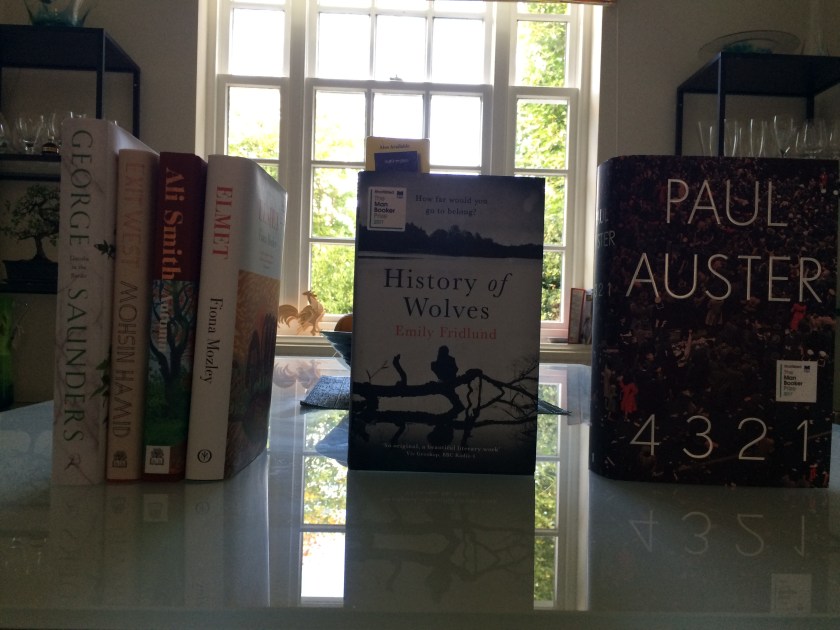
 The narrator and central character is Daniel, who lives with his father (always “Daddy”) and his sister Cathy (a nod to Wuthering Heights, I wonder?) somewhat on the margins of society. Initially, they live with Granny Morley somewhere in the north east, and seem to attend school regularry, though not particularly successfully; it is clear they are ‘different’ and considered outsiders, rather akin to travellers. Cathy and Daniel’s mother has been mostly absent, seemingly a troubled soul with mental health problems and probably addiction, but who then disappears completely, assumed dead. Daddy is a more reliable carer, though he too is frequently absent as he tours the country competing in illegal boxing bouts. He is at the top of his game, however, unvanquished wherever he goes, and seems to make enough of a living from this activity, as well as making plenty of money for those with sufficient funds to gamble heavily on his success.
 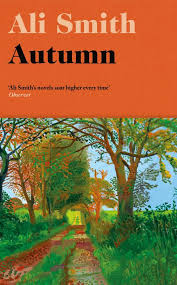 Ali Smith has said that she wrote this book very quickly in the aftermath of the EU referendum in the UK last year. As UK citizens will all understand by now, as we continue to reflect upon/reel over the events of Summer 2016, the outcome of that vote was about so much more than should Britain remain in or leave the European Union. That our social, cultural and political path in this country could be determined by a simple yes or no answer to that question now looks absurd. The election of Donald Trump to the US Presidency in November last year was another cataclysmic event, which provides the context to this novel. Ali Smith has, I believe, outside this book, nailed her political colours fairly firmly to the mast. (I’m not going to do that.) But what we are seeing now, I believe, is the response of artists and writers to the shock of last year’s events, and Autumn is for me, my first foray into a literary reflection.
 Eleanor communicates poorly with others, being rather too literal and pedantic for most people to tolerate and is therefore unable to form effective relationships. At first, she is not an easy character to love, except that we as readers know a couple of things about her that her workmates do not, and which make us more sympathetic to her. Firstly, we know she drinks herself into oblivion at the weekends: as a reader we are bound to ask what she is trying to escape from. Second, there is Eleanor’s mother, with whom she speaks every Wednesday evening; “Mummy” is controlling, manipulative, cruel, nasty. Eleanor is an adult and yet there is something disturbing about the way she always refers to her parent as a child would (never ‘Mum’ or ‘my mother’). The fact that Eleanor also receives regular monitoring visits from social workers tells us that there is something dark in Eleanor’s past that has contributed to her present quirkiness, but we are not told what.
 This is Gail Honeyman’s first novel and it is a stunning achievement. A thoroughly enjoyable read. In an era where poor mental health, social isolation and dysfunctional relationships seem to have reached epidemic proportions, this novel is both an examination of one person’s particular circumstances and an antidote. Highly recommended.
 The novel begins more or less where The Glorious Heresies left off with the central character, Ryan Cusack, embroiled ever more deeply in the Cork city underworld of drugs, money laundering and violence. McInerney has managed to keep Ryan’s character consistent – he has evolved in an entirely credible way – although, unlike in the first novel, there now seems almost no hope of the more refined, gentler side of his personality prevailing to choose a different lifestyle. He is more embedded in the criminal fraternity than ever but remains an engaging and attractive central character. If anything, his charisma grows as he matures; true, he does some pretty unpleasant things, and not always at the behest of his criminal masters, but you can see that McInerney, if this turns out to be part of a series of novels, is building him up to be the tormented gangster.
 However, The Power is a prize-winner and seems to have been universally lauded, most notably by Margaret Atwood (Alderman’s literary mentor) whose ground-breaking novel The Handmaid’s Tale has just enjoyed a very successful television adaptation. The premise of The Power is a subversion of current social norms where men dominate, to one where women discover that they have a physical superiority, an ability to electrocute and disable, even kill, men. The novel begins (presumably in the current time) when women begin to discover they have this power and start to use it in ways that enable them to dominate. The story is told through the experiences of a number of women and a male. First there is Roxy, the young daughter of a London gangster who, once she discovers her power, undertakes a purge of all her male foes, her father’s enemies, and her half-brothers who threaten her, to become the top gangster in her field. Then there is Margot a small-time US politician who discovers she has the power and uses it, over a period of years to eliminate her political enemies and rise to great things. Initially, Margot has to hide her power; society is initially hostile to it, and therefore those who have it, seeing at as a threat which could upset order and stability (yes, much of the novel has to be read as a deep irony). Margot, as a politician is also connected with a number of corporations who would no longer support her if they knew she was a carrier of the power. Third, there is Allie, a teenager adopted into a right-wing southern American Christian family (more irony). She is abused by her adoptive father and in one of his assaults she electrocutes and kills him. She then escapes to a convent from where she morphs into Mother Eve, the head of the cult which spreads the power worldwide. One of the followers of the cult is Tatiana Moskolev, the estranged wife of the President of Moldova, who sets up her own republic in the north of the country and establishes a brutal regime where men are mere playthings, sexually abused and murdered at will. Finally, there is Tunde, a young Nigerian, who when we first meet him is trying to seduce a young woman, unsuccessfully as it turns out, because she gives him a small but still very humiliating electric shock when he makes his move on her. It is clear the power dynamic has shifted! Tunde senses that change is about to come to the world and so he sets about travelling the globe, posting his obervations on the internet and thereby becomes an international journalistic sensation.
