The second book in my Man Booker shortlist challenge (two down and four to go, and only 2 weeks before the winner is announced!), Exit West has been on my list of books to read for some time. It is the story of Saeed and Nadia, two young people enduring the horror of civil war in their home city as Islamic extremists take hold of the reins of power. The city is not named – it is not a ‘Raqqa’ or a ‘Mosul’, just two of the cities which have been torn apart by religious fundamentalists and opposing forces seeking to eject them – nor is it clear when in time the novel is set. These are left deliberately vague because this is a novel that wants to focus on the issue of migration rather than historical facts; the movement of people from parts of the world so riven by violence that many able-bodied citizens find they have little choice but to flee. And it is about the impact of this mass movement on those parts of the world mostly unwilling to receive them.
 At first, the novel seems quite rooted in a real time and place, as we get to know the two central characters, Saeed and Nadia, learn the details of their lives, their families, how they were brought up and what motivates them. Though they are quite different personalities they fall in love, and when tragedy strikes Saeed’s family, they make the decision to leave their homeland for what they expect to be a safer and more peaceful life in the West. They escape the city through the first of the novel’s doors (inside a dentist’s surgery) and they emerge in Mykonos. At this point I saw the door as a narrative device enabling the author to focus on their experience of leaving and of arriving, rather than the journey (one can only imagine the horrors of that, see my review of The Optician of Lampedusa). It gradually becomes clear, however, that the door is more of a metaphor for transition from one place, one state, to another. Saeed and Nadia will go through many more doors in this novel.
In Mykonos they feel a mixture of hope (they have escaped and they are beginning a new life together) and fear, as we see the first hints that the receiving population may be less than welcoming to the escapees. There is also the contrast between the tourists, choosing to visit the Greek island on their holidays, and the refugees seeking a new home. Mykonos is where Saeed and Nadia also begin to learn that the way you look, the way you dress and your skin colour can have a dramatic impact on your fortunes in the West.
From Mykonos, the couple move on again to London, where they stay in a disused apartment in an area that gradually becomes a ghetto of the dispossessed. From here the novel becomes gradually darker; darker even than the terror that Saeed and Nadia escaped in their home country. I also began to feel here that the novel was less about the experience of escape and more about envisioning some future scenario where simmering tensions, brought about by the failure adequately to address mass migration, explode onto the surface. Hamid foretells the possible reactions of the indigenous population and the domestic authorities; this was not comfortable reading.
This novel deals with one of the greatest challenges of our age and is bleak reading in parts. But the author also attempts to root it very firmly at the human level by telling the story through this young couple, who could be anyone. The issues and difficulties that they encounter in their relationship as a result of their migration experience provide a moving and accessible dimension to the book. The doors are not only metaphors for the physical movement from one location to another, but they also signify changes in the nature of Saeed and Nadia’s relationship.
This is a tough read at times, but also an important one. Recommended.
How are you getting on with the ManBooker shortlist?
If you have enjoyed this post, I would be delighted if you would subscribe to the blog. Let’s also connect on social media for book-related chat.
 This was the third book I read last term with the children’s book club at my daughter’s primary school. It was something of a risk as it’s not conventional either in its subject matter or its format. But having read


 What is so immediately intriguing about the title of the novel, of course, is that Holland is very, very flat. But In the Dutch Mountains imagines a world where the Netherlands extends much further south of its modern borders to northern Spain and the Pyrenees (hence the Dutch mountains). The narrator is himself a Spaniard, a civil servant who not only relates the story, but also philosophises on the processes of writing and story-telling: a story within a story. The main characters in the tale are Kai and Lucia, a slightly other-worldly circus couple, remarkable for their physical perfection, who are relieved of their jobs (because times have moved on and audience tastes have changed) and find themsleves travelling south to look for work. Kai is kidnapped and Lucia sets out on a journey to find him, accompanied by an old woman she meets on the way who agrees to drive her to find her lover.


 Now, dear reader, this blog is rather like the proverbial swan – whilst it may look smooth and effortless to you on the surface, the planning (reading, idea generation, social media, writing, etc) that goes on behind the scenes is like a military operation! Well, not exactly, but, you know, I do plan my reading, aim to bring you a book a week and try to blog twice a week. And this book has totally blown my schedule! You know what it’s like when you’ve got a busy day planned either at home or at work…and you hear the words “Mum, I’ve just been sick!” and you know your day is irretrievably banjaxed. Well, that’s how I feel.
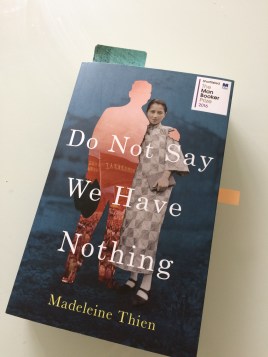 Do Not Say We Have Nothing, broadly speaking, is about China after the revolution, what it was like living under the dictatorship of Mao Tse Tung and about the hardships endured by the population, particularly by artists and intellectuals, in an era when culture was heavily proscribed. I have had a lifelong fascination with China, have read very widely about this enormously diverse and culturally rich nation, so I should be loving it. But I’m not! And I’m barely halfway through! I took a break from it this week and read Love, Nina by Nina Stibbe (which I’ll be reviewing soon), and that book is at the very opposite end of the literary spectrum – light, fun, quick to read. Many people probably would have given up by now. After all, a book, particularly a long one, is a huge investment is it not? I rarely give up on a book – I gave up on White Teeth by Zadie Smith a few years ago after a couple of false starts, but I have always planned to go back to it. My rationale for continuing with Do Not Say We Have Nothing is as follows:
 Julia's books