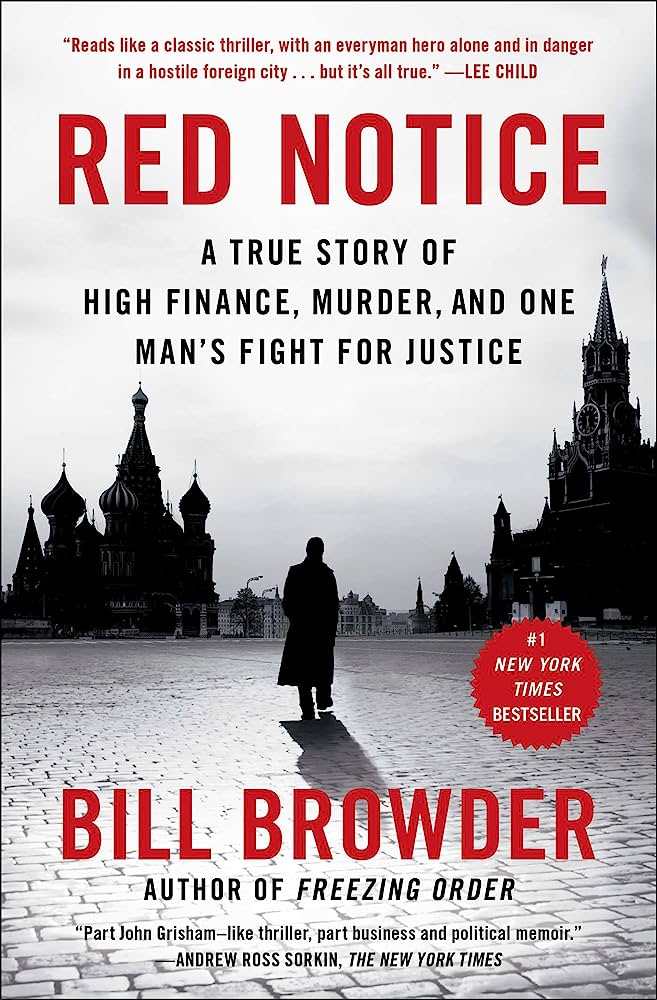
This was my book club’s June read. It wasn’t a title I suggested but I was happy to go along with it even though the blurb didn’t appeal that strongly. A true-life thriller about high finance and espionage did not seem like the kind of book I would normally read, but then isn’t that the joy of a book club, to make new discoveries? The book opens with the narrator (the author) giving a detailed account of his being detained at a Moscow airport without explanation, being held for endless hours without food or water. Attempts to contact friends, family, contacts in the British Embassy bear no fruit and finally his phone battery gives out. The intention of the Russian authorities seems to be to terrify their detainees, keeping them guessing about what might happen to them.
Finally, the author is allowed to leave and is put on a plane back to London, where he lives. This happened in the early 2000s, but there is a long history leading up to this event. Bill Browder then takes us on the long journey to explain how he came to be in this situation, beginning with his childhood in Chicago as the lowest-achieving child in a highly academic family. Young Bill clearly had something of the entrepreneur about him and despite his early difficulties in education (exclusion, boarding school, severe bullying) he eventually wins a place at Stamford business school.
After completing his college education and a stint at a couple of consultancy firms he decides on an adventure, following somewhat in the footsteps of his eastern European grandparents. From an early age he shows clearly his entrepreneurial streak and a nose for an opportunity. He moves to Russia in the 1990s, as that country is emerging into the post-Soviet Union era. Browder begins to see the huge financial benefits that can be secured by being an early investor in the privatisation of national industries and he persuades a number of wealthy individuals to come on board with him. His Hermitage investment fund is extremely successful and he makes a lot of money, for himself and his investors.
[Spoilers below]
Browder bases himself between Moscow and London, where he also starts a family, but it is clear that the pressures and demands of his lifestyle take their toll on his marriage. Eventually, he and his wife divorce – there is a lot of very personal material in this book too. Browder will eventually meet and marry a Russian woman with whom he has two daughters.
To support his finance business, Browder has to set up a strong team of lawyers and advisors, as well as colleagues with connections and insights into Russian society. In the time that Browder is operating in Russia, the country changes dramatically and a small number of people begin to make a lot of money – the rise of the oligarchs. Corruption was always part of the system, but now becomes endemic. As a foreigner (even worse, an American) profiting handsomely from Russia’s embrace of capitalism, Browder becomes a marked man. His life becomes endangered (hence the detainment at the airport) and he has good reason to believe that Putin himself is behind efforts to eliminate him. The ‘red notice’ of the title refers to the Interpol arrest warrant that the Russians tried to have exercised on him (which was eventually withdrawn, much to the ire of the Russian authorities for whom this is a huge embarrassment). Browder realises that the Russians might attempt to get at him through his associates. He persuades most of them to flee the country, sometimes under cover, but one of his lawyers, Sergei Magnitsky, refuses. Browder tells us that he simply “loved his country too much”. Magnitsky is arrested, charged with trumped-up accusations of fraud, and imprisoned in a labour camp. His treatment there, including beatings, eventually leads to his death.
This event shapes Browder’s life from then on and occupies the final third or so of the book. The author’s attempts to fight his friend’s case, and then to seek justice for him become the cause of his life. He devotes his time to raising awareness of human rights abuses in Russia and eventually succeeds in persuading the American Congress to pass ‘Magnitsky’s law’, with the help of key politicians such as the late John McCain, which permits sanctions against those guilty of human rights abuses, such as freezing of overseas assets and refusal of visas. Bill Browder continues to devote his life to persuading other countries to adopt similar legislation.
This is a fascinating story and after my initial scepticism I have to say that I was completely hooked. In the context of Russia’s current behaviour it has extra resonance and gives an insight into the psyche of those in power in that country. I had heard of Magnitsky’s law, but had no idea of the background. Browder and his team were one of the first to use the then new platform YouTube to great effect as a publicity tool to raise awareness of their cause, when Sergei Magnitsky was still alive. The videos can still be seen on there and are powerful. Also, powerful, is the final chapter of the book, narrated on the audio version by the author himself. It is chilling when he tells us that if he is killed, we the readers will know who did it.
A stunning and unique story, highly recommended.
 This book is magnificent and I urge you to read it. It was my book club read this month and we all loved it. It concerns a period in hsitory that is seldom openly discussed – the brutality of the Russian advance into Germany at the end of the WW2. One of the earliest books I reviewed on this blog was
 To my shame I have never read any of the Fleming novels (my husband has and he likes them a lot), so I was delighted to pick up this book from the children’s section of my local library and if you have pre/young teens in your household, I think they might like it. Red Nemesis by Steve Cole, is the ninth novel in the
  Julia's books