A couple of weeks ago I caught a debate on Radio 4’s PM programme about whether listening to a book on audio counted as ‘reading’. The conversation was linked to the announcement of 2026 as the National Year of Reading, an initiative launched by Queen Camilla, who has done a great deal of work as a literacy and literature champion, and has been supported by many high level people from across the worlds of culture, media, politics and sport, including Richard Osman, the wonderful Stormzy (just when is he going to get a gong!?), Bridget Phillipson and Theo Walcott. Reading as a pastime continues to hold its own, and audiobooks have recently seen double digit growth in popularity year on year. I stopped being sniffy about audiobooks a very long time ago so was slightly surprised to hear this issue being debated! Whilst I still prefer, on the whole, the feel of a book in my hands and the imaginative freedom it gives me, I definitely would read a lot less were it not for audiobooks. It enables me to enjoy reading whilst doing other things that do not require much intellectual engagement, such as cleaning, running, driving or gardening. I find the combination of the two quite therapeutic as it brings a meditative quality to an otherwise mundane or repetitive task.
I listened to two audiobooks over Christmas, which were perfect candidates for the medium. The first was Dickens’ A Christmas Carol, read brilliantly by the inimitable Hugh Grant. (I re-watched all the Bridget Jones films and Love Actually over the Christmas holiday and found myself loving him all over again!) Anyway, he read A Christmas Carol with aplomb and it was well worth using up one of the credits on my Audible subscription for rather than listening to the free version (perhaps I’ll listen to that one next Christmas).
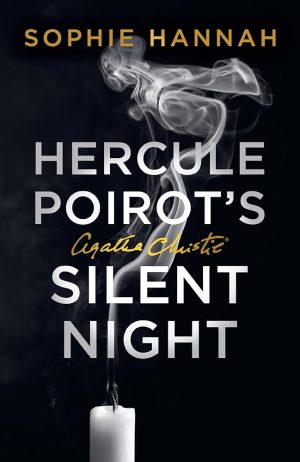
My other Christmas audiobook was Hercule Poirot’s Silent Night, the fifth of six Hercule Poirot novels penned by Sophie Hannah, in honour of the great detective and his creator, Agatha Christie. It is the first Sophie Hannah Poirot that I have read and I will definitely seek out the other five as she does a brilliant job of recreating the spirit and character of Poirot, his linguistic quirks, self-regard (well-deserved) and of course his genius wit. This particular novel is set primarily in Norfolk where Poirot and his sidekick, Inspector Edward Catchpool, are summoned by Catchpool’s mother Cynthia. Her close friend Arnold is terminally ill with an unspecified condition which does not appear to hinder him either physically or mentally. A seemingly safe local hospital is identified as the place where Arnold will spend his final days when the time comes, but when a baffling murder of a patient is committed there, Edward’s family is split. His wife, in particular, does not want him to be admitted, fearing that he will be murdered too, and the couple’s two sons, and their wives (who are sisters) are thrown into a bitter conflict at a time when they should be supporting one another.
To make matters worse, Arnold is very keen to be admitted to the hospital as soon as possible; as an amateur sleuth himself he is keen to try and solve the murder, and it is his dying wish that he should assist his hero Hercule Poirot in doing so, hence the summons from Cynthia. Edward seems to have strong negative feelings towards his mother and though the two men agree to the plan, albeit somewhat reluctantly, their goal is to solve the case quickly and to return home to London before Christmas (giving them about a week). A tall order perhaps when the local constabulary have been unable to make any headway, but not of course for Poirot.
I am not sure why murder and death are such powerful and engaging topics for artistic endeavour, especially when handled with a degree of comedy, but we are endlessly fascinated and entertained. The ongoing popularity of the great master Agatha Christie, attests to this. Sophie Hannah deploys great skills of characterisation, plotting worthy of Christie and dark humour to tell this tale and I enjoyed it very much. As an audiobook, it was a great example of how the medium can work particularly well.
Highly recommended.
 Julia's books