Literary adventures in the Netherlands

Relaxing Zeeland

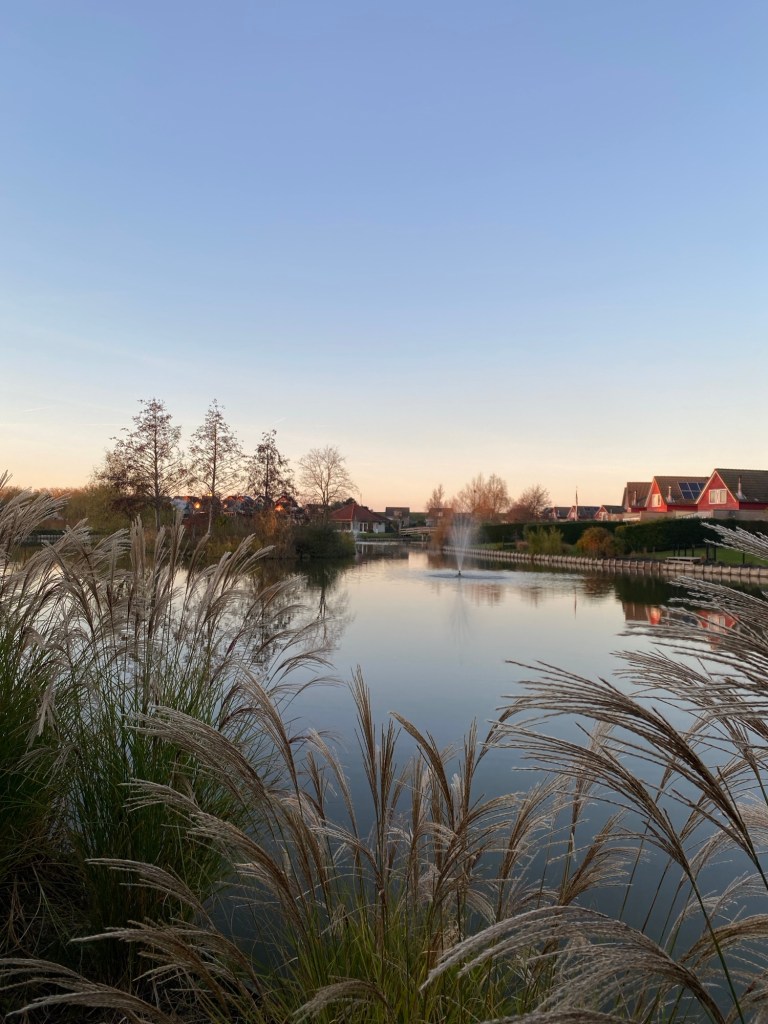
I spent a couple of weeks in my beloved Zeeland recently, a place we have been visiting annually for almost 25 years now. It’s a place where you meet so few Brits and I often find myself feeling the need to explain why I would holiday in such a remote and seemingly unprepossessing place. I am always shocked, therefore when, very occasionally, I bump into someone who knows exactly where I am talking about. This happened just a couple of days ago while chatting to someone I have not met before in my organisation, who is Dutch and knew exactly every town I was talking about!

Middelburg, the main city in the province of Zeeland might just be my favourite place in the world and the only other place I would want to settle permanently outside of Greater Manchester or the UK. It is more of a large town than a city and it is beautiful and relaxing and historic and friendly. It also has probably the best bookshop in Zeeland, a wonderful independent store called De Drukkery, a must-see if you ever find yourself in this part of Europe.

Getting ready for Kerstmas in the Markt, the main square in Middelburg

This trip was our longest ever and very off-season – now that we are not so bound by school term times. We decided to take a trip to Den Haag, just a couple of hours by train from our nearest train station in Goes. Den Haag is a city we have visited briefly before and were very impressed with so wanted to spend a bit more time there. It does not pack as big a punch as Amsterdam or Rotterdam (both of which are actually very close by) but it is a lovely city, rather more relaxed and less touristy than its brasher neighbours. It is also the home of the Dutch parliament and most government ministries, the offices of the Dutch royal family, the International Court of Justice and many international embassies, so it has a feeling of gravitas and authority about it.

The Binnenhof, the home of the Dutch parliament is one of the oldest parliamentary estates in the world still in use. It is undergoing some extensive renovation at the moment so we were unable to visit it. The International Court of Justice is housed in the stunning Peace Palace – again, unfortunately, it was not open to visitors on the days we were there, but I feel sure we will go back.

The Binnenhof, Den Haag

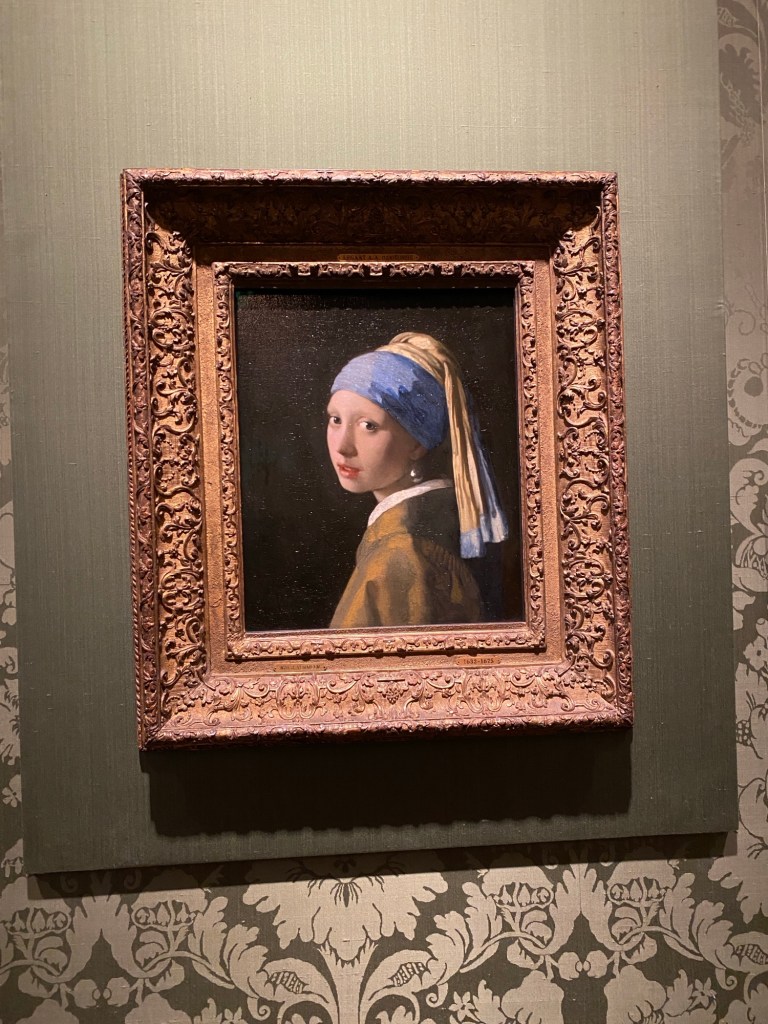
I did not mind this too much as my main objective was actually to visit the world famous Mauritshuis museum, a lifelong ambition of mine. This is a small and stunning museum, located close to the Binnenhof that houses two paintings with literary connections – Vermeer’s Girl with a Pearl Earring and The Goldfinch by Carel Fabritius.

I adore Vermeer’s work – it captures everything that Holland means to me. There was an exhibition of almost all of Vermeer’s paintings at the Rijksmuseum in Amsterdam in 2023. I would have made a special trip to go and see it, but it very quickly sold out so I was unable to get tickets (although I have just learned that there is a documentary about it now available on Amazon Prime). Girl with a Pearl Earring did not have to travel very far as the Rijksmuseum is less than 60km from the Mauritshuis, the home of the painting since 1902. Tracy Chevalier hit literary gold with her 1999 novel of the same name. It was only her second book and it made her name. I remember reading the book when it came out and I absolutely loved it. It was also what stimulated my interest in the work of Vermeer. We made out first visit to Zeeland in 2002 and I have been in love with the Netherlands and with painting from the Dutch Golden Age (broadly, the 17th century) ever since.
If it was a joy to see Girl with a Pearl Earring in real life, Fabritius’s The Goldfinch (Het Puttertje in Dutch) took my breath away and brought tears to my eyes. It is tiny, a little over 30cm high and 20cm wide, and it is so simple, but so deeply captivating – a wild bird, fixed to a perch by a delicate chain. The colours are muted and earthy, apart from a dash of yellow gold on the bird’s wing. The shadow of the bird on the plastered wall behind it creates a sense of foreboding and shows the painter’s skill at creating a sense of light and shade.

Donna Tartt’s book of the same name is one of my all-time favourite reads – I read it about five years ago and it sparked my interest in both this painting (which I had only been vaguely aware of up to that point) and the painter Carel Fabritius. His story is also a fascinating one – he died in an explosion in the city of Delft in 1654 (the year The Goldfinch was completed), at the tender age of 32. His canon consists of only thirteen known paintings, others are assumed to have been lost in the tragedy in Delft which claimed his life. I read Laura Cumming’s excellent biography of the painter, Thunderclap, earlier this year and it has made me want to see all of his works in real life. I now have three under my belt – in addition to The Goldfinch, I saw Young Man in a Fur Cap and A View of Delft, with a Musical Instrument Seller’s Stall on a visit to the National Gallery last January. There are three more in the Netherlands (in Amsterdam and Rotterdam) which I am sure I will get to see at some point, a further two in Germany and Poland, and all the rest but one are in North America. Sadly, I suspect the one in the Pushkin museum in Moscow will never be ticked off.

The town of Delft, where Fabritius died, and also the home of Vermeer (there is a museum there dedicated to him), is just a half an hour tram ride from Den Haag. We paid a brief visit to the town and will definitely go back as it is beautiful.

So, another magical, inspiring and restorative visit to the Netherlands and to Zeeland, a place hardly anyone thinks to visit. Their loss, but that suits me just fine!

Audiobook review – “The Goldfinch” by Donna Tartt

I have probably spent more time listening to audiobooks in the last twelve months than in all of the previous four years of subscribing to an audiobook service put together! There were in fact times in those previous four years when I suspended my membership because I was building up so many credits. I mainly listened to them on long drives alone and these were relatively infrequent. Last year, however, I found myself, like many people, going out for a walk or run daily. I haven’t walked more in the last twelve months than I did before, but my walking these days is less about purpose (going somewhere to get something) and more about pleasure, nature and exercise, and, well, let’s be honest, because when something is rationed you realise how important it is to you.

I’ve reviewed a number of my particular favourite audiobooks on here: Andrew Taylor’s Ashes of London series (I listened to three out of the four last year), Douglas Stuart’s Booker Prize-winning Shuggie Bain, and of course David Sedaris’s Santaland Diaries. I have yet to review the audiobook that was the absolute standout for me in 2020, though, and which I listened to in the autumn – The Goldfinch by Donna Tartt. I can only put my reticence in posting a review down to being in complete awe of Tartt’s genius as a writer, and the feeling that I could never write anything that would in any way do justice to the mastery on display in this book.

I will try and summarise the plot as briefly as possible. We first meet the main character Theodore “Theo” Decker when he is thirteen years old. He lives with his mother, who works on an art journal, in New York City, his alcoholic father having left the family some years earlier. Theo is in some difficulty at school and he and his mother have an appointment with the Principal. To kill time before the meeting, Theo’s mother takes him to the Metropolitan Museum of Art. A terrorist bomb explodes while they are there, killing Theo’s mother and many others, and devastating the building. In the middle of the wreckage Theo spots an elderly man, whom he had noticed earlier on in the visit because he was accompanied by a sullen, but ephemeral looking young girl of about Theo’s age, carrying an instrument case. Theo goes to the old man, who is dying from his injuries. The old man gives Theo a ring from his finger and a curious message which it will later transpire refers to an antique shop that he Welty Blackwell, ran with his partner James “Hobie” Hobart. During their brief time together, in what was a room devoted to Dutch paintings from the 17th century, Theo finds himself captivated by a tiny picture by Carel Fabritius called The Goldfinch. Welty notices Theo’s fascination and with his dying breath seems to encourage Theo to take it. The explosion scene is compulsive listening, jaw-dropping.

Theo takes the painting and manages to find his own way out. He takes cover back at home, not knowing if his mother is alive or dead. Eventually, the authorities track him down and he is placed in temporary care with the family of a school friend, Andy Barbour, a slightly sickly, precociously intelligent boy, who, like Theo, does not quite fit in at school. Andy’s family is from the Upper East Side – wealthy, formal, slightly odd, and more than a little dysfunctional. But after a period of adjustment Theo and the family gradually get used to one another, until, at the point the Barbours announce that they would like formally to adopt Theo, the boy’s life takes a dramatic turn.

I wish to say nothing more of the plot, because it is simply too delicious and too clever and if you have not read the book yourself and are tempted to do so, I want you to enjoy every single moment of shock and drama.

The Goldfinch by Carel Fabritius dated 1654

Theo does not reveal that he has the painting for many years. And it burns in his conscience, influences almost all his actions and decisions. The plot is a joy, an absolute roller-coaster, and the character of Theo is complex and brilliantly-drawn. He is in turns damaged and damaging through the book, but all the while the two things that constantly influence his life are the catastrophic loss of his beloved mother in such traumatic circumstances, and the concealment of the painting, an extremely valuable internationally renowned piece, which becomes the subject of a worldwide search. Theo’s increasing paranoia in relation to the painting, has echoes of The Picture of Dorian Gray. In addition to Theo there are a clutch of other superb characters: Boris, his Nevada schoolfriend who becomes a major influence on events in his life; Hobie, the business partner of the old dying man in the museum who Theo tracks down; Pippa, the young girl with the music case, Welty’s granddaughter; and, of course, Theo’s mother, who, although she dies early, is a constant presence in the narrative.

This book has everything: brilliant characters, brilliant plot, action, reflection, literary merit. It won the Pulitzer Prize for Donna Tartt in 2014 (my second Pulitzer Prize-winner reviewed in a week!) and was adapted for screen in 2019. I’m not sure I want to see the film. There is surely no way it could do justice to the book? Although I note that it has Nicole Kidman and Sarah Paulson among the cast so I’m tempted.

I have no idea why I have not read this before; The Secret History, Donna Tartt’s debut novel, published in 1992, is one of my favourite books of all time, a masterpiece, so you would have thought I’d be hanging on everything she has ever written. She is hardly prolific though – her second book, The Little Friend, did not come until ten years after her first, in 2002. That was the start of my childbearing, aka reading wilderness, years, so I’m not really surprised I didn’t get around to that one. Tartt’s books are long – The Goldfinch is 880 pages, or 32 hours of listening joy, and The Little Friend is almost 600 pages – there was no way I would have got through that with a two year old!

The Goldfinch is highly, highly recommended. And the painting, a fragment of which is shown on the cover of the book, is utterly beautiful. That’s it, I’m out of superlatives.