My 100th post! (And the Man Booker shortlist)

This is my 100th post and I feel it’s quite fitting that I should be writing on the very day that the Man Booker 2017 shortlist has been announced. Last year, I set myself the task of trying to read all six books on the shortlist before the prize winner was announced. I managed three and a half! This year, I’ve cleared the decks and am going for it again – all six books by 17 October…34 days.

If you haven’t seen the shortlist, here it is:


Autumn and Exit West have been on my ‘to-read’ list for a while. Autumn is a post-Brexit novel and is about the fissures that became apparent in UK society after that referendum, seen through the eyes of elderly Daniel and youthful Elisabeth. It may help with understanding this social turmoil. Exit West is also about social and political turmoil and its effect on the lives of ordinary people, lovers Nadia and Saeed, forced to flee their homeland when it is torn apart by civil war, and seek refuge in the West.

Veteran prizewinner Paul Auster’s latest novel, 4 3 2 1, has won praise for the deft handling of a complex storyline in which he explores four possible paths that an individual’s life could take. It’s the longest book on the list by some distance! Lincoln in the Bardo by George Saunders is the first venture into fiction by a well-established writer and is a fictionalised account of the true story of Abraham Lincoln and the loss of his eleven year old son at the start of the American Civil War.

Finally, from two less well-known writers, to me anyway, A History of Wolves by Emily Fridlund, which is about a fourteen year old girl living a sheltered life in rural Minnesota, with unusual parents, and her association with a new family that moves into the area, forcing her to confront some uncomfortable truths. And Elmet  by Fiona Mozley, another first novel from a young British writer, is also about the effects of growing up in an unusual family and how that prepares people for a challenging world.

I haven’t read any of these (no head start for me this year then!), so I can’t judge the shortlist at the moment, but I am surprised by some of the omissions. Colson Whitehead’s The Underground Railroad and Arundhati Roy’s The Ministry of Utmost Happiness are everywhere at the moment and have been highly praised. It’s always surprising to see Zadie Smith left out of this kind of list, huge talent that she is. Sebastian Barry’s Days Without End, which I reviewed here in June,is possibly the best book I have read this year and I’m astonished that it’s not shortlisted. That novel will be my benchmark for judging these.

Anyone care to join me in the shortlist challenge?

If you have enjoyed this post, I would love for you to follow my blog and for us to connect on social media.

Autumn resolutions

back-to-school-1622789_1920

January is never a great time of year for me – I’m not good with the cold, dark days of winter so it’s pointless me making New Year’s resolutions. In contrast, Autumn is, for me, the perfect time of year to reflect and think about the future. As a mother of three school-age children, my life is, in any case, dominated by the term time calendar, and there is something about the feeling of newness (shoes, pencil cases, planners, etc), the fresh start and the enthusiasm (yes, really, even the kids are usually excited to get back) that screams hope. Outside it’s the time of year associated with decay, when the blooms in the garden are starting to fade, the leaves on the trees begin to turn brown and fall, and the nights are definitely drawing in. In a funny way, though, I find this reassuring. It makes me feel that everything is in the right place, the natural order of things is safely on track, and that is a comfort to me in this era of accelerated climate change.

Big MagicSo, September is my month of choice for resolutions. My reading challenge this month is to read a self-help book and after a bit of indecision I’ve decided on Big Magic: Creative Living Beyond Fear by Elizabeth Gilbert. It’s actually been on my list of books to read for some time, but seems particularly appropriate now as my main resolution is to complete at least a third of the book I am writing by half term (and hopefully another third by Christmas). I’ve been tinkering with it for months, and made some good progress with Camp NaNoWriMo in July, but I feel really focused now and am keen to capitalise on my motivation.
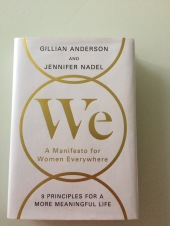
2017-07-26 20.42.01Before the summer break I also read WE: A Manifesto for Women Everywhere by Gillian Anderson and Jennifer Nadel and it caused me to reflect on the time and care I give to myself. I think it’s true to say that, as a mother, when you have young children you can often put yourself and your needs at the bottom of the priority list, well after the rest of the family. Ultimately, this often takes a great toll. Now that my children are older, (all at secondary school as of this week, my eldest now in sixth form), I find myself not so much with more time, but definitely with more mental space to tend to my own needs, pursue some of my own passions and award myself more respect. So, I am re-reading WE, slowly and deliberately, a little each day, and working through the exercises.

As a Mum I feel I have for years ricocheted between feelings of resentment at the extent of my ‘self-sacrifice’ and guilt at not doing or being enough! I hope that over the coming weeks the reading and the exercises will help to shift my mindset more towards contentment, resilience, and gratitude – the Holy Grail! I don’t find it particularly difficult to change my habits, get a better eating or fitness regime, etc, but mindset change is much harder. Wish me luck!

Are you one of those who prefer to make their resolutions in September rather than January?

If you have enjoyed this post, I would love for you to follow my blog by clicking on the button below or to the right (depending on your device).

Book review: “On Chesil Beach” by Ian McEwan

I read this for my August reading challenge, which was to choose a book, the title or cover of which was reminiscent of summer. I chose On Chesil Beach because I love Dorset, possibly my favourite county in England, and I love Chesil Beach, which we visited on a family holiday about three years ago. Chesil Beach is one of those fascinating geographical features, dating back to Jurassic times, which reminds you that human habitation on earth is a mere blip in time. It’s an 18-mile stretch of shingle beach, separated from the mainland by a saline lake called the Fleet Lagoon, and formed thousands of years ago as deposits of sediment were plopped near to the coastline, but not on the beach, so creating a ‘barrier beach’ separated from the actual coastline. It’s a haven for wildlife as well as being one of those mysterious oddities that Wessex (yes, I’m a huge fan of Thomas Hardy!) does so well.

2017-08-05 07.34.39

The front cover of On Chesil Beach shows a picture of a woman in a white dress walking along the beach at what appears to be either dawn or dusk. She is walking away from us, into a vague distance. The sky is grey-blue, twilit, with a slash of brightness from the emerging or receding sun. In the far distance are cliffs and the sea on either side of the beach is grey, somewhat forbidding. The skirt of the woman’s dress, and her hair, are blowing in towards the land; there is clearly a strong breeze coming in from the sea. This image is everything I love about the English coast. It reminds me that nature is in charge here, that the earth will prevail. This area is part of Dorset’s Jurassic coast where fossils are easily found and where there is much evidence of the prehistoric past. It is a humbling place to be.

Chesil Beach is the setting of McEwan’s moving, domestic tragedy. Set in the summer of 1962 it begins in a hotel where Edward and Florence are having dinner in their suite on their wedding night. The awkwardness, the tension and the weight of expectation are apparent from the outset, and the detail with which McEwan describes every aspect of the scene made me feel like I was living every excruciating moment of the evening in real time. It is clear very quickly that this is a book about sex. It’s 1962 so the couple have not yet experienced the benefits of the sexual liberation of the 1960s and are still victims of the much more staid post-war attitudes of the 1950s. Despite being newlyweds, and therefore supposed to be a happy young couple, it is clear very early on that each is in a very different place; it is apparent that they have had little intimacy, sexual or otherwise, prior to their wedding. Edward has been ‘patient’ assuming that all will be well once they are married, while Florence has been hoping simply for strength, that she will be able to endure what she thinks will an unpleasant duty once within the confines of marriage.

“They separately worried about the moment, some time soon after dinner, when their new maturity would be tested, when they would lie down together on the four-poster bed and reveal themselves fully to one another. For over a year, Edward had been mesmerised by the prospect that on the evening of a given date in July the most sensitive portion of himself would reside, however briefly, within a naturally formed cavity inside this cheerful, pretty, formidably intelligent woman. How this was to be achieved without absurdity, or disappointment, troubled him…..But what troubled her was unutterable, and she could barely frame it for herself. Where he merely suffered conventional first-night nerves, she experienced a visceral dread, a helpless disgust as palpable as seasickness.”

And therein lies the nub of the whole book really, how these inner truths reveal themselves, how the pleasant mask of their love begins to crumble and how the relationship is affected under the pressure of these problems.

The book is structured in five parts: the first part is the awful wedding night, subsequent parts provide the back story to Edward and Florence’s relationship, their early lives and their very different backgrounds – class difference plays a big part in the novel too and whilst this is not named as an explicit barrier between them, you get the sense as a reader of her as more refined, affluent, uptight, middle-class, while he is seen as ultimately more vulgar, preoccupied by earthier matters and that this is somehow a consequence of his socially humble background.

I don’t wish to spoil the ending for you if you haven’t read the book, but the final part, the denouement, takes place on Chesil Beach itself, as the two individuals encounter one another at the climax of their so far bitter wedding night experience. It is like a classical scene, like a game of chess as the two manoeuvre around their respective problems. It is a very fine, forensic study of a 1960s relationship that could barely be called a relationship.

A stunning read, which I didn’t expect to be so good. Highly recommended.

(Apologies for any typos I haven’t spotted – my daughter’s hamster gave me a nasty bite on the middle finger of my right hand it has badly affected my typing!)

If you have read this book, what did you think?

If you like what you read here, please follow my blog. I would love also for us to connect on social media.

September reading challenge: a self-help book

I swished through my August reading challenge very quickly (a book whose cover title reminded me of summer) having selected a fairly slim volume (On Chesil Beach by Ian McEwan) that was absolutely compelling. I couldn’t put it down and since I was away visiting family at the time I decided to read it, I had plenty of opportunities to not put it down.  It’s a fabulous book, so look out for my review next week.

This month, the challenge is also related very much to the time of year. I have written on here before about how I find Autumn very energising. It is probably related to the fact that I have had children at school for twelve years now (by the way, allow me a proud parent moment – we are celebrating the eldest one’s excellent GCSE results!) My year is very much determined by and planned around the ebb and flow of school term times and holidays. After a period of repose stepping off the treadmill of the daily school routine, usually a family holiday and bit of sun, the change of pace again when school returns, and the sense of new beginnings seems to give me a sense of optimism and vitality.

There is also something about the climate and the light in England in the Autumn that makes my mood reflective: the days are getting shorter so I am reminded that time is precious. The weather is usually cooler but because I don’t have kids to entertain or days out planned, my expectations are lower, so I appreciate the rain (it waters the garden), I don’t mind the wind (it dries the laundry) and I am thankful when the sun appears, not cross when it doesn’t. It’s as if my mental goalposts have moved.

2017-08-31 10.53.26

For me, September is a great time to make plans, think about where I am and where I’m going. I also know that I will have more energy and fewer commitments in the next two to three months than at any other time of the year, so it’s an oppportunity to take some big steps forward. This month’s challenge is to read a self-help book.

I went browsing in my local bookshop as I did not have a very clear idea about what I wanted to read this month. The self-help section seemed to have a different sort of feel to it compared to the last time I was buying there. After years of exhortation to do better, be better, have more, look better (ideals that few of us can sustain in real life, leading to inevitable anti-climax, disappointment and feelings of failure) the general tone of most of the titles seemed to be more about acceptance, gratitude, and enjoying the smaller things in life. That has to be a good thing.

I spotted three irresistible books, and can’t decide which one to read this month. My biggest goal this season is to complete the first draft of the book I’m working on. I made some strides with NaNoWriMo in July, but I’m still only about a quarter of the way in and and I’m finding it incredibly challenging. So Elizabeth Gilbert’s Big Magic: Creative Living Beyond Fear seems appropriate, a book I’ve been meaning to read for a while. I also like the look of Quiet: the power of introverts in a world that can’t stop talking by Susan Cain, and Women Who Run with the Wolves: contacting the power of the wild woman by Clarissa Pinkola Estes. I am an introvert, and I’m also a feminist who believes all of us women have special inner resources that benefit the world, so both of these appeal.


Hmm. Decisions, decisions. What would you pick?

If you have enjoyed this post I would love for you to follow my blog. Let’s also connect on social media. 


Book review: “The Lady and the Unicorn” by Tracy Chevalier

Tracy Chevalier’s second novel Girl with a Pearl Earring was published in 1999 (really, it was that long ago!) and was a sensation. I remember reading it at the time and was bowled over. It was made into a film starring Scarlett Johansson and Colin Firth in 2004. I’m afraid to say that I have not read any of Tracy’s subsequent work and until now would not have been able to name any of her nine other books (although I love the look of New Boy, published this summer, and recommended it just a few weeks ago).

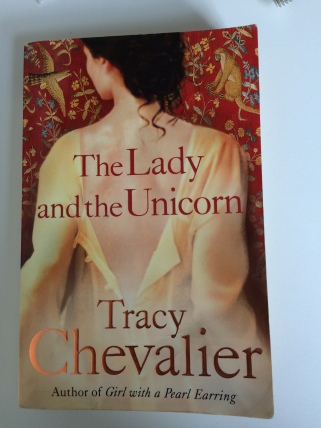
The Lady & the Unicorn imgI picked up The Lady and the Unicorn at the secondhand book stall at my youngest daughter’s school summer fair and read a large chunk of it whilst there. It would not normally have caught my eye on a bookshelf as the cover is more suggestive of a cheap sexy romance (nothing wrong with that if that’s your thing!), but I was very quickly drawn into the world that Chevalier evokes, as she also did so brilliantly in Girl with a Pearl Earring.

The novel is set in Paris and Brussels in 1490-92. Parisian nobleman Jean Le Viste wants an impressive tapestry in his home, a way of showing off his wealth, status and fine taste. He commissions local artist Nicolas De Innocents to paint a design which will then be turned into a tapestry by specialist weavers in Brussels. The subsequent story is about Nicolas’s travels between the two cities, the time he spends in Brussels with the family of weavers and the effect the work has on all their lives.

It’s a very simple premise and you would be forgiven for wondering how a full-length novel could be strung-out from this. Like Girl with a Pearl Earring, it’s the characters, their motivations, their internal lives and the relationships between them that drive the narrative. Here, Nicolas des Innocents is the central figure. He is young, virile, charismatic and mischievous. In Paris, he threatens to destabilise the Le Viste family when the youngest daughter Claude falls for his charms (he has already seduced the maid!), but socially, he is an outsider, a class well below his employer, and thus it is important he is kept at arm’s length. In Brussels, he penetrates the family more deeply as he needs to work alongside the weavers to design the various features of the tapestry and to help realise these in the final product. Nicolas the charmer develops a close bond with the weaver’s blind daughter. I’ll leave it at that – no spoilers here!

The book is written from several perspectives, with each chapter narrated by different characters. This allows us as readers to observe the events of the story from a number of viewpoints. It’s a sexy novel, there are simmering passions throughout (to that extent the suggestive cover on my copy is not far wrong!). It provides an insight to the issues of the period – honour, social status, the role and standing of women, as well as the process of creating a tapestry and the meaning behind all the imagery – and Chevalier has a brilliant talent for bridging the past and the present and showing us that in many ways day to day concerns remain the same throughout the ages. I particularly like how the author marries her skills for story creating into some bare facts about a real tapestry (it does exist) and real people. This is what she did in Girl with a Pearl Earring too, of course.

Whilst this novel clearly did not make the same splash as Chevalier’s more famous earlier book, it’s a good read and I would recommend it. Glad I found it on that book stall!

Have you read any of Tracy Chevalier’s books?

If you have enjoyed this post, I’d love for you to follow my blog. Let’s also hook up on social media. 

The Top 10 things I love about Lisbon

So, our wonderful holiday in Portugal has come to an end. After a week of rest and relaxation on the Silver Coast (near Obidos) we headed for a few days in the country’s capital, Lisbon, a city I have been wanting to visit for years. It did not disappoint. More compact and lower key than some other European capitals it comes in at number nine on TripAdvisor’s top European destinations, ahead of the likes of arguably more famous places like Amsterdam, Venice, Florence and Edinburgh. Excluding our arrival and departure days, we were there for four full days, and there was far more to do than we could squeeze in. The high August temperatures (mostly exceeding 30 degrees Celsius during the day) and the peak time crowds made sightseeing more challenging than it might be at other times of the year, which perhaps slowed us up a bit. Other people (and those without kids) might be able to pack more in. We were not in a hurry (we are determined to go back again anyway!) and spent a lot of time just watching the world go by in cafes, bars and restaurants. Here are the top 10 things I love about Lisbon:

1. The views

IMGP0029

Lisbon is a city of hills. There are many opportunities to get a higher perspective of the city and the surrounding area, including plenty of  well signposted Miradouros (viewpoints).

2. Castelo de Sao Jorge

2017-08-20 13.34.46This ancient fortress up on a hill is a potted Portugese history lesson. It’s fabulous and from here you can get a panoramic view of the city. You take the antique Tram 28 to reach it. Aside from the main site I recommend the tour of the ancient archaeological area (above, where they have found evidence of habitation as far back as the Iron Age) which is generally under-attended, and is fascinating because you get to see and understand exactly how people have lived in and used the fortress over the centuries.

3. Museu de Farmacia

2017-08-22 22.01.29

Quirky museum by day, bar and restaurant by night with some fab cocktails (both with and without alcohol), imaginatively served. See above, #Elixir, #Oxymetazol, Vinho Verde (see 6), and we-won’t-rip-you-off-by-making-you-buy-bottled-water H2O (see 4).

4. It’s relatively good value

I grew up in London, but haven’t lived there for 20 years now. When I go back as a visitor I am struck by the hugely inflated prices compared to the rest of the country. Sadly, this is true of many major cities. Lisbon, indeed, Portugal as a whole, does not fleece its tourists. Long may it last. Food, drinks, travel, entry prices all seem reasonable, even in the light of Sterling’s weakness against the Euro.

5. The Waterfront

We took many an evening stroll along the waterfront, where there was a great buzz. The stunning Praca do Comercio (above right) looks majestically out over the River Tejo. It lies at the foot of the area of Chiado, the main shopping and commercial hub of the city.

6. Vinho Verde

The so-called Portugese ‘green wine’ is very drinkable indeed, and ridiculously cheap for the quality!

7. Cascais

Golden beaches are less than half an hour by train (for 2 Euro!) from the city centre. The husband took the two girls for the day and had a fantastic time. A great escape if the sightseeing is getting too much!

8. Fish

To see? At the amazing Oceanarium on the Expo site to the north of the city – did you know that a cuttlefish looked like this?

IMGP0048

To eat? Fantastic fish is served everywhere, and Mr Cuttlefish is very tasty as well as cute! Cacilhas, a suburb of the city just a short hop across the river seems to be almost entirely made up of fish restaurants.

9. Pastellaria

If you have a sweet tooth, expect to be well-supplied in Portugal. From the delicious Pastel de Natas (ubiquitous small custard tarts) to Macarons (below) you will find much to choose from in the many small cafes and bakeries serving fine coffee and cakes.

2017-08-20 18.00.00

10. The people

Portugese people are warm, kind, laid-back and welcoming. The language is very different to Spanish and most visitors will not have even a smattering of Portugese, I suspect (though it’s a fascinating language and I’m determined to learn a little before I go again). The natives don’t seem to mind, however, and most speak excellent English. Lisboans seem quietly proud of their city and so they should be. As such, they are delighted to help you and keen that you as a visitor should have a great experience in their city.

If you have been to Lisbon I would love to hear what your highlights were. 

If you have enjoyed ths post, I would love for you to follow my blog by clicking on the ‘Follow’ button below (or to the right, depending on your device).


Book reviews: ‘Dear Ijeawele’ and ‘We should all be feminists’ by Chimamanda Ngozi Adichie

I posted on here recently that the reading I seemed to have planned over the summer had a definite feminist theme to it. This was largely accidental although it could be something to do with having read WE: A Manifesto for Women Everywhere recently, and thinking about the subconscious messages that women and girls inherit. Top of my list we’re these two slim volumes from Chimamanda Ngozi Adichie.

img_3767
I was given We should all be feminists by a friend for my birthday last January and have been mulling over its content ever since. It is the modified text of a TEDx talk that the author gave in 2012 and was published in book form a couple of years later. Adichie grew up in Nigeria and now divides her time between there and the USA. It would be true to say that the book is written with an African context, that she has in mind many of the social and cultural norms that women in some African societies experience. It would also be narrow-minded and complacent, however, to dismiss the points she makes as not being relevant elsewhere. Adichie writes that in some parts of society ‘feminism’ is a term of abuse or is used as an insult; it is used to describe women who have not been successful in finding a husband! I have heard the term ‘feminist’ used in derision in the U.K. too and we are sometimes inclined to think that it is no longer necessary; equality has been achieved they say, it’s merely spiteful to keep banging on about it! (Then you see the online vitriol that JK Rowling, and many others, have to put up with on social media and it’s very clear that battle is nowhere near won.)

Adichie writes of the problems of ‘normalising’ discrimination when we allow casual differences in the way we treat boys and girls to go unchallenged. Having different standards and expectations is part of the problem, as is gender-specificity in things like toys, behavioural norms and the interests which are promoted to different groups.

Adichie writes that these attitudes can be problematic for boys too; they can create expectations which may lead to poor self-esteem for many young men (if they are not able to be physically strongest or not inclined towards rough and tumble).  Adichie wants us to raise both sexes with equality in mind.

Dear Ijeawele takes this theme a step further. Published earlier this year it is written in the form of an extended letter to a new mother. Some years previously, a friend of the author wrote to her after she had just given birth to a baby girl, asking for advice on how she might raise her daughter as s feminist. The author explores more deeply the ideas that she first expressed in We should all be feminists and has come up with a list of fifteen suggestions for her friend. There is much here to digest. She encourages her friend to ensure the task of raising their daughter is shared and that gender roles must be eschewed not only in the endeavour itself but also in the language they use and the expectations they express to their daughter.

The knowledge of cooking does not come pre-installed in a vagina.

Daughters should never be called “princess” (passive, linked to prettiness and dependency) nor taught to value marriage as an achievement. A girl does not need to be likeable but merely to be her full self.

Instead of teaching her to be likeable, teach her to be honest. And kind. And brave.

This is a powerful little book that I can imagine giving as a gift to a new mother or to a friend who might be experiencing dilemmas about how to handle certain parenting problems. As a mother of two daughters (and one teenage son) it has given me much food for thought.

Reading these books made me reflect deeply on how I raise my girls. Thanks for the comments on the post I published last week about that. 

If you have enjoyed this review, please subscribe to the blog. 

On holidays in Portugal

I’m on my holidays with the family in Portugal. It’s a lovely country: the people are warm and laid-back, the food is wonderful, it’s a seafood-lover’s paradise. The weather where we are, north of Lisbon on what is known as the ‘Silver Coast’, is warm and sunny, with Atlantic breezes keeping the temperature below the more intense numbers you get on, say The Algarve – mid-30s Celsius is tough on a fair-skinned Brit! When you have to take your holidays in August (school!) you have to think carefully about where you go. It’s so much more expensive before you even arrive and popular locations can be jam-packed, unbearable with children. Our location here in Portugal feels perfect just now. 


The beach is stunning, vast and empty, and the ocean majestic, though cold even to paddle in for me and mostly too much undertow for swimming.

Since we arrived on Saturday I have finished reading The Power, the Bailey’s Prize-winning novel by Naomi Alderman. 

I wasn’t bowled over by it I’m afraid, but will post a review in a couple of weeks. 

We are staying close to the beautiful town of Obidos, which has designated itself, rather fortuitously for me, ‘City of Literature’! My book-seeking antennae were out and we found two amazing bookshops. 


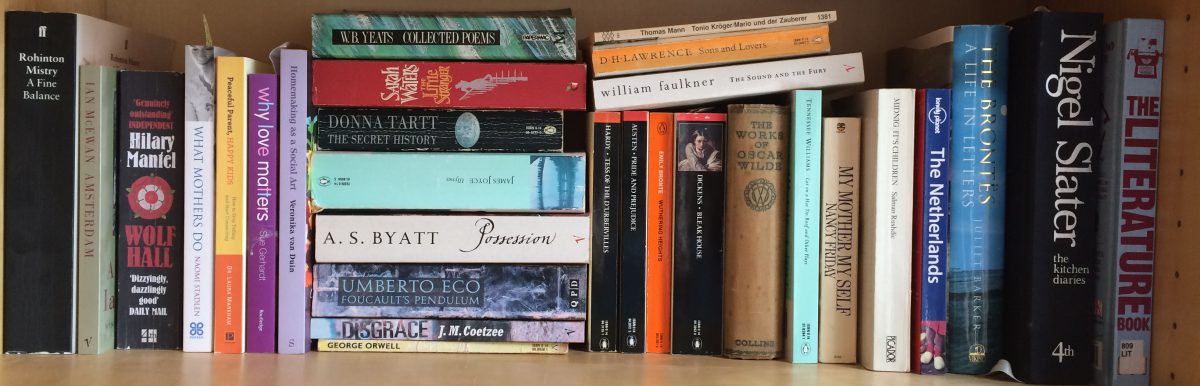
The first was a secondhand bookshop that also incorporated an organic food market – what’s not to love! Look at what I picked up from the English shelf: 


Plenty of Manchester references here I expect!

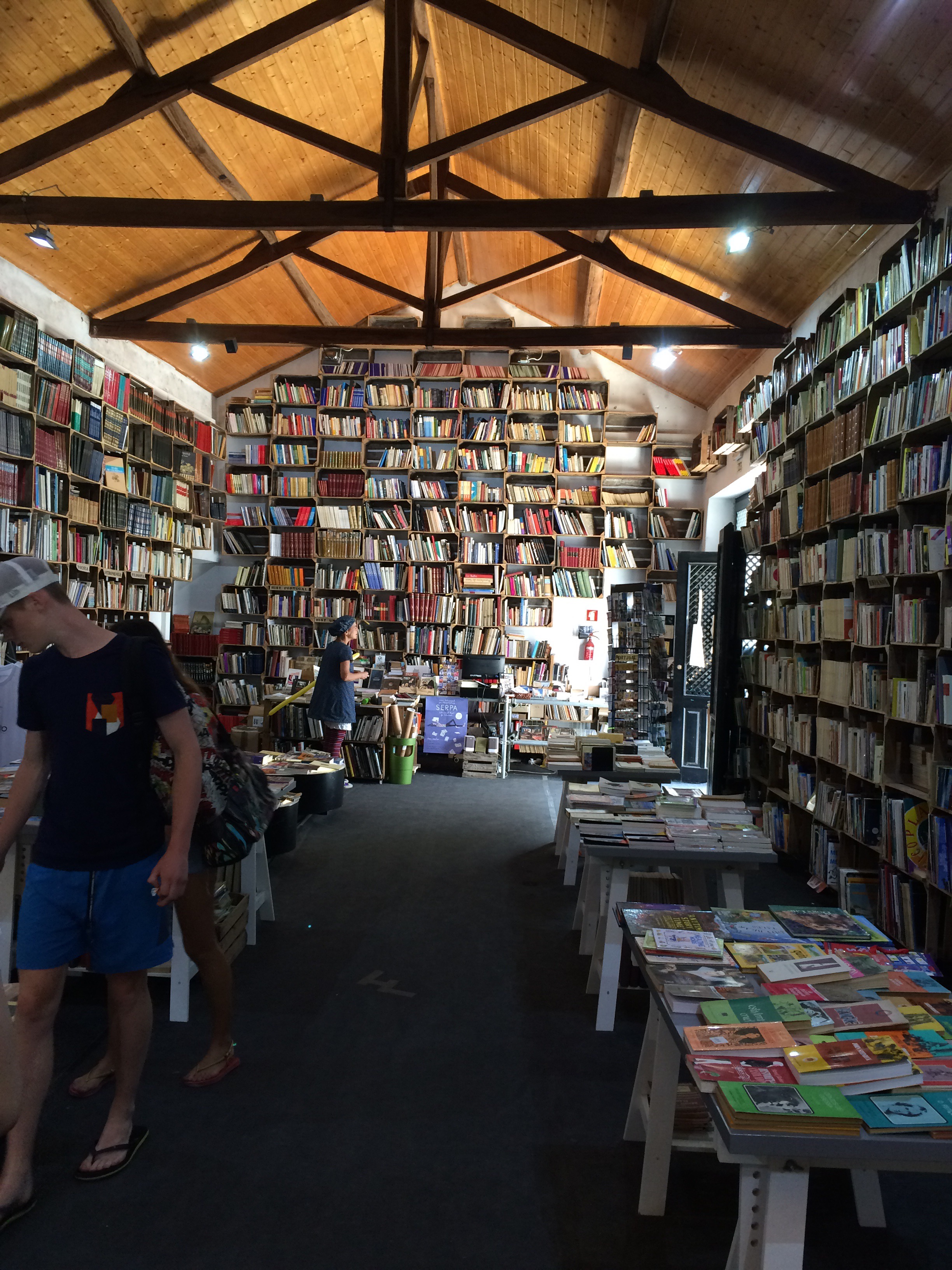
The next bookshop was in a converted church and had the most amazing structure of wooden shelving which doubled as stairs and a mezzanine. 


Beautiful isn’t it?

Reading-wise I’m currently enjoying  Lisa McInnerney’s The Blood Miracles, which is so far matching the quality of her first novel The Glorious Heresies

I hope you are also enjoying the holiday season and that you’re getting plenty of R&R (reading and relaxation) in!

Reflections on being a mother of girls

My elder daughter turned 13 recently. I find this fact quite extraordinary and I am filled with a new sense of responsibility. Getting three children this far has been something of a feat, of course (!), but I now feel as if I have the huge challenge of nurturing a young woman. I have an older son, but that seems different somehow. Perhaps that’s because I have never been a young man, but I do have experience of being a young woman, so I am profoundly aware of all the special ups and downs that life can present to girls.

girl-2480361_1920
A beautiful mother and daughter (this is not us!)
My daughter is strong, talented and determined. She is also loving, conscientious and kind, and experience tells me that this can make her vulnerable. The world has yet to fully come to terms with this potent mix of feminine powers, does not yet know how best to embrace it. It seems to me the world often seems to fear it. So, as a parent, as a mother, the conundrum is how to prepare my daughter for a world that may not be fully ready to receive her for all that she is and all that she can be, whilst also fostering her single-mindedness, encouraging her independent spirit and emboldening her to stay true to herself.

I recently read We should all be feminists by Chimamanda Ngozi Adichie (look out for the review next week). This was given to me by a friend as a birthday gift. It’s a fuller version of a speech the author gave to a TEDx conference in 2012. Its context is Nigerian society, but there is much here that we can all take on board in terms of how we bring up our children and the values we attempt to instil.

I have a particular conundrum in that I have for a long time been what is disparagingly termed a ‘full-time Mum’. I took the usual maternity leave with my first child (my son) and when I went back to work he went to nursery for four long days every week (we had no family nearby to support us), a fact which haunts me to this day. My job was challenging and I was 50 miles away, so it was a difficult time. When I became pregnant with my second child not only did it make little economic sense for me to continue working but I felt my higher education job was incompatible with our circumstances. There was no way I could be the kind of parent I wanted to be whilst being committed to my career, and with no back-up it seemed impossible. My husband’s job was senior, demanding and in a relatively male-dominated industry so there was little prospect, in reality, of a shared model. So when my daughter was born I took a career break. I had another child during that time and took seven years off, which ended with voluntary redundancy.

When I recount this story I find it quite hard to believe myself – I was always very ambitious, acquired a Bachelors and a Masters degree, had a good career where I was respected, have always been a feminist, and yet as far as my children are concerned Mummy stays at home. Mummy does work of course (I have run a small business, I write and I do some occasional work for a charity) but I don’t work long hours out of the house like Daddy does so the lion’s share of the household work also falls to me. I don’t feel unhappy with this and I don’t regret any of the decisions we made and if I could do it all again I would make the same choice to stop working (I only wish I’d been there for my son sooner and not put him in nursery), but I do worry about the kind of messages this sends to both my son and my daughters about gender roles. What kind of a role-model am I?

We should all be feminists and the small companion book Dear Ijeawele have given me much food for thought. One of the first suggestions in Dear Ijeawele is that a woman should be “a full person” and not be defined by motherhood. I think in the early years I allowed this to happen, although with three young children and a husband working away every week for a number of years I had little time to define myself any other way! However…that is changing now. As my children get older and can take more responsibility for themselves I am trying to strike a balance between being there for them, but also not being there always, if you see what I mean.

Suggestion number ten in Dear Ijeawele is to “be deliberate in how you engage with [your daughter] and her appearance”. Adichie is a beautiful woman who embraces her femininity. She is a face of No. 7 cosmetics, a fact for which she has been criticised and for which she makes no apology. I have always struggled with my femininity; I think it was handled clumsily and fearfully when I was a teenager (I don’t think I’m alone). Being feminine should not be incompatible with feminism, this much I believe, but I struggle with both my young daughters’ desires to wear make-up, for example. I feel very conflicted as I want them to be happy with their natural appearance, to know they are beautiful as they are, and not to feel influenced by the media that they have to look a certain way or that a certain beauty product is a ‘must-have’. I also worry about the pressure to wear revealing clothing, although, as Adichie says, we should never link appearance with morality.

With a teenage and a pre-teen daughter, these are all very urgent issues. I’m afraid when they were young they did play with dolls and much of their environment was pink, though trains, lego and other colours were available! I agree it is important not to provide gender-specific toys and to encourage breadth and variety. Mostly, my kids liked to paint, make things and play with water, and I never tried to stop the girls getting messy – they were worse in fact! But the issues seem to be weightier now, especially as their thoughts gradually turn to their futures and as sexuality begins to emerge. They hear the news and find that there continues to be a gender pay gap in society, that there is not parity of treatment between LGBTQ and straight people, and that women and girls continue to be abused and exploited more than their male counterparts.

There is much that we all still need to do.

I would love to hear your thoughts about raising girls in the 21st century. 

If you have enjoyed this post, please subscribe to my blog by clicking on the button below or to the right, depending on your device.


August reading challenge: a book with a summery cover

Last month I ticked off my July reading challenge pretty quickly, having skipped through Evan Davis’s Post-truth: Why we have reached peak bullshit and what we can do about it fairly quickly after a train journey.

2017-08-05 11.14.50

This month, mindful that we are in the middle of the holiday season, the challenge is to choose a book, the cover of which is reminiscent of summer. (Whilst I definitely do not judge a book by its cover, I’m afraid I’m a sucker for the book that jumps off the shelf and grabs my attention!) Between the Baileys Prize in June and the Man Booker longlist in July, I’ve bought quite a lot of books recently, so I thought I’d dig through my not insubstantial pile of unread books purchased over the years for inspiration.

2017-08-05 07.34.39I have chosen On Chesil Beach by Ian McEwan, which was published in 2007. I suspect it has been languishing unread on my shelf for a number of years! The cover is, arguably, not particularly summery, showing a young woman walking along Chesil Beach in Dorset, at what looks like dawn, but could possibly be twilight. For those of you unfamiliar with Dorset, Chesil beach is a unique natural feature of the area. Geographically, it is known, I believe, as a tombolo. It is a 20 mile stretch of shingle beach that lies in a long, fairly straight line from Abbotsbury (near the swan sanctuary) to the Isle of Portland in Dorset. Whilst it is connected to the land at each end, it sits apart from the main beach along its length, creating  a kind of lagoon which is a haven for bird life.

Dorset is one of my favourite counties of England. I wouldn’t say I have spent lots of time there, I have been maybe four or five times, but each time I’ve visited I have found it the most beautiful, fascinating and interesting place. It is also deeply connected with my literary life. I am a huge admirer of Thomas Hardy and a few years ago, following a horrible relationship breakdown, I spent the most wondrous and life-affirming fortnight cycling around the county, visiting many of the towns, villages and monuments which appear in Tess of the D’Urbervilles and other Hardy novels. Jane Austen also has connections with Dorset, and who could forget The French Lieutenant’s Woman, a wonderful book, set in Lyme Regis, possibly the loveliest seaside town in the world.

Dorset also has many fascinating geographical and historical features; you can go fossil-hunting in Charmouth, and there are of course, the incredible cliffs at West Bay, made famous as the site of the murder of Danny Latimer in the TV series Broadchurch. The beaches are spectacular, my favourite is the beautiful, horseshoe-shaped Lulworth Cove. As I write this, I am reminiscing about a wonderful week we had there with the children two of three years ago, and aching to go back, even though the weather was typically British!

So, I will look forward to reading this book, as I set off on a short trip to Dublin later today to visit my in-laws.

What books remind you of summer?

If you have enjoyed this post I would love for you to subscribe to my blog by clicking on the link below or to the right (depending on your device).