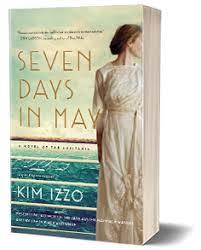
When I began my Facebook reading challenge at the start of 2018, the monthly themes were fairly easy – a YA novel, a work of feminist fiction, crime fiction, etc. Over the last three years I’ve read some cracking books that I would probably not have picked up otherwise. Memorable titles have included The Secret Lives of Baba Segi’s Wives by Lola Shoneyin, Please Look After Mother by Kyook-Su Shin and The Birth of Venus by Sarah Dunant. As time has gone on, I’ve been scraping the bottom of the barrel for themes and they have become a little more random, to say the least! Bereft of ideas, for May I decided it would be “a book with May in the title”. I don’t know what I was thinking – perhaps a touch too much sherry over Christmas when I was putting the list together, or months of lockdown making me go a bit loopy! Well, finding a title was challenge enough, but I did – Seven Days in May by Kim Izzo. This novel was first published in Canada in 2017. I never like to criticise a book, but I think it was not one of those which I would include on my most memorable list.
I love historical fiction and this book ticks that box since it is based on the true story of the sinking of the Cunard liner RMS Lusitania in May 1915. Most people will have heard of the Lusitania, but I wonder how many know the background to the story. The luxury cruise liner’s maiden voyage was in 1906 and she travelled the north Atlantic route between Liverpool and New York. At the time, she was one of the fastest vessels of her kind. It was almost at the end of her 202nd voyage on 7 May 1915, that she was torpedoed by a German submarine and sunk a few miles off the southern coast of Ireland, near Kinsale. The wreck still lies there. Almost 1,200 passengers and crew perished, and 761 survived. One of the survivors was the author’s great-grandfather. The story of the Lusitania is important, historically, because it was instrumental in drawing the Americans into the first world war. Many conspiracies about the ship abound, including that Churchill (who was First Sea Lord at the time), placed the Lusitania directly in harm’s way, by failing to adequately warn or protect her; it has been said he calculated that the loss of American citizens would trigger the US to declare war on Germany. Kim Izzo explores some of these conspiracies in the novel, hinting strongly at Churchill’s negligence.
There is more story than history in this novel, however, and the main plot of the novel concerns the relationship between wealthy American socialites, sisters Brooke and Sydney Sinclair, and English aristocrat Edward Thorp-Tracey. The elder Sinclair sister, Brooke, is engaged to be married to Edward. The match is a fond but loveless one, a marriage of mutual convenience; Brooke’s wealth will preserve the Thorp-Tracey seat, Rathfon Hall in Somerset, while Edward’s title will add status to the Sinclair name. When Edward finally meets Brooke’s younger sister Sydney, at the engagement party in New York, just before they set off for England for the wedding, he finds he is instantly attracted to her. Sydney is headstrong, passionate in her political beliefs and more down to earth than her sister. Brooke and Sydney have a falling out just ahead of the voyage which leads to Sydney refusing to share the suite her sister has booked for them, and instead booking a cabin in third class. Over the course of the voyage, Edward and Sydney find themselves falling in love with one another and Sydney’s separate and distant quarters make their clandestine meetings possible.
A parallel story is taking place in London. Isabel Nelson, also, it turns out, a passionate, headstrong and determined young woman, finds herself working in ‘Room 40’ at The Admiralty. She worked in service in Oxford, but after an affair with her employer, who, amongst other things, had arranged for her to obtain some clerical qualifications, was banished to London after his wife had found out about his infidelity from another servant. This turns out rather well for Isabel since she finds she likes the work. Room 40 was a real code-breaking unit, a prototype of Bletchley Park, so important to the Allied victory in the second world war. Isabel’s job is to type up and distribute the coded messages translated by the (all-male) code-breaking team. Isabel follows the movements of the German submarine captain who is said to have fired the torpedo which downed the Lusitania and a number of other vessels at the time. She becomes increasingly concerned about the passenger ship and fears it is a target and that not enough is being done to protect it.
There is a personal dimension to the Isabel story too when her former fellow servant, the ghastly Mildred, turns up at the Admiralty, also having got a job there, and threatens to undermine Isabel’s position, by spreading gossip about her past.
The book was not unenjoyable; it had some interesting historical detail. But I found the plot a little thin for my taste. I did not really warm to any of the characters, and found myself a little agitated by the cliched portrayal of the different classes of person, from the passengers aboard the ship to the civil servants in London. Kim Izzo is a bestselling author and her most successful book is The Jane Austen Marriage Manual.
Recommended if you want a little bit of uncomplicated escapism with some history thrown in.