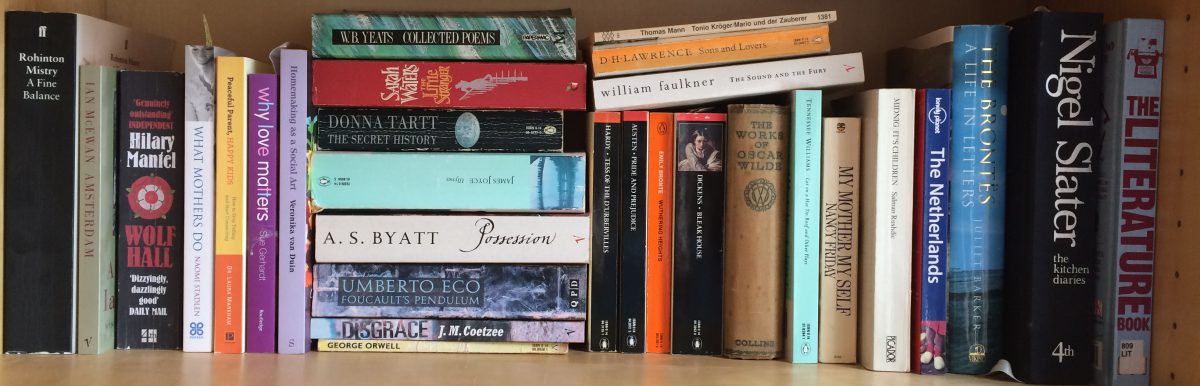
I posted on here last week about my brain needing to have a little break from the Man Booker shortlist (especially as I have not found all the books particularly engaging so far). It is a rather bleak shortlist. I have also been unwell for a couple of weeks with sinus problems, and none of these books are exactly a ‘pick me up’! So, on a day when I was feeling particularly sorry for myself I lay down on the sofa with The Music Shop, my book club’s reading choice for November, and read the whole thing in one sitting. I loved it!
This book caught my eye last year, so it has been on my mental TBR list for some time. In September I attended a one-day conference run by the group that publishes the Writers’ and Artists’ Yearbook on how to get your book published (almost finished my novel), at which Rachel Joyce was a speaker. Rachel came to novel-writing relatively late in life, coming to prominence only in her late 40s (encouraging!) when her first novel, The Unlikely Pilgrimage of Harold Fry (2012) was widely acclaimed, and in fact found its way onto the Man Booker Longlist. Rachel came across as a lovely, down to earth human being, but with her own fascinating story to tell, and a warm and inspiring approach to all the novice writers in the room. I bought The Music Shop at that event.
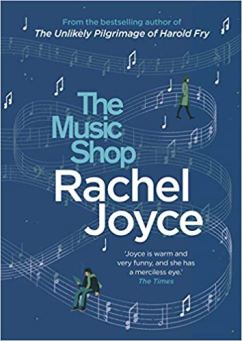 The books open in 1988 when the central character Frank opens a music shop in a rundown area (Unity Street) of an unnamed city. Frank is passionate about music, something that was instilled in him by his late mother, the eccentric Peg. It is probably the only the good thing that Frank got from her, and as the book goes on, we learn much about the lack of love and security in his childhood. This is important as it helps us to understand Frank’s actions later on. The other thing that Frank is passionate about is vinyl; he refuses to sell either cassette tapes or the new-fangled CDs in his shop, much to the chagrin of the salesmen who tell him he is a dinosaur and will have to change with the times. They gradually abandon him.
Unity Street is run-down and regularly vandalised. There are only a handful of businesses, all of them marginal and barely surviving, such as the small shop selling religious souvenirs, run by a former priest, the tattoo parlour run by the indomitable punky Maud, and the two brothers running the funeral parlour. It is a street of misfits and Frank, with his assistant Kit – clumsy, loveable, naïve – slots right in. It is the ‘80s, however, and Britain is changing. Property developers are anxious to get into Unity Street, for the residents in their run-down houses and the shop-owners barely making ends meet to leave and to bulldoze the whole area to make way for shiny new apartments.
One day, Frank meets Ilse Brauchmann. First, she faints outside his shop. The traders all rally round to help her. Frank is immediately attracted to her, which throws him into a tailspin as this is something he has never felt before. Frank has no self-esteem and does not believe she could possibly feel the same way about him. Ilse, however, leaves her handbag behind in the shop. Kit and the others make great efforts to track Ilse down, fascinated by her mysterious presence, though Frank is nonchalant. They find Ilse and draw her into their community.
Eventually, after some false starts, Ilse, on hearing how Frank has changed the lives of so many of his customers by bringing music to them, asks him to teach her about music. They begin to meet weekly in a café where Frank’s confidence gradually builds as he talks about the one subject he knows, that he feels confident about and which enables him to be his true self.
Their burgeoning relationship is destined to fail, however, as they stumble from one misunderstanding to another, because of Frank’s fear, but also because there seems to be something about Ilse that she is not revealing.
This book is a love story, but it is a roller-coaster of one, that will take you on twists and turns you cannot anticipate. It kept me absolutely gripped – I was at times so frustrated with both of them, but also deeply moved by their respective stories and the things I as the reader knew were getting in the way. The ending is not what I was expecting at all.
It is also a story about something softer and gentler which we lost when certain powerful commercial forces came and took over our towns. To that extent this book is much more than a love story, it succeeds on so many other levels too. The Unity Street traders are all lonely people who have had their troubles in life. They are all ‘the left-behind’ but they have each other and they are rich, nuanced, powerful characters in their own right and mostly have the last laugh.
I recommend this book highly. A great story which is truly uplifting. It will make you laugh at times and it may also make you cry.
Have you read The Music Shop? If so, what did you think?
If you have enjoyed this post, I would love for you to follow my blog and to connect with me on social media.
 The story concerns Romy Hall, a young woman whom we first meet in a prison van en route to Stanville Women’s Correctional Facility, somewhere in California. Romy was convicted of a brutal murder and has been given two life sentences plus six years. Romy worked as a lap dancer at The Mars Room nightclub in San Francisco and it was a former customer at the nightclub that she killed. Romy is at once similar but different to her fellow convicts. For one thing she has a seven year old child, Jackson, whose welfare she becomes increasingly concerned about during her incarceration, and she also completed high school, so she is considerably more educated than many of those around her.
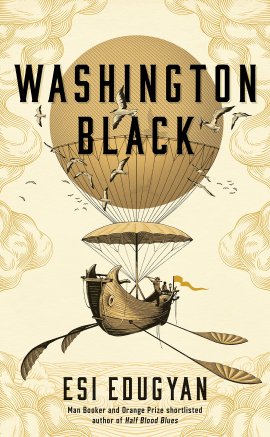 Washington Black’s life is turned around, however, when Erasmus’s younger brother, Christopher, or ‘Titch’, arrives at the plantation. He is an inventor, a man of science like his father, who does not share his brother’s views on slavery. Titch has come to Barbados in order to work on a flying machine he has designed and asks his brother for a helper. Erasmus loans him Washington Black and the boy goes to live in Titch’s quarters, helping him with drawings and experiments as well as practical household tasks. Titch discovers that Washington has considerable artistic talent as well as abilities which will be useful in his science projects and he teaches him to read. This change in Wash’s circumstances means he can probably never go back to being with the other slaves and the question is posed whether Titch has served his protégé well.
 Gretel is a 32 year old woman living alone in Oxford. She works as a lexicographer, a natural career for her as her life has been dominated by words – their invention, their use, and, perhaps also, their lack. She had an unconventional upbringing with an eccentric mother on a canal boat. In her early years, Gretel and her mother developed their own language, a succession of private words for things for which a single expressive term did not exist, for example “sheesh time” refers to a desire to spend time alone, and “Bonak” will come to mean something to be afraid of, something threatening.
 The central character is Walker, a man from rural Nova Scotia, who fought with the Allied forces in the D-Day landings. He has seen and experienced terrible events, death and injury that most of us can barely even imagine, and he survived. After the end of the war, he goes back to the United States and finds himself living among the homeless in New York City. The book is divided into four sections: 1946, 1948, 1951 and 1953 each set in a different US city (though Los Angeles is the setting for both 1948 and 1953). As he reflects on his experiences, it becomes clear that it was impossible for him to return home to Canada. He reminisces about the quiet, gentle life he led there, where the rhythms of the seasons, the dependence on the harvests of the seas, and community events (such as village hall dances) dominate everyone’s existence. It’s as if the contrast between that life and the brutality he witnessed in the war means he fears contaminating the innocence of those he has left behind. He can never go back, never unsee what he has seen, and those he once loved will never be able to understand how he has been changed.
 Milkman is set in Belfast during the Troubles in Northern Ireland and the central character and narrator is a young Catholic woman who finds herself drawn unwillingly into a relationship with a local paramilitary leader. It is not clear when the book is set, but I am guessing around the late 1970s, early ‘80s. Northern Ireland is known to be socially conservative, but the general sense of the place of women in society suggests to me that it dates back quite some time. Our central character (not named, I’ll come onto this) is from a large family. Her father is dead and she has several siblings, both older and younger. She is in a “maybe-relationship” with a local young man, who she has been seeing for about a year, though they have not made a commitment to one another. She is keen on running as a hobby and shares this with “third brother-in-law”. Whilst out running one day in a local park she finds that she is observed by a man in a white van. Over subsequent weeks he infiltrates her life by stealth, indicating that he expects her to have a relationship with him. He is known only as “Milkman”. It becomes clear to her that he is quite a powerful local figure in the paramilitary world, so not only does she have little choice about whether to become involved with him or not, it is made quite clear to her that as long as she goes along with him no harm will come to her “Maybe-boyfriend”.

 One thing that is so impressive about Chevalier is how beautifully she creates the historical setting: the two novels I have read so far have been set in 17th century Holland and 15th century Paris and Brussels and I can only begin to imagine the amount of research she has to undertake. The Last Runaway is set in the United States in the mid-nineteenth century when parts of the country were only just being settled. Honor Bright, our main character is a young Quaker woman from Dorset in England. She has led a modest and sheltered life, but her world was turned upside down when her fiancé left her and their close-knit Quaker community for another woman. This was not only a scandal but it left Honor distraught and in a very difficult position. When her sister, Grace, is persuaded by her fiancé that they should move to America, Honor decides she must go with her, not only to support her sister, but to escape the oppression of her situation and have some chance of making a life for herself.
 In some ways, there is not a great deal to say about Death on the Nile that you couldn’t say about any other Christie novel, I suspect: there is a situation, in this case, a Nile cruise, being undertaken by 10-15 characters, all for different reasons. Conflicts and tensions are set up amongst the different characters, mysterious aspects of their personality or behaviour are noted, one of their number dies and then there is a process of detection to work out whodunnit. I did largely guess the correct outcome in the case of this novel, although I didn’t with Orient Express.

