Last week I posted a review of Agatha Christie’s Murder on the Orient Express, the first of two crime fiction novels I read over the Christmas holidays. The Girl in the Green Dress could hardly be more different, despite also being a crime novel and it is indicative of how the way we entertain ourselves has changed in the eighty odd years that separate the publication of these two books. Where Agatha Christie provided escapism, upper class characters, exotic locations and traditional murder mystery with the big reveal at the end, Cath Staincliffe’s book provides gritty realism, some repellent characters, familiar locations and a limited amount of mystery. There is no job here for the reader to play the detective, spot the clues and guess the outcome. The job of the reader is to engage with the characters at a deep level.
 The book starts with 18 year-old Allie Kennaway, and her friends heading out for their college prom night. They are at Allie’s home with her father Steve and younger sister Teagan. Steve is a single parent, his wife, the girls’ mother, Sarah, having died a couple of years earlier from cancer. Allie, we learn is a transgender woman, formerly Aled.
We meet the other characters who will form the main part of the drama, in quite quick succession: Donna, the workaholic Detective Inspector, who has four children and a less than happy marriage; Jade, a new detective, Asian, and whose mental health problems are hinted at early on; Martin, a long-standing colleague of Donna’s, a horny-handed old-fashioned copper. The murder takes place quite early on; Allie’s body is discovered in a deserted street near the nightclub where the prom was being held. Soon after, we meet Sonia, single mother of the feckless youth Oliver, who spends his days eating junk food, hanging out with his mates and playing online games. His culpability for the crime is fairly obvious.
If we know whodunnit, then what is the story about? Well, there is a fairly major and dramatic plot twist, which, of course, I shan’t reveal. Mostly, though, it’s about the characters and their internal lives, their hopes, dreams, motivations and frustrations. The police (Donna, Jade and Martin) are all flawed in their own individual ways and are trying to deal in a systematic and process-orientated way with a terrible event, trying to set aside their personal selves, and yet completely unable to do so. Work and ‘home’ cross over in the most challenging ways. Much like the crime shows I watch on television (I’m thinking Happy Valley, Morse, Prime Suspect), the issues of the central character are part of and not separate from the story. Although, for Agatha Christie, Poirot’s personality is key to the narrative, it does not form part of the plot in the way that more modern crime fiction does. Or perhaps you would disagree?
There is also the storyline of transgender young people and their experiences, which the author handles deftly with great care and sensitivity. It is a huge and topical issue to tackle and the result is commendable.
I struggled to get into this at first. The clipped writing style, which reminded of the way police officers narrate radio dramas, ie not in fully-formed sentences, was off-putting to me, and I found the structure, short chapters within chapters focussing on a different character in turn, meant it did not flow so easily. Having just read Agatha Christie, however, knowing the murderer from the outset seemed odd and I wondered what on earth the rest of the book was going to be about! There is that twist, of course, and as I got to know the characters, so I began to engage with them and their stories more.
I did get hooked and enjoyed the book immensely. It’s a quick read, though its grittiness makes it hard-going in places; the reader is not spared any detail! I’d recommend this book, though, and I will definitely read more of Cath Staincliffe’s work.
If you are a reader of crime fiction do you prefer the modern or the more old-fashioned Christie-style writing?
If you have enjoyed this post, I would love for you to subscribe to the blog by clicking on the ‘Follow’ button. Let’s also connect on social media.
 To my shame, I have not read anything by Agatha Christie before, although I have stayed at the Old Swan Hotel in Harrogate, to which Agatha famously disappeared for nearly two weeks in 1926 after a row with her husband! She is quite extraordinary when you look at the stats: said to be the best-selling author of all time, her books have sold around two billion copies (yes two billion!) worldwide, second only to Shakespeare and the Bible. She wrote 72 novels, 14 short story collections, and one play, The Mousetrap, the longest-running in the world. Miss Marple and Hercule Poirot are perhaps two of the best-known literary characters of all time, and her work has been adapted for film and television countless times. She is truly a literary giant.
 I concluded my 2017 Reading Challenge with something a little less challenging (in terms of length anyway), a short story. I knew it would be a busy month so I did not want to set myself up to fail by choosing some lengthy tome. (I’ve done the same for my 2018 Reading Challenge). December was so busy that it actually took me a couple of weeks to get around to choosing what to read, and then Cat Person fell in my lap, so to speak!
 Cat Person, by Kristen Roupenian has caused a social media storm. Set in America it is a story about Margot, a 20-year old college student, and a brief relationship she has with 34-year old Robert. Margot works at a small independent cinema and she meets Robert when he buys some confectionery from her stand before watching a movie. She feels mildly attracted to him: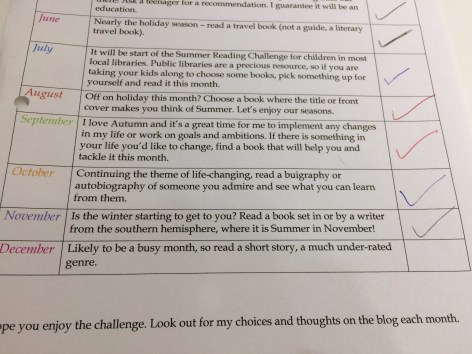
 The Bastard of Istanbul is a curious book, which my fellow book club members found disappointing. At the heart of the novel is the Kazanci family, living in Istanbul. The household is exclusively female and comprises Asya, (the eponymous ‘Bastard’) her three aunts and her mother (whom she also calls ‘Auntie’), her grandmother and ‘Petite-Ma’ who I think is her great-grandmother (more of that later, it’s part of the problem with the book). There is an uncle, who moved to America as a young man and has never returned. All the men in the family are afflicted by early death. Mustafa, the prodigal son, is in his 30s.
 I was really torn between Claire Tomalin, Anjelica Huston and Alan Cumming. I left it in the hands of the local library and it was Alan Cumming that became available first! I’m still waiting for Claire Tomalin, and that is probably the one I was keenest to read. I was attracted to Alan Cumming’s book, however, because its premise is not dissimilar to the book I am writing, namely family research and the uncovering of a long-held secret. There the similarity ends, however, as Alan’s book is much more about his relationship with his father.
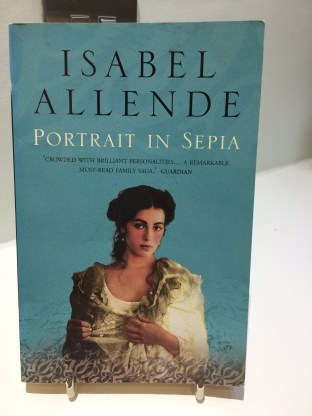
 For November, the challenge is to read a book set in or by a writer from the southern hemisphere – which is, broadly, South America, southern Africa and Australasia. As the nights draw in and it gets increasingly wintry I wanted to be reminded that in other parts of the world it is Summer! So, my choice this month is Isabel Allende’s Portrait in Sepia, a book I picked up in my local Oxfam bookshop and which has been sitting on my ‘to read’ pile for far too long. Allende is such a fine writer and I’ve read a number of her books over the years. It’s great to have an excuse to dive into this one and experience the sensuousness of her writing and the world she evokes, as the last leaves fall from the trees here and nature seems to go into hibernation.
 I read A Clockwork Orange on my husband’s recommendation, straight after he’d completed it – it’s one of his favourite films, which we have watched many times, but neither of us had read the book. It’s quite short, but also quite hard-going as it is narrated by the central character, Alex, who speaks in ‘nadsat’ a kind of teenage vocabulary of the future, based loosely on Slav languages. I read it with a glossary (though Burgess intended that it should not be), but after while I found I did not consult it, and it flowed better just to read it and understand the sense, if not every word.
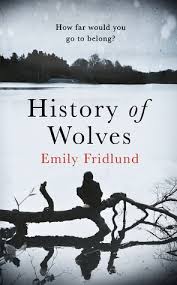 It’s a tough one to review without giving too much away, and the comments on the jacket don’t say very much about the story either, only that it is “exquisite”, “compelling” and “forcefully moving”. The central character is Linda (also Madeline or Mattie to her parents), who is an only child living with her parents in small town Minnesota. To say they live in a rural environment is an under-statement; they live in a cabin in the woods, which they seem to have built themselves, with their dogs. It seems they were formerly part of a small commune, but the other residents have gradually moved away as the cooperative spirit broke down. Linda’s parents are rather remote and she is allowed to roam the area freely, to canoe on the lake as and when she pleases, and to walk many miles in all weathers.