And so, my annual reading marathon is under way and I have the first of this year’s Booker shortlist under my belt. At only 128 pages in length, Claire Keegan’s third novel (she has also written short stories) is the shortest ever to be shortlisted for the Booker Prize. But make no mistake, it is not one to be read quickly. All the author’s skills as a short story writer are here, every word is necessary, the writing is crisp, almost sparse. And yet the subject matter is grave and heavy, too much perhaps for Keegan’s usual medium of a short story to bear. The sense of time and place is brilliantly executed. It is one of those books which you ‘feel’ but where you have no clue how the writer has achieved this!
It is 1985, just before Christmas, in a provincial town in Ireland. Bill Furlong, the local coal merchant, is making his deliveries. It is cold, there is snow on the ground, and this is pre-Celtic tiger. Bill is well aware that many of his customers are struggling to make ends meet and he reflects on his own good fortune, that he, happily married, a father to five daughters, lives in comfort. Bill’s start was not auspicious, however; he was the only son of a young single mother who became pregnant whilst working in the house of a wealthy local woman. Thanks to her kindness, his mother was allowed to remain in her employment, despite her ‘disgrace’, and both Bill and his mother were treated with sensitivity and respect.
Whilst delivering to the local convent, which sits just outside the town, Bill makes a discovery in the coal shed which affects him deeply. The convent is a bleak and isolated place and the nuns who live there, particularly the Mother Superior, do not have a reputation for warmth and kindness. Bill discovers a disturbed young woman, scantily clothed and barefoot in the coal shed. He returns her inside to the nuns, and is taken aback by their apparent lack of alarm that this woman should have been found in an outhouse on a winter’s day in such a state. The young woman mutters about ‘escape’, but she is shuffled away by the nuns and Bill is given a large tip for his trouble.
Bill’s discovery preys on him in the days that follow. The contrast of the woman’s situation with his own relatively comfortable one troubles him. It seems to be well-known in the town that young girls who fell pregnant out of wedlock were taken in by the nuns and Bill realises that no-one seems to question what happens to them thereafter. Given his own background, he reflects how his own mother might easily have been in that very same situation had she not, by pure good luck, found herself in the employment of a benevolent woman.
The story pre-dates the revelations of the Magdalen laundry scandal in Ireland, events which the country is still trying to come to terms with today given the instrumental role of the Church. It seems barely credible that this could have taken place so recently, in an age when we all consider ourselves so enlightened, tolerant and open-minded. Keegan’s novella shows us how blind and how complicit we can actually be. How easy it is to judge and how easy it is to remain silent when others are harshly judged.
This is a small but perfectly-formed story and I recommend it highly.
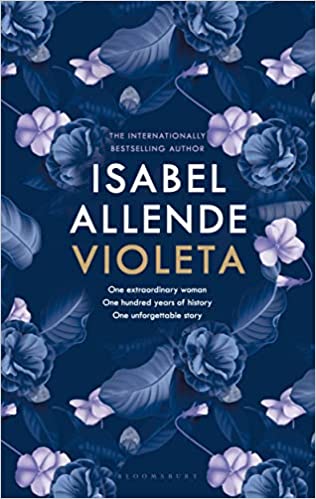
I have a particular fondness for Isabel Allende. She is an icon of world literature, of global feminism, of how to embrace ageing and of the joy, beauty and depth of south American culture. In a week when the world said its goodbyes to one female icon (Queen Elizabeth II, regardless of what you think about monarchy, it was quite a moment) and were shocked to learn of the sudden death of another, this time from the world of literature (the terribly sad news of Hilary Mantel’s untimely passing), it seems appropriate to praise Allende and value her for all that she has given us.
The last arts event I attended before most of the world went into lockdown on the brink of the Coronavirus pandemic, was a talk in Manchester between Allende and Jeanette Winterson on the publication of her last but one novel The Long Petal of the Sea. I enjoyed that book though I felt it was not among her best. Allende’s latest novel, Violeta, published earlier this year and written, one assumes, during the pandemic feels like that to me too.
The central character, Violeta, is an elderly woman (almost 100 years old we will learn) writing a letter, memoir, for another character Camilo. We don’t know the connection between Violeta and Camilo until about halfway through the book and I’m not going to give any spoilers here, though we do know that she loves him “more than anyone else in this world”. The story begins with Violeta’s birth in 1920 at the time of the Spanish ‘flu outbreak in Chile. Her father committed suicide, after a series of failed business ventures brought him and his family to a situation of near penury, and it was Violeta who found his body.
Her childhood was spent mostly in a rural setting on a smallholding where she was educated in the school of life. The family was forced to flee there after they lost everything in the Depression. She grew up with her brother in the care of a poor family who showered her with love and protection. She married a man who was the son of affluent European hoteliers, but the marriage was largely sexless and doomed. When Violeta met the dashing Julian Bravo, a pilot, and a passionate lothario, she was immediately swept off her feet and left her husband. This brought disgrace upon her head, particularly as Julian refused to marry her, even when she bore him a son and a daughter.
Julian lived life on the edge, having lots of money one minute and none the next, so although their relationship was initially a fulfilling one, it lacked stability. As a young woman it was clear that Violeta had business acumen so she set up a company with her brother in the construction industry and was very successful, able to support herself and her family without being dependent on her wayward lover.
That is as much as I will say about the plot. The book is basically the story of a life so to tell you any more would be to give you a full synopsis! The life story it tells is an interesting one and Violeta certainly has an interesting life. She is also telling the story from the perspective of a person of a great age, so she is able to reflect on her mistakes as well as celebrate her life’s achievements. It is a pretty linear first-person narrative and that, for me, is where it disappoints. I have come to expect more of such a great writer and the book for me never really delivers. Throughout I was just wanting more. There is no doubt that Allende is a great storyteller and the interweaving of history into the narrative, the politics of south America in the twentieth century, the dictatorships, the terrors, the corruption and the sheltering of Nazis fleeing Europe, is fascinating and deftly done, but I just felt she was capable of more. Some parts of it are clumsy (for example the love scenes which made me squirm a little!) and some parts of it feel autobiographical (for example, Violeta’s views on feminism), almost as if Allende herself is writing a letter to her readers.
I hope there is more to come from this wonderful author, and fans of Allende (and I count myself as one) will of course treasure every word she writes, but I do rather feel this book lacks some of her usual creative energy. Perhaps that is a result of its having been written during a lockdown. My fellow book club members enjoyed it, and found its uncomplicated approach quite refreshing, especially as we read it over the summer. It also does have a rather neat symmetry, which you will see if you read it.
Recommended if you like a good story that does not ask too much of a reader.
I’d heard a bit about this book before I read it, but I have to say that I had not paid too much attention to it. I’d recently tried to watch the film Passing (made in 2021 and starring Ruth Negga and Tessa Thompson), one that had been on my must-watch list for some time, and I fell asleep less than halfway through! It was slow and I found it hard to get into, but perhaps I should give it another chance. The Vanishing Half deals with a similar topic so I was not in a rush to pick it up. It came up as an audiobook suggestion, however, so I decided to give it a go over the summer.
The story begins with twin sisters Stella and Desiree Vignes, growing up in the small town of Mallard, Louisiana in the 1950s. Segregation remains in place in the Deep South of America, of course, but the black citizens of Mallard are unusual in that they are particularly light-skinned, a consequence of the town’s history and in particular its founder. Prejudice and discrimination are nonetheless deeply embedded. Both girls are bright and ambitious, but their widowed mother withdraws them from school prematurely in order that they can work with her at the house of wealthy local landowners and help to support the family.
Stella and Desiree are frustrated by the manual toil and the unwelcome sexual advances of their employer and decide to run away. The twins have starkly different personalities; Stella is the quieter one, the more academic, Desiree is more outgoing, more vocal in her desire to escape the oppressed atmosphere of Mallard and is the prime mover in the escape plan.
The two young women find themselves in New Orleans working in a laundry, with little money. After her sister is fired, Desiree encourages Stella to apply for a clerical job. Stella does not expect to be successful, but, with her very light skin, she is mistaken for a white woman which means that her skin colour is less important than her skills and she gets a job working for Blake Sanders. Finding that her status as a “white woman” affords her privileges which she has never before experienced, Stella maintains her secret and soon finds there is no way back. Furthermore, Blake falls in love with Stella and eventually asks her to marry him. Stella decides to leave her sister and her old life behind.
The hardest part about becoming someone else was deciding to. The rest was only logistics.
From Brit Bennett’s “The Vanishing Half“
Meanwhile, Desiree, newly bereft, gets on with her own life. She marries a black man and moves to New York, where they have a daughter, Jude (whose skin is very dark like her father’s, not light, like her mother’s). But her husband becomes violent and so she decides to leave him. Desiree has nothing and has completely lost touch with her sister and so returns home to her mother’s house in Mallard with her daughter. Desiree never intends to stay, but somehow she does. She gets a job in the local cafe, where she quickly becomes indispensable, begins a relationship with a childhood admirer, Early Jones, who works as a shadowy investigator, and settles into small town life.
Meanwhile Stella has also had a daughter (blonde and white), Kennedy, and leads a privileged life in California. Her world is somewhat rocked when a black family moves into her affluent neighbourhood. They are treated with suspicion and contempt by local residents and Stella finds herself torn. Despite herself, Stella develops a close friendship with the woman, which triggers a series of events and changes in Stella, a burgeoning of desires which will eventually lead her back to Mallard.
Unlike what little I saw of the film Passing, The Vanishing Half has a complex plot which is deftly handled by Brit Bennett. It spans a large time span, from the 1950s to the 1990s, and moves back and forth in time and between the parallel lives of the two sisters. It becomes even more complex when the two women’s daughters begin to play a larger part in the story, leading their own lives away from their mothers. The book also explores many different types of relationship, between Stella and Desiree and their husbands, Desiree’s with Early, fathers and daughters, the women’s relationship with their mother Adele, and the two, very different, cousins, Kennedy and Jude. There are many ‘halves’ in the book; Stella and Desiree, as twins, are of course, two halves of a single birth event, but there is also the dichotomy in Stella’s life in particular. There is also the issue of two sides to every story and in this novel each person’s personal narrative is multi-layered.
I was gripped by this book and on audio it was brilliantly read by Shayna Small. I might have wished for a neater ending, but in fiction, as in life, things don’t always work out quite how you want them to!
The last month has flown by. Not only have I not been blogging very much in the last few weeks, but my reading has also been patchy at best. As I mentioned in my last post, I was on a family holiday in France for two weeks. My eighteen year-old daughter, who has turned into a bit of a bookworm in the last couple of years, observed that you always think you are going to read more on holiday than you actually do. I always take at least one book for each week that I am away (and that’s when I am being restrained!), but if my recent performance is anything to go by, I seldom get through even one! I planned to read Margaret Atwood’s very bulky Burning Questions, but it came back with me unread because I had only just started a book called The Behindlings by an author I do not know, Nicola Barker. It’s a bizarre and curiously compelling (also very long) book which I have yet to complete. More about that for a future post.
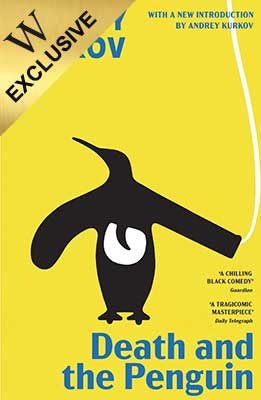
This week I would like to tell you about another book that took me a very long time to get through, and which I posted about my intention to read many weeks ago – Death and the Penguin by Andrey Kurkov. This was first published in Kyiv in 1996. The first edition in English came out in 2001. It has been reissued this year with an updated foreword by the author under theRead for Ukraine initiative in association with Oxfam. For each copy sold, a donation has been given to Oxfam’s Ukraine Humanitarian Appeal.
Death and the Penguin is considered one of the greats of contemporary Ukrainian literature and Andrey Kurkov is a respected international commentator. He has written over twenty novels as well as books for children and is a documentary maker. Born in St Petersburg, he writes in Russian but in his foreword to this edition he writes of has sadness and dismay at the Russian invasion of his country.
I read this book very slowly, almost in real time with the events of the novel! The central character is Viktor and his pet penguin is Misha, a powerful presence in the book and a motif for Viktor’s state of mind. Viktor is an aspiring writer who is offered a job writing obituaries for a newspaper. It soon becomes apparent that he is writing notices about people not yet dead, and that his subjects are being assassinated mafia-style. Viktor becomes increasingly paranoid and he enters into a series of bizarre relationships. First he is left in charge of a young girl, Sonya, the daughter of the Chief of Police, known as ‘Misha non-penguin’ to distinguish him from his animal namesake, a hilarious touch. Misha non-penguin disappears and Viktor hires Nina, the niece of a militiaman he meets, as a nanny for Sonya, to look after the child while he is working, or hiding form the increasing list of dangerous individuals he believes are in pursuit of him. Viktor starts a relationship with Nina, but it is a strangely cold one and stands in contrast to his relationship with the penguin.
Viktor’s situation starts to look increasingly desperate when he finds that a new person has been hired to write obituaries and that he, Viktor, is to be the subject of one. In the meantime, Misha starts to become sick and Viktor is told that the penguin needs a heart transplant or else he will die. A child’s heart becomes available and the operation is successful, but Viktor decides that he must return Misha to Antarctica. He learns of an expedition that is travelling there and he pays for Misha to go. At the very last minute, however, Viktor opts to save his own life and switches places with the penguin, figuring that the penguin in popular and someone else will take care of him.
This is a surreal and dark book, with moments of black humour. Set in the 1990s in Kyiv and its environs it captures the sense of surveillance, of corruption, of secrecy and scarcity that pervaded the former Soviet republics at the time. It has been described as an existentialist novel, exploring as it does Viktor’s inner turmoil and expressing that through the mood and health of the unspeaking penguin.
It is a work of surreal quality that reminded me of The Unbearable Lightness of Being by Czech writer Milan Kundera, set in a similar context and with the same feeling of oppressiveness, as well, of course, as the presence of a pet. There were times when I wondered what on earth the book was about, but I understand it better having reflected on it. Kurkov is definitely an author whose work I would like to explore further.
I would recommend this book to gain an insight into a very different literary tradition, and to trigger a donation to the Ukraine Humanitarian Appeal. Let’s hope the war is over soon and that justice prevails.
This was my my fourth non-fiction book of the year and, very helpfully, also my book club read for June (now only two behind!). I have to admit I was a little sceptical at first. It was suggested by one of my fellow book club members and I had not heard about it before. I thought it would be just another rich family memoir, but it seemed to have a bit of history about it, so I was game.
The author is a British ceramicist whose grandmother was part of one of the richest Jewish families in Europe, the Ephrussi banking dynasty, before the Nazis confiscated their property and they were forced to flee their native Vienna in the late 1930s. At the start of his journey the author apparently knew very little of his family history and it is only through the discovery of a collection of ‘netsuke’ tiny Japanese carved figures of people and animals in ivory or wood, that he decides to explore further. The author was on an academic sabbatical in Japan, where his great uncle Iggy (Ignatius) lived when he sees the collection for the first time. He is fascinated by the netsuke and this prompts him to dig deeper into their history and how they came to be in his family.
The book does begin as something of a rich family memoir. Originally from Odessa, the accumulation of wealth through banking enables them to live variously in Paris and Vienna, mixing with the highest-calibre thinkers and artists of the day. It is Charles Ephrussi, an enthusiast for ‘japonisme’, which was popular at the time, who put together the collection of netsuke. Later, they would be considered more like minor trinkets (compared to other parts of the collection), played with by the children of the family, as taste for japonisme waned and the market became saturated with lower quality objects. Because of the family’s wealth and importance, the author has been able to compile a detailed history of the family and imagines the scenes and events at their various homes, the salons they held with the famous people of the day present. It is fascinating but a touch sterile for me.
As the narrative moves into the twentieth century, and the inevitable decline of the dynasty, I felt it became more interesting. The first world war changes everything, of course, for that stratum of society, but the author writes most movingly when describing the decade or so before the outbreak of the second world war, with the gradual demonising of Jews, particularly the wealthy ones. As various members of the family see the writing on the wall and flee the continent, the dynasty begins to break down. The final humiliation comes when the Nazis confiscate their mansion in Vienna and all its contents. The netsuke only survived this process because the family’s long-serving maid, Anna, who was kept on at the house, gradually spirited them away and hid them in her mattress. Later they were smuggled out of the country.
This part of the book is also most moving because it is within the author’s living memory almost, his grandmother having been one of those to flee Vienna, arriving in Kent with next to nothing and having to start her life again. De Waal also becomes increasingly reflective as the history gets closer to the time of the war and to his living family members. It is as if he becomes able to feel their pain. He is also philosophical about how relatively lucky his family were – yes, they lost everything (and they had a lot to lose), but they survived and prospered, unlike many other European Jews. Their wealth meant they were able to leave more easily than most. He is also deeply moved by the loyalty of Anna, the family maid, who risked her own life by trying to save something of the family’s collection, the netsuke.
I listened to this on audio and it was beautifully read by Michael Maloney, but it would have been useful to have the family tree that is in the print edition to refer back to as I did lose track of the members of each generation. The book won the Costa Book Award in the Biography category in 2010. Since its publication, some historians have challenged some of the facts in the book, I gather, for example suggesting the standing of the Ephrussi family has been overstated. I suspect some misrepresentation is inevitable in this kind of book, where the author has fleshed out bare facts with imaginings about day to day life, and this does not detract too much.
It is a fascinating account – recommended.
My next non-fiction read is a book I have had for a while now, Margaret Atwood’s Burning Questions – a collection of essays and comment pieces. It is another big book, so I suspect I am not going to be catching up too easily on my non-fiction challenge for the year, but I plan to take it on my summer holidays so we’ll see!
The second holiday reading recommendation I’d like to share with you is The Break by Marian Keyes. For years I eschewed Marian Keyes (though I always enjoyed hearing her whenever she popped up on the radio) in the mistaken belief that her books were a bit too ‘chick-lit’ for me – I say this completely ironically, since I loathe that term – it’s so pejorative and patronising! I would argue all night that no genre is better or worse than any other, it’s all just about what you enjoy reading. I might just draw the line at ghost-written autobiographies by very young minor celebrities, but that would be a personal line, and I would be happy to be proven wrong. Back to Marian; my book club read Grown Ups a couple of years ago, after which I was completely hooked and vowed that I would work my way through all of her eighteen novels and five non-fiction books – I’ll write that again…EIGHTEEN novels! She has apparently sold more than 35 million books worldwide. She is one popular writer, and deservedly so.
As with Grown Ups I listened to The Break on audio, and I absolutely loved it. It wasn’t Marian herself narrating this time, but Aoife McMahon does an excellent job. The plot is simple but effective. Amy and Hugh are seemingly happily married with three daughters – Niamh is from Amy’s first marriage, Keira is their own and Sophie is her niece, who came to live with them after her own two parents (Amy’s feckless brother and his equally feckless Latvian girlfriend) separated and showed no ability to care for their daughter. Hugh hits a difficult patch after the death of his father and best friend, and announces to Amy that he wants to take a complete six month break. He doesn’t just want a holiday on his own, he wants to spend six months in Asia with a backpack living as if he was single, with all that this entails.
Naturally, this comes as a tremendous shock to Amy. By the time he tells her, Hugh has already made most of his plans and so there is little time for her to influence his decision. He insists that he loves her completely and fully intends to come back and resume their life as it was before, he just needs this ‘time out’. After he leaves, Amy goes through something like a bereavement, trying to come to terms with the practical and emotional implications of his actions. Amy’s family (sprawling, loving and a bit chaotic, typically Irish, you might say, and a common characteristic in Keyes’s work) has challenges of its own – her father has dementia, which puts a strain on the offspring, there are sibling rivalries and each of Amy’s daughters is going through their own turmoil, partly connected and partly unconnected to Hugh’s departure.
Amy has a job as a PR executive, working two days a week in London with her two partners in their small company. Life as a single parent therefore presents her with many practical challenges; even though the girls are old enough to look after themselves on one level, it is clear that they still need a lot of support. Amy’s life is busy and Hugh has left her in the lurch.
Amy’s friends encourage her to embrace her own bit of single life while Hugh is on the other side of the world having his fun. (Amy cannot help stalking his Facebook account and when she sees him with another woman, it is a devastating blow.) Amy’s relationship adventures turn out not to be as easy or exciting as might be expected, and neither do Hugh’s.
I don’t want to give away any spoilers, but needless to say, the book is not just about what each of them does while they are apart, but also what happens when Hugh returns, how they are changed and what the implications are for the relationship. Keyes keeps you guessing and it does not pan out quite how you expect. Part of this author’s skill, I think, is in taking the everyday mundane aspects of life and making out of them something special. It is so engaging because the characters, and therefore the events that befall them, could easily be us. There is an impressive cast of characters in this novel and yet they are all distinctive, well-drawn and multi-faceted. The narrator of the audiobook does very well also to give a slightly different voice twist to each one.
So, another ‘highly recommended’ for your summer reading!
For many of us (lucky enough to have a passport and the funds to do so), thoughts are turning to summer holidays. Even if you are not getting away this year, perhaps you will have some relaxation time to enjoy the warmer weather from the comfort of your own garden or a local park or beauty spot. I am seeing quite a few ‘best books for the summer’ type features in newspaper supplements, magazines and in online newsletters so I thought I would join in and share a couple of my own recommendations this week.
What do we want from summer reading? Well, I read Ulysses on a trip to Spain many years ago, but life has changed somewhat since then and that would be a bit ambitious for me these days! Generally, holiday reads should not be too taxing, can be picked up and put down as we take a dip, that we don’t mind getting sand over and which we might just leave on the holiday let bookshelf to make space in our luggage when we leave. Oh, and long enough that they will definitely last the whole trip plus any potential waiting time in stations or airports!
The first book I’d recommend is The Seven Husbands of Evelyn Hugo by Taylor Jenkins Reid. This was actually recommended to me by sixteen year old daughter who read it cover to cover in days, could not put it down (AND she was revising for GCSEs). It tells the story of the life of ageing film star, Evelyn Hugo, giving a rare and possibly final interview to accompany the auction of a number of her gowns for a cancer charity. Evelyn agrees to the interview (a major scoop for the magazine Vivant) on the basis that it is conducted by one of its least-known writers, Monique Grant, a condition which irks the magazine’s editor.
Monique, who is going through some difficult life events herself, her husband having recently left her, is surprised when at their very first meeting, Evelyn reveals that she has in fact hand-picked Monique to write her biography, NOT to do a magazine interview, though she will not reveal the reason. Evelyn begins to tell Monique the story of her life, from the very beginning when she lost her mother and as a teenager married Ernie Diaz (husband number one), as a way to escape Hell’s Kitchen in New York and her violent father and go to Hollywood where she plans to find fame and fortune. She quickly finds roles in a number of films and after divorcing Ernie she marries her handsome and popular co-star Don Adler. Evelyn is a huge success and is nominated for an Oscar for her role in an adaptation of Little Women. She finds herself embroiled in scandal however, when she leaves Don who, after a brief honeymoon period turned out to be abusive. But as a woman, it is Evelyn who is publicly ostracised and the Oscar goes instead to her co-star Celia St James, with whom Evelyn will go on to have an important friendship.
The story goes on, with Evelyn recounting the events of her life, how she came to have seven husbands and the circumstances behind each of her marriages. She had a daughter, the result of her fifth marriage to Hollywood producer Harry Cameron, one of her very few true friends. But Connor, their daughter dies of breast cancer, hence the sale of Evelyn’s gowns to benefit the charity. Evelyn tells her story in parallel to the reader learning of Monique’s relationship troubles. Through her meetings with Evelyn, Monique gains a certain courage which enables her to confront some of the issues in her life and begin to take control of her destiny rather than being the victim of circumstances.
I listened to this on audiobook and it far exceeded my expectations. My daughter told me that I would “never get the plot twist”. There are in fact quite a few very clever plot twists, some of which I foresaw (and felt rather smug about) and one or two jaw-droppers I did not. The book has become an international bestseller of course, since its publication and the author, Taylor Jenkins Reid has had other popular and critical successes, most notably Daisy Jones and the Six (which I picked up secondhand the other day and which might be one of my own summer reads). Monique and Evelyn were voiced separately and both were very good, I felt.
The book is everything you could want from a summer read – doesn’t require too much brain power, engrossing, a fantastic plot, great characters and an interesting premise. Highly recommended.
The non-fiction reading challenge that I set myself at the beginning of the year has not been going quite to plan – I set myself the goal of reading one non-fiction book a month, so I should be well into my sixth by now, but I have only completed three. My reading has been quite erratic these last few months; my two daughters have been doing their GCSE and A level exams and have needed a lot of support from me, including taking them to and from school for the exams themselves. Happily, they finish this week and I am pleased to report that they have both coped really well with the enormous pressure.
After the challenge of Andrew Arsan’s Lebanon, I went for something completely different for my third non-fiction, a book by the Japanese author, Haruki Murakami, who is much better known for his novels, such as Norwegian Wood and 1Q84. He is considered one of the world’s greatest living writers and has published fourteen novels, several short story collections and a number of essays and works of non-fiction.
I came across What I Talk About When I Talk About Running by complete accident when I was looking for books to give my son for a foreign trip he took recently. He is a keen runner too and I thought he might find it interesting. Reading the blurb I determined that I would give it a go myself.
I decided to listen to it on audiobook, and to listen while I was running! It’s fairly short, less than five hours listening time, around 200 pages, so I got through it fairly quickly. In it the author talks about his experience of running marathons, which he does once a year, and an ultramarathon in his home country of Japan. He writes about his highly disciplined approach to running; he has run six miles a day, six days a week for more than two decades. He wrote the book in 2007, when he was in his late fifties, and was still managing to maintain this schedule. Despite his busy life as a world-famous writer, international lecturer and academic, he has stuck very successfully to this schedule. He is now in his early seventies – I wonder if he is still doing it?
He writes of the benefits to his mental and physical health from his running schedule, but he is not fanatical about promoting his particular method. He is simply writing about what works for him. He draws parallels between his approach to running and his approach to writing – the meticulous attention to detail, the obsession with timings, the need to remain on task. It is also fascinating when he writes about what he notices when he runs, the landscapes and people around him, how it makes him see the world in a certain way. This is the continuous practice of the writer, observing what is happening in the world they inhabit.
This felt like a very intimate book; Murakami lets us into his very private running world. As a runner myself I do not talk very much about the strange thoughts that go through my mind when I’m running, how I feel when approaching a known hill or what my legs feel like after 7km, but Murakami takes us there. Some of the narrative is extremely detailed, for example when outlining his training schedule for an upcoming marathon – this could be the literary equivalent of showing someone your holiday photos! In other words not really interesting to anyone else! But if you are a runner and interested in the process you will be drawn into his world of measurements, timings, footwear and clothing considerations, like it was all completely normal conversation. As with running the book has a meditative quality.
I thoroughly enjoyed this book and I recommend listening while running.
My next non-fiction title is actually one my book club is reading – The Hare with the Amber Eyes by Edmund de Waal, about the well-known potter’s search for his family history as he traces the origins of a cache of Japanese miniature sculptures. Let’s hope I can catch up on this challenge!
The Women’s Prize has really gained in profile in the last few years. I think it’s actually been better since it stopped being sponsored by, first, Orange and then Bailey’s. By calling itself simply ‘The Women’s Prize’ it seems to have been able to be truer to its purpose. It also seems not to have suffered from some of the criticisms that other literary prizes have attracted around diversity. I make it my intention to read the Booker Prize shortlist each autumn; perhaps I should do the same for the The Women’s Prize.
This year, I have read three of the six titles on the shortlist, although one of these, Maggie Shipstead’s Great Circle, was shortlisted for the Booker last year too, so I was one step ahead for a change! I have already written about how much I loved that particular book.
When the shortlist was announced, my book club decided we’d read The Sentence Louise Erdrich. Erdrich is an American author. She won the Pulitzer Prize in 2021 for her novel The Night Watchman. I know very little about her, except that she has Native American heritage on her mother’s side, and that this cultural inheritance influences her writing.
The Sentence is a complex book. The main character is Tookie, an Ojibwe woman who is convicted of drug smuggling and given a prison sentence. She has had a difficult upbringing (in common with a disproportionate number of Native American and African American young people, an issue which underpins many of the novel’s themes), but during her incarceration she discovers literature. When she is released she marries Pollux, the man who arrested her, a kind of tribal law enforcement officer, and gets a steady job in a bookstore. Her life is good, on track, and she and Pollux live very happily.
All that changes on All Soul’s Eve in 2019 when a former customer of the bookshop, a cantankerous elderly woman called Flora, dies. Tookie is convinced that Flora is haunting the bookstore, more as a poltergeist than a friendly ghost, and the impact this has on Tookie’s mental state is mirrored by wider social events which seem to signify a kind of societal breakdown. The novel is set in Minneapolis (where Erdrich herself lives so she will have been close to events) and the murder of George Floyd in 2020 is a totemic moment that causes grief and chaos. Then there is the Covid pandemic, the lockdowns, the visceral fear of disease and the social isolation that it leads to. Tookie and Pollux at least have each other (plus Pollux’s daughter Hetta and her baby son, who come to live with them), but it is clear that this is a period during which the things they have thus far taken for granted are being swept away.
The Sentence is a powerful novel which explores many important issues, but I cannot say that I really ‘enjoyed’ it. It is one of the first ‘pandemic novels’ I have read and it will have been written when the world was still in the grip of Covid, not really knowing how or if we would get out of it. That comes through strongly in the novel, the sense of entering an unknown state, whilst also observing things falling apart. The aftermath of George Floyd’s murder will also have been quite raw and the sense of history repeating itself, of lack of justice for minorities and fear of the police, a sense of social structures collapsing, is expressed in Tookie’s despair. For me, though, the novel feels a little under-cooked. I’m not sure many of us have fully processed the events of 2019-21 and the novel seems to flounder a bit on not really having a clear direction.
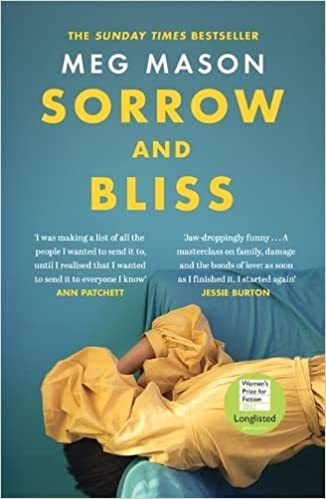
My feelings about another of the shortlisted books, Meg Mason’s Sorrow and Bliss could not be more different. It too deals with a pressing social issue, mental illness, but it deals with it through, for me, a much stronger narrative. Martha is unwell. She has her first bout of depression, or ‘episode’ we might call it, when she is seventeen. Her family might be described by some as bohemian, dysfuctional by others. Her parents are artists, her father a poet and her mother a sculptor, and neither is especially successful. Her mother, Celia, was brought up largely by her older sister Winsome, after their mother died. Winsome married a rich man, lives in Belgravia, and largely supports Celia and her family. Martha has one sister, Ingrid, to whom she is very close.
Every year, the whole family gathers for Christmas in Belgravia, and included in their number is Patrick, a boarding school friend of one of Martha’s cousins. Patrick’s mother is dead and his father lives abroad and appears not to care very much about his son. Patrick is one of the few people able to empathise and show genuine care when Martha is first unwell, that Christmas in Belgravia, and we later learn that he has been in love with her ever since. Martha makes a very brief and disastrous marriage to wealthy and obnoxious financier Jonathan, who bolts at the very first sign of her illness. Later she will marry Patrick (not a spoiler since the book begins with what is described as the end of her marriage to him after Martha’s fortieth birthday). Their life together is entirely dominated by her illness, which is misdiagnosed, misunderstood, mismanaged, and incorrectly medicated. Eventually, Martha receives a new diagnosis from a new psychiatrist – significantly, the name of her condition is left blank. This is not a book about a condition, it is a book about how mental illness tears lives apart, and not just the lives of those who have the condition. Martha is prescribed medication which finally seems to work, but when Martha seems to be getting ‘fixed’, her life actually begins to fall apart.
This book is an astonishing account of a severe mental illness from the point of view of the person experiencing it. We see the world entirely through Martha’s eyes for most of the book, until the final, correct, diagnosis is made. As the fog clears for Martha, the experience of being a loved one of someone with a mental illness, partner, sibling, parent, is given air time. It is astonishing and I have not read anything quite like it before. Meg Mason writes concisely and brilliantly, with a style that is both spare and completely exposing. She also has the most extraordinary dark humour – the trauma is so deep that you do actually need the laugh out loud moments. It reminded me a bit of Phoebe Waller-Bridge’s Fleabag in that respect. The characters are powerfully drawn and I loved the exploration of the relationship between Martha and her sister Ingrid – brilliant, comic, intensely loving and brutally honest.
I don’t know much about the remaining books on the shortlist, but I would be delighted to see Meg Mason or Maggie Shipstead win – both their books rank in the top five titles I have read in the last twelve months.
So, Sorrow and Bliss highly recommended, The Sentence, I am more lukewarm about. You can watch a live stream of the prize-giving event and the announcement by following the link here.
At the start of the year I set myself a non-fiction reading challenge. I realised that although I loved non-fiction, it was a genre I had neglected a bit. I set myself the goal to read one non-fiction title a month. It has not been going well! My January book, BJ Fogg’s Tiny Habits, took a while to get through. My February book was Lebanon by Andrew Arsan, which I spotted in my local bookshop at the end of last year and bought on impulse. It was big and not cheap, so not the usual kind of book I would buy, so it was very much a treat to myself – I know, most people would go for a new lipstick or something!
There is a story to this. I had the privilege of visiting Lebanon about twenty five years ago. My closest friend at university was half-Lebanese and lived most of her life between Lebanon and the UK. Some of the time she was forced back to the UK due to civil unrest in Lebanon, but she always had a foot in each camp. At the time (the second half of the 1990s), Lebanon was relatively stable and I spend a wonderful few weeks there. The people I met could not have been warmer or more welcoming and I loved every minute of my trip. The history of the region is the history of civilisation and it is heartbreaking to see that that part of the world endures so much suffering and destruction today.
The ancient Roman ruins at Baalbek – a UNESCO World Heritage site
Lebanon is a tiny country, one of the smallest states in the world, but its strategic importance means it has a higher profile on the international stage than its size might suggest. Its population is though to be close to seven million now, but well over 1.5 million of these are thought to be refugees from the various conflicts going on nearby. Over a million refugees from the war in Syria are thought to be living in Lebanon.
I always knew that the country was comprised of a fragile balance of different religious interests, known as confessionalism. I also always knew that much of its political system was characterised by corruption and vested interest. I also always knew that it was a country whose people have endured the worst effects of that corruption and the factionalism. Who could forget the terrible explosion of out of date and highly combustible fertiliser at the Port of Beirut in 2020, which killed in over 200 people, and for which no-one has yet been held fully accountable? Lebanon is also a country that its other more powerful neighbours, particularly Israel and Syria, have sought at times to control. The story of Lebanon is fascinating if also rather tragic.
The aftermath of the explosion at the Port of Beirut (Copyright ABC news)
What I was expecting from Andrew Arsan’s book was a history of the country which would give me a more detailed perspective of its present conditions. I was expecting a textural narrative which would tell me more about the Lebanese people, their nature and character, and about the culture. That’s not quite what I got!
Andrew Arsan is a Cambridge scholar of Middle Eastern history, with Lebanese origins. This book is a work of great scholarship that focuses on the period 2005-2019 – the references alone run to almost fifty pages. The book begins with the assassination of Rafiq Hariri, the great political hope of the Lebanese people at the time. The Syrian government are thought to have been behind his killing. It triggered a period of political turmoil in the country that the author describes in great detail. I found much of this very difficult to follow. I suspect, however, that anyone with some prior knowledge of the country and its politics, or who was from Lebanon, would be able to appreciate this account more. The overwhelming impression that I was left with, however, was that the government is corrupt; it’s about who owes what to whom, is influenced by outside interests, and is more interested in itself than improving the lot of the population.
The second half of the book was more interesting to me as it followed many of the social developments in the period, the cultural changes, how corruption has compromised the basic rights of Lebanese people, for example, the extensive privatisation of beach areas, previously unowned public goods, to the exclusion of all but the wealthiest citizens. The very basics of life have become increasingly difficult – there are frequent power cuts, intermittent access to the internet, and there is a whole chapter on how government incompetence and corruption led to a months-long failure in refuse collection services, with predictable consequences.
The book is extensively researched – I don’t think I have ever read anything quite like it. It looks like the kind of book you would dip into, but in fact it is a book that is meant to be read as a single narrative work. It is extremely well-written, with dark humour as well as profound irony. It is a shame that it is unlikely to be read widely.
I could only read this book about ten pages at a time, so it took me almost two months to work through. It is not bedtime reading and it won’t be top of many wish lists, but it is the kind of book that deserves to be read and understood, because Lebanon is a country that deserves more of our attention and to be better understood.
The next book I read in my non-fiction challenge was Haruki Murakami’s What I TalkAbout When I Talk About Running – much longer title, much shorter book. I listened to it on audio over the course of about three runs. Look out for my review next week.







 Julia's books