Non-fiction book review – “Lebanon: A Country in Fragments” by Andrew Arsan

At the start of the year I set myself a non-fiction reading challenge. I realised that although I loved non-fiction, it was a genre I had neglected a bit. I set myself the goal to read one non-fiction title a month. It has not been going well! My January book, BJ Fogg’s Tiny Habits, took a while to get through. My February book was Lebanon by Andrew Arsan, which I spotted in my local bookshop at the end of last year and bought on impulse. It was big and not cheap, so not the usual kind of book I would buy, so it was very much a treat to myself – I know, most people would go for a new lipstick or something!

There is a story to this. I had the privilege of visiting Lebanon about twenty five years ago. My closest friend at university was half-Lebanese and lived most of her life between Lebanon and the UK. Some of the time she was forced back to the UK due to civil unrest in Lebanon, but she always had a foot in each camp. At the time (the second half of the 1990s), Lebanon was relatively stable and I spend a wonderful few weeks there. The people I met could not have been warmer or more welcoming and I loved every minute of my trip. The history of the region is the history of civilisation and it is heartbreaking to see that that part of the world endures so much suffering and destruction today.

The ancient Roman ruins at Baalbek – a UNESCO World Heritage site

Lebanon is a tiny country, one of the smallest states in the world, but its strategic importance means it has a higher profile on the international stage than its size might suggest. Its population is though to be close to seven million now, but well over 1.5 million of these are thought to be refugees from the various conflicts going on nearby. Over a million refugees from the war in Syria are thought to be living in Lebanon.

I always knew that the country was comprised of a fragile balance of different religious interests, known as confessionalism. I also always knew that much of its political system was characterised by corruption and vested interest. I also always knew that it was a country whose people have endured the worst effects of that corruption and the factionalism. Who could forget the terrible explosion of out of date and highly combustible fertiliser at the Port of Beirut in 2020, which killed in over 200 people, and for which no-one has yet been held fully accountable? Lebanon is also a country that its other more powerful neighbours, particularly Israel and Syria, have sought at times to control. The story of Lebanon is fascinating if also rather tragic.

The aftermath of the explosion at the Port of Beirut (Copyright ABC news)

What I was expecting from Andrew Arsan’s book was a history of the country which would give me a more detailed perspective of its present conditions. I was expecting a textural narrative which would tell me more about the Lebanese people, their nature and character, and about the culture. That’s not quite what I got!

Andrew Arsan is a Cambridge scholar of Middle Eastern history, with Lebanese origins. This book is a work of great scholarship that focuses on the period 2005-2019 – the references alone run to almost fifty pages. The book begins with the assassination of Rafiq Hariri, the great political hope of the Lebanese people at the time. The Syrian government are thought to have been behind his killing. It triggered a period of political turmoil in the country that the author describes in great detail. I found much of this very difficult to follow. I suspect, however, that anyone with some prior knowledge of the country and its politics, or who was from Lebanon, would be able to appreciate this account more. The overwhelming impression that I was left with, however, was that the government is corrupt; it’s about who owes what to whom, is influenced by outside interests, and is more interested in itself than improving the lot of the population.

The second half of the book was more interesting to me as it followed many of the social developments in the period, the cultural changes, how corruption has compromised the basic rights of Lebanese people, for example, the extensive privatisation of beach areas, previously unowned public goods, to the exclusion of all but the wealthiest citizens. The very basics of life have become increasingly difficult – there are frequent power cuts, intermittent access to the internet, and there is a whole chapter on how government incompetence and corruption led to a months-long failure in refuse collection services, with predictable consequences.

The book is extensively researched – I don’t think I have ever read anything quite like it. It looks like the kind of book you would dip into, but in fact it is a book that is meant to be read as a single narrative work. It is extremely well-written, with dark humour as well as profound irony. It is a shame that it is unlikely to be read widely.

I could only read this book about ten pages at a time, so it took me almost two months to work through. It is not bedtime reading and it won’t be top of many wish lists, but it is the kind of book that deserves to be read and understood, because Lebanon is a country that deserves more of our attention and to be better understood.

The next book I read in my non-fiction challenge was Haruki Murakami’s What I Talk About When I Talk About Running – much longer title, much shorter book. I listened to it on audio over the course of about three runs. Look out for my review next week.

Audiobook review: Notes on an Execution by Danya Kukafka

This was suggested by one of my fellow book club members for our April read. I had not heard of this author before – this is only her second novel – but I feel sure hers is a name that we will all hear about in the future. Danya is an American and is a literary agent in her day job. She published her first novel Girl in Snow in 2017, and Notes on an Execution was published earlier this year, to great acclaim it seems, judging by everything I have been able to glean about the book since finishing it.

Danya Kukafka
Danya Kukafka – an incredible young talent

The novel is set in the US and covers a period of thirty or more years and moves effortlessly back and forth in time. The present day strand is narrated by Ansel Packer, a convicted murderer who is on Death Row in a Texas prison, twelve hours from his execution. He reflects on the nature of life and death and philosophises about right and wrong. He has been writing down his thoughts in what he considers to be a work of philosophy (harking back to his time in college where he majored in the subject but failed to complete his degree) and plans to leave it as his legacy. He has been having a Death Row visitor, Shawna, to whom he grants custody of his manuscript.

Interspersed with Ansel’s narrative is an account of his past. He spent his early years on a remote farm, where his violent father Johnny abused his young wife, Lavender, then only seventeen years old, virtually keeping her prisoner and well away from normal society. Ansel receives no formal schooling and is isolated from other children. When Johnny takes Lavender on a trip, leaving four year old Ansel in charge of his baby brother, Lavender escapes her husband’s clutches at a gas station and manages to call the police to tell them about the children. Ansel is taken into foster care. He is told that his baby brother died.

An account of Ansel’s time in foster care in upstate New York is given by Saffy, another of the orphaned children living in the home. Saffy has had troubles of her own – her Indian father is unknown to her, she is the result of a short relationship her mother had, and her mother was killed. Saffy eventually finds her purpose as a police officer, working her way up to detective. She is put on a case involving three murdered girls whose bodies have been found buried in the woods. Saffy knows one of the victims – it was one of the girls she grew up with in the foster home. A suspect is found, but Saffy knows the homeless man being fingered for the crime is not the real killer. She harbours a private agenda to catch the murderer, which grows into an obsession.

A further narrator is Hazel, the twin sister of Ansel’s wife Jenny. Hazel recalls her first meeting with Ansel; shortly after he and Jenny get together at college, he joins the family for the Christmas holidays. Hazel is strangely attracted to him and jealous of her sister, but there is something about Ansel she does not trust. In the middle of the night she looks out of her bedroom window and sees him burying something in the family’s back garden, an action she cannot explain, but she says nothing.

This is a book about a serial killer; we know the ending, we know that Saffy must therefore eventually get him. This book is not a whodunnit. It is part cat and mouse – the chase, how Saffy will eventually catch up with him. It is also about the women Ansel killed, it tells their stories. It is also about the mind of a killer, how this is cultivated, what part his upbringing and his being left by his mother played in that evolution. Lest we blame his mother for “abandoning” him, the author explores Lavender’s story too – she was a child herself when she was impregnated by Ansel’s abusive father and it was his violence that forced her to take the only course of action possible to save herself and her children. She will carry the burden of that action for the rest of her life.

I was reading this at about the same time as Crime and Punishment and there are some interesting parallels – the brutal murders of women, the lack of remorse shown by the killer, the philosophising on right and wrong by the person committing the crime. The two books, separated by more than 150 years, share some similar characteristics, but Kukafka, makes the victims front and centre even though Ansel is trying to make the story about himself.

This is a brilliant book. It is powerful and interesting in a way that I did not expect and even though we know how it ends, the author still manages to throw in some heart-stopping surprises. I listened to the audiobook and was riveted. The performances were excellent.

Highly recommended.

Reading the classics – Russian literature

Russia’s invasion of Ukraine has galvanised most of the rest of the world in a way that one suspects Vladimir Putin did not expect. Economic sanctions have been imposed, Ukraine is being supplied with large scale weaponry to help it defend itself and organisations everywhere are questioning the participation of Russians in sport and the arts. Wimbledon will not be welcoming Russian and Belarussian participants this year. The Royal Opera House cancelled performances by the Bolshoi ballet scheduled for the summer. I read a news article this week about how Ukrainian citizens have been pulling down statues of Russian historical figures and renaming streets named after them, making their own views about Russian culture pretty clear. Days before Russia invaded Ukraine, I had just started to read Fyodor Dostoevsky’s Crime and Punishment. After 24th February, I asked myself whether I should be setting the book aside.

Fyodor Dostoevsky (or is it Dostoyevsky?) 1821-1881

Dostoevsky’s work pre-dates modern Russian history by some margin: he was born in 1821 in Moscow. He travelled widely in Europe and was for some time addicted to gambling, running up significant debts as a consequence. He died of a pulmonary haemorrhage in St Petersburg in 1881 aged 59. He is undoubtedly one of the greats of world literature and was writing at the time of what is considered to be the golden age of Russian literature; he was a contemporary (or near-contemporary) of the likes of Gogol, Pushkin, Turgenev, Tolstoy, and Chekhov. Dostoevsky is perhaps one of the greatest novelists ever and Crime and Punishment (first published 1865-66) is perhaps one of the greatest novels ever. That surely makes it a must-read whatever the geopolitical situation.

Dostoevsky has always been celebrated in Russia although his own politics are not easily defined. He was sentenced to penal servitude in Siberia at one point in his early life, for speaking out against the Tsar. This got him a sentence of four years, whereas Raskolnikov, the central character in Crime and Punishment , gets a mere eight years for a brutal double murder! Dostoyevsky was a Christian and decried the decline of ‘true faith’ in Europe in the nineteenth century in favour of secular constitutions.

My edition – with the old-fashioned spelling!

Raskolnikov manages to flee undetected, and the blame for the crime is pinned on a decorator working in the building at the time (he confesses!). But Raskolnikov is unable to live with his culpability. I use this term deliberately because it is clear that what our perpetrator feels is somewhat short of guilt, and certainly not remorse. Large parts of this novel are extended internal debates Raskolnikov has with himself, justifying his actions, but also fearing capture. He is paranoid about being caught by the wily police investigator Porfiry Petrovich. He becomes gravely ill (somatic sickness triggered by his mental torture) and is cared for by his loyal friend Razumikhin, as well as his long-suffering mother and sister.

Raskolnikov is not a likeable character and the devotion of his friend, mother and sister seem misplaced. The book is littered with other unlikeable characters, also of dubious moral fibre, from Dunya’s cold-hearted fiance Luzhin, to the drunk Marmeladov, who spends all his money at the tavern while his wife and children starve, to the malevolent Svidrigailov who lusts after Dunya and tries to blackmail Raskolnikov after overhearing him confess to the saintly Sonya (step-daughter of Marmeladov). Raskolnikov wants us to see his crime as merely on a spectrum of immorality; all men are bad, and he is not really that much worse.

The novel is profound and interesting and examines the state of mind of a particular type of criminal in a particular setting. A highly self-absorbed and entitled young man who cites poverty as the main reason for his actions. It so happens that I have also just finished reading Notes on an Execution by Danya Kukafka, a contemporary novel which also explores the mind of a killer. The central character there, a damaged young man who never really recovers from feelings of abandonment by his mother at a young age, also philosophises on his actions and invites us to consider how much worse he really is than others. Look out for my review of that shortly.

So, yes, we should still be reading, watching and listening to the giants of Russian culture because these are rooted in a history and reflect a people that is entirely separate from the present regime in Russia. The likes of Dostoevsky were established as great long before the present Russian leader came along and will remain so long after he is gone.

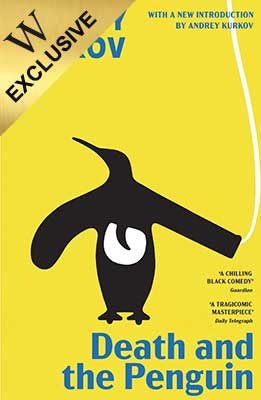
I will be reading Ukrainian classic Death and the Penguin by Andrey Kurkov next. Waterstones is donating the proceeds of all sales of this book to Oxfam’s Ukraine Humanitarian Appeal.

Book review – “Briefly Yours” by Cat English

A few months ago I read Erica Jong’s Fear of Flying and reviewed it on here. It was part of my 2021 reading challenge and for that month I’d set myself the challenge of reading some classic erotic fiction. The post must have got me noticed in certain quarters because shortly afterwards I was approached to participate in a book review tour. Now, this was my ‘first time’ so I agreed, rather excitedly! I may have been blogging for some time, but clearly there is a whole sector of book bloggers out there that I have never discovered before! They mostly inhabit Instagram and post short punchy reviews with lots of hashtags. (Note to self: must log into Insta again one day.)

Briefly Yours

Briefly Yours by Cat English is a non-fiction erotic memoir. ‘Cat’, her nom-de-plume and working pseudonym, is a call-girl, but she is no ordinary sex worker. It is very much a career choice which she has made in order to help fund her sister’s law degree and to support her passion, which is rescuing feral cats, feeding them, helping them to get well and arranging veterinary treatment, including neutering. Cat has worked in other sectors and in the book she takes time out from the sex work to try her hand at something more conventional, working in a department store. However, the lifestyle of the commuter and the bullying she is subjected to by her supervisor, are not worth the pitiful salary.

Cat’s life story is interwoven into her accounts of work at the parlour and many episodes of encounters with clients. She creates three separate worlds – the parlour, with the other women who work there, the clients and staff, a fun and credible cast of characters; her cat world, with all the feral creatures she names and cares for, with the help of her sister; and her family life, her mum, sister and brothers. She seems close to her family and they are aware of her lifestyle, even though she tries to keep it a secret generally from friends and neighbours. I would have liked to have had a little more sense of her sister’s gratitude – wow, what a sacrifice! Cat grew up on a council estate in the north west, so she is a down to earth girl who comes across as both deeply caring and pretty shrewd.

She deals with the issues around her sex work head-on. She invites the reader to set aside their prior assumptions and asks whether what she is doing is really any more exploitative than working for minimum wage in a dead-end job she hates. Whilst I was deeply uncomfortable with some of the issues she raised, it did open my eyes. It helps that she actually enjoys the work, both the sex and the customer service aspect (she meets people’s needs, and knows that she does it well). Some of the clients are ghastly, some are cruel and borderline violent (the set-up of the parlour brings with it a degree of protection), but Cat certainly feels like she has a degree of control. She has mixed feelings about the clients; some she really likes, others she has no respect for particularly if they have partners and children at home, but insisting their wives don’t understand them. There is a nice camaraderie in the parlour, but this is high-end, and therefore expensive. Even if you can accept prostitution at this level, one does wonder about the women who are doing it for much less, or to support a drug habit, or putting themselves at great risk on the streets. I found that quite difficult to get out of my head.

I suspect I am not the target audience for this book! I have to say though that I did enjoy it. It’s a light fun read. There is a lot of really bad erotic fiction out there, that is written for a certain kind of stimulation. I think this definitely better than most of the ‘written to a formula’ trash in that category. The sex scenes are very graphic (though not much more so than, say Luster or Queenie, even though those books would fall into a more literary category), but mostly they ring true. Cat writes well, actually, and with charm; she captures the array of clients really well and it feels authentic. I suspect she might not find the life of an author quite as lucrative as that of a call-girl, but I wish her well!

I was sent a complimentary advance copy of this book by Literally PR.

Book review – “The Secret Scripture” by Sebastian Barry

This is the third book I listened to in Sebastian Barry’s McNulty family trilogy. The first was The Whereabouts of Eneas McNulty, published in 1998, then I listened to The Temporary Gentleman, published in 2014, and then finally this book, which was published in 2008 and shortlisted for the then Man Booker Prize. I read them in the wrong order, but in doing so, arguably, I saved the best till last! The Secret Scripture is an astonishing and powerful piece of work, and provides answers to some of the unresolved questions raised in the other two books.

At the centre of the trilogy is the McNulty family and in particular the three brothers, Eneas, Tom and Jack. Eneas, as I have already posted about in my review of the first book in the trilogy, is something of a black sheep in that he is largely exiled from the family, in America, Africa and finally England, because of his job as a policeman which gets him into trouble with the republican Sligo underworld. The Temporary Gentleman concerns Jack, the golden child of the family, with a degree in engineering and a respectable marriage to the daughter of a doctor. However, this book reveals the lie about his life, hinted at in The Whereabouts of Eneas McNulty, his alcoholism and gambling and the problems in his marriage. The third son, Tom, who becomes a local councillor, is married to Roseanne, who is the subject of The Secret Scripture and who appears in both the other novels. Having come to The Secret Scripture last I feel now that this trilogy is as much about Roseanne as it is about the McNulty family, because their relationships with her tell us almost more about them than their own lives.

When the book opens we meet Roseanne, a woman in her 90s, perhaps even 100, a long-term resident of a mental hospital that is about to be demolished. Her psychiatrist, Dr William Grene, must assess her and determine whether she is able to be discharged into the community. There is a recognition that many of the residents of such institutions were committed for social as much as mental health reasons. Dr Grene sets about trying to establish why Roseanne, who has been a patient at the hospital for around half a century, was admitted. The story is told from the parallel perspectives of Roseanne, who writes her own story in secret, and Dr Grene who records his notes and observations in a day book. These become a kind of confessional for both of them.

What we know about Roseanne is that she was very beautiful and therefore treated with suspicion, considered almost a temptation to sin, and therefore a sinner herself. To make matters worse, she is a Protestant. As a child she idolises her father and spends a great deal of time with him at his place of work – his job is as caretaker of a cemetery, a role he takes very seriously. However, after a tangle with local gangsters, active in the political strife that beset Ireland in the 1920s and 1930s, he is served the humiliation of losing his position and being redeployed as a rat-catcher. He maintains his dignity, however, and is conscientious, but the family’s fortunes decline thereafter. Roseanne’s mother is committed to an institution and her father dies. The local priest arranges a marriage to Tom McNulty, and he truly loves her, but she is never accepted by his parents, the elder Mrs McNulty in particular.

Roseanne is ill-treated by them all, except Eneas. After being spotted in a mis-judged but innocent meeting with another townsman on a mountain walk, she is exiled as an adulteress. This is largely an excuse for the family to be rid of her. Her marriage is annulled and she is forced to live in a hut outside the town. Tom marries again and it is as if Roseanne never existed. She is maintained at subsistence level, but no more. Her fate is sealed when she becomes pregnant and gives birth to a child alone on the strand with the tide coming in. She collapses unconscious after the delivery and awakes to find herself being taken away by ambulance, and no sign of her baby.

Events unfold rapidly in the final third of the book. Connections are made with Eneas and with Jack, and the family’s stories become knitted together. It is a slow build, however, up to this point. What the author is doing very skilfully, is building the picture of this woman, of her relationship with Dr Grene, who provides us with a perspective on her and the treatment she received at the hands of the McNulty family and the Sligo community more generally. Roseanne is a marginal figure in the other two books, but a figure, a mystery, nonetheless. The Secret Scripture gives us answers to questions the reader might have had whilst also exposing the dysfunctional relationship between religion and society that bedevils Ireland’s modern history.

A film adaptation of The Secret Scripture was released in 2016, starring Vanessa Redgrave and Rooney Mara, though the story differs in some important respects.

This novel has been Barry’s most successful to date, winning the Costa Book of the Year in 2008 (his novel Days Without End won in 2017, making him the first double-winner) and the James Tait Black Memorial Prize the same year. Apparently, however, some have found the ending of the book flawed and unpalatable. I disagree wholeheartedly! I do not wish to reveal any spoilers, so I will only say that I found it extraordinary. I can see how some might find it a plot twist too far, but from a reader’s perspective it is heart-stopping and I loved it.

I am on a real roll with Sebastian Barry at the moment; having only discovered his work in 2017 when I read Days Without End, I cannot now get enough of him – there is the Dunne Family trilogy to savour next.

The Secret Scripture is a brilliant and powerful book and I recommend it highly.

Book review – “Where the Crawdads Sing” by Delia Owens

This book has been a phenomenal success since its publication in 2018 and has spent most of that time on various best-seller lists. A film is now in production starring Daisy Edgar-Jones (who played Marianne, to great acclaim, in the television adaptation of Sally Rooney’s Normal People) and I am reliably informed by a young person that Taylor Swift has written a song for it! I approached it with some trepidation – I don’t normally go for best-sellers and I feared this might be over-hyped and overly sentimental. I could not have been more wrong and my book club decided this might be one of the best books we had ever read.

Delia Owens
Delia Owens is better known as a conservationist than an author. Crawdads was her debut novel, published when she was 69.

The novel covers events in the period 1952 to 1970 and the central character is Kya (short for Catherine) Clark, known to the local rural community of Barkley Cove as “the swamp girl”. The North Carolina setting of the novel is crucial because Kya becomes an integral part of it. And the setting is brilliantly and powerfully evoked by the author.

The novel is told on two timelines. It opens in 1969 with the discovery of a body in an old tower beside the swamp. The victim is Chase Andrews, a local man, the sporting pride of Barkley Cove, suave, confident and outgoing, he is married but has a reputation as something of a playboy. The local police begin their investigation. The novel then reverts to 1952 where six year-old Kya, the fifth and youngest child of a ‘swamp’ family (one which lives in a rundown house beside the swamp, where their income is precarious and their reputation as outsiders separates them from the mainstream Barkley Cove community) watches her fragile mother walking down the dirt track away from their home, leaving the family for good. Kya’s father is a feckless, violent drunk and Kya’s older siblings gradually leave the home too, unable to bear his aggressive dominance. This leaves Kya on her own with her father. At times they are able to live relatively agreeably together – he sometimes gives her money from his war pension (the family’s only income) and she is able to purchase supplies from the town – but mostly, he disappears, sometimes for days at a time, and Kya is forced to learn to fend for herself. Eventually he disappears altogether. Kya manages to evade the local authorities who try and get her to attend school; they give up eventually too. Kya grows up alone developing an intimate knowledge of the natural world of the swamp, living in harmony with it.

Kya avoids everyone in the town, she has learned to stay under the radar of both the authorities and the two gossips, to whom she is a mystery, to be treated with suspicion and disdain, but she makes three friends: Jumpin’, and his wife Mabel, the proprietor of the swamp-side general store where she must go to replenish her basic supplies, and childhood playmate Tate Walker. When the young child Kya starts to visit his store alone, Jumpin’ quickly realises that she is living alone and he and his wife support and protect her discreetly as best they can; as “coloreds” they are themselves marginalised. Tate Walker was friends with Kya from a very young age when they played together, and is well aware of her father’s violent tendencies. His mother died, a loss which binds them, and he lives alone with his father. When Kya’s father vanishes they renew their acquaintance and their relationship deepens. They eventually become “lovers” of a kind, though avoid intercourse. Tate receives the education Kya is denied and is ambitious to go to college and study natural science. He promises that he will visit Kya during the vacations, but on his first visit home he spots Kya from a distance on the beach near her hut and realises that she is almost a wild creature (that is indeed part of what he loves about her) and that she will never be able to fit into the new academic world he now inhabits. Tate leaves Kya without saying goodbye or explaining.

In her deep grief at being abandoned once again Kya falls into a relationship with Chase Andrews. He seduces her and the two begin a secret affair. Chase tells Kya that he will marry her, though he never introduces her to his family. On a visit to Barkley Cove Kya sees an announcement in the local newspaper that Chase is engaged to be married.

Kya’s progress, from small child learning to live by her wits to beautiful young woman living alone on the swamp, fending for herself, is told alongside the story of the police investigation into Chase Andrews’s murder. Inevitably, the twin stories collide when Kya is accused by Chase’s mother and charged with the murder. The account of the trial is told in gripping detail in a way that is reminiscent of To Kill a Mockingbird. No spoilers here, however, as it will have you on the edge of your seat!

I listened to this on audio and it was read brilliantly by Cassandra Campbell, the same actress who read Maggie Shipstead’s Great Circle so powerfully. If you’ve read the hype about this book then believe it! I cried several times throughout – there are so many big moments in it. The plotting is extremely clever. The characters are all strong, fully thought through and well-rounded. But what makes this book so brilliant, and what for me makes it great, is that it is just a cracking good story!

Highly recommended.

Non-fiction reading challenge – “Tiny Habits” by BJ Fogg

I like to set myself an annual reading challenge – it’s a great way of expanding your reading horizons and I’ve thoroughly enjoyed the selections I’ve made over the last few years that I’ve been doing it. This year, I decided to do something a little different and set myself the goal of reading twelve non-fiction books. Non-fiction is a genre I neglected a bit last year and yet I come across so many books that look so fascinating.

Tiny Habits
First book of my non-fiction reading challenge complete!

For January, I set myself a relatively easy book, Stanford academic BJ Fogg’s Tiny Habits: Why starting small makes lasting change easy. I picked up on this when I was thinking about why so many of us find new year resolutions so difficult to keep. I generally make a conscious choice to not set myself any, in the firm belief that I’m setting myself up to fail! The opening of a new calendar or diary has the powerful effect of making me want to do or change something, however! Instead of resolutions I thought about some new habits I would like to adopt into my life. Nothing too earth-shattering, mainly things like drinking more water, practicing piano daily or writing something (anything!) each day. Small, incremental changes that don’t look that hard to do, but which I have singularly failed to implement in my life to date.

I liked the sound of this book. I like the idea of starting small – this seemed achievable. There is a website to accompany the book, https://tinyhabits.com/, which includes some free resources and, as you might expect, options to join mailing lists and paid-for courses.

The basic premise of the tiny habits approach is based on the science of psychology: first it’s about finding the motivational sweet spot of a habit (too many of us seem to set ourselves habits that we don’t really want to do, like go to the gym every day); second, it’s about designing behaviour changes that we are actually able to implement (within our means, doable in our daily lives); thirdly, it’s about finding ways to remember to do the things we want to do. I can really identify with this last one – I really want to drink more water, but I just forget! There is an underpinning equation to all of this: B = M A P (Behaviour = Motivation, Ability, Prompt).

This is not a book to be read straight through. It’s more of a workbook, and it is intended that you should implement some changes as you go along. There are lots of exercises at the end of each chapter and appendices with ideas and further resources. My copy now has lots of post-it notes sticking out of it. It’s quite a long book (270 pages, but very small typeface). It’s written in the typical self-help style with lots of anecdotes and a fair bit of repetition. I find most of these kinds of books could be shortened by at least a third!

As with most lasting change, there is no quick-fix method here, although I have to say that this book has helped me to implement some small desirable changes, for example, drinking more water, doing daily stretches, flossing my teeth and reducing my sugar consumption a little. The big take-away for me has been the concept of the ‘Anchor’ – ie pegging a desired new habit to something you already do very reliably like brushing your teeth. This has worked very well for me for the small things; the jury remains out on whether this is going to ‘scale up’ as BJ Fogg promises, into bigger changes. So, for example, if you set yourself the ‘tiny habit’ of one press-up per day, this can in time, evolve into a full-blown exercise regime, and therefore greater health and well-being, because you will be buoyed-up by your success in achieving the single press-up habitually. Fogg is also big on ‘celebrating’, for example, making sure you give yourself some sort of fist pump or similar when you achieve even the tiniest habit. This does not quite suit my English character, but I’m trying!

This is definitely a book I have learned from and one I feel sure I will dip in and out of. If you want to make some major changes overnight this is not going to work, but I am in agreement with the author’s basic premise that small changes have the greatest chance of success and that you can probably build on them over time.

Lebanon
Book two of my 2022 non-fiction reading challenge

Book number two in my non-fiction reading challenge is a very big one: Lebanon: A country in fragments by Andrew Arsan. Lebanon is a country that fascinates me and I had the very good fortune to spend some time there in the late 1990s. I’m looking forward to this one, though it may take me some time!

Interested in self-help books? Here are some others that I have reviewed:

WE: A Manifesto for Women Everywhere by Gillian Anderson and Jennifer Nadel

Women Who Run With Wolves by Clarissa Pinkola Estes

Big Magic: Creative living beyond fear Elizabeth Gilbert

Notes on a Nervous Planet by Matt Haig

The life-changing magic of tidying by Marie Kondo

The Things You Can See Only When You Slow Down by Haemin Sunim

Reading the classics – “Far From the Madding Crowd” by Thomas Hardy

One of the great joys of my life has been to have had the privilege to spend a solid three years of my life engaging with the classics of English literature (University of London, 1990). I have a particular passion for nineteenth and early twentieth century literature and one of my favourites is Thomas Hardy. I read all of his major (and many of his minor) works. I was very young when I read them though and had had nothing like the life experience I have now – of falling in and out of love, getting married, having children, dealing with deaths, dark times, joyful times and the like. Hardy is therefore a particularly interesting author to come back to later in life, when you have been through all those ups and downs of life.

Far From the Madding Crowd

I was delighted when my book club decided we’d read Far From the Madding Crowd. Although it is not my “favourite” Hardy novel, it definitely makes my top five. My favourite is Jude the Obscure, or at least it used to, but perhaps my feelings would be different now, closely followed by Tess of the D’Urbervilles, which I studied at school (a ‘first love’ if you like). I adore the Roman Polanski film adaptation from 1980, starring Nastassja Kinski which is so loyal to the book.

Bathsheba Everdene is one of English literature’s iconic female characters. Young, spirited, independent and ambitious, Hardy puts her in a position of power (running a business, a thriving farm) which would have been rare for women at the time. Hardy also allows his female characters to feel lust, passion and to follow through on their desires. They are even allowed to have sex! Poor, unfortunate Fanny Robin, pregnant out of wedlock by Sergeant Troy, dies penniless in childbirth. Hardy might even be considered an early feminist writer.

I experienced Far From the Madding Crowd on audio this time, a 2020 release narrated by Olivia Vinall, which was brilliant. It takes a particular skill to get the voices of the opposite sex right and the narrator achieves this extremely well, conveying very successfully the variations in character between Bathsheba’s suitors, Gabriel Oak, Farmer Boldwood and Sergeant Troy. I also loved her narration of the rural scenes with the farmworkers which could have been patronising, but were not.

This book is pure joy and so many of Hardy’s passages are simply breathtaking. I frequently found myself bookmarking chapters on the audio so that when I got home I could look up the printed version and immerse myself all over again.

Dorset
Puddletown in Dorset, renamed Weatherbury in Far from the Madding Crowd

In my book club we also watched the most recent film version, from 2015 starring Carey Mulligan, Matthias Schoenaerts and Michael Sheen. It was beautifully shot, wonderful to look at (because of Hardy, Dorset is my favourite English county); Wessex is well and truly captured. For me, however, it had a couple of fundamental flaws; firstly, it is simply too short! At a little under two hours it cannot deal effectively with all the themes explored in the book and so it is distilled down mainly to the slow-burning love story of Bathsheba and Gabriel. Neither is there sufficient time to truly justify the transition of its main protagonists. Secondly, Carey Mulligan, much as I love her as an actor, is, for me, just too old for the role. By my reckoning she would have been about ten years older than Bathsheba and I think she just comes across as too ‘experienced’, particularly at the beginning.

I have found a great blog from 2017 comparing the different film and television adaptations by Jennifer Rose Writes which seems to favour the original 1967 version starring Julie Christie. At three hours in length it might address at least one of my complaints about the 2015 film. It goes to show how audiences’ tastes and tolerances have changed. So, I am off to watch that.

The classics are classics for a reason – they bear multiple re-readings and it has been such a pleasure to come back to Hardy after so many years. I am resolved to make this a more regular pursuit. Next up, Crime and Punishment, I think.

Give the gift of books this Valentine’s Day!

My local shops are filled with hearts and red and pink things at the moment. I can’t begrudge them the opportunity to generate some profits on higher-margin sales after what have been a couple of very painful years for so many, but my heart sinks somewhat at the ghastly products sold in the likes of Marks and Spencer (which has had a good pandemic), as they further milk the Colin the Caterpillar and Percy Pig brands!

I don’t want to come over all Scrooge-like, however; we all need a bit of fun at this stage in the year and Valentines Day can certainly provide that. If your loved one is less than impressed by pink and shiny things, however, or if you’d like to give a rather more sustainable gift, there can surely be nothing better than a book. Bookshops are working harder than ever and those in my local high street have certainly put out a nice display of options – my lovely local secondhand bookshop (shout out to Abacus Books, Altrincham) always puts on a brilliant, ever-changing locally-themed front window.

The high street shops will cover all the classics of course, but I thought I’d give you a few ideas of my own based on my reading over the last year or two.

The Long Petal of the Sea

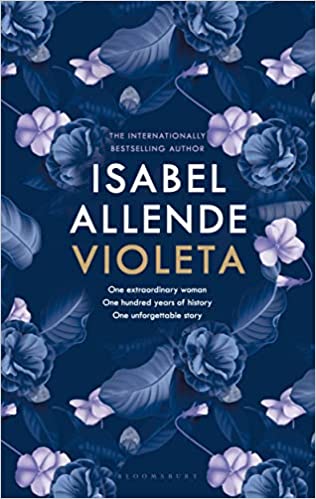
The Long Petal of the Sea by Isabel Allende – a romantic story of

Set in turbulent times (first the Spanish Civil War, then political unrest in Chile) this is a saga which tells of the love story of Victor and Roser, thrown together by tragedy, they stay together out of duty. But they ultimately discover the true nature of their love for one another after many decades. Based on real events.

The Unbearable Lightness of Being

The Unbearable Lightness of Being by Milan Kundera – this 1984 classic set at the time of the Prague spring in 1968 follows the relationships of Tomas, his wife Tereza, his lover Sabina and her lover Franz. And a dog. Complex and philosophical it is nonetheless a romance of sorts and very sexy!

If Beale Street Could Talk

If Beale Street Could Talk by James Baldwin – an American classic with a lovely film adaptation. This book tells the powerful story of two devoted young lovers Tish and Fonny in New York, whose lives are torn apart when Fonny is falsely convicted by a racist justice system, of rape. Tish fights for her lover’s aquittal, but she cannot overcome massive institutional hurdles. Can their love survive.

Normal People

Normal People by Sally Rooney – one of the books of the decade, surely, if your loved one has not read this or seen the television adaptation, then you must get it for them. Charming, sexy, with a top-notch male hero it explores the journey of young love, the ups and downs, the turbulence and misunderstandings, but ultimately how people can look after each other’s vulnerability.

Aristotle and Dante Discover the Secrets of the Universe

Aristotle and Dante Discover the Secrets of the Universe by Benjamin Alire Saenz – a powerful story about loneliness, friendship and how this can blossom into love. Two young teenagers, from very different backgrounds, with different life experiences and perspectives, different journeys to go on in terms of discovering their sexuality. Charming, heart-warming. Regardless of your gender or sexuality this is a story about the triumph and the beauty of love.

Call Me By Your Name

Call Me By Your Name by Andre Aciman – a summer romance set in Italy between an American adolescent on the threshold of adulthood, the son of two academics, and a visiting research student. The setting is beautifully evoked, the blistering heat of the landscape providing the perfect backdrop to the burgeoning sexual feelings between a teenager and the slightly older object of his desire. The romance is real, tender and, like most first loves, painful at times. Beautifully done.

I hope this gives you some ideas – it’s not too late!

Book review – “Dominicana” by Angie Cruz

Dominicana by Angie Cruz

This book first crossed my radar when it was shortlisted for the Women’s Prize in 2020. Most of us were under severe lockdown restrictions at that time, of course, and spending much of our social and cultural lives on video platforms. This was quite liberating for those of us living outside major cities; lots of cultural outlets, whose activities had been shut down by the pandemic, were forced to seek new sources of income and found them by broadcasting live-streamed Zoom events which anyone anywhere could join. The National Theatre (like other theatres across the globe) had been doing this for years of course with its NT Live and Encore programmes where performances are streamed into regional cinemas, but everyone suddenly got in on the act and it was great! I do live near a major city (Manchester, England), but still most events in the publishing world take place in London. One such event, in the past, has been the Women’s Prize talks, interviews with the shortlisted authors, but in 2020 we were all able to participate, and I even had a question answered!

It was a very strong field in 2020 (it always is!) which included Maggie O’Farrell’s Hamnet (the eventual winner that year), the final part of Hilary Mantel’s Wolf Hall trilogy, The Mirror and the Light, and Bernardine Evaristo’s Girl, Woman, Other. Both of the latter books were also Booker Prize shortlisted, Evaristo having won it (jointly with Margaret Atwood) in 2019. When I heard Angie Cruz talking about her book I knew I had to read it. She described it as about the immigrant experience, of a young, naïve girl, moving from her rural home in the Dominican Republic (a small and at that time turbulent nation in the Caribbean Antilles that shares the island of Hispaniola with Haiti). Ana, the central character, has been married off at the age of fifteen to a suitor who is more than twice her age, who plans to take her with him to New York City. Juan Ruiz is a businessman, the eldest of three brothers who have created modest commercial interests in America, but in Dominica they are the local bigwigs who boast of much greater wealth and power than they actually have, particularly Juan. Ana’s mother sees a chance for the whole family to benefit from Juan’s interest in her daughter; she forces her daughter into the marriage in the hope that the whole family will eventually be able to emigrate to America and make a much better life in the land of opportunity.

On arrival in New York, it soon becomes apparent that Ana has been sold a pup. Juan’s business empire is little more than small-scale trading that he runs out of the apartment to which he now confines his new young wife. Ana is forced to cook and clean for Juan, his cronies and his brothers. Juan forces her to stay indoors and keeps her imprisoned by convincing her that the world outside their door is a place of terror. They reside in a part of town where there are outbreaks of violence associated with the civil rights movement and where sirens seem to blare constantly. Ana has been told that her family will soon join her (Ana mainly misses her brother and wants him to be able to get an American education) but Juan clearly has no intention of facilitating this. It is not entirely clear what Juan wants from Ana; yes, he expects his conjugal rights, but he also has a New York lover, a woman his own age. Ana is little more than a slave.

Juan takes a business trip back to the Dominican Republic – political unrest there means he needs to sort out the family’s affairs. During his absence, Ana ventures beyond the apartment for the first time. She shops, starts English lessons given for free by a local nun and falls in love with Juan’s younger brother Cesar, who has been ordered to look after his sister-in-law and goes above and beyond the call of duty in this respect! By this time Ana is heavily pregnant, but with Cesar she has fun for the first time since she arrived in New York. Encouraged by Cesar, she starts selling her home-cooked pastries to the Dominicans working (mostly illegally) in the clothing factories. Ana begins to find her power.

In The Heights by Lin Manuel Miranda
Lin Manuel Miranda’s award-winning musical In The Heights deal with similar themes to Dominicana including the experience of immigrants arriving in New York City from the Dominican Republic

This is a great story; the author described it as based loosely on her own family’s stories. It took me a long time to get to it – it was on my TBR pile for the best part of a year – and when I did get to it, it took me a long time to read. I’m not really sure why, but I couldn’t really get into it. I really wanted to love Ana, but I just did not feel she was fully developed. The chapters were short, the typeface on my edition was, oddly, tiny which made it quite difficult to read, and parts of it, I’m sad to say, just felt like a bit of a slog. There seems to be a bit of a fashion at the moment as well, for not using speech marks – has anyone else noticed this? Perhaps it is me, but I find this really jarring because you sometimes think you are still reading prose, when actually it is dialogue, or vice versa. This worked well in, for example, The Promise, last year’s Booker winner from Damon Galgut, but in Dominicana I found it problematic.

The story ends a bit abruptly for my taste, but not to have ended it where the author did would have entailed many more chapters so there is an argument for closure at that point. This is a powerful story, which needs to be told, but for me there was something missing in the telling.

Sort of recommended.