Well, I did not hot my target, but I had fun trying! When the shortlist for this year’s Women’s Prize was announced a few weeks ago, I set myself the goal of reading all six titles, much as I do with the Booker Prize in the autumn. The Women’s Prize is at least as big as the Booker now, so why not. (Dare I say it is also a bit more accessible?)
I’ve read three out of the six novels and have posted reviews on Fire Rush by Jacqueline Crooks, Black Butterflies by Priscilla Morris, and The Marriage Portrait by Maggie O’Farrell. I have almost finished my fourth, Trespasses by Louise Kennedy. I have not yet started Demon Copperhead by Barbara Kingsolver or Pod by Laline Paull, although I will definitely read both of them.
I have loved all the books I have either finished or am reading. Two are debut novels, and in only one instance (Maggie O’Farrell) have I read anything previously by the author. I have heard a great deal of praise for Kingsolver, but have not heard much about Pod, though it sounds a very unusual and innovative work.
The winner will be announced this evening at 7.10pm by Chair of Judges Louise Minchin, and it can be watched live on YouTube.
Of the four that I have read or am reading, all would be a worthy winner. They are fantastic novels. For me, the one that has stood out though is Fire Rush. It has such a raw energy and the author creates a world that draws you in and is completely compelling.
Only a few hours to go – let’s see if the judges agree with me!
I always enjoyed reading Oliver Burkeman’s columns in the Saturday supplement of The Guardian, but then two or three years ago he announced that he was going to stop doing them. Reading this book, one assumes that he had a bit of a revelation and that is what he is sharing with us in this his third non-fiction book.
Burkeman opens by telling us that when asked to guess how long the average life is, most people, when told not to think too long or hard about it, come up with numbers such as 200,000 weeks, or longer. When people are then invited to calculate the number of weeks in a long life of around 80 years (if you’re lucky), most are quite shocked. Burkeman’s central point is that this is an absurdly, insultingly short amount of time, given the capacity of the human brain for ambition and the desire for happiness and fulfilment. As technology has enabled us to do more with our lives (we no longer have to spend time growing our own food, we can travel much further and faster and more cheaply than even our grandparents’ generation and we are living longer than ever) we have tried to cram ever more in, in the belief that this is the signifier of an objectively ‘good’ life.
Burkeman describes himself as a time management geek and insists that he has tried every method and read more than most about how to squeeze even more into his busy life, to expand his list of goals and ambitions and to try and achieve more. He claims that not only do most of these methods fail at first contact with reality, but that they are not making us any happier either, quite the contrary.
Within the first few pages of the book, you realise that you have in fact been cheated. You are not going to find the one true time management method that is finally going to “work”. What you get is a long essay on why it is much healthier and more productive to embrace the fact that we do not actually spend very much time on this earth and that rather than trying to squeeze more in, we should be focusing on quality over quantity. So, it’s a book about learning to choose differently. When we understand what our purpose really is, what truly gives us joy, we can prioritise those things rather than the long list of more prosaic and ultimately less satisfying goals that we give ourselves. It can be so hard to let things go, of course – what if you want to be a great parent, a great cook AND a great painter. Well, I’m afraid Burkeman thinks we can’t do it all and we have to choose. But in choosing we will become better at the things we truly want.
When I became a mother in the early 2000s, there was a lot of literature about on the topic of ‘having it all’ – a fulfilling career, adorable high-achieving children, a loving partner, a stunning home, and a gym membership. I quickly realised that if that was a possibility, then I was a failure. I still feel at times that I did fail; I gave up my career on the birth of my second child because I hated sub-contracting my children’s care, I could not do everything to the best of my ability, oh and it made no economic sense. Reading this book brought some of those thoughts back to me and at times I felt vindicated. On the other hand, as a woman in my fifties now, well over half way through my four thousand weeks if that is to be my gift, it was also quite a sobering read. But perhaps also a timely one. Now my family is almost grown up it is time to shift my priorities once again and focus on what my real goals are. I don’t have time to visit every country, read every book or learn every skill that I’d like to. That is just a fact. And since the love of my family and my friends is actually the most important thing in my life it sharpens the mind. Time to choose and choose wisely.
Highly recommended, but not for the faint-hearted!
Perhaps it is the approach of the year’s end that is causing me to write posts about ‘progress’ at the moment. Over the past year or so, I have written a few times on here about a book I am currently writing, a novel with the working title ‘Flood’. In a little under three months’ time (on the 31st of January 2023) in some parts of the country (and in the Netherlands) commemorations will take place for the victims of the 1953 flood disaster. The devastating events of one night saw more than 300 people killed in east coast communities of England and Scotland, a further 230 deaths at sea, and more than 1,800 in the Netherlands and Belgium.
My novel is set in Canvey Island in Essex, a place I was familiar with as a child, having grown up in the east of London. Canvey was one of the worst affected communities and as a place it fascinates me, due in part, I think, to the fact that it bears some similarities to Zeeland in the Netherlands, a place I know well and which is very special to me.
Low-lying Canvey – the Lobster Smack pub (shown on the right of the photo) is mentioned in Charles Dickens’s Great Expectations
I dialled back my paid work (I’m self-employed) over the spring and summer both to support my two daughters during their exams and to put some serious time into writing the novel. I managed about half of it in that time, and the other half has been squeezed out over the last three months. I am happy to report that I have almost finished the first draft. Hallelujah! It’s been tough work though and I found there were some gaps in my knowledge as I went along.
I paid a further research visit to Canvey a few weeks ago and met with some wonderful ladies running the Canvey Island Heritage Centre (which has been closed on both my previous visits) who let me look through their archive of material about the flood. The staff in the local library were also extremely helpful.
I had hoped to get hold of a copy of a book while I was there, called The Great Tide: the story of the 1953 flood disaster in Essex by Hilda Grieve, which was published by Essex County Council in 1959. Grieve was a council employee, a researcher and historian and her book is considered to be the seminal account of the disaster. It is almost 900 pages long and gives a detailed account of the maritime history of the coastal and river communities affected by the flood, the meteorological phenomena present on that terrible night, as well as the evolution of the storm and its progress from its Atlantic source, around the coast of Scotland (many fishers lost their lives that night too), and then down the east coast of England, climaxing at the Thames estuary. I hoped to be able to consult a reference copy of the book in Canvey library, but alas they did not have one (much to their own astonishment!). Not having time to go to another library which did have it in stock, I found myself purchasing a copy. At £50, I had been reluctant, but now that I have it I realise what a treasure it is. What is so amazing to me is how the author has managed to combine a factual historical account with the real-life human stories. Her hour by hour description of the rising tides at each point along the coast, the growing alarm of people employed to monitor high tides, the warnings being sent to police stations, and then the impacts on individuals is thoroughly gripping. The book is both a work of some scholarship and a poignant tribute to the suffering of those affected.
The next stage of the work on my book is to re-read and edit it. This process can often be harder ad just as time-consuming as writing the first draft. I hope not! When I first conceived this project, a few years ago now, I had hoped that I might find a publisher in time for the 70th anniversary. Alas, that will not be the case now, but there is a chance it could still come out in 2023. My research into the industry (and my awareness of how spectacularly difficult it is for a debut author to get a publishing deal) is making me consider self-publishing, but I need to find out a bit more about that. I wonder if anyone reading this has any experience or advice about self-publishing or e-publishing?
Whatever happens, writing this book was my biggest project for 2022, and I am satisfied with what I have accomplished. When you approach the end of the year (or sometimes even the end of the week!) it can be easy to get frustrated about what you haven’t done, or about goals missed. We have to remember that there is fun, fulfilment, learning and real achievement in the journey too, and looking at how far one has come is more productive than how far one has still to go. I hope we can all remember this as we reflect on 2022.
It has not escaped my attention that today is Thanksgiving in the United States. I’ve always loved the idea of this festival and wish we had something similar on this side of the Atlantic. So, Happy Thanksgiving to my American friends and family!
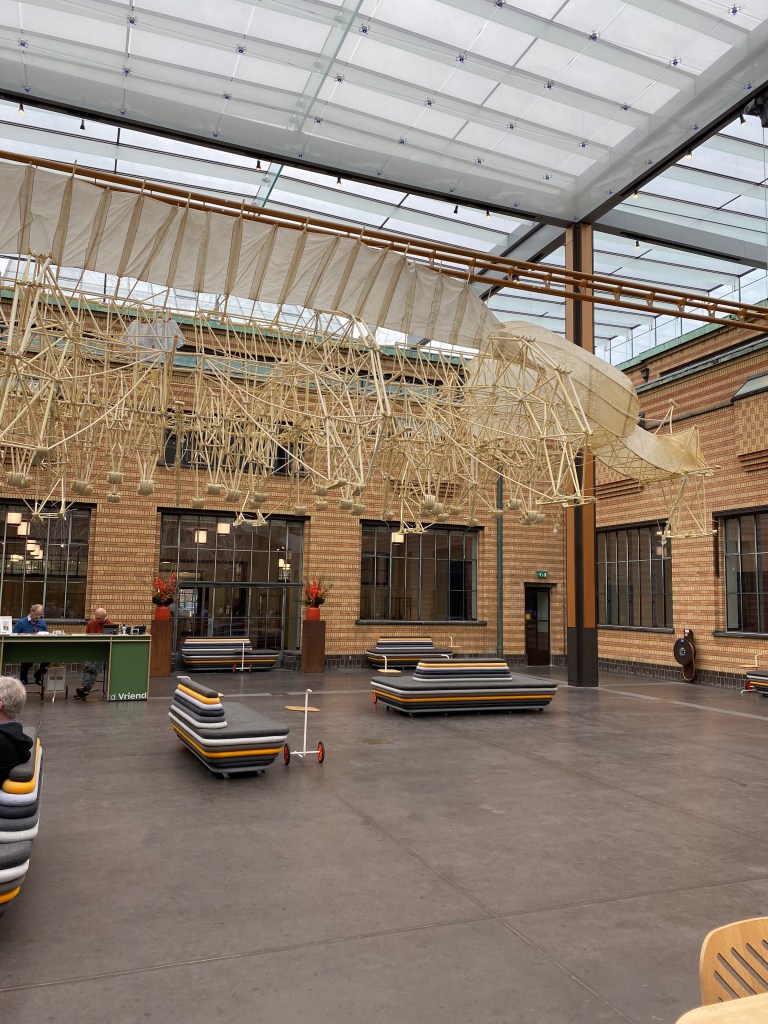
I have not posted for a couple of weeks – let’s call it life getting in the way, the usual thing. I did have a few days away in the Netherlands during that time, however, so I certainly cannot complain. We go there every year, to Zeeland, and I have often posted on here about my trips. This time, my husband and I went, for the first time ever, without our kids, who were all elsewhere. On an impulse we drove all the way from Zeeland in the south to Den Haag (about 150km north) to visit the city’s renowned art gallery, the Kunstmuseum. They hold a large collection of work by an artist my husband was keen to see, but unfortunately none of it was on display! It is an amazing place – an Art Deco building, rather severe-looking on the outside, but fantastic on the inside with a large glass-roofed central atrium (below) and galleries around the edges and magnificent tiling work. There were displays of paintings, sculpture, ceramics and textiles and works were set out in a really innovative way, juxtaposing old and new to illustrate contrasts as well as showing the traditional techniques underpinning even the most modern pieces. We spent the entire day there and did none of the other things we’d planned for our day in the city!
My reading has been really up and down this last few weeks too. After the announcement of the Booker prize shortlist, I set about working through all six books, as I have done every year for a while now. I managed four and a half, I think, but was struggling with the book that in fact won, The Seven Moons of Maali Almeida by Shehan Karunatilaka. I am sorry to say that I STILL have not finished it! I am just not finding it is drawing me in and I am struggling to care about any of the characters. Perhaps one day I will get around to reviewing it on here…!
The non-fiction challenge I set myself at the start of the year (one non-fiction title a month) has completely gone out of the window! Many of the books I have chosen to date have simply been too lengthy to get through in a month and I am finding with non-fiction that I need to read it with more attention because it generally does not draw you into its world engaging all the senses, in the way that fiction does. My current non-fiction of choice is Margaret Atwood’s Burning Questions, which I have been dipping in and out for weeks (months?). As with everything the great lady touches it IS brilliant, and witty, and clever, and informative, but I am reading it with the author’s Canadian drawl in my ear. So it’s slow.
By contrast, the audiobook I am listening to at the moment (my book club’s choice) is classic Haruki Murakami 1Q84. It is outstanding. I am devouring it. But it’s 45 hours of listening time, three thick volumes’ worth. When listening to it I find I am completely drawn into its peculiar world and Murakami’s writing is just delectable. But it is long.
I was talking to my daughter yesterday. She started university this autumn and is finding that this last week or so has got very challenging, that the workload has stepped up suddenly (week five is the worst, apparently). She was telling me that she does not feel very productive, even though she seems to be spending hours working. I feel a bit like that with my reading right now. Reading of course is a pleasure and a joy in itself and one should not feel pressure to finish, or to tick a book off the list, particularly where slower-paced reading is required to get the very best out of it. But when you review a lot of books, you get used to zipping through them, and it can feel ‘unproductive’ when you find yourself wading through very long books, or less fulfilling books.
I am reaching the end of both the Booker prize winning book and the Murakami so I hope to have something to review in the next week!
Do you ever find yourself in a reading rut? I would love to hear your thoughts.
It has been a long, hot and eventful summer, but the year has ticked round, as it inevitably does, and we find ourselves once again at the start of meteorological autumn – my favourite time of the year.
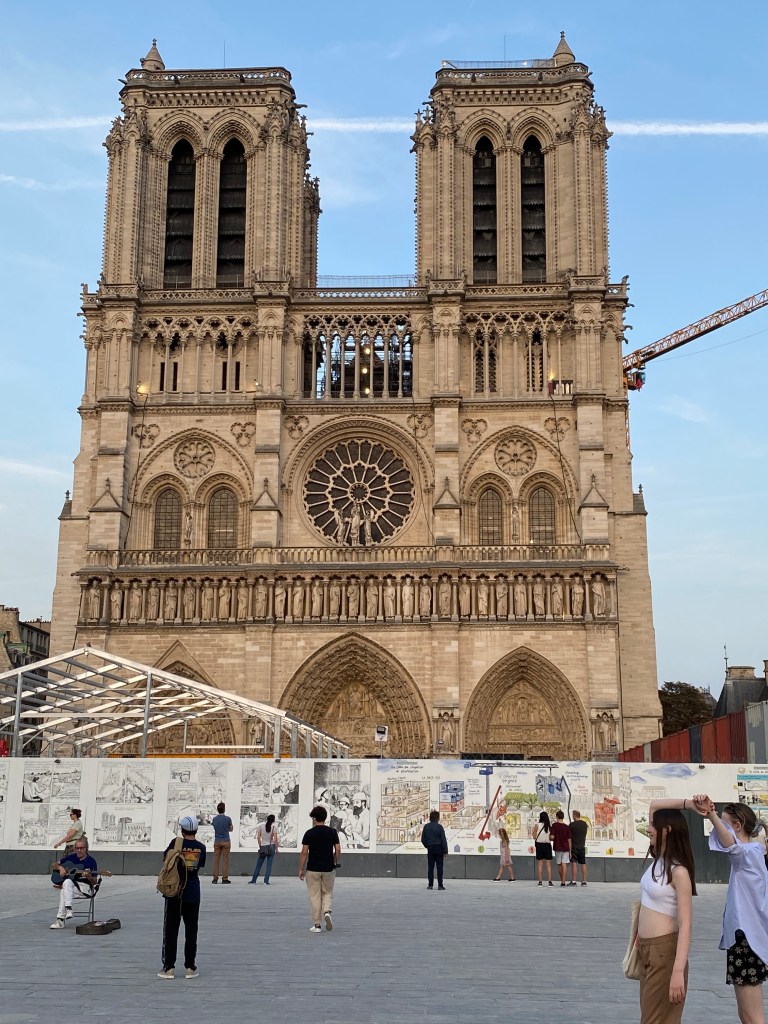
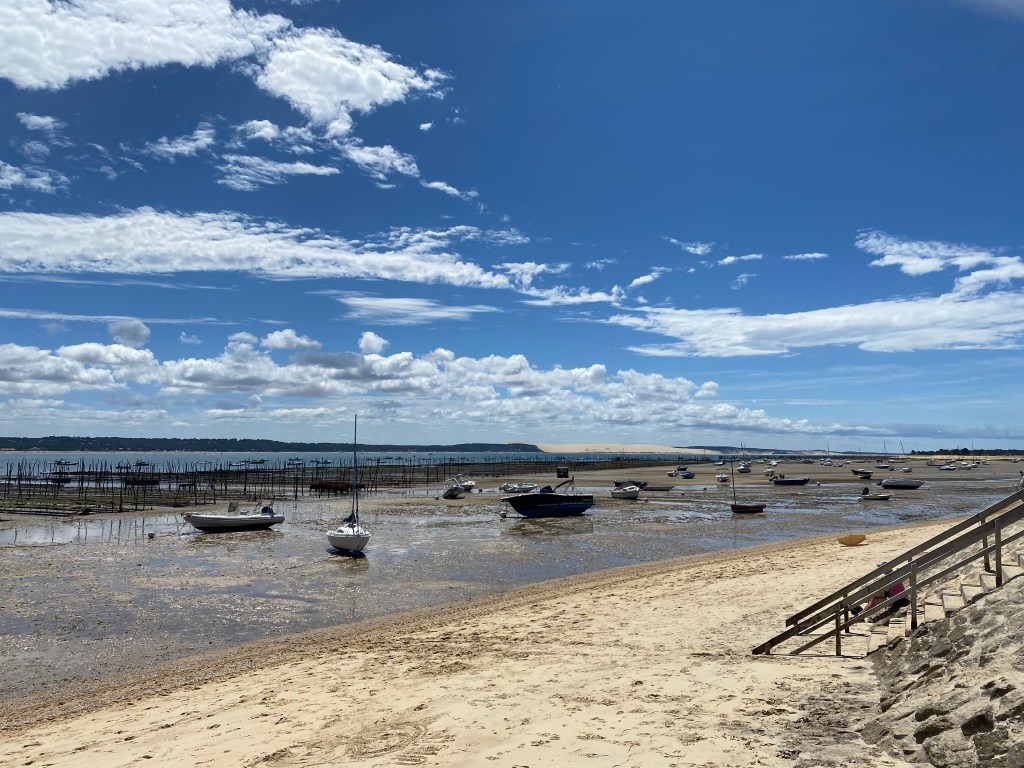
Like many people, we found ourselves travelling more this year than we have done for what has felt like a long time, primarily because we COULD. Two, summers of severe restrictions curtailed lots of people’s plans and it has certainly felt to me as if there was a high degree of pent-up wanderlust. We had a family holiday in France this year, a few days in sweltering Paris, followed by a longer spell in the south-western Gironde area, not far from the location of some of the terrible forest fires to hit parts of continental Europe, although we were lucky not to have been directly affected. It was heaven and I ate far too much patisserie, partly thanks to our holiday home being located next door to what we were told was the best boulangerie in town – it would have been rude not to partake!
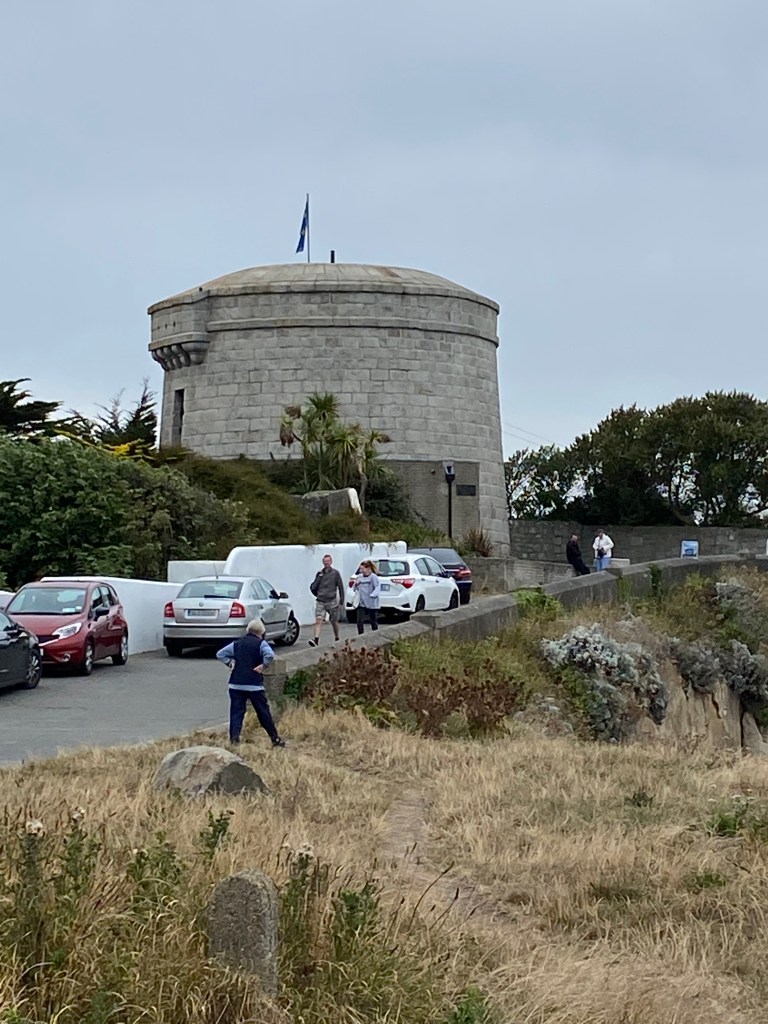
Beautiful Notre Dame, restoration ongoing; the Eiffel Tower at night; the James Joyce Museum, Sandycove; Cap Ferret with the Dune de Pilat visible in the distance; Sandymount Strand in the morning, Dublin
We also spent time with family in Ireland, as well as a couple of shorter trips in the UK. Interspersed with that was the stress/excitement of not one but TWO results days. It has been the most difficult year for 16-18 year olds in this country, with the damage done to so many by Covid and online learning, all the talk of bringing down the perceived grade inflation of the last couple of years, fewer university places on offer, not to mention the uncertain economic environment. I am relieved to say that both my daughters did fantastically well, getting results they thoroughly deserved, and I will be despatching my middle child off to university in a few short weeks.
With only my youngest child left at school (and with her going into sixth form that’s only two years left!), September for me now is less about ‘back to school’ – that is a hard habit to break after 16 years! – and more about renewal and re-focus. I have had my break (three weeks without posting a single blog!) and now I am ready to start again.
What does September mean for you?
One event that has been on my radar for some time, but which was somewhat overshadowed this year by the appointment of yet another new Prime Minister in the UK (our fourth in six years!), was the announcement of the Booker Prize shortlist last night. It went largely unnoticed here because the mainstream media was completely absorbed by the shenanigans in Downing Street. As ever it is an interesting list, and I am familiar with only two of the authors.
As usual, I will be attempting to read my way through the shortlist before the winner is announced on 17th October, a little under six weeks’ time. Last year was the first time I actually managed to get through all six, and I am fairly optimistic of being able to do so again this year as quite a few of them are pretty short! That does not necessarily mean one can speed-read of course as short books are often more intense, I think. A couple of them are very long!
I aim to publish reviews regularly in the coming weeks and to make my prediction on the day itself. I’m very excited! Having only just returned from Dublin I think I will be starting with Claire Keegan’s Small Things Like These, a novel set in a small Irish town in the 1980s, a period when society there was dominated by the Church.
I would love to hear what you’ve been up to over the summer and what your plans are for the autumn.
I got very into my #KeepKidsReading week last week and my 400th post completely passed me by! It has been a busy time, with one thing and another, not least my two daughters starting their GCSE and A level exams, so I put out my posts last week without paying attention to stats or anything like that, not that I do much anyway! It wasn’t until early this week, when I looked back at my list of blogs so I could re-share, that I noticed I had clocked up 402.
So, I’m feeling pretty pleased with myself.
I have been blogging for almost six years so I’m not exactly prolific (I make that a little under six posts a month), but I’m okay with that. I prefer quality over quantity and I know that if I tried to chuck a blog out every day, I would put less effort into each one. Also, as a bookblogger, each post usually takes a fair bit of research, so the writing part is usually the least time-consuming.
I also don’t have thousands of followers so I don’t have any great insights for any novice bloggers out there. Nor do I monetise my blog in any way – this was always a passion project for me, not a job, and that gives me freedoms.
If I had to summarise what I heave learned from six years and 400 posts-worth of blogging, it would probably be this:
Blog because you enjoy it, not because you think you’re going to get anything out of it.
Read other people’s blogs – you can’t expect anyone to return the favour otherwise and you never know what you might learn.
Communicate with people – the blogging community, particularly fellow bloggers writing about similar things (your ‘tribe’) are amazing. Get to know them.
Write from the heart, be your authentic self, not what you think you should be.
Keep a meticulous log of your posts – maybe this sounds corny, but I have a huge spreadsheet which enables me to plan ahead, keep track of my reading (without which I would not have a blog) and keep track of events in the book world (prizes, etc).
Engage with social media if you want to, but you don’t have to. I used to share a lot on the various platforms, but now I do very little, and I don’t think it has made one iota of difference. Except that I am a lot happier when I’m NOT on social media. It depends on your subject area and target audience of course, but for me, the blogging community is a far more honest and rewarding one.
I’d be interested in your thoughts about blogging, whether you’re a newbie or an old-hand, bookblogger or something else. I’m always open to learning more.
A few weeks ago, I posted on here about the terrible flood events of January 1953 that devastated parts of the east coast of England and the Netherlands. In England over 300 people lost their lives in one terrifying night and in the Netherlands the death toll exceeded 1,800. This event is rarely talked about in England and I am not sure why as events which have caused much less loss of life and less destruction and which also took place a generation or more ago, command much greater pubic attention. Perhaps it is the ‘no-fault’ nature of the disaster – it was a natural event, not caused by negligence, corruption or malicious intent, unlike say the bombing of the Pan Am aeroplane over Lockerbie in 1988 (270 deaths) or the Aberfan colliery disaster in 1966 (144 deaths). I do not wish to ‘rank’ these events in terms only of death toll – the Aberfan disaster killing as it did mostly schoolchildren is particularly horrific – but I am simply somewhat surprised that it seems to have slipped from memory.
The morning after – Canvey Island after the devastating floods on 31 January 1953
The loss of life associated with the 1953 storms could not be said to be entirely ‘no fault’. Enquiries found a woeful lack of a meaningful communication system, and the fact that the events took place over the weekend (meaning that officials were not working) certainly contributed to the death toll. Perhaps it was the proximity of these events to the second world war that has contributed in part to the amnesia; tens of thousands of civillians died in the war that had ended only eight years earlier. It is also likely that the lack of investment in maintaining civil defences both during and after the weather contributed to the ease with which flood barriers were breached.
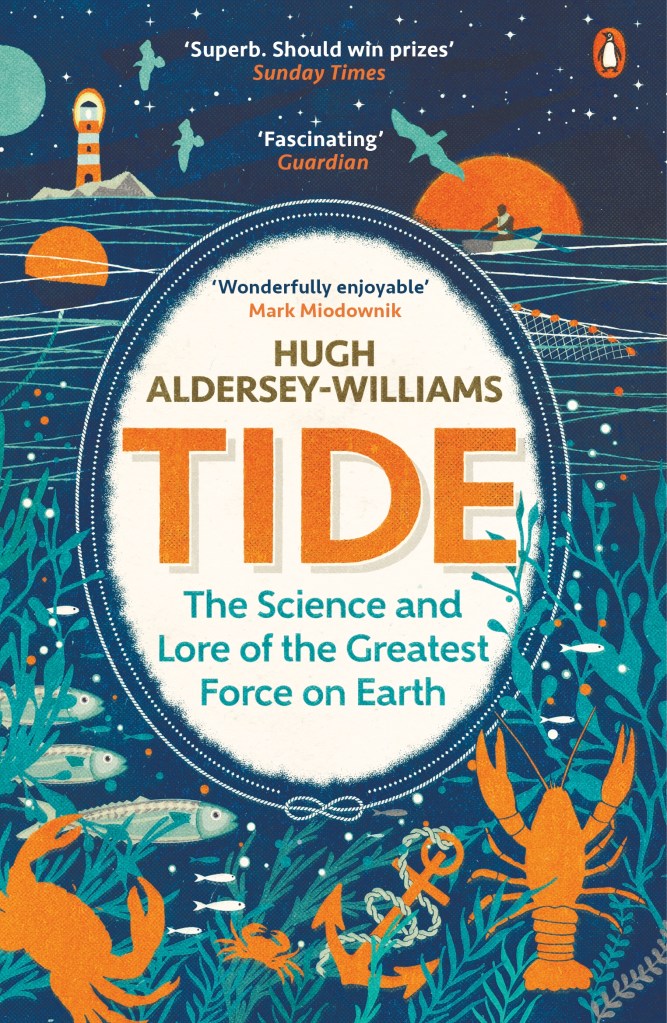
So, as you can see, I’ve been doing research! I’ve read pretty much all the main sources on the subject, and watched quite a lot of newsreel footage from the time. I’d like to tell you about one of the books I read, which had a section on the 1953 floods but which was about the tides more generally. Tide: The Science and Lore of the Greatest Force on Earth, written by Hugh Aldersley-Williams, a scholar of natural sciences, and published in 2017 is a brilliant read. I borrowed it from my local library, intending to read only the section relevant to my research, but I ended up working through the whole book, and thoroughly enjoyed it. The author is an intelligent and witty writer whose knowledge and authority on his subject is slightly concealed by his humour and deft use of language. It is scholarly work dressed up as an entertaining read, and there aren’t many serious works of non-fiction you can say that about.
The author looks at the link between the sea on earth and our moon, something I had never before understood fully. He also explores the cultural impact of the tides, particularly on nations like the United Kingdom which has such a long coastline relative to its size. Before clocks were invented, “measuring time” was meaningless. People lived their lives by natural phenomena such as the position of the sun, the phase of the moon, the behaviour of wildlife, and the ebb and flow of the tides. Clocks have largely inured us to these movements.
“The coast of the British Isles is one of the most tidally lubricated coasts anywhere in the world.”
Hugh Aldersley-Williams
Hugh Aldersley-Williams writes in detail about historical events that have been influenced by tidal flows, such as the cholera epidemic in London in the 1880s (construction of a sewerage system in the west end of the city meant that the tides of the Thames forced river water into the drinking water in the east of the city). The success of the D-Day landings in northern France in 1944 depended heavily on the accurate prediction of the tides. The author also travelled widely to investigate tidal phenomena all over the world and writes finally (and inevitably) about rising sea levels and the impact of the tides on low-lying coastal communities. Devastating flooding in Europe this last winter has given us a foretaste of this.
This book was an absolutely brilliant read and I recommend it highly.
Another book I read as part of my research and which I did not enjoy was Vulgar Things by Lee Rourke. I read it because it is set in Canvey Island, the location of my own book. However, I found that this book did not keep my interest – the plot was thin and the premise weak. I hope my own book portrays Canvey Island in a more positive light than Vulgar Things. I don’t like criticising books so I won’t say any more.
I recently attended an online writing class with Kate Mosse and Maggie O’Farrell. As writers of historical fiction they said that a book should wear its research thinly. We have all, I am sure, read books where the author is just dying to tell you everything they have found out about their topic! As a novice writer I need to be very careful about this. So, it’s the school Easter holidays and I am using this time to take a break between completing the research phase and beginning the writing phase of my book. Writing starts next week! I have cleared my diary for the next month or two and have high expectations of myself. There is danger to this of course; I could hit creative blocks, or plot problems, and will get myself in a panic about not hitting my daily word count! We will see.
This week was the 69th anniversary of the worst natural disaster to befall Britain in the 20th century, one of the worst ever in fact. On the night of the 31st of January 1953 a storm that began as a depression in the north Atlantic, moved to the North Sea and rolled down the east coast of Britain. Earlier in the day, the storm had already claimed 135 lives when it caused fatal damage to the MV Princess Victoria, an early roll-on/roll-off style ferry operating between Stranraer and Larne in the Irish Sea. This alone was Britain’s worst peacetime maritime disaster.
The MV Princess Victoria sank 69 years ago. The story was covered on the Belfast Live news website earlier this week (Image: Mirrorpix)
Tragically, even though the Princess Victoria sank on the afternoon of 31 January, poor communications meant that news of the storm did not reach communities on the east coast. If you look at a map of Britain and the north west coast of Europe you will notice the dramatic narrowing of the North Sea as it reaches Kent and northern France at the English channel. The bit between East Anglia and the Netherlands is shaped like a funnel. And that is exactly how it behaved on the night of 31 January. By tragic coincidence, the storm occurred on the night of a new moon spring tide, when the waters reach high levels anyway. It was, to use an extremely apt expression, ‘a perfect storm’. A huge surge of water could not escape through the channel fast enough and the funnel overflowed in dramatic fashion. The water had nowhere else to go except on to the low-lying flatlands of Norfolk, Suffolk, Essex, Lincolnshire, and most devastatingly of all, the Netherlands.
Because it occurred in the middle of the night, many homes flooded while their inhabitants slept. Many of those coastal homes were poorly built, timber framed and single-storey. In all, 326 people died in Britain. A further 230 deaths at sea can be attributed the storm. In the Netherlands, there were 1,863 deaths, much of the land being below sea level. The Netherlands has been no stranger to devastating flooding over the centuries and so it has long taken its sea defences programme very seriously, but even the renowned Dutch ingenuity at dealing with the sea was no match for a surge which saw sea levels on that night rise to 5.6m above the norm.
I know Zeeland, the southernmost region of the Netherlands and the worst affected by the floods, well; I have been visiting it regularly for twenty years. And I first learned about the 1953 storm surge when I was there in 2003 and there were commemorations to mark the 50th anniversary. There is a museum which tells the story of that night in fascinating and very poignant detail. The last time I was there they had a virtual reality exhibit where you could see what it was like to be surrounded by rising waters inside your own home. It seemed to me extraordinary that I had never heard about the disaster at home, even though I grew up in Essex.
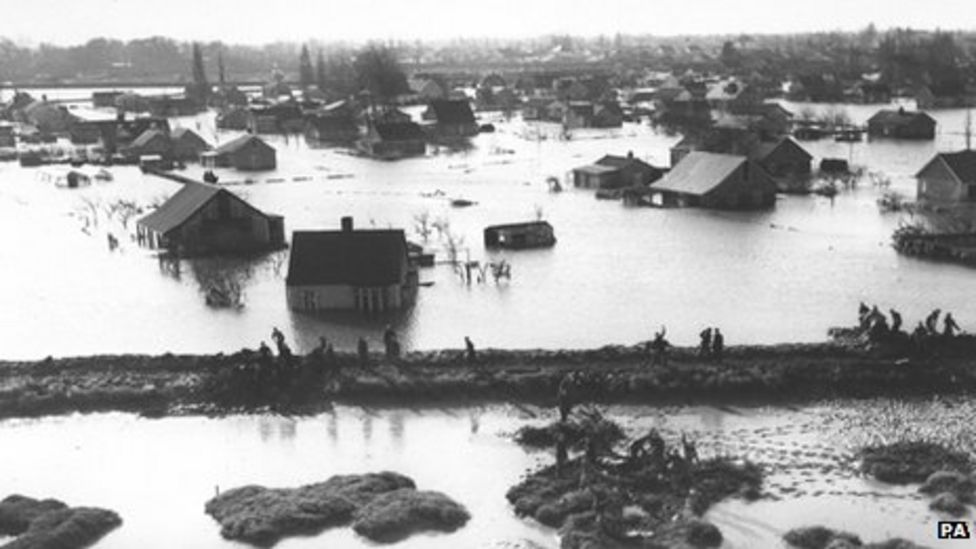
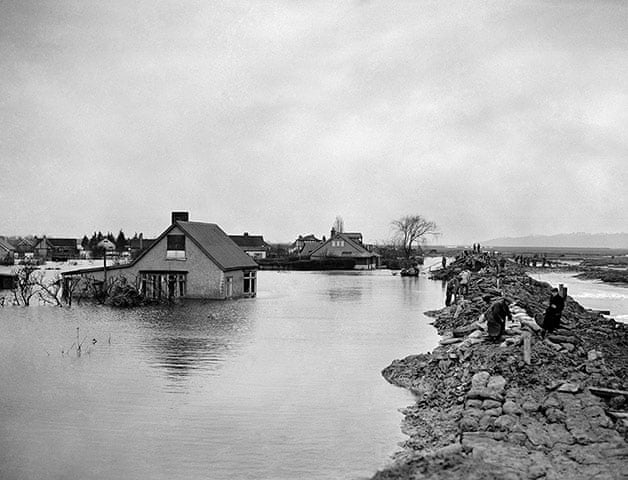
I have been wanting to write about this neglected piece of British history for a very long time and have been ruminating on a novel which I had hoped might be publishable on the 70th anniversary of the disaster (this time next year) – if I’ve any hope of meeting that deadline I’d better get my skates on! In December I made a long-delayed trip to Canvey Island in Essex to undertake some research. Sadly, the Canvey Island Heritage Museum, the only museum I know of in the UK which has information about the floods, has been closed since the start of the pandemic. But just walking around the island (it is tiny) gave me a powerful sense of what it might have been like. Canvey Island lies in the Thames estuary and is separated from its nearest town, Benfleet, by a wide creek. Until the early 1900s, the only means of access was via a causeway at low tide, on foot or by horse and cart. Canvey lies barely above sea level and 58 people on the island lost their lives on the night of 31 January, many of them children. It suffered the greatest loss of any of the towns and villages affected that night.
Flooding in Cavey Island, 1953 (Image: PA/PA Archive)
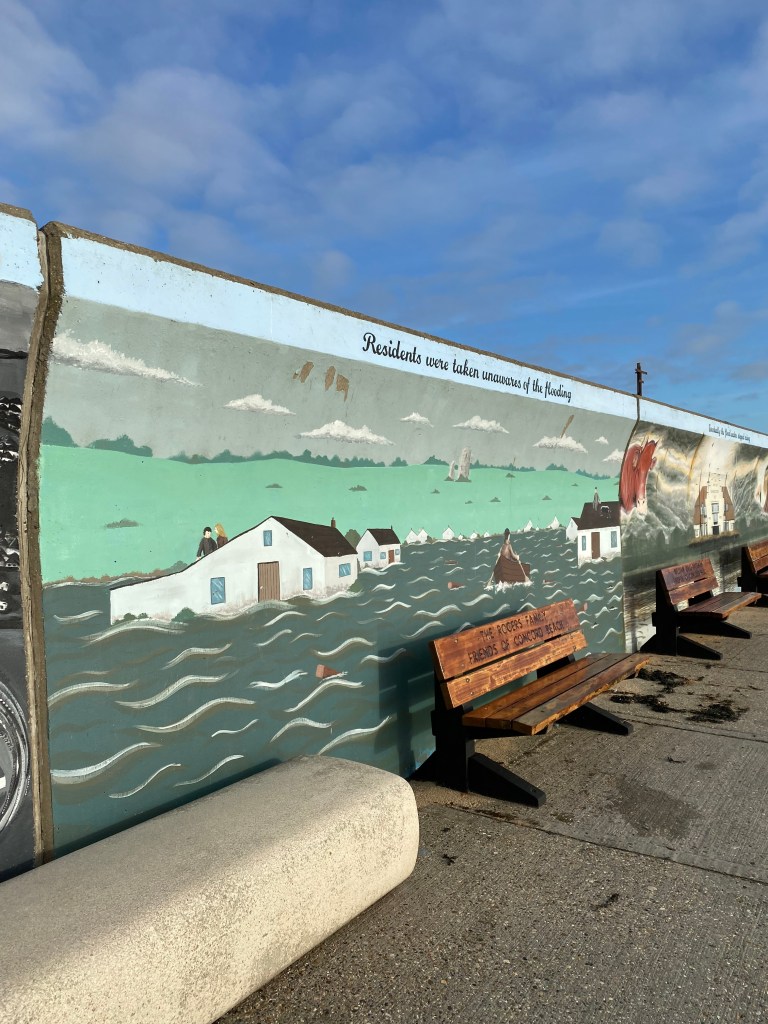
The memories of the island’s terrible experience are still palpable today. Along the sea wall, a powerful mural depicts some of the stories of that terrible night. I remember visiting Canvey as a child – it was a sort of seaside place. No-one would disagree that the island has seen better days; people think that the south-east of England is all bright lights, prosperity and high property values, but it isn’t. The sense of community remains powerful, however, and, sitting in the local library poring over their collection of books about the flood I was struck by the sense of separateness felt, as a mark of pride. I hope the pictures below convey a small part of its specialness.
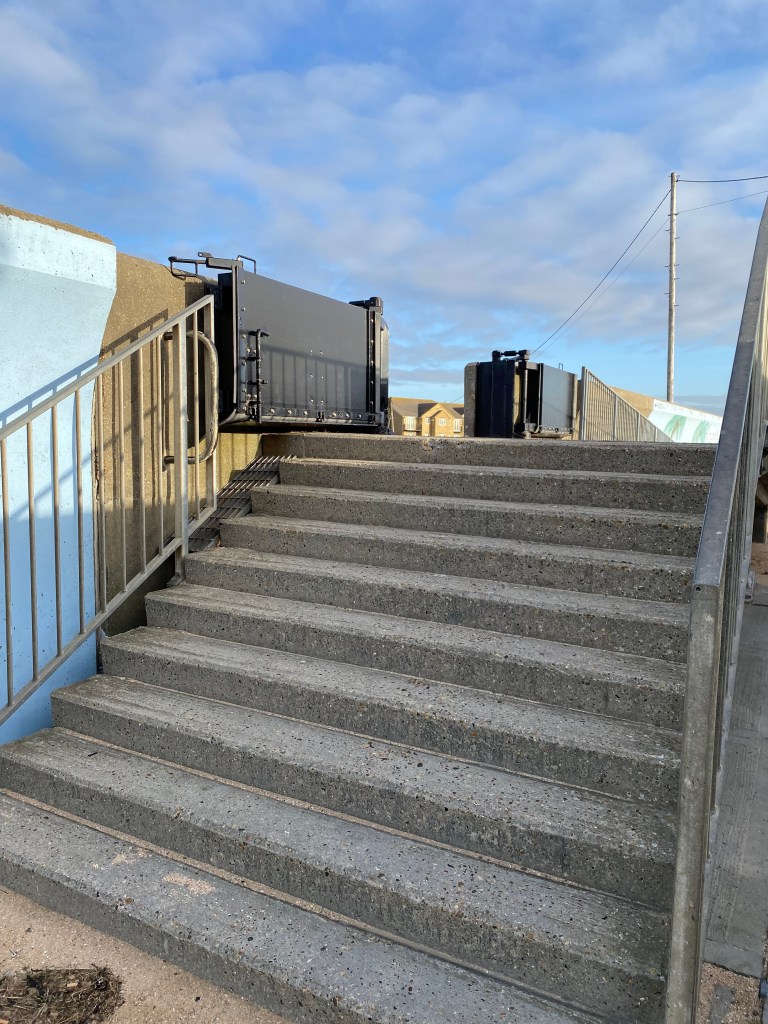
Images from the Sea Wall murals on Canvey Island, an example of the steel gates that now provide protection to the islanders, and houses lying on land that is as low as the level of the sea on the other side of the wall.
The trip gave me a powerful impetus to get the book started – and I have! I am writing this post now, partly to put a marker down that, hey, I’m doing this! Trying to make myself accountable. But also to draw attention to this terrible disaster that seems to have slipped from our national memory.























 Julia's books