Audiobook review – “The Beekeeper of Aleppo” by Christy Lefteri

I’m on an audiobook roll; earlier this week I posted about The Last Protector, the fourth in Andrew Taylor’s Marwood & Lovett series, all of which I have listened on on audio and all of which I have loved. Today I am, by coincidence, reviewing another audiobook, The Beekeeper of Aleppo. I had known about this one for some time and wanted to read it, then it came up as a suggestion from one of my fellow Book Club members. It is read by Art Malik, whose voice is sublime, absolutely perfect for this story, so it was an easy choice to turn to the audiobook.

Although it is a work of fiction the author writes in her afterword about her time spent working with refugees fleeing the war in Syria, and that the book represents an amalgam of various peoples’ experiences. Although it is a tragic and heartbreaking story, even a superficial awareness of what has been happening in Syria for almost ten years now will render it entirely believable. Aleppo was particularly badly affected by the civil war in Syria; over 30,000 people are said to have been killed between 2012-16, when fighting there was at its most intense. A further half a million people were displaced and much of the city was left in ruins.

The story is narrated by Nuri, a beekeeper who lives a peaceful life in Aleppo with his wife Afra, an artist, and their young son Sami. Nuri runs his successful beekeeping business with his partner Mustafa, the more charismatic of the two men.

[Slight spoiler alert in the next paragraph]

Nuri and Afra are devoted to their homeland, but they watch in despair as their city is torn apart and they witness horrific acts in the increasingly vicious civil war. Their turmoil reaches a climax when their young son is killed by a mortar. Mustafa decides to flee Syria, determined to head for the United Kingdom, and encourages Nuri and Afra to do the same. Nuri is persuaded, but Afra cannot find it within her to leave. Deeply traumatised by her son’s death she does not want to, as she sees it, leave him behind. As events spiral out of their control and the gulf between them, caused by their grief, seems impossibly large, Nuri finds that his wife, the artist, has become blind.

Nuri persuades, virtually forces, Afra to leave Syria; presenting her with a stark choice – it is that or death. Afra would rather die, but Nuri has to nurture the last tiny remaining bit of the human survival instinct that he has, for both of them. What follows is an account of the couple’s journey from Syria, across Europe and finally to England. They spend many weeks in Athens, sleeping in a public park with many others in a similar position, dependent on the kindness of strangers, volunteers and NGO workers to bring them food. They face many dangers, their lives are at risk on many occasions and they are cruelly robbed and cheated by criminals and gangsters who seek to profit from the plight of desperate people. As a reader you know this story is not fantastical. It is heartbreaking to see how these cultured, educated gentle people are brutalised, dehumanised and forced into danger and a level of criminality themselves by their situation.

This is not an easy read. It is heart-wrenching throughout and the ending is both dramatic and surprising. I would also say the ending is clever, but that seems a rather inappropriate word to apply to a story such as this. For an insight into what it is like to be a refugee, an outsider, this book is superb.

I recommend this book highly.

The book has won international acclaim, but sadly it does not seem to have changed the world’s attitude to refugees. Perhaps that is too much to ask when almost every country in the world is now battling a global pandemic. But just as we can’t let Covid cause us to forget the many other problems and causes of suffering in our own society (cancer, domestic violence, homelessness are not on hold), neither can we let ourselves forget the unimaginable plight of refugees across the globe. UNHCR estimates that around 1% of the world’s population, about 80 million people, are currently displaced. Of these, 40%, about 32 million, are children.

Audiobook review – “The Last Protector” by Andrew Taylor

Regular readers of this blog will know that I am an audiobook enthusiast – having long-eschewed the move to digital formats (ie e-readers – I have one, but I rarely use it), I find the audiobook adds a dimension to the experience of ‘reading’; you get the interpretation of a skilled actor/narrator and the sense of connection, as if someone else is enjoying the experience alongside you. The e-reader, on the other hand, for me, takes away; paper just feels more authentic between my fingers than glass and plastic, and the ‘swipe’ is a distraction that removes me from the narrative. I get that it’s convenient (not to mention space-saving!), but it’s just not really for me. The audiobook doesn’t work every time – of the books I have listened to over the last few years, there are some where the narrator annoyed me. One that comes to mind is Paula Hawkins’s The Girl on the Train where the Rachel character just grated every time she spoke.

Andrew Taylor’s Marwood & Lovett books (now four titles) are books that I have enjoyed immensely on audio. I listened to the first book, The Ashes of London, during the summer last year and followed up very quickly with the second book, The Fire Court, both of which I loved. I listened to the third book The King’s Evil, in the early part of this year, and then the fourth and most recent addition, The Last Protector, I downloaded pretty much as soon as it was published in April. It was my companion to my 5-10km running programme during the early weeks of the Covid-19 pandemic. It was perfect escapism and a timely reminder that we are not the only generation to live through ‘plague’.

In this book, James Marwood, now well-known at court as an effective ‘investigator’ and ‘fixer’ is firmly established in his slightly shadowy ‘civil servant plus’ role; the James Bond of his day, perhaps! His fortune is fairly secure and his household is growing in size; a man of compassion he has gathered around him a group of waifs and strays who have become his trusted and loyal servants. As his successes have increased, however, so have his enemies, some of them very powerful, most notably the Duke of Buckingham, a scheming, two-faced and clever courtier, direct threat to the King himself. With each new book, the stakes for Marwood get ever higher. Cat Lovett is the other constant character in the books, long-time associate of Marwood, intimately connected by their past dealings, and between whom a frisson of energy fizzes, a fact which often puts them at loggerheads.

Cat is now married, rather unhappily, to the ageing and sickly architect, Hakesby so her contact with Marwood is limited, but they are thrown together again by a seemingly chance meeting between Cat and a childhood friend, Elizabeth Cromwell. Elizabeth is the daughter of Richard Cromwell, son of the more famous Oliver, who was reluctantly thrust into the position of ‘Protector’ after his father’s death. He fled to France after the restoration of the monarchy and has now returned to England; he misses his homeland, but is also destitute and needs funds. Cromwell himself is not a threat to the King, but he has become a poster-boy for the still-nascent enthusiasm for the time of Cromwell (Hakesby is among such a group and does not conceal his delight at the return of a Cromwell, much to Cat’s dismay, who, given her own family history, must keep a low profile). His financial needs also make him vulnerable to exploitation by those who do indeed seek to disrupt the existing order (ie Buckingham) and capitalise on the widespread dissatisfaction with the royal court.

Richard Cromwell seeks to retrieve a package that his indomitable late mother had hidden in a sewer beneath St James’ Palace where she once resided. We do not know what exactly is in this package, but Cromwell believes it will answer all his problems. He needs, however, to ingratiate himself to Hakesby, the architect who undertook much of the remodelling at the palace in the years since the restoration, in order to get access to the sewer.

As usual, a simple premise sets off a train of events that lead to violence and duplicity, intrigue and death. Marwood becomes embroiled, once again at the request of the King and senior courtiers, and events seem to spiral out of his control. Once again, however, Marwood (and Cat), through ingenuity, resourcefulness and wit, manage to come through.

Everything about this book, and the earlier volumes, delivers. Great plot (logical enough to be credible, and complex enough to entertain whilst being just about understandable), well-rounded believable characters, and, very importantly, a level of historical authenticity that suggests deep and painstaking research.

I recommend this and the rest of the series highly. For best results, read in the right order!

Facebook Reading Challenge – October choice

Hey, get me! Two posts in one week – can’t remember the last time I managed that! Perhaps I am emerging from the Covid doldrums and rediscovering my motivation again. I like to dip into so-called ‘self-help’ or motivational books from time to time. It can give you a bit of a refresh, an opportunity to reflect on the way you do or approach things, and there is never any harm in that. Earlier this year (yes, during THAT period when time lost all meaning) I read Women Who Run With Wolves by Clarissa Pinkola Estés and it has had the most profound effect on me. I dip into it every now and then (I have marked and highlighted so many pages that inspired me) and it continues to provide a unique kind of nourishment.

Recently I discovered on one of our less visited bookshelves at home, a copy of Stephen Covey’s 7 Habits of Highly Effective People. It’s not the kind of book I would usually go for (though at one time when I was all about my career I definitely would have done) and neither my husband or I have any idea where it came from. I expected to read a chapter or two and then toss it aside, assuming it would be all business-y and ’80s, but I’m actually really enjoying it and getting some useful ideas from it. Yes, there is a lot about management in it, but primarily it’s about personal mastery, and who couldn’t use a bit of that from time to time.

I digress, since this post is meant to be about October’s choice for my Facebook Reading Challenge. I have posted my less than enthusiastic review of last month’s choice (The Unbearable Lightness of Being) and after struggling with the rather heavy philosophical content, I am delighted that this month’s theme is classic children’s fiction! Yay! I love children’s books and try to read at least one every month or two. I haven’t read one for a while – perhaps that is another reason I’ve been feeling under par – so I am very much looking forward to this one.

The book I have chosen is Goodnight Mister Tom by Michelle Magorian. Published in 1981, it is set during the Second World War and concerns the relationship between William, a young boy from London, evacuated from his home, where he has been ill-treated by his mother, and Tom, a widower in his sixties, in whose care William is placed. It was made into a film in 1998, starring John Thaw as Mister Tom, which has been recommended to me too.

So, that is definitely going to be a treat during what is, in my view, the most beautiful time of the year.

Conkers – one of my very favourite things! (Image by Elsemagriet from Pixabay)

Book review – “The Unbearable Lightness of Being” by Milan Kundera

This was my choice for September in my Facebook Reading Challenge, the theme of which was a novel by an Eastern European writer. The Unbearable Lightness of Being is considered a classic in that particular category; it was first published in 1984, in French translation, and not in the original Czech until 1985, but outside the then Soviet controlled Czechoslovakia. This was for political reasons as the novel is set against the background of the so-called ‘Prague Spring’ of 1968, when the Soviet Army occupied the country.

The main protagonists are Tomáš, a surgeon, his wife Tereza, and their dog Karenin. Other characters are Sabina, an artist, and Tomáš’s lover (one of them!), and Sabina’s lover Franz. Tomáš is a womaniser, I’d even go so far as to say a sex addict, whom I did not warm to. Despite his genuine love for Tereza, he is serially unfaithful. After he is relieved of his post as a surgeon, after getting into difficulties with the government about a critical letter he wrote that was published in a newspaper, he is employed as a window-cleaner, and seems to spend his work days having sex with his clients. Tereza is aware of his infidelities, but tolerates them, for reasons that are not quite apparent – yes, she loves him, but it seems mainly to be fear and vulnerability that keep her with him. I did not warm to Tereza either; she is a damaged person, body-dysmorphic, which seems to have been caused by her challenging relationship with her mother. Tereza is a talented photographer, but she never manages to exploit her abilities, working instead in a series of dead-end jobs. Tereza is perpetually sad, quite a depressing character.

Sabina and Franz are more marginal characters and I struggled to fully understand their relevance; Sabina, an artist, is Tomáš’s lover when he begins his relationship with Tereza. She represents cheer, lightness and ease when Tomáš is concerned that Tereza is going to tie him down. Sabina is his way of convincing himself that he is still free to pursue his erotic interests. Later, in Geneva, Sabina becomes the mistress of an academic, Franz, who leaves his wife for her, although a permanent domestic life with him was not really what she was seeking so they part and he settles down with one of his students.

This is a clever book and the political backdrop interested me. The philosophy did not, however, and so I found it difficult to get into. I did not enjoy Jostein Gaarder’s Sophie’s World when I read it in the early 1990s, for much the same reason. In Sophie’s World, the story is almost entirely subjugated to the history of philosophy, which I’m afraid rather bored me. That is less the case here in The Unbearable Lightness of Being, where there is just about a story to hang onto, but still, for me, it was not enough. I am a lover of literature, a lifelong student of it, but I am also a lover of a good story and this one just did not do it for me.

It has an interesting narrative voice; the author is self-consciously present and takes the reader on philosophical digressions, commenting on his characters’ actions as we go along. Essentially, the author’s position is in opposition to Nietzsche’s concept of ‘eternal recurrence’ – that all events that have ever happened are repeated endlessly. This means everything we do has huge eternal significance. What Kundera is exploring here is the very opposite, that each event occurs once only, making all events and choices essentially without great import, thus ‘light’. He therefore reflects throughout on the extent to which the character’s are experiencing ‘lightness’ in their lives or not.

It’s okay not to like a ‘classic’ isn’t it? Life is pretty hectic at the moment and grounded in much more prosaic matters, namely, finally, the (fingers-crossed) sale of my late mother’s house, the winding-up of her affairs and interment of her ashes. Bogged down with all this earthly detail I was probably not in the best frame of mind to ponder big issues of philosophy! I also found myself reading it in shortish bursts, which is never how I best enjoy a book.

So, all in all, not a great read for me.

I’d love to hear anyone else’s thoughts on this book.

Book Review – “The Mirror and the Light” by Hilary Mantel

The big excitement in the literary world recently was, of course, the announcement of this year’s Booker Prize shortlist. In past years I have set myself the task of trying to read the whole shortlist before the award is made, but I have never yet managed it. I think I read five out of the six one year, but last year I think I only managed two or three and abandoned the intention somewhere around Christmas-time. The Booker Prize seems like less of a landmark than it once was, though; one of the criticisms is that it is now dominated by US-published books, since it was opened up to writers in English from outside the Commonwealth in 2014. One of the fears was that it would “homogenise” literary fiction, although it is curious that this year’s prize nominees constitute one of the most diverse I can remember with it having a majority of women and a majority of people of colour. I would like to read all of the novels on this year’s shortlist, they all sound fascinating, but if there is one thing the past twelve months have taught me it is that I should not be too goal-orientated. My world feels like it has been on shifting sands and most of my plans have had to be abandoned, with the consequence that I have often felt like I was failing at every turn. At this point in time I am just trying to be kind to myself, recognise that things change and give myself a pat on the back for things done rather than admonishing myself for things still to do. And keen readers will know that that TBR pile NEVER shrinks!

The brilliant finale to the Wolf Hall trilogy

The big shock of the Booker Prize shortlist was that Hilary Mantel’s The Mirror and the Light, the third and final part of her Wolf Hall trilogy, was not even nominated. This followed hard on the heels of not winning the Women’s Prize a week earlier (that award went to Hamnet by Maggie O’Farrell – my next read!). Hilary Mantel has spoken of these twin ‘failures’ as being something of a relief – there had been so much talk of whether she could ‘do the treble’ (Wolf Hall and Bring Up the Bodies having won in 2009 and 2012, respectively), but remember this is literature not football! I don’t think Hilary will be suffering too much of a crisis of confidence! As an artist, I hope her feeling of achievement is from the work itself. And what a work it is!

Talking of goals, I wrote on here back in March, when we all first went into ‘lockdown’ (I really, really hate that word), that one of the things I was planning to do with all my spare time was to both read The Mirror and the Light and re-read Ulysses (so much endless time), but of course I did not. Both books are enormous. It took a concerted effort during August to finish The Mirror and the Light. One of the reasons it took me so long was because it is so brilliantly written I wanted to savour absolutely every word. Also, with such a huge cast of characters, it was not always easy to follow who was conspiring with whom.

We all know the ending – Cromwell falls out of favour with Henry, following a fairly concerted campaign by his enemies at court, and is eventually executed. Knowing this, rather like re-reading a good book, helps you to track how events are unfolding. This is a really outstanding book, a fine achievement, and one which rewards the hard work, the investment the reader has to put into it. It is much longer than the first two parts of the trilogy, and at times, especially at the beginning, I felt it could have been edited down a bit, but, now I’ve finished it, I’m not so sure. There is no doubt that, as a reader, you get your money’s worth – less than £1 per hour of reading is pretty good value! And the craft, the authorship, the writing skill, and the research, not to mention the years of her life Ms Mantel has put into this book, make it, in my view, a true literary landmark. It seems above prizes.

Hilary Mantel has also given us all a lesson in politics and a lesson in history. It was an interesting time to be reading the book. The name Dominic Cummings (most famous breaker of lockdown rules) will be familiar to most people in the UK. Not just in the UK but in other countries too, there is a culture war going on between an establishment ‘elite’ and ‘upstarts’ perceived not to belong. I do think this is an element in some of the hostility that is expressed towards people perceived to be outsiders. I should add quickly that I do not think this is undeserved (I’m thinking Cummings, but also Trump), but there is undoubtedly self-interest in the hostility coming from some quarters and some people seem to be piggy-backing on legitimate criticisms. Waiting for their moment to strike, perhaps.

Cromwell, as painted by Hans
Holbein the Younger

Thomas Cromwell (according to Mantel) was a schemer, self-interested and a manipulator, but he was also (and I should add that my comparison with the contemporary examples of outsiders mentioned above ends right there!) a brilliant tactician and a man of extraordinary talents with an unmatched intellect. His chief ‘crime’ in the eyes of his enemies at court, though, was being low-born, he son of a blacksmith; he dared to ascend to the very highest roles at court, the chief confidante of the king, but he paid the price, ultimately, for that daring. His enemies eventually succeeding in getting rid of him.

I recommend The Mirror and the Light very very highly.

September renewal


My daughters have gone back to school, my son will be back at university in a few days’ time and at last life is starting to resemble the one that was suspended so suddenly back in March. How long ago those ‘claps for the NHS’, traffic-free roads and once-a-week-only visits to the supermarket seem. Whilst we are still all somewhat restricted, life has become busy again, and the last few weeks, since we returned from our hastily-aborted trip to the Netherlands (due to the short notice imposition of quarantine rules for that country) have been, I would even go so far as to say, ‘hectic’! There have been all of the usual ‘back to school preparations’ – haircuts, uniform top-ups (including a whole new ‘capsule business-wear wardrobe’ for my new sixth-former!), stationery and book shopping. There has also been the sense of something ending; in many ways, despite the challenges, lockdown has been a precious time, for it is unlikely that we will ever have this much family time together ever again. My teenagers will increasingly separate from us in the years to come, as indeed they should.

I have written here before how one of the surprising aspects for me about lockdown, turned out to be how little I would able to use the time ‘productively’ (whatever that means). At the start, as I rubbed out more and more commitments from my usually busy diary, I thought, ‘great, now I’ll have lots of time to do loads of things’, thinking, of course, about that long overdue re-write of my book, getting some other writing projects off the ground, and, indeed, blogging regularly. Of course, very little of that managed to happen – how did I let all that time go to waste, I have asked myself many times. I didn’t of course – when it comes to judging myself I am chronically glass half-empty. Among my many achievements I built up my running distance to 10k, I maintained a steady supply of toilet rolls (without ANY stockpiling, I might add), I sold a load of now-unused toys on ebay, and, most importantly I kept my family on an even keel and healthy.

I did not do as much reading as I expected, especially in the latter months, but the most frustrating thing was being unable to do any writing. I felt bereft not only of time (I was literally never alone in the house, something I had previously taken for granted), but of access to the computer, of the quiet that I find I need and of the mental energy. Reflecting as I have been on these strange months ‘in limbo’ I realise now that I have been on ‘standby’, in ‘fight or flight’ mode, more focused on survival than I probably ever have been in my entire life. This is not an over-dramatisation – at one point, remember, it seemed the virus might kill hundreds of thousands of us, at random. Food supplies were unable to keep up with demand – some of us stockpiled through selfishness, most did so from fear, I suspect. Plus, none of us knew whether we’d still have our jobs, our lifestyles or be able to keep the roof over our heads at the end of it all, whenever that was likely to be. Is it really any wonder I was unable to be creative?

I was reassured last week, watching a live-streamed interview with Hilary Mantel and Angie Cruz ahead of the announcement of the Women’s Fiction Prize winner, when Hilary described reading as ‘a creative act’ for a writer. Indeed it is. I read much slower than I used to, because I read differently now. So perhaps I have not been as creatively unproductive these last few months as I thought. Perhaps it is all just waiting to burst through.

September is always an important month for me; that seems counter-intuitive given that, in nature, it is the time of things dying off and nights closing in, preparing for hibernation, the big sleep. For me, it feels like the opposite. It is when I feel most alive. Last year, that was derailed – it is very nearly one full year ago that my mother died – so this year I feel even more energised and determined to push through and express myself more fully than I have been able for some time.

So, here’s to September, to creative and spiritual recovery. Let’s hope we keep our health and our sanity if we find ourselves in a second spike, a resurgence, or whatever we want to call it. Please stay healthy all and I hope you too are in thriving mode again.

Facebook Reading Challenge – choice for August

This month’s theme for my Facebook Reading Challenge is a love story. I always try to pick a topic for August which is suitable for a holiday read, a bit of escapism, not too taxing. When I came up with the 2020 list of themes I could not have known how 2020 would pan out and that most of us would not in fact be going on holiday at all. Barely going outside our front doors for many weeks. I had no holiday plans at all in fact – my elder daughter was due to be doing the four-week NCS (National Citizenship Service) programme this month, and then getting her GCSE results on the 20th, so there was no space for a holiday. We had a loose plan to take a last-minute week off just before the end of the school holiday but no firm ideas. The NCS programme was cancelled, of course, and travel restrictions abound. However, we are hoping to drive to Zeeland, in the Netherlands, our usual Spring vacation destination, in a couple of days. That is, of course, if the Dutch allow us in! And since I live in Greater Manchester, which is seeing a resurgence in cases of Covid-19, it is entirely possible that we Brits will not be welcome. However, let us remain hopeful. And vigilant.

Back to books…

Call me by your name imgI had been thinking about some of the classic love stories – Jane Eyre, Anna Karenina, Gone with the Wind, The Remains of the Day – but none of these felt much like ‘holiday reading’. But then a bit of online research threw up the perfect suggestion – Call Me By Your Name  by Andre Aciman. First published in 2007, this novel was made into a very successful film in 2018 starring Timothee Chalemet and Armie Hammer. It is set in the 1980s on the Italian Riviera (perfect!) and concerns a romance between Italian-American Elio (Chalemet), spending the long hot summer at his parents’ holiday home, and visiting academic Oliver (Hammer). It is apparently quite steamy (perfect!). I have not yet seen the film, so I am delighted to read the book first.

My choice for July was ‘something from the Americas’ and I picked a contemporary Argentinian crime novelist, Claudia Pineiro – a prolific author, well-known in her own country, and someone I had never heard of. Yay for reading challenges! I selected her novel Betty Boo, first published in 2010. The novel begins with the murder of Pedro Chazarreta at his home on the exclusive Maravillosa Country Club estate. Chazarreta is a wealthy businessman and widower, whose wife was murdered three years earlier, also at their home and in suspicious circumstances which were never fully resolved. The murder of Senor Chazarreta is equally mysterious and whilst suicide is widely suggested (a sign of his guilt in relation to his late wife’s death?), there are inconsistencies which arouse the curiosity of among others, Nurit Iscar. Nurit is a writer whose crime novels made her famous. However, she has written nothing for some years after her last novel received terrible reviews; she decided to write a romantic novel, encouraged by her then lover, newspaper editor Lorenzo Rinaldi, but the change of genre was not a successful career move.

Betty B00 imgAt the start of this novel Nurit is divorced, ghost-writing money-spinner books for celebrities and somewhat directionless. Her affair with Rinaldi is long over, but he contacts her and asks her to write some columns on Chazarreta’s murder. He arranges for her to stay at the home of his newspaper’s proprietor at La Maravillosa so that she can get close to the scene of the crime and the people who live there. It was Rinaldi who called Nurit ‘Betty Boo’, because of her dark eyes and dark curly hair. As Nurit gradually becomes immersed in the crime, her relationship develops with two other journalists at El Tribuno, which her ex-lover edits: Jaime Brena, the disillusioned middle-aged hack, former crime journalist, now reduced to the lifestyle section of the paper, and ‘Crime Boy’ the young upstart, now the lead crime writer on the paper, who, with his limited experience, turns increasingly to Brena for help on the Chazarreta case.

These three disparate individuals thus find themselves thrown together on the case, not entirely through their own choosing. Each brings their own skills to bear to try and solve a case (two cases in fact, both Chazarreta and his wife), that the police seem unable, or unwilling, to. As they get closer to what they believe is the truth, more murders occur, which appear to our intrepid trio, to be connected.

This book felt like it had a slow start to me; some of the scene-setting felt a little laboured. Also, I felt that perhaps the translation was not the best; at times the language was awkward and stilted. One problem I had with it was the lack of punctuation to delineate speech! No speech marks or ‘he/she said’ which at times made it difficult to follow who was speaking. Perhaps this is Pineiro’s style or perhaps it is more obvious in Spanish, but for me it really affected the flow at times.

I liked the characters though and in particular the relationship that develops between Nurit, Brena and Crime Boy. Investigating the murder becomes a cathartic process for each of them, a journey, and at the end of it they have resolved some complicated personal issues they each have. The plot also develops in interesting an unexpected ways which keeps you turning the page.

I’d definitely read more of Pineiro – I think it’s always good to broaden your reading horizons and it can give you a good insight into other societies. I am ashamed at how little I know about Argentina. An interesting book that is not too demanding.

Recommended.

I would love for you to join me on the Reading Challenge this month – look out for my review of Call Me By Your Name in September.


June choice for my Facebook Reading Challenge

My usual routines, including my reading habits, are all over the place right now! What about you? I have both my daughters at home from school and my son home from university, plus my husband working from home. Although we are fortunate to have enough space and enough technology to enable everyone to do what they need to do, there are times when we get in each other’s way. I am also a creature of habit and do not always find it easy to adjust my rhythms to fit with other people’s. So, other commitments permitting, I like sit down with a cup of tea to read at around 3pm most afternoons, just before the return home from school. But, now, that is actually the busiest time of the day in our household – everyone seems to be ‘clocking off’ and wanting interaction! First world problems, as they say. We are all well, work is plentiful; we are among the more fortunate.

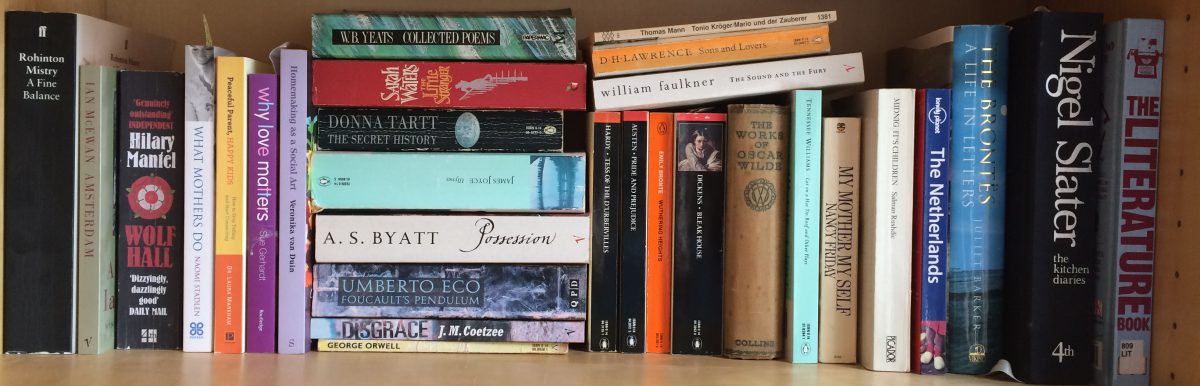
At times like this, I find it’s the little things that are important, so I try to find some time every day, no matter how small, to do some reading. I have several books on the go at the moment – Ulysses (which I promised myself I’d re-read this year and which I spent a glorious couple of hours simultaneously reading and listening to on Tuesday, 16th June, Bloomsday), Hilary Mantel’s The Mirror and the LightThe Beekeeper of Aleppo, which I’m listening to on audiobook, for my book club, and which is amazing, and my Facebook Reading Challenge choice for this month – The Secret Lives of Baba Segi’s Wives. 

The secret Live sof Baba Segi's Wives This book by Nigerian writer Lola Shoneyin, was published in 2010 and longlisted for the then Orange Prize for fiction the following year. Shoneyin writes beautifully. I have only just started it but I already love the characterisation and the humour, although a more melancholic note is now beginning to enter. It is described in the publisher’s blurb as at once funny and moving and I can definitely see that. Baba Segi is a traditional Nigerian male, still following the practice of polygamy in modern-day Nigeria. He has seven children by his first three wives, but desires more and when he meets Bolanle, a young graduate from a more enlightened family, who are against the marriage, he thinks his wish has been granted. Not all goes to plan, however.
I am enjoying the exploration of the family dynamics – a polygamous household will be outside the experience of most Western readers – and how the relationships between the four wives are beginning to evolve.

If you would like to join me in my reading challenge this month, hop on over to the Facebook Group– there is still time! It’s a fairly short book and we are only just over halfway through the month; I might even finish on time this month!

How have your reading habits changed in these last few months?

If you have enjoyed this post, I would love for you to follow my blog. Let’s also connect on social media.

Book review – “Grown Ups” by Marian Keyes

I posted last week about my ups and down dealing with life during Covid-19. It sparked a lot of comments from friends about others feeling similar emotional swings. It just goes to show that you can’t rely on social media to reflect life accurately; if I look at my Facebook or Instagram feeds it looks as if everyone is having an amazing time and achieving all sorts of interesting challenges! Perhaps everyone else is just ‘faking it till they make it’ as well, putting a brave face on, or, if their profile is also their livelihood, perhaps they are thinking about their business. I am not normally someone who suffers from anxiety or other mental health issues, at least not at the severe end of the spectrum, but it strikes me that more openness and honesty would help those who do.

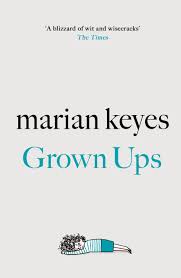
I mentioned in my last post that one of the books that has really helped me this last few weeks is Grown Ups, the latest novel from Marian Keyes. I have long admired Marian; though I have not read any of her other books, I often hear her on the radio. She is also very active on Twitter and is hilarious. She is able to project her personality very strongly, she is forthcoming about her vulnerabilities and her frailties and she is an engaging and witty speaker. Grown Ups was suggested at my book club for April and I listened to it on audiobook. I absolutely loved it and especially Marian’s wonderfully authentic narration.

The novel is set over the course of six months in the life of one extended family – the Caseys – which comprises the three separate families of brothers Johnny, Ed and Liam and their various wives, girlfriends and children. The novel is set mostly in Ireland and mostly in Dublin, where the main characters all live. It opens on the occasion of Johnny’s 49th birthday, and the three brothers and their families have gathered together,, as they do frequently and regularly. These are usually organised (and paid for) by wealthy Type A personality Jessie, Johnny’s wife, successful business owner of a chain of stores selling high-end and exotic groceries. All of a sudden, Ed’s wife Cara begins to have what can only be described as a mental meltdown during dinner. Although I found this initial scene quite difficult to follow because I did not, of course, know any of the characters, it is quite clear that Cara’s outburst is entirely out of character, deeply embarrassing for many of the attendees, exposing behaviours they believed they had masked pretty successfully, and that it is going to cause deep fissures in what might otherwise appear to be a ‘happy’ family. It’s as if Cara has taken some sort truth drug.

All is in chaos and then Marian takes us back six months and we begin to explore the sequence of events that has led to this breakdown. These include an Easter break in a smart hotel in Killarney, a weekend away to celebrate the 50th wedding anniversary of the Casey brothers’ awful parents (which goes a long way to explaining the various ‘issues’ their sons have), a hilarious but disastrous murder mystery weekend for Jessie’s 50th birthday and a holiday in Tuscany. Most of these extravagant events are organised and paid for by Jessie, who, as an only child, longs for the happy extended family.

Although it’s the three men who are related, the story seems mainly to revolve around their partners – Johnny’s wife Jessie, who married him a few years after she had lost her beloved first husband Rory, Cara, Ed’s wife, a mild-mannered hotel receptionist, who has an eating disorder, and Nell, the young and lovely set designer, who marries feckless Liam after a whirlwind romance.

At first I found some of the scenes overly long, which made the pace quite laboured in the first quarter or so of the book, but on reflection I think this is necessary to building the personalities of the characters, understanding their motivations, and really getting inside their heads. By the time I got to the last quarter I could not put it down. I became totally lost in the world of the Caseys and found I cared very deeply about what happened to them all. Best of all Marian’s dialogue feels entirely authentic and made me feel nostalgic for get-togethers over the years I have had with my own extended family of Irish in-laws, though none quite so eventful as those depicted here!

This book was a real tonic and I recommend it highly. I will definitely explore more of Marian Keyes’s books.

What books have kept your spirits up during the pandemic lockdown?

Hello again!

It’s been a while since my last post. I’m normally pretty organised when it comes to planning my blog posts, and fairly diligent about posting regularly. School holidays and busy work periods can make things tricky but generally I’m a committed and regular blogger. I imagined that during this period of global lockdown due to Covid-19, I would have much more time to post regularly. That did not quite happen, of course, what with having the whole family at home all the time, and doing much more cooking and cleaning than I do normally (‘help’ sometimes creates more work!). I was getting on okay though, appreciating the facts of our situation: we were all together, we were well, our income was fairly secure, we had a roof over our heads, those basics were in place and so all was good.

After Easter, though, I noticed a real dip in my mood. I cannot really explain it because nothing specific happened. A few things upset or angered me – the ever-increasing death tolls on the nightly news, the increasingly grave news about the economy, the anxiety about how countries with weaker health systems than ours would cope (some of them rather better than the UK it turns out), events I had booked for the coming months were gradually cancelled. I also find myself getting irrationally cross about people who seemed to believe that the measures designed to protect us all didn’t actually apply to them. But, those things didn’t seem to explain the more general malaise I found myself experiencing. I struggled for motivation. Even with at least a million things I could have been doing I felt at a loose end. And when I heard the stories on the television of people who had lost loved ones to the virus, I found the complicated grief I felt about my mother’s death last Autumn, resurfaced in ways I had not expected. Some days I felt relief that she wasn’t here to experience or be worried about getting the disease (she would certainly have died had she got it as she was very unwell), but at the same time I felt, selfishly, like screaming, hey what about the rest of us who lost people recently, NOT due to Covid-19. It was all very complicated.

I even found it difficult to read. I wasn’t able to focus. I bought Hilary Mantel’s The Mirror and the Light at the start of the lockdown, thinking that long weeks of no socialising would give me plenty of opportunity to work my way through the hefty tome. Alas not. I have not even picked it up yet.

Thankfully, I can feel my mojo starting to return this last week or so, just as suddenly and as inexplicably as it went away. To what do I credit this change of mood? The following:

  • Grown Ups imgMarian Keyes – Grown Ups to be precise. It was my book club’s choice the last time we met in person and although it was probably not a book I would have picked up it was the most perfect tonic, especially as I listened to it on audio, with Marian’s wonderful narration.
  • Vincent Van Gogh – many years ago my husband bought me a 1000 piece Photomosaic jigsaw puzzle of a Van Gogh self-portrait. If you’ve never seen these, they are very clever, the larger image is made up of hundreds of tiny little photos, fiendishly difficult, but completely addictive. I had never done that jigsaw, but seemed to decide that ‘now’ was the time. Many dinners were burned or delayed as I found it difficult to drag myself away from it. We had to eat round it as it sat at the end of the dining table, a fortnight-long work in progress.  There was one near-disaster when the cat, in a last desperate attempt to get my attention to feed him, leapt up on the dining table and almost sent several hundred carefully colour-organised pieces crashing to the ground. Lucky for him, only a few pieces fell and Ziggy the cat lives to fight another day!

VVG

  • Withdrawal from social media – I’m not a big social media user, but I dabble.I found I really couldn’t take much Facebook though and Twitter was a total no-go – way too much anger and too many chronically-opinionated people.
  • And finally, free arts online – more than anything I am missing the arts (hope that doesn’t sound too pretentious). The audience with Hilary Mantel I had booked for April was cancelled, as was West Side Story at Manchester’s Royal Exchange, the Hay Festival, the Thom Yorke gig in Manchester next month as well as various performances my kids were involved with and a couple of work trips to London with exhibitions to be taken in. Thank goodness for the National Theatre’s weekly NT Live recordings, the virtual tours of museums around the world, and Radiohead classic concerts on YouTube.

It hasn’t been all play, of course, I only dabbled with all of the above. I got a bit sick of hearing lifestyle-y type people saying how bored they were and were looking for things to do. I have felt busier than ever, my work has been emotionally quite demanding, and it’s never good hearing from over-achievers in those circumstances.

So, like most people, I am muddling along, looking forward to some normal things and trying to make the best of the situation. And hopefully getting back to an even keel on the blogging front.

I hope you are all doing okay.