I had my fill of Frankenstein last week – I read the book, saw the play and listened to Derek Jacobi narrating the audio book! My book club selected it as we were looking to read a classic, and, as it happens to be the 200th anniversary of the novel’s publication, it was also showing at the Manchester Royal Exchange Theatre in a new adaptation by April de Angelis.
 It is extraordinary to think that this remarkable novel, still as popular and as shocking today as ever, was written when Mary was just 19 years old. The fact that she was such a literary talent is not surprising given that she was the offspring of the two famous intellectuals, Mary Wollstonecraft, philosopher and author of the seminal feminist work A Vindication of the Rights of Woman, and William Godwin, the radical political philosopher. In her lifetime, she was highly regarded as a radical writer and intellectual, as well as being the wife of the poet Percy Bysshe Shelley, whom she met and fell passionately in love with at the age of 17. Her reputation since her death, however, has been overshadowed by that of her husband’s, with whom she bore four children (three died in infancy), whose affairs and financial troubles she endured, and whose poems she edited both before and after his death. Percy Bysshe Shelley drowned at sea in 1822, just six years into their marriage when she was 25. She died at the age of 53 in London from a suspected brain tumour.
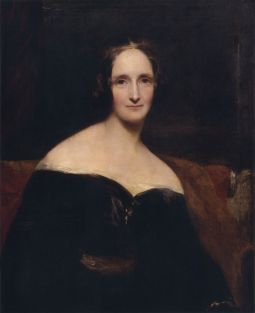 By any standards her life was remarkable and in the last few years her reputation has been revived and she has begun to be more widely considered as a formidable talent in her own right, rather than just a ‘one-book author’. Frankenstein has been a staple of English literature GCSE and A level syllabuses for years, but most of her other works have fallen out of print. A new biography, In Search of Mary Shelley: The girl who wrote Frankenstein, by Fiona Sampson was published earlier this year, some of which I caught when it was serialised in Radio 4 recently. What I heard sounded fascinating. Sadly it is not available on the BBC iPlayer at the moment.
Frankenstein is a brilliant book. It’s not particularly long so if you are not accustomed to the classics it is not too daunting. It is extraordinarily sophisticated in the themes it explores, from ideas about religion and creation, the vanity of man (men) and moral relativism. Its structure is also interesting: it is narrated initially by Robert Walton in letters to his sister. Walton is the Captain of a ship which he is sailing to the Arctic in the hopes of making a great discovery about the North Pole. He describes his ambitions, but also his loneliness and need for companionship. He meets an unexpected friend in the form of Victor Frankenstein who is on an unlikely pursuit of a mysterious giant figure which Walton and his crew had previously spotted. Frankenstein takes over the narration and we learn about the terrible events that preceded this chase, from his early family life in Switzerland and tragic death of his mother, his relationship with his cousin Elizabeth, to his university life in Ingolstadt. It was in Ingolstadt that he first felt the pain of academic embarrassment, when his naïve ideas were exposed, and he set out on the extraordinary task of creating a human. Unfortunately for Frankenstein, he did not think it through, and once he realised the horror of what he had done, quite soon after he brought his creation to life, he disowns it and leaves to its own fate while he spends the next few years wringing his hands. Frankenstein’s procrastination is fatal.
For a time there is also narration from the ‘monster’ (relayed by Frankenstein) who manages initially to survive on vegetation whilst concealed in a hovel, from which he is able to spy on a once wealthy but now fallen French family in a small village. From them he learns language and the ways of humans, and hopes that he will be able to become friends with them, as he longs for company. Unfortunately, when he introduces himself to them, his hopes are shattered; they assume from his, presumably horrific appearance, that he means them harm and they beat him and drive him out of the cottage. Disappointed and infuriated, the monster goes in search of Frankenstein, with the intention of demanding that he make him a female companion, with the threat of death and destruction if he refuses.
I will say no more. Though the story is well known, I do not wish to give away any further spoilers for anyone unfamiliar with it. I wanted to finish the book before seeing the play, so I mixed reading it with listening to the audiobook narrated by Derek Jacobi. This was read brilliantly, as you would expect, though I have to say it gives you the impression that both Walton and Frankenstein are older, wiser men when in fact it is their naivety and youthful impetuosity that is partly responsible for the grave decisions both make.

The play was also wonderful and provided a rewarding extra-curricular outing for the book club! It was visceral, shocking, truly gruesome in parts. I loved the way the complex narrative structure, and the jumping back and forth in time was handled. I also loved the way it was interpreted for a 21st century audience, particularly in drawing out the feminist undertones (Elizabeth is played more strongly than in the book, while Frankenstein is often exposed as foolish). It had thrills, spills and lots of action, and stayed very true to the book, leaving out remarkably little and using some of the really powerful passages (particularly those spoken by the monster) verbatim. It will have been a fantastic bonus for any young people studying it for exams this year.
A thoroughly enjoyable monstrous week!
 The novel begins more or less where The Glorious Heresies left off with the central character, Ryan Cusack, embroiled ever more deeply in the Cork city underworld of drugs, money laundering and violence. McInerney has managed to keep Ryan’s character consistent – he has evolved in an entirely credible way – although, unlike in the first novel, there now seems almost no hope of the more refined, gentler side of his personality prevailing to choose a different lifestyle. He is more embedded in the criminal fraternity than ever but remains an engaging and attractive central character. If anything, his charisma grows as he matures; true, he does some pretty unpleasant things, and not always at the behest of his criminal masters, but you can see that McInerney, if this turns out to be part of a series of novels, is building him up to be the tormented gangster.
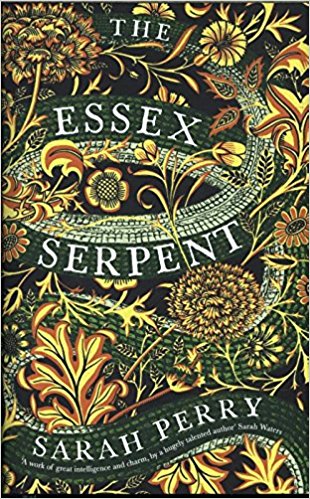 The book is set mostly in the fictional Essex village of Aldwinter in the 1890s and the action takes place over the course of a year. The central dynamic of the plot is the relationship between Cora Seaborne, a woman approximately in her late 30s, who at the start of the novel is newly widowed, and William (Will) Ransome, the local minister. Will is happily married to Stella and they have three children, while Cora is happily widowed! It seems hers was a fairly loveless marriage in which she felt constrained and imprisoned and her husband appears to have been somewhat older than her. The lack of intimacy in the marriage is indicated by the fact they had only one child, Francis, and that he is an unusual boy (for Cora “nothing shamed her as much as her son”), who is almost certainly autistic.
 The novel opens with our central character Maddy’s eighteenth birthday. She celebrates this with her mother and her nurse, Carla; Maddy suffers from severe allergies and lives an isolated existence in her hermetically sealed home, which she has not left for many years, so these two women provide the only relationships she really has. Maddy is home schooled, receiving almost all her tuition over Skype from various tutors. Occasionally, they are allowed to tutor her in person, but only after they spend a period of time in a decontamination unit in the house, to ensure Maddy does not come into contact with any pathogens or foreign particles which might harm her. Maddy’s father and older brother were killed in an accident when Maddy was a baby and she and her mother are therefore incredibly close.
 It’s basically a book about sickness, and the various forms it takes; the sickness of the troubled central character, Yeong-hye, whose decision to renounce meat from her diet is the catalyst to a catastrophic sequence of events; the sickness of some of her relatives who simply cannot accept Yeong-hye’s decision or who use it to perpetrate their own base acts; and the sickness in the society which degrades and dehumanises Yeong-hye. The insidious and malevolent control meted out to Yeong-hye over a period of many years (a control that was legitimised by social and cultural norms) leads to her attempting to starve herself in a desperate attempt to assert her autonomy, and this has explosive consequences
 This was April’s choice for my book club and one of the members described it as the best book we have read – she consumed it in virtually one sitting in the middle of the night when she was wide awake with jet lag! A fine endorsement indeed. It really is a marvellous book and, as I so often say on this blog, totally unfair that one so young should exhibit this much talent in a debut novel! It has also been shortlisted for the Baileys Women’s Prize for Fiction this year (winner to be annonced on 7 June), so it’s hot.


 What is so immediately intriguing about the title of the novel, of course, is that Holland is very, very flat. But In the Dutch Mountains imagines a world where the Netherlands extends much further south of its modern borders to northern Spain and the Pyrenees (hence the Dutch mountains). The narrator is himself a Spaniard, a civil servant who not only relates the story, but also philosophises on the processes of writing and story-telling: a story within a story. The main characters in the tale are Kai and Lucia, a slightly other-worldly circus couple, remarkable for their physical perfection, who are relieved of their jobs (because times have moved on and audience tastes have changed) and find themsleves travelling south to look for work. Kai is kidnapped and Lucia sets out on a journey to find him, accompanied by an old woman she meets on the way who agrees to drive her to find her lover.
 Julia's books