
Science fiction has never really been my thing but, ever keen to push my reading boundaries, I included it as a theme for my Facebook Reading Challenge in October. It’s a genre I know little about, so picking an author or title might have been tricky, but I had in fact known for some time who I would select, having become aware of Le Guin after she died in January last year at the age of 88. The obituaries talked about how she had for years been under-rated, the inference being that as a woman she was overlooked in this male-dominated genre, but that she had a devoted critical following and has been cited as an influence by the likes of Margaret Atwood, Salman Rushdie, Neil Gaiman and Iain Banks.
She was prolific, producing nineteen novels, as well as short story collections, poetry and non-fiction during a writing career that spanned six decades. (I note that her first full-length novel was published when she was 37, which gives me some hope!) Many of her novels form part of her Earthsea series, so I chose The Lathe of Heaven as it is a stand-alone novel.
 The Lathe of Heaven was written in 1971, but was set in ‘the future’ – Portland Oregon in 2002. This future world is one in which the global population is out of control, climate change has wrought irreparable damage and war in the Middle East threatens geopolitical stability. The most alarming (and engaging) thing about the book, for me, was how prophetic it was; in 1971 did readers think this was some dystopian world? Worryingly, many of the problems envisaged by Le Guin are recognisable features of our environment in 2019.
The main character is George Orr who has an unusual affliction – he is able to change reality through his dreams. It is a difficult concept to get hold of, but when he dreams a new situation, all history is also altered to facilitate the revised present and no-one but he is able to recall how it was before. For example, in 1998, a nuclear war virtually destroyed life on earth, but George ‘dreamed it back’ and in the new iteration the nuclear war never happened.
George is disturbed by these dreams and turns to prescription drug abuse to stop himself from entering deep sleep when these ‘effective dreams’ happen. He has to break the law to get sufficient supplies, however, and when he is caught he is forced to see a psychiatrist, Dr William Haber, to help him wean off the drugs. When George explains his problems to Haber, the ambitious but under-achieving doctor quickly sees the potential for using hypnosis to ‘suggest’ dreams to George which will organise the world the way Haber wants it. Haber’s intentions are not entirely malign; he wants world peace and widespread good health, for example, though he is careful also to ensure he benefits financially and in terms of academic status as a side-consequence. The problem is, Haber’s suggestions are not always interpreted by George’s brain in the way Haber intended. So, when Haber suggests a dream for the elimination of racism, the result is not, as Haber thought, that people become universally open-minded and accepting, rather everyone’s skin colour changes to grey, ie there is no longer any visible indicator of race.
Events become ever more bizarre and George, desperate and realising that Haber is using him for his own ends, which George is worried will have devastating consequences, ultimately, turns to a lawyer to try and get out of the therapy and stop Haber. The lawyer, Heather, becomes George’s ally and partner and he ultimately falls in love with her. But as realities keep changing, she is at times, farther and farther away from him.
It is a fascinating story and I enjoyed the philosophical journey, the question of the extent to which we are in control of our destiny, as well as the very relevant themes of global warming and the locus of power in society. I won’t give away any spoilers, but the ending lost me a little – at that point it felt more ‘of its time’, though I can also see where Le Guin was coming from. Don’t forget this was published not long after the moon landing so the concept of outer space, whether there was anyone else out there, were, I imagine seen somewhat differently than they are today.
Recommended, if you’d like to try something a little different.
If you are a fan of science fiction, what other authors would you recommend?
If you have enjoyed this post, I would love for you to follow my blog. Let’s also connect on social media.
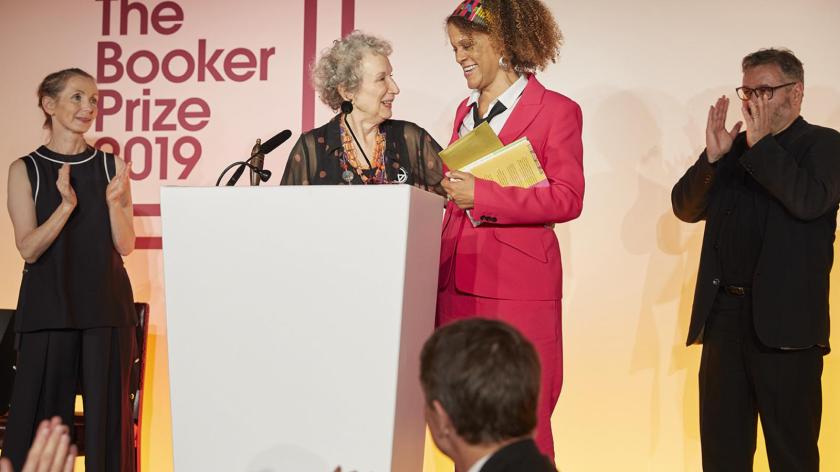 The Booker prize winner(s) were announced last week and for the first time in years, and against the explicit rules of the contest, the judges awarded the prize jointly to Margaret Atwood and Bernardine Evaristo. I have not read either book yet, though I am currently listening to The Testaments on the excellent BBC Sounds and enjoying it enormously, though it is extremely dark. There has been so much publicity around Atwood and The Testaments that I was wondering how on earth the Booker prize judges were going to be able to not award it to her! So, I think the judges probably made the right decision. By now, I would probably have worked my way through at least two thirds of the shortlist (I’ve never managed all six in the period between shortlist and winner), but, for obvious reasons, I have not read that much so far this year.
 It is somewhat and sadly ironic that I was reading Elif Shafak’s 10 Minutes 38 Seconds in This Strange World at the time of my mother’s death, a novel about a woman, Leila, an Istanbul prostitute known as Tequila Leila, who is brutally murdered in a back alley by street thugs. Rather than death being an instant occurrence, however, the author explores the idea of it as a transition from the world of the living to the ‘other’ (with a duration, for Leila, of ten minutes and thirty-eight seconds) during which time her whole life flashes before her. Leila’s life story is told through a series of recollections about her five closest friends, how and when she met them and what impact they have had on her life. We learn that Leila came from a relatively affluent family. Her father was anxious for heirs, but when his wife proved incapable of having any he took a second wife, Binnaz, a much younger woman from a lowly family, who gave birth to Leila. Binnaz was forced to give up the child to the first wife to bring up as if she were her own, whilst Binnaz, who never recovered mentally from the trauma of that event, was thereafter known to Leila as ‘Auntie’.
 It seems appropriate that I should be posting a review of Normal People this week, a book so very much about Ireland, the challenges and contradictions at the heart of a nation that has transformed itself in recent years. It is not just about Ireland, but about what it means to be young in Ireland and about class. It is also about identity and, in common with some of the issues faced in the UK and many other societies I am sure, the draw away from regional towns and cities, towards a centre, a capital, where there is perceived to be more opportunity, and what that means both for the individual and for society in the wider sense.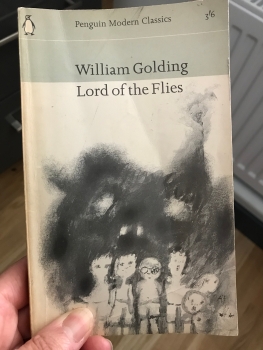
 So my reading time has been severely curtailed. I managed to finish Why Mummy Drinks just after the book club meeting, just as well it was a quick read and did not require too much mental investment. My other big read for last month, however, did. Colin Thubron’s To A Mountain in Tibet was the April title for my
 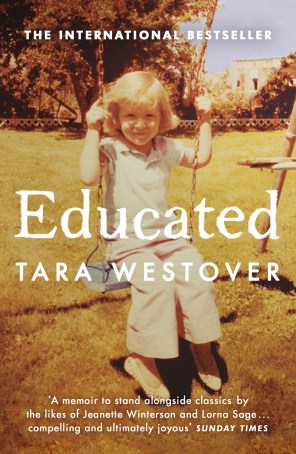 This book caused something of a sensation when it was published last year. It is the extraordinary memoir of a young woman who grew up in rural Idaho, as part of a large Mormon family. Nothing too outlandish there until the author begins telling you about the father’s survivalist beliefs (he hoards supplies of food and fuel in their bunker for when catastrophe strikes, as he believes it inevitably will), his Christian fundamentalism (quite extreme beliefs about, for example, what women should wear, that even their fellow Church members find uncomfortable) and the obsessive control he exerts over the rest of the family. The unconventional nature of the family would be enough to make this a fascinating read, but what makes it shocking is the level of violence, of almost sadistic cruelty. Some of is quite hard to read and at times I found myself gasping out loud.
 The books open in 1988 when the central character Frank opens a music shop in a rundown area (Unity Street) of an unnamed city. Frank is passionate about music, something that was instilled in him by his late mother, the eccentric Peg. It is probably the only the good thing that Frank got from her, and as the book goes on, we learn much about the lack of love and security in his childhood. This is important as it helps us to understand Frank’s actions later on. The other thing that Frank is passionate about is vinyl; he refuses to sell either cassette tapes or the new-fangled CDs in his shop, much to the chagrin of the salesmen who tell him he is a dinosaur and will have to change with the times. They gradually abandon him.
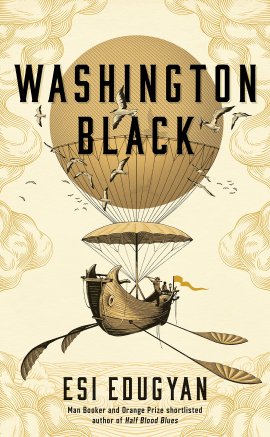 Washington Black’s life is turned around, however, when Erasmus’s younger brother, Christopher, or ‘Titch’, arrives at the plantation. He is an inventor, a man of science like his father, who does not share his brother’s views on slavery. Titch has come to Barbados in order to work on a flying machine he has designed and asks his brother for a helper. Erasmus loans him Washington Black and the boy goes to live in Titch’s quarters, helping him with drawings and experiments as well as practical household tasks. Titch discovers that Washington has considerable artistic talent as well as abilities which will be useful in his science projects and he teaches him to read. This change in Wash’s circumstances means he can probably never go back to being with the other slaves and the question is posed whether Titch has served his protégé well.
 Gretel is a 32 year old woman living alone in Oxford. She works as a lexicographer, a natural career for her as her life has been dominated by words – their invention, their use, and, perhaps also, their lack. She had an unconventional upbringing with an eccentric mother on a canal boat. In her early years, Gretel and her mother developed their own language, a succession of private words for things for which a single expressive term did not exist, for example “sheesh time” refers to a desire to spend time alone, and “Bonak” will come to mean something to be afraid of, something threatening.
 The central character is Walker, a man from rural Nova Scotia, who fought with the Allied forces in the D-Day landings. He has seen and experienced terrible events, death and injury that most of us can barely even imagine, and he survived. After the end of the war, he goes back to the United States and finds himself living among the homeless in New York City. The book is divided into four sections: 1946, 1948, 1951 and 1953 each set in a different US city (though Los Angeles is the setting for both 1948 and 1953). As he reflects on his experiences, it becomes clear that it was impossible for him to return home to Canada. He reminisces about the quiet, gentle life he led there, where the rhythms of the seasons, the dependence on the harvests of the seas, and community events (such as village hall dances) dominate everyone’s existence. It’s as if the contrast between that life and the brutality he witnessed in the war means he fears contaminating the innocence of those he has left behind. He can never go back, never unsee what he has seen, and those he once loved will never be able to understand how he has been changed.
