Book review – “Hot Stew” by Fiona Mozley

Fiona Mozley’s first novel, Elmet, was published in 2017 and was shortlisted for the Man Booker Prize that year. Set in Yorkshire, for which ‘Elmet’ is an ancient pseudonym, it is a brilliant, dark portrait of a small somewhat disenfranchised family, threatened both by the authorities and by a shady underworld. I loved it and Mozley was, at the time, the youngest ever shortlisted author, until Daisy Johnson came along the following year and bested her by a couple of years. I wrote recently about the ‘difficult second novel’ when I was reviewing Splinters of Scarlet by Emily Bain Murphy. That novel was a little disappointing, but Fiona Mozley has well and truly cracked it with a stunning follow-up.

Elmet had a close focus on a small family (a father and his two children), but Mozley’s skill for creating a strong supporting cast of characters was being tested out even there, and in Hot Stew she has drawn her view back and created an ensemble of diverse characters among whom she moves with dexterity. The novel is set in Soho and Mozley’s interest in history is brought out once again as she weaves in information about the origins of that part of London, including how its name derived from a hunting cry “So Ho”. The novel opens with a conversation on a rooftop between two sex workers, Precious and Tabitha, the former active and the latter retired. Tabitha, we will learn later, is the assistant, companion and adviser in a relationship that defies convention and definition. The novel is populated by many others residing in the area, sex workers, itinerants, entertainers and those who belong in no other place.

The buildings they occupy and work out of are owned by Agatha, the half Russian, half English sixth daughter of a former property peculator whose last wife (the Russian one) managed to persuade her husband to leave all his wealth to their unborn child, whom she had convinced him was a boy. Agatha was born after her father’s death and so never knew the man to whom she owes all her privileges. She was sent to the finest schools, and has wealth beyond most people’s imaginings, thanks to her father having bought up much of derelict and undesirable Soho after the war. Agatha wants to get the sex workers out so that she can develop her holdings further. This tussle for dominance creates the premise of the novel, but in Fiona Mozley’s hands it is so much more than that.

We explore the many worlds of the full range of characters, while never losing a grip on who is who. Some are more relevant than others, but all have a part to play in the story. The reader is invited to examine their preconceptions about sex workers and sexuality as the different lifestyles are explored and complex moral conundrums are set up. There is a huge amount going on in the 300 or so pages of this book.

As with Elmet, the denouement of the novel is dramatic and just far-fetched enough to make us realise that the world we are in is somehow ‘other’. The catastrophe that brings the novel to its close resolves some of the thorny issues thrown up by the story. This does not make it ‘unbelievable’, however; there is gritty social realism here, contemporary social dilemma (how to deal with capitalism) and the dysfunctionality of attitudes to sex and sexuality.

I loved this book and it is a challenge to review because it is so ambitious in scope and so broad in its content. I listened to it on audio and it wasn’t the best narration I have ever heard – the actress was too young, it seemed to me, and there were a number of mispronunciations which should have been edited – that’s not the actor’s fault, more the producer’s laziness. Such things jar. I would recommend the book highly and will be surprised if this does not find itself on some literary prize shortlists this year.

Facebook Reading Challenge – July choice

Last month’s reading challenge book, Murder in Midsummer, a collection of short stories by the likes of Sir Arthur Conan Doyle, Dorothy L Sayers and Ruth Rendell, was the perfect bit of light-hearted escapism for me. Nothing too challenging, great entertainment. Look out for my review next week.

This month is going to be completely different! The theme is “a book to travel with”. Since travel as we know it, is pretty much off the agenda at the moment (the UK government’s new list of green and amber countries was announced last week, and, guess what, most of us are going nowhere!) we are all having to think a little laterally at the moment. Perhaps you booked your caravan in Torquay months ago, in which case congratulations, but those less organised among us, waited. I thought we were being organised by booking the ferry to Ireland back in March, assuming we would be out of this pandemic by the summer, but alas, it does not look as if Ireland will have us and our potential Delta variant, not for the moment at least, without stringent quarantine restrictions that make the trip impractical. So, it’s back to the drawing board for us and yet more months before we see family again. I’m sure many of you are in the same boat.

What does it mean to ‘travel’ anyway? Many of us will have at least a few far-flung destinations on our bucket lists, but if we look back, the trips that mean most to us are usually the ones which involved some sort of mental or emotional journey, or spiritual transformation too. So, rather than choose a book about A N Other’s fantastic trip to Paradise, that makes me too jealous to read, I’ve chosen a book which is about travel as catharsis or recovery. Wild: From Lost to Found on the Pacific Crest Trail was published in 2012 by American writer Cheryl Strayed and was the first choice of Oprah’s book club when it was launched the same year.

Strayed wrote this memoir during a particularly difficult time in her life; her mother had died prematurely, when Cheryl was only 22, she and her husband divorced and she became a drug user. She undertook the punishing 1100 mile hike through California, Oregon and Washington as a form of therapy.

Okay, so it’s not going to be a barrel of laughs, maybe even triggering for some, but I think it is possibly a journey worth taking. And I get the sense that it is ultimately uplifting.

So, I would love for you to join me in the challenge in July. Hop on over to the Facebook group and join if you would like.

Happy reading everyone, however and wherever you will be travelling this month.

Book review – “Klara and the Sun” by Kazuo Ishiguro

I don’t buy very many hardback books, hardly ever in fact until I started this blog, tending to find them cumbersome and too heavy for a handbag. Most of my reading now, however, is done at home rather than on the fly and I find I enjoy the weight and feel of a hardback and the better quality paper. Perhaps that is also down to my age! There are just some books that are more of an event though – Hamnet, The Mirror and the Light and The Testaments come to mind – and simply deserve the gravitas of the hardback format. Klara and the Sun by literary giant Kazuo Ishiguro is one such book. Plus I just couldn’t wait for the paperback! There was great fanfare about its release on 2 March; a whole episode of Alan Yentob’s BBC arts programme Imagine was devoted to the author, and I was delighted to watch a Manchester International Festival online event where Ishiguro was interviewed by fellow writer and poet Jackie Kay. Kazuo Ishiguro comes across as such a lovely man – confident but humble, respectful and measured, subtly charming. And someone who it would not be too scary to meet, I suspect.

Klara and the Sun is Ishiguro’s eighth novel (in a forty year career), proving that you don’t have to be prolific to be great; he has won just about every major literary award going, including the Nobel Prize for Literature in 2017. I knew that Artificial Intelligence was the subject of the novel and knowing that Ishiguro is never afraid to try out new things, I feared this would be a ‘dystopian future’ book – not the kind of book I tend to enjoy. It is not such a book, however. Rather, it is an exploration of what it means to be human.

Klara is an “AF” – Ishiguro leaves us to work out what this stands for – an AI robot produced for the specific purpose of acting as a companion to young people. The pre-supposition here is that human beings have reached a point of evolution where teenagers need a robot to accompany them at this stage in her life. We first meet Klara when she is in a shop window, waiting to be purchased. Poor Klara always seems to be overlooked in favour of newer models, despite the special qualities that the shop’s manager believes she possesses. From her vantage point in the shop, Klara watches the sun each day, its rising and setting and computes that it has special powers. For Klara the sun is almost god-like; a futuristic AI robot that sees the sun in a similar way to some of our ancient ancestors. Klara is also given energy by the sun – her batteries are solar.

Klara is eventually chosen by a young girl, Josie. Josie and her mother take Klara away to their home outside the city in an isolated rural setting and Klara is at last given her task. It is interesting how the reader gets drawn into having feelings about Klara. Klara is the narrator and we see the world through her rather childlike eyes, except she is not childlike; there are just some bits of data she has not processed and stored yet. But it is hard not to feel for Klara when, for example, the maid at Josie’s house is suspicious and a little hostile towards her, perhaps because she fears for her own job. And when Klara stands silently in the corner with her back to the room because her presence is not required we cannot help but see her like the child who has been left out. Klara is not human and yet she is the closest thing to it.

It soon becomes apparent that Josie has special needs. She has a kind of ‘elevated’ academic status which seems to mean that her parents have given her some sort of treatment which means that she receives a different kind of education to children who have not had this done to them. One such child is Rick, Josie’s nearest neighbour and childhood best friend. It is clear that Rick’s mother would never be able to afford the special status that Josie and her peers have and so his chances of succeeding academically and professionally are slim. The reader can see that there is a very short hop between this world and the selective nature of modern education we have in real life (both as a matter of policy and a matter of social determinism), and indeed between this world and Huxley’s Brave New World. A warning has been fired across our bows here.

In order to attain this special status, however, something had to be done to Josie (we are not told exactly what) and this has put her in some danger – for parents, the decision whether to give their child an academic leg-up is not risk-free. Hmm. Klara is capable of some rudimentary feelings and feels protective and fond of Josie. When she realises that Josie’s life may be in danger, she sets about trying to save her, utilising the sun’s enrgy. What Klara has not worked out, however, is how this AF is being groomed for something very different altogether.

The plot of this novel is pure genius and Ishiguro has conjured some contemporary themes out of a futuristic premise. What he has also done, very cleverly, is create a world that does not seem very different to our own and yet presents some prospects that we should take care we don’t stumble into. AI is a fact of our present life and will be a fact of our future. Stephen Hawking believed we should be careful as it had the potential to be the “worst event” in human civilisation. It is not clear which side Ishiguro comes down on, indeed, Klara is one of the most likeable characters in the book, but perhaps that is the point; it is not necessarily what AI will become that is the threat, but what it will cost us in human terms to get there.

A brilliant, engaging, complex novel, I recommend this highly.

Literary sightseeing in the UK #1 – Haworth

My husband and I had our second Covid vaccinations last week, so I now feel pretty protected and relieved that we are less likely to pass the virus on to someone who might be less able to withstand it. One of my daughters has had her first dose and my student son should be able to book his vaccination by the end of the week. That only leaves my youngest who at fifteen is unlikely to get it any time soon. This sudden ramping-up of the vaccine roll-out comes in a week when the Delta variant of the virus is seemingly running wild throughout the country and when the G7 seem finally to have woken up to their responsibilities to distribute vaccine to parts of the world less well-endowed than us.

A few weeks ago, when it still seemed possible that most social distancing restrictions would be lifted on the 21st of this month, we booked a trip to Ireland for July to visit my husband’s family. We have not seen them for eighteen months. As I write this, I hear that the Republic of Ireland has extended its quarantine requirements for travellers from the UK. Suddenly, it looks as if our trip may be postponed. There will be many others like me, disappointed at this news. We normally travel to the continent for our summer holiday – we long ago realised THAT wasn’t going to happen, but many people will have been hoping to make such a trip to visit friends and family who, like us, they have not seen for many months.

Most of us in the UK will have to amuse ourselves with a holiday at home this year, if we are lucky enough to be in a position to take one. I have no idea what we will do, but if you are in the same boat I would like to share with you some literary gems that you might find interesting!

Last autumn, desperate for a change of scene, we spent a weekend in West Yorkshire during half term, just before we were all sent into lockdown for a second time. We visited Haworth, home of the Brontë family of course, just outside of Bradford and only about ninety minutes drive from Manchester. I went there many years ago, staying in the youth hostel in the summer, and I remember it being extremely busy, the vertiginous high street thronged with tourists. At the end of October 2020 the atmosphere could not have been more different.

The near-deserted main street through Haworth

The weather was awful – the moors were definitely wild and windy! – very wet and cold. But this just made it feel more… Brontëan to me! The other benefit from the weather and the pandemic was that the place was empty, though not so good for the businesses that depend on tourism of course. The Brontë family home is now the Brontë Parsonage Museum, a fairly modest dwelling that has been laid out much as it would have been in the 1800s, at the time the sisters were living there, and which displays many of their belongings. There is a permanent exhibition giving the history of the family and their work. Most striking for me were the tiny books the sisters wrote about the Angria, and a gown of Charlotte’s – she was such a small woman! There was also an exhibition of Anne’s paintings, which was in part an attempt to set the record straight on her literary status.

The Parsonage – where the Brontë children grew up

Social distancing rules mean that entry is by timed ticket, which actually allows you to enjoy the museum in an uncrowded way. The downside of this for the Museum of course is reduced revenue, so a donation is called for. The experience was near spiritual; for me the Brontës represent a literary pinnacle and visiting their home is like visting a shrine. The coolness of the place (doors and windows were open), the damp outside, and the silence and emptiness, just made the experience more authentic.

The moors provide a stunning backdrop to the Museum. They were where the sisters would walk daily and to follow the guided paths, particularly as far as Top Withens, the ruined house said to be the inspiration for Wuthering Heights, it feels as if you are truly walking in their footsteps.

All aboard!

Haworth is magical, but there is more to see in the area, not least the wonderful Worth Valley steam railway which runs from Oxenhope to Keighley. This too has a literary connection, having provided the location for the filming of much of The Railway Children, the classic 1970 film of E Nesbit’s children’s novel.

We had a wonderful weekend and it cheered us up after months at home doing nothing. We stayed in a rental cottage just a few minutes walk from the centre of the village. A restaurant table for dinner proved hard to come by so we took advantage of the delivery services of one of the many local Asian takeaways, having the most amazing Indian feast brought to our door.

So, if you are looking for places to visit this year while you holiday at home, I cannot recommend Haworth highly enough.

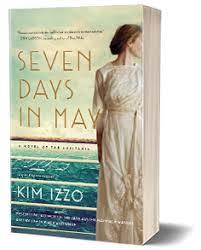
Book review – “Seven Days in May” by Kim Izzo

When I began my Facebook reading challenge at the start of 2018, the monthly themes were fairly easy – a YA novel, a work of feminist fiction, crime fiction, etc. Over the last three years I’ve read some cracking books that I would probably not have picked up otherwise. Memorable titles have included The Secret Lives of Baba Segi’s Wives by Lola Shoneyin, Please Look After Mother by Kyook-Su Shin and The Birth of Venus by Sarah Dunant. As time has gone on, I’ve been scraping the bottom of the barrel for themes and they have become a little more random, to say the least! Bereft of ideas, for May I decided it would be “a book with May in the title”. I don’t know what I was thinking – perhaps a touch too much sherry over Christmas when I was putting the list together, or months of lockdown making me go a bit loopy! Well, finding a title was challenge enough, but I did – Seven Days in May by Kim Izzo. This novel was first published in Canada in 2017. I never like to criticise a book, but I think it was not one of those which I would include on my most memorable list.

I love historical fiction and this book ticks that box since it is based on the true story of the sinking of the Cunard liner RMS Lusitania in May 1915. Most people will have heard of the Lusitania, but I wonder how many know the background to the story. The luxury cruise liner’s maiden voyage was in 1906 and she travelled the north Atlantic route between Liverpool and New York. At the time, she was one of the fastest vessels of her kind. It was almost at the end of her 202nd voyage on 7 May 1915, that she was torpedoed by a German submarine and sunk a few miles off the southern coast of Ireland, near Kinsale. The wreck still lies there. Almost 1,200 passengers and crew perished, and 761 survived. One of the survivors was the author’s great-grandfather. The story of the Lusitania is important, historically, because it was instrumental in drawing the Americans into the first world war. Many conspiracies about the ship abound, including that Churchill (who was First Sea Lord at the time), placed the Lusitania directly in harm’s way, by failing to adequately warn or protect her; it has been said he calculated that the loss of American citizens would trigger the US to declare war on Germany. Kim Izzo explores some of these conspiracies in the novel, hinting strongly at Churchill’s negligence. 

There is more story than history in this novel, however, and the main plot of the novel concerns the relationship between wealthy American socialites, sisters Brooke and Sydney Sinclair, and English aristocrat Edward Thorp-Tracey. The elder Sinclair sister, Brooke, is engaged to be married to Edward. The match is a fond but loveless one, a marriage of mutual convenience; Brooke’s wealth will preserve the Thorp-Tracey seat, Rathfon Hall in Somerset, while Edward’s title will add status to the Sinclair name. When Edward finally meets Brooke’s younger sister Sydney, at the engagement party in New York, just before they set off for England for the wedding, he finds he is instantly attracted to her. Sydney is headstrong, passionate in her political beliefs and more down to earth than her sister. Brooke and Sydney have a falling out just ahead of the voyage which leads to Sydney refusing to share the suite her sister has booked for them, and instead booking a cabin in third class. Over the course of the voyage, Edward and Sydney find themselves falling in love with one another and Sydney’s separate and distant quarters make their clandestine meetings possible.

A parallel story is taking place in London. Isabel Nelson, also, it turns out, a passionate, headstrong and determined young woman, finds herself working in ‘Room 40’ at The Admiralty. She worked in service in Oxford, but after an affair with her employer, who, amongst other things, had arranged for her to obtain some clerical qualifications, was banished to London after his wife had found out about his infidelity from another servant. This turns out rather well for Isabel since she finds she likes the work. Room 40 was a real code-breaking unit, a prototype of Bletchley Park, so important to the Allied victory in the second world war. Isabel’s job is to type up and distribute the coded messages translated by the (all-male) code-breaking team. Isabel follows the movements of the German submarine captain who is said to have fired the torpedo which downed the Lusitania and a number of other vessels at the time. She becomes increasingly concerned about the passenger ship and fears it is a target and that not enough is being done to protect it.

There is a personal dimension to the Isabel story too when her former fellow servant, the ghastly Mildred, turns up at the Admiralty, also having got a job there, and threatens to undermine Isabel’s position, by spreading gossip about her past.

The book was not unenjoyable; it had some interesting historical detail. But I found the plot a little thin for my taste. I did not really warm to any of the characters, and found myself a little agitated by the cliched portrayal of the different classes of person, from the passengers aboard the ship to the civil servants in London. Kim Izzo is a bestselling author and her most successful book is The Jane Austen Marriage Manual.

Recommended if you want a little bit of uncomplicated escapism with some history thrown in.

Reading Challenge – June’s choice

It’s the beginning of the month (I count the whole of the first week as ‘beginning’!) so that must mean it’s time for another book in the reading challenge. True to form, I have not yet finished last month’s book, Seven Days in May, by Kim Izzo, but it’s a fairly easy read, so should be able to finish in time to post a review next week.

This month’s theme is ‘a book for midsummer’. What I had in mind here is something I can read in the sunshine, in the garden, perhaps imagining I’m on holiday somewhere, that is not going to be too taxing. Is that what ‘midsummer’ conjures up for you too? We have had precious little summer these last few weeks; in the northwest of England May was a complete wash-out. And cold – as I look out of my window now at the glorious sunshine, it is hard to believe that a little over a week ago we still had the heating on!

The planting work in the garden is now done, so I am hoping to sit back on a lounger and enjoy watching the fruits of my labours flourish, between chapters. I think I have found the perfect reading companion for this activity – Murder in Midsummer – Classic mysteries for the holidays. It is a collection of short stories by renowned crime writers, including the likes of Dorothy L Sayers and Ellis Peters. The collection has been put together by Cecily Gayford and edited by none other than Ruth Rendell, giving it some heavyweight literary merit. Every time I have read a short story recently (most notably over last Christmas) I have promised myself I will read more of this form. And every time I have read a crime novel, a genre I have not explored very much, I have thoroughly enjoyed it, so I have high hopes for this one.

The stories in the collection, as suggested by the title and sub-title, are also set in holiday spots, another good reason to choose it. Since our ability to travel at the moment remains so limited, it will be lovely to enjoy a bit of armchair travel. And if reading isn’t escapism then I don’t know what is.

I hope that, wherever you are, you are keeping safe and well as this terrible pandemic rumbles on, and that you are enjoying whatever joys early summer brings for you.

Happy reading!

Kids book review – “Splinters of Scarlet” by Emily Bain Murphy

I chose this novel for my Facebook Reading Challenge in April, the theme of which was a children’s book. I was delighted to have this as a theme; regular readers of this blog will know that I am a huge fan of children’s literature and regularly post reviews of books for young readers. It has unfortunately been some time since I read a children’s book, however, so I was keen to get started on this one. Splinters of Scarlet is Emily Bain Murphy’s second novel. Her first, The Disappearances, was a huge success, both critically and commercially, and so her follow-up was hugely anticipated. I read The Disappearances as part of this very reading challenge in January 2018 and absolutely loved it. My elder daughter who I insisted read the book, rates it as one of her favourite novels of all time and has re-read it several times. Every music fan will be familiar with the concept of the ‘difficult second album’, and the same may be said of books, except that books are produced and marketed somewhat differently, and first-time authors rarely achieve huge first-time success in the same way that certain pop performers do. I fear, however, that Emily Bain Murphy has not quite pulled off the ‘difficult second novel’. Don’t get me wrong, it is good, but my expectations were perhaps a bit too high.

The novel is set in Copenhagen in 1866-67, initially in an orphanage and then in the home of a wealthy mining widow Helene Verstergaard. The central character is Marit Olsen, an orphan seamstress. Her closest friend is Eve, a younger fellow orphan with a precocious talent for ballet, who is about to be adopted by the famed former ballerina Mrs Vertergaard. Marit adores Eve, loves her friend like a sister, even as a mother might, and has mixed feelings about the likely adoption. She is happy that her friend is happy, but it will be a poignant outcome for her since her father was killed in a Vestergaard mine and she remains bitter at the callous way she and her sister were treated; Helene Vestergaard’s late husband was the owner of the family mining dynasty and Marit blames him for her father’s death. When her father died, Marit’s older sister suddenly became responsible for the two of them, and Marit believes this burden, in turn, killed her.

What we also learn in the opening chapters is that certain people in the country have magical powers. Marit does for example and uses these in her job as a seamstress, and especially in the costumes she makes for Eve. Marit’s sister did too and ‘over-used’ her magic in trying to provide for the family. The over-use of magic is dangerous for its owner as it can lead to that person’s death if they are overtaken by ‘the firn’.

Eve is adopted and Helene Vestergaard decides that in addition to a daughter she would like a talented seamstress and so decides to take Marit from the orphanage too. Despite her mixed feelings Marit agrees so that she can be with Eve. Her lifestyle will be very different to her friend’s, however, for she will be a servant and live among the staff.

Marit becomes close to a number of the servants, most of whom it seems possess magical powers – Marit realises this is no accident; Helene has chosen her household carefully. A foreboding presence in the Vestergaard household is Helene’s brother-in-law Philip. Marit quickly begins to suspect something sinister is going on in the Vestergaard mines and that Philip is linked to it. She also begins to suspect a link with her father’s death and her quest for the truth drives risk-taking investigations.  

Marit shares her suspicions with the servants she has become close to and they agree to help her. Thus they set about various surveillance operations to try and find out what is going on in the mines and what exactly Philip Vestergaard has to do with it. The remainder of the book concerns Marit’s activities, for which she uses her magical powers extensively, as well as her increasing concerns about ‘the firn’ and whether she will fall victim to it. Philip Vestergaard senses Marit’s interest and begins to see that she and some of the others are a threat. He sets about silencing them, even killing one of the servants. The scene is set for the denouement – a showdown between the two opposing forces in the novel – truth and lies.

This novel has quite a complex plot and wide cast of characters, some of whom I found it hard to distinguish. The Disappearances also has a complex plot and a wide cast of characters and yet the author, in my view, handles it more deftly in that book and with greater imagination and coherence. For me, this novel is sometimes confused, and there are some non-credible twists which seem to be made to serve the plot. It is perhaps unfair to compare this novel to the earlier book, which was so good. If Splinters of Scarlet had been the first novel I would possibly be looking upon it more favourably. As it is, I’m afraid I didn’t enjoy it anywhere near as much. I suspect this book would suit a younger reader, perhaps 11-13 year olds, whereas The Disappearances is more suitable for 12-14 year olds. However, I think it is less good than other books in this age group.

Competent and her fans will love it, but for me it was not as engaging or brilliant as this author’s first novel.

Book review – “Frenchman’s Creek” by Daphne du Maurier

You will recall that I read Daphne du Maurier’s Rebecca a few weeks ago. I devoured it, could hardly put it down, loved the film too. Once I had written my review I went to put the book away and, being  a strictly alphabetical storer of books, discovered I had another du Maurier tucked away on the shelf that I had completely forgotten about. It looks like I bought it in 1989 (I used adhesive book plates in those days) so I was still at university and must have picked it up in a secondhand bookshop. It’s a 1965 Penguin edition, which means it has a very small typeface and is only a little over 230 pages long. I was very excited about this find and could not wait to get stuck in.

My vintage, pre-decimalisation copy!

I assumed that as the book appeared to be so short it would not take me too long to read. It took me the best part of three weeks! I kept falling asleep reading it, which may have been due to the fact that my life has been a bit topsy-turvy this last month or so and I have been tired, or the fact that 1960s typeface is actually impossible to read and a tremendous strain on the eyes. Or perhaps it is just that I was so decidedly underwhelmed. I think that is the kindest thing I can say about it. It was the first novel published after Rebecca, (the latter published in 1938, while Frenchman’s Creek came out in 1941) and yet it reads like it could have been her first, practice or unfinished novel, discovered posthumously. I was so disappointed.

The plot is a simple one – set in Restoration England, wealthy Dona St Columb, bored with the frivolousness of London life (and also bored with her husband), decides to take herself, her two young children and the nanny to the family’s estate in Cornwall, Navron House. The house has been locked up, unoccupied for some time, looked after solely by a single mysterious servant William. There is much gossip around the town in Cornwall about a French pirate, terrorising the locals, and jeopardising the noblemen whose fortunes are made through maritime activity. Dona is intrigued by the stories. At the same time, Dona begins to notice some strange things in her house: a jar of tobacco and a volume of French poetry in her private bedroom, and the feeling that there is more to the servant William than meets the eye.

When Dona confronts William she learns that he is in fact an associate of the infamous Breton pirate of the La Mouette, Jean-Benoit Aubery, who, between raids, lays his ship at anchor in the hidden creek below Navron. Dona is clearly immediately attracted to the idea of the mysterious pirate, and when she does finally meet him, he does not disappoint. They begin a fairly passionate (by the standards of the time!) love affair, and…well, I won’t give you any more spoilers. Suffice it to say, that Dona finds herself torn when her fellow Cornish nobles decide that they want to capture the Frenchman and hang him for his crimes. She will have to use all her feminine wiles to help her lover evade capture. This event is slightly comic (due largely to the ineptitude of most of the men invovled), but the threat grows somewhat darker when Dona’s husband Harry decides he will join her in the country and brings his friend, the rather sinister Lord Rockingham, who is not so gullible as Harry. Not only does he suspect that Dona is hiding something but is clearly intent upon using his suspicion to get what he wants out of her.

I feel like I have just outlined the plot of a Mills & Boon and I’m afraid that’s how I felt reading it. The novel is set in the Restoration era, presumably because that is when pirates were around terrorising coastal communities, but there is very little sense of either time or place in this novel, something that du Maurier does so brilliantly in Rebecca. The love affair between Dona and her pirate is so extremely implausible as is the interaction with the servant William, as are the key events of the novel. None of the characters are fully developed and our Breton pirate (himself a nobleman in his part of the world, but who, like Dona, is a restless soul who likes a bit of high-seas adventure) speaks impeccable English!

I read that du Maurier was often dismissed as a “romantic novelist”, but that she resisted this pigeonhole. Certainly, Rebecca, is so much more than a romance; perhaps not even a romance. But Frenchman’s Creek, in my view, is a poor follow-up to that novel, a throwaway romance that has little of real substance. I’d be interested to know what du Maurier fans think of it and how it is perceived critically. I’m going to try more du Maurier and hope that this novel is an aberration.

Read this book if you love Rebecca and are as intrigued as me by the contrasting quality!

Facebook Reading Challenge – May’s title

The twists and turns of life are unexpected and as I sit down to write this blog, having not opened WordPress for about two weeks, I was presented with my last post and the photo of our lovely cat who, I’m afraid, has not returned. Seeing him there set me off again. We have no idea what has happened to him and, since it is now almost three weeks since he went missing, we are pretty resigned to his disappearance. The worst thing is the not knowing.

Kazuo Ishiguro was interviewed about his new novel, Klara and the Sun, by Jackie Kay for the Manchester Literature Festival

Alas, it happens and we must move on. It is already May 5th and not only have I still not completed last month’s book (Emily Bain Murphy’s Splinters of Scarlet), which is fairly par for the course, I haven’t even posted May’s choice! Just as well it’s a thirty-one day month. I must admit that Splinters of Scarlet is not grabbing me as much as I’d hoped. I’m only about halfway through and my daughter assures me it gets better, so I will post a review next week, by when, I hope, I will have finished it. I need to because I’ve got so many books to read at the moment – I need to get my book club book finished and read Kazuo Ishiguro’s new novel Klara and the Sun by the 17th – I bought a ticket to the online talk between him and Jackie Kay, which was part of the virtual Manchester Literature Festival. I was unable to watch it on the night it took place, but I can still access the recording, but only for another twelve days! I prefer to read a book before attending a talk about it, don’t you?

Anyway, back to my Facebook Reading Challenge – what was I thinking when I chose May’s theme?! ‘Something with ‘may’ in the title?!’ I thought there would be loads of books to choose from, but, guess what, there aren’t! There are a few though and there is one I have stumbled across which could actually be really fascinating. So, I have chosen Seven Days in May by Kim Izzo, and I’m pretty sure this would not have crossed my radar had it not been for my rather randomly selected theme, but isn’t that what reading challenges are all about?

Seven Days in May is a fictionalised re-telling of the story of the luxury cruise ship the RMS Lusitania, which was sunk by a German U-boat in 1915, just a few miles short of her destination following a transatlantic crossing from America. Almost 1,200 passengers and crew were killed. I have of course heard of the Lusitania, but I could not have told you anything about it, so I have learned a lot just by reading the blurb. This is author Kim Izzo’s third book, and her first (The Jane Austen Marriage Manual) was a bestseller.

So, having initially despaired that I would find anything decent to fit my theme, I now feel quite excited and I would love for you to join me.

Happy reading!

PS There is another book of the same name, a political thriller written by Fletcher Knebel and Charles Bailey II in 1962, which was made into a film.

Earth Day 2021 and a lost cat

It’s Earth Day today and I am relieved at last to see the United States taking a global leadership role once again in pushing urgent climate matters forward, setting new and ambitious targets for reducing carbon emissions. Let us hope all nations follow-through (and in fact go further than) the promises that have been outlined today.

The global coronavirus pandemic has, I think, caused many of us to reflect on the way we live our lives and to ask ‘How did we get here?’ What bits of the present world order have led to this desperate situation? I think our cavalier attitude to the environment is right up at the top there among the possible answers. Over this last year of curtailed movements many of us have got to know our local areas much better and I have become well-acquainted with many of the beautiful and interesting trees in my neighbourhood that I see on regular walks. It’s not that I didn’t know they were there before but I definitely paid less attention. Even the most pedestrian trees are quite spectacular when you get close to them. Here are a few in my locale:

Two trees side by side that have become one!
The exposed roots on this tree, which is growing on a slope, look other-worldly!
I wonder what caused this midriff bulge!

I started to see trees and their importance in a different way after I read The Overstory, the 2018 Booker-shortlisted novel by Richard Powers. It is an extraordinary book that I still consider one of the best I have ever read. Another book I read more recently, Diane Cook’s The New Wilderness, was a rather more frightening foreshadowing of where we might end up if we, as the nations of the world, continue in the present direction of travel. Both books are sobering reads for World Earth Day.

Another thing that has made me very reflective this week, and, indeed, got me out and about in my neighbourhood, is that our lovely family cat Ziggy went missing seven days ago. We have had him almost eleven years and we think he is about twelve (he came from a cat rescue centre so we are not really sure), but he is the friendliest cat I have ever shared my space with and we all miss him terribly.

Our handsome boy

He never goes very far so we have hunted high and low for him in the neighbourhood. I have put up posters and leafleted all the houses in the vicinity of our house, but so far to no avail. I have had so many calls from different people wishing me luck in the search as well as possible sightings (all false alarms sadly, as a neighbour of ours has a very similar-looking cat). It is heartwarming to think that people take notice and want to help.

We continue to look and to hope.

It is that spirit and human kindness that has got us through a pandemic and will, I hope, get us through the challenges we face in the future.

Haven’t picked up a book at all this week – too distracted.

Happy reading everyone.