Libraries up and down the UK have launched their summer reading challenge for kids this week as schools break up for the holidays. My local library service (Trafford in Greater Manchester) has launched its challenge under the title Mischief Makers – hmm, a thinly disguised attempt to appeal the more reluctant reader, methinks! The little pack they get looks great so get your kids along to the library.
Libraries always work hard to provide great recommendations for kids so they will have a display of the latest and most appealing titles. Some brilliant kids’ books I have read and reviewed this year have been Kick by Mitch Johnson, A Whisper of Horses by Zillah Bethel, Tin by Padraig Kenny and 36 Questions that Changed My Mind About You by Vicki Grant.


In addition, there are some great new books around that have caught my eye. Age ratings can be tricky as children reach reading abilities and levels of maturity at different stages, so I’ve defined by key stage. Here are my picks.
For KS1-KS2 (age7-10ish)


The Wild Folk by Sylvia V Linsteadt is a quest story with an eco theme about two young people trying to stop the city taking over the country by completing a series of challenges set by a pair of hares. Migration by Mike Unwin and Jenni Desmond – non-fiction is good, pictures are good, this is a beautiful book. The Creakers by Tom Fletcher – bumps in the night, all the adults gone from the town! Lucy is on a mission to discover the truth.
For KS2, going on KS3 (8-12 ish)


Anthony Horowitz, Derek Landy and Tom Gates, all popular and much-loved, each have new books out this summer. For something a little different try Riddle of the Runes by Janina Ramirez, set in the Viking town of Kilsgard. Alva, our young heroine solves mysteries with the help of her pet wolf Fenrir. This is the first book in a new series which I am sure will go down a storm.
For tweens and teens (11-14)


Push the envelope with some poetry – Everything All At Once by Steve Camden is a series of poems about one week in secondary school and all its trials, tribulations and pleasures. Theatrical by Maggie Harcourt follows the fortunes of Hope, who wants to work backstage in the theatre but whose Mum is a famous costume designer, which is a problem. Oh, and she falls in love with a young actor. Perfect summer reading! Suffragette: The Battle for Equality is an illustrated history of the movement with some stunning artwork. Perfect non-fiction for young people interested in political issues.
I hope that has whetted your appetite – it certainly has mine! Get your kids along to the library or local bookshop and there’ll be loads more to choose from.
What are your suggestions for kids reading material this summer?
If you have enjoyed this post, do follow my blog for more reviews and book talk.


 Last month, we battled our way through Madame Bovary, some enjoying it more than others, it has to be said. Our theme was a classic novel, and this can be a challenging genre. It can take you right back to schooldays and unhappy memories of working line by line through a text that had no relevance to your teenage life. And if you are out of the habit of reading classic, usually older, novels, the language can feel outdated, and hard work.
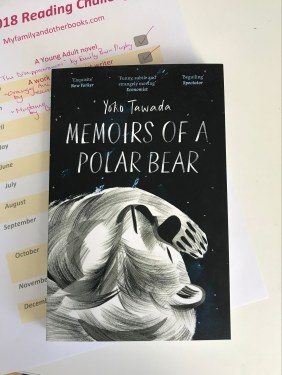 This months’s challenge is something altogether different – a children’s novel and I have chosen Memoirs of a Polar Bear by Yoko Tawada. This book first came to my attention before Christmas and I have been keen to read it ever since. It is written from the perspective of three different polar bears: the first , a female, who flees her homeland in Soviet Russia, the second, her daughter, a dancing bear in a Berlin circus, and the third, the most recent, born in captivity in Germany.
 The central character in the story is Budi, a football-mad eleven year-old boy whose hero is an English footballer called Keiran Wakefield, who plays for Real Madrid. Budi and his friends spend all their free time playing football, role-playing their favourite teams and stars. One of Budi’s friends has an old television and they sometimes watch matches together too, late at night Indonesia time. To that extent Budi and his friends are like any other boys their age and your children will be able to identify with their passions and their aspirations. The similarities end, however, when you compare the daily lives of these children with ours in the developed world; Budi and his friends work in factories, mainly sweat shops, where the conditions are poor and where the manager is cruel and exercises discipline through the use of corporal punishment. Budi makes football boots that are shipped off to Europe. They work for a pittance and, despite both Budi and his Dad working, the family still does not have enough income to eat a meal every day. Budi’s best friend is Rochy who lives with his mother and two sisters (his father is dead). Budi tells us that Rochy is the cleverest person he knows but that he had to withdraw from school because he needed to work to support his family. His existence is altogether darker – his mother barely communicates (depression?) and there is the suggestion that the two sisters are involved with the sex industry, although younger readers will not pick this up.
 This book is set in a familiar country (England) but in a future time where life has changed and the world is very different: bus journeys cost hundreds of pounds, many routine tasks and jobs are carried out (not very well) by robots and everyone carries a QWERTY, which it seems is some next generation pocket computer. Auden Dare is an eleven year-old school boy who lives with his mother in Forest Gate in east London. When we first meet him we learn that his father is away fighting in the war in Europe. Climate change has taken hold and water is scarce. Indeed, water, or the lack of it, seems to be the root cause of the conflict in which Auden’s father is involved. Auden has a condition called achromatopsia, which means he is unable to see colours, only shades of grey.
 The central character is Jaz, a 12 year-old girl who is in Year 7 at secondary school. She is dyslexic, doesn’t care too much for school (“Boring!”) and lives with her Mum and three older brothers, their Dad having left shortly after Jaz was born. Jaz is a bit of a rebel with a big heart. She struggles a bit at school, she comes across as someone who finds it difficult to deal with the mainstream demands of sitting still, concentrating, and not least the focus on reading and writing; there does not seem to be much allowance made for her dyslexia. She also struggles a bit with friendship issues, having jealous feelings towards another girl who she feels is going to ‘steal’ her best friend Lily. So we see Jaz is a bit insecure too.

 Julia's books