There is a great deal of debate and attention on the UK National Health Service at the moment as it celebrates its 70th anniversary this year. If you live in Britain, you can’t move for television, radio and newspaper commentaries at the moment. But the talk is not just about celebration, but about what we want and expect public services to provide in the way of healthcare, and, just as important, how the immense costs of it all should be met. The challenges are mind-boggling: we have an ageing population, advanced medicines come at a high price, the long-term nature of public health investment, not to mention dealing with developed world problems such as obesity, addiction and mental illness. The issues are massive.
The NHS was described by politician Nigel Lawson as “the closest thing the English people have to a religion” and it is indeed dear to the hearts of many. Observe the profile it enjoyed at the opening ceremony to the London 2012 Olympics and the influence the promise of extra cash for the NHS most likely had on the Brexit debate.
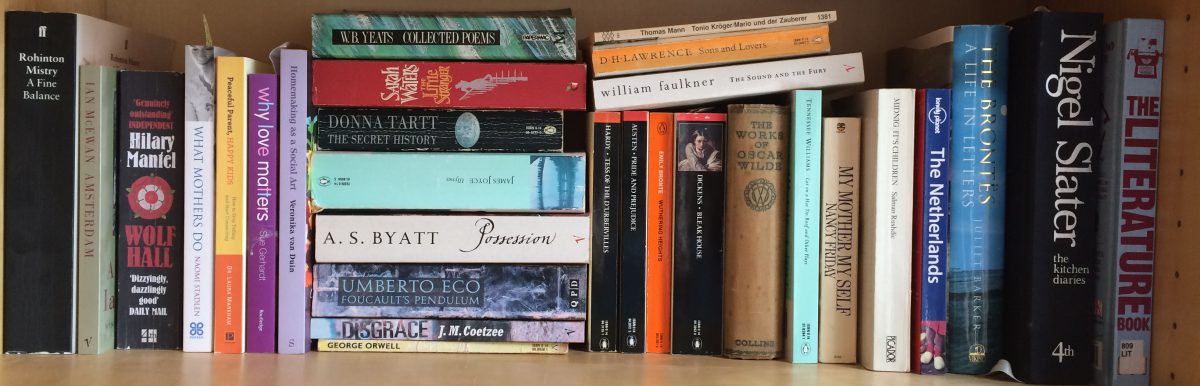
I have no intention of starting a political debate here, but if health is on your mind, you might want to dip into some books with a medical theme. Here are some of my suggestions (not all of which I have read, I should add):


- Still Alice by Lisa Genova – a moving account of a 50 year-old woman’s development of early onset Alzheimers. Made into a film starring Julianne Moore.
- Everything Everything by Nicola Yoon – a YA book about a young woman suffering from a rare condition which means her immune system is dangerously impaired.
- The Diving Bell and the Butterfly by Jean-Dominique Bauby – a harrowing true story where the author developed locked-in syndrome after a car accident. He was initially thought to be in a coma, but was in fact fully conscious. He was eventually able to communicate through blinking, and wrote this book using only this tool. Incredible and reminds you of the fragility of life.
- The Fault in Our Stars by John Green – another YA novel, both my daughters love this book, about teenage terminal illness. Also made into a tear-jerker of a film.
- This Is Going to Hurt by Adam Kay – award-winning non-fiction writing from a junior doctor telling it like it is on the NHS front-line.
- Call the Midwife by Jennifer Worth – love the TV show, currently reading the follow-up Farewell to the East End, Worth was a young midwife in East London in the 1950s so for a taste of the early days of the NHS look no further.
- Eleanor Oliphant is Completely Fine by Gail Honeyman – a young Scottish woman’s mental illness, compounded by loneliness, detachment and the harshness of modern life.
- The Curious Incident of the Dog in the Night-time by Mark Haddon – challenging life events, seen through the eyes of a young man with Asperger’s Syndrome. A must-read.
- Two Girls, Fat and Thin by Mary Gaitskill – I have recommended this book so many times. It’s an intense novel about eating disorders, mental health and sexuality.
If you have suggestions for any other books with a medical theme that you have enjoyed, I would love to hear them.
If you have enjoyed this post, do follow my blog or connect with me on social media.
 I have learnt my lesson and carve-out reading time for myself in the day. My bedtime reading is usually reserved for lighter books, entertainment. I have recently discovered the Maisie Dobbs series by British-American writer
 The book starts with 18 year-old Allie Kennaway, and her friends heading out for their college prom night. They are at Allie’s home with her father Steve and younger sister Teagan. Steve is a single parent, his wife, the girls’ mother, Sarah, having died a couple of years earlier from cancer. Allie, we learn is a transgender woman, formerly Aled.
 To my shame, I have not read anything by Agatha Christie before, although I have stayed at the Old Swan Hotel in Harrogate, to which Agatha famously disappeared for nearly two weeks in 1926 after a row with her husband! She is quite extraordinary when you look at the stats: said to be the best-selling author of all time, her books have sold around two billion copies (yes two billion!) worldwide, second only to Shakespeare and the Bible. She wrote 72 novels, 14 short story collections, and one play, The Mousetrap, the longest-running in the world. Miss Marple and Hercule Poirot are perhaps two of the best-known literary characters of all time, and her work has been adapted for film and television countless times. She is truly a literary giant.
 I concluded my 2017 Reading Challenge with something a little less challenging (in terms of length anyway), a short story. I knew it would be a busy month so I did not want to set myself up to fail by choosing some lengthy tome. (I’ve done the same for my 2018 Reading Challenge). December was so busy that it actually took me a couple of weeks to get around to choosing what to read, and then Cat Person fell in my lap, so to speak!
 Cat Person, by Kristen Roupenian has caused a social media storm. Set in America it is a story about Margot, a 20-year old college student, and a brief relationship she has with 34-year old Robert. Margot works at a small independent cinema and she meets Robert when he buys some confectionery from her stand before watching a movie. She feels mildly attracted to him: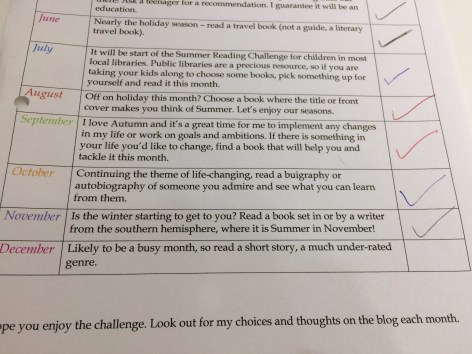





 The Bastard of Istanbul is a curious book, which my fellow book club members found disappointing. At the heart of the novel is the Kazanci family, living in Istanbul. The household is exclusively female and comprises Asya, (the eponymous ‘Bastard’) her three aunts and her mother (whom she also calls ‘Auntie’), her grandmother and ‘Petite-Ma’ who I think is her great-grandmother (more of that later, it’s part of the problem with the book). There is an uncle, who moved to America as a young man and has never returned. All the men in the family are afflicted by early death. Mustafa, the prodigal son, is in his 30s.
