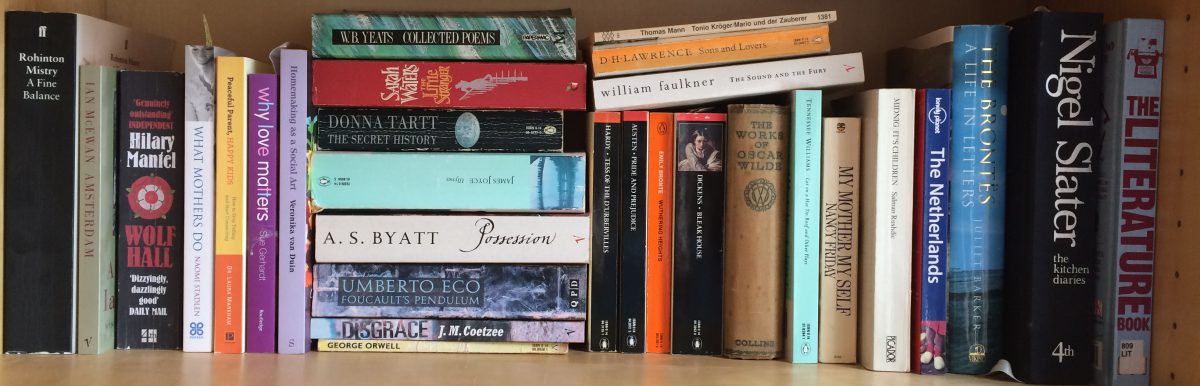
When I announced that this book was May’s choice for my Facebook reading challenge (theme, a 20th century classic), there were mixed feelings – it seems a few of our participants had studied it at school for their ‘O’ level English Literature (predecessor to the GCSE for anyone young enough not to know!). Some were delighted…others less so! I did not study this at school, but I read it at University (I did an English degree). My childhood home was not one filled with books, though I spent a great deal of time at my local library, so when I went to University I had a lot of catching up to do on many of the classics. Golding’s book is one of those and is widely considered to be one of the all-time great novels.
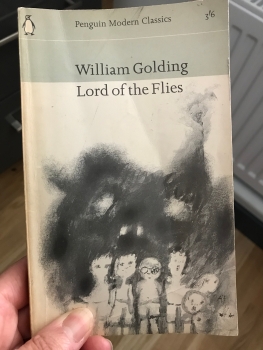
Lord of the Flies was Golding’s first novel, published in 1954. I doubt many people could name any of his other works (I couldn’t!), although he won the Booker Prize in 1980 for his novel Rites of Passage, and the Nobel Prize for Literature in 1983. He died in 1993 at the age of 81. Lord of the Flies has been adapted three times for the big screen, and several times for stage and radio.
The basic plot is that a group of boys (thought to number about thirty, but it’s not entirely clear) are marooned on a Pacific island following a wartime evacuation attempt that ends in a plane crash. There are no adult survivors and the boys, ranging in age from perhaps nine to thirteen years, must learn quickly to survive. Three main characters emerge: Ralph and Jack are the two alpha-males of the group, but have very different instincts about the priorities, and Piggy, an overweight, severely near-sighted boy, probably of lower class than Ralph and Jack, who proves to be the most thoughtful, sensible and self-aware but who lacks the leadership skills to wield any power.
Initially, the boys attempt to organise, with Ralph at the helm. His primary concern is that they should get rescued and stay alive and safe until then. He meets resistance in the form of Jack, who is less keen on the rules and disciplines that Ralph wants to impose. His priorities are “fun” and hunting animals so that they can eat meat. As the days and weeks pass morale drops, particularly among the younger boys, many of whom are clearly terrified. They fear the darkness and the heavy forest on the island and what may be lurking within it – they imagine a terrible beast. Order begins to break down and powerful instincts surface. There is a terrible power struggle between Jack and Ralph which intensifies as the novel progresses. Factions form around the two leaders and the behaviours become increasingly reckless. Simon, one of the other older boys, and a sensitive soul, is killed in a case of mistaken identity, the now savage and adrenalin-fuelled group around Jack believing in his night-time approach to the camp, that he is in fact the much-feared “beast” they imagine stalks them.
Simon’s death at the hands of those who were once his schoolmates, unleashes further savagery, like the genie is out of the bottle. There is also, however, a kind of denial; it seems only Piggy recognises and is able to articulate the danger they are in – from themselves! It seems inevitable that Piggy should also die, brutally; Roger crashes a boulder onto him during a fight between Ralph and Jack in which Piggy is trying to intervene. Jack’s group would have killed Ralph too had it not been for the timely arrival of a rescue ship.
Although it was written in the early 1950s, this is very much a post-war book for me in which the author is reflecting on the base levels human beings can reach. If you simply scratch the surface of society you will find some instincts most of us would rather not admit to. A modern reading of the novel might also see the hazards of excessive masculinity and how lust for power can easily corrupt. You can also look at how easy it is for followers to forget their own moral codes and normal standards of behaviour when seduced by charismatic or persuasive leadership. The younger boys are unable to face the reality of their situation, stranded on a remote island, with an unknown chance of rescue, and the picture of excitement that Jack offers, playing at hunting, escapism from their problems, leads them to follow him down a dangerous path.
Whilst re-reading this book, I couldn’t help thinking about the current political turmoil we are in, both in the UK and globally. Some social norms seem to me to be breaking down. And when it came to the Jack/Ralph power struggle the Conservative party leadership contest came to mind! The only thing I couldn’t decide – who in our current crop of politicians is Piggy?!
A must-read for anyone wanting to gain a serious understanding of English literature.
Did you read Lord of the Flies as a teenager – can you remember what you thought of it?
If you have enjoyed this post, I would love for you to follow my blog. Let’s also connect on social media.
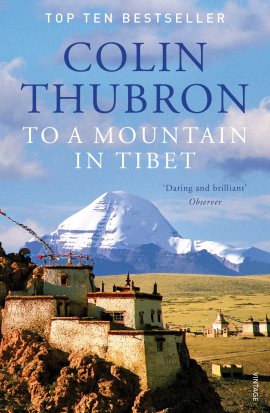 The title I have chosen is To A Mountain in Tibet, partly, I’m afraid, because it is one of the slimmer volumes; I’m struggling to keep up with all my planned reading at the moment…where did March go? Ah yes, I know, I spent a lot of time with my mouth open glued to the news and political analysis programmes (the less said about that the better!). Reading the blurb and the reviews of this book, I also feel it encapsulates what I am looking for in a travel book, which is not only the author on a physical journey, but also on some kind of process of learning. In To A Mountain in Tibet Thubron is undertaking a pilgrimage well known to Hindus and Buddhists, but is also a story of him coming to terms with loss and bereavement.
 In summary, this book is set in the late ‘60s, early 70s and is about Freda and Brenda, two young women who work together in a London factory where Italian wine is bottled. They also live together in a pokey bedsit, and share a double bed at nights. Freda is blonde, buxom and outgoing, sexually frustrated and of a romantic inclination. She has the hots for Vittorio, the nephew of the factory’s Italian owner, and fantasises about being seduced by him, contriving situations to enable this. Brenda is a redhead, but mousey in personality, timid and sexually repressed. She has left her drunken husband Stanley in the Yorkshire farmhouse which they shared with his domineering mother. Freda and Brenda met after Brenda had a tearful outburst in a butcher’s shop. Freda took her in and got her a job at the factory. Freda can be kind but also cruel and the book is as much about the complex nature of relationships between women as anything else.
 Despite being outside skiing all day I did get a fair bit of reading done and managed finally to break the back of a book I have been reading for some time now – The Overstory by Richard Powers, the final one of the
  Over the holiday I also completed Michelle Obama’s Becoming. This is a much faster read and very different, though also thoroughly enjoyable. Look out for my reviews of both books over the next couple of weeks.
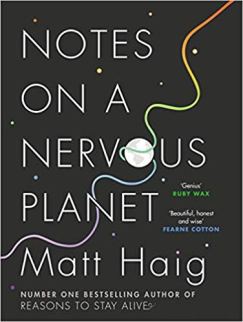 I have made an exception and decided to read Notes on a Nervous Planet again. I’m surprised at how different the reading experience is versus listening. Firstly, the author has a wonderful reading voice and I suppose because it is non-fiction and is very much about his experiences of anxiety and depression, you can sense that it comes straight from the heart. I really think that the narrator of an audiobook plays such an important role in the experience. For example, I loved Hilary Huber’s narration of Elena Ferrante’s Neapolitan Novels, but I struggled with the reading of 1984 by Andrew Wincott…who is Adam in The Archers. I just couldn’t get Adam out of my head!
 The plot is not complicated: ‘Swede’ Levov is a third generation Jewish immigrant whose grandfather came to America from Europe. He was a glovemaker and set up a business in Newark, New Jersey which became highly successful. Swede’s father continued the business, which peaked in the 1950s and 1960s when glove-wearing for respectable women was the norm and most would have several pairs. (There is more information on gloves in this book than you will ever need to know, but it’s fascinating!) Swede inherited the business from his father, while his more wayward brother became a cardiac surgeon.
 I chose this book for my 2018 Facebook Reading Challenge. The June theme was an autobiography, a tricky category since enjoyment can often depend on your feelings about the author. I also wanted to avoid titles that would most likely have been ghost-written. After thinking about it for some time, I chose this, the first volume in Angelou’s memoir series, and the one which is often considered to be the best. It can be read as a stand-alone.
 I had read this book previously, but many years ago as an undergraduate, so whilst I had remembered the basic story, I had forgotten much of the detail. I had forgotten for example just how brilliant the writing is and how very like Jane Austen Flaubert can be in his use of irony. By all accounts, Flaubert was a perfectionist and spent years on this book; it is certainly masterful and for me the writing was sublime. I had also forgotten how unlikeable all the characters are! Even Emma, our supposed “heroine”, is at times unpleasant, childish, selfish, superficial and self-obsessed. When I discussed it with my husband (who speaks fluent French and read it in the original) he was surprised that I did not find Charles Bovary, Emma’s husband, sympathetic. Interesting that he felt affection for the long-suffering, betrayed husband who loved his wife to the death, despite her many faults, whereas I found him ineffectual and basically unable to connect with his wife on any level, and that was part of the problem in their marriage.
 Julia's books