Last week, I blogged about some of the interesting new children’s titles that had caught my eye. In recent years, YA fiction has rightly developed as a genre apart from younger children’s fiction, and there are some fantastic young writers out there catering for the needs of this age group. Most adults would accept I think that the pressures on teenagers these days are numerous and new, and for many parents navigating this unknown terrain can be challenging and worrying. In the same way that children’s literature can help our little ones work through some of their fears and worries (from the monster under the bed to the impending arrival of a sibling), so YA fiction can help teenagers deal with the issues they face, when they may feel their parents just don’t understand.
Here are a few of the titles that have attracted me.
Irish writer Orlagh Collins’s story No Filter covers traditional teen territory, that of first love. It tells the story of Emerald who comes from a privileged background, and appears to enjoy an outwardly perfect life. Then Emerald discovers her mother unconscious on the bathroom floor and her world begins to fall apart. She is sent off to stay with her grandmother in Ireland for the summer, where she meets Liam, and begins to reevaluate what’s important.
Just Fly Away is the debut novel from 1980s brat-pack actor, turned award-winning director and author Andrew McCarthy. It tells the story of fifteen year old Lucy who discovers that she has a half-brother, the result of an affair her father had, living in the same town. Like No Filter it is a novel about secrets and lies, as Lucy escapes to Maine to live with her grandfather, himself estranged from the family, and to work through the confusion and torment her discovery has left her with.
Finally, on a different topic, there is All the Things that Could Go Wrong by Stewart Foster which concerns the relationship between two boys, initially at loggerheads, who find common cause when they are forced to spend time together. Alex suffers from OCD and worries about everything. His condition is so severe that he rarely leaves home. Dan is angry, because his older brother Alex has left home and he feels lost. Initially, he takes it out on Alex, whom he perceives as weak and ineffectual, but the boys’ mothers force them together on a garden building project and the understanding that develops between is healing for both.
I hope one of these might be of interest for your teenager. Better still, take them along to the library or bookshop and let them choose something themselves.
I’d love to hear what your teens are reading just now.
If you have enjoyed this post, please follow my blog and let’s connect on social media.
Eleanor Oliphant is what we would politely describe as quirky. She lives a fairly isolated lifestyle, seeing no friends or relatives. She lives alone in a flat where she was placed by Social Services after leaving the care system. She is a creature of habit, wearing identical clothes each day, and following habitual daily and weekly routines. She works, in the accounts department of a design company, but her lowly position seems out of kilter with her high intelligence. There is nothing especially remarkable about her quirkiness (apart from the fact that she drinks two bottles of vodka every weekend), but her habits mark her out from the usual crowd. In particular she eschews social interaction, is cool, often hostile, to her co-workers, looking down on them, never wears make up or gets her hair cut. She appears to others as someone who doesn’t make an effort, but through Eleanor’s eyes we observe some of the absurdities of ‘normal’ life and there are some real laugh-out-loud moments, for example, when Eleanor goes for a makeover at the department store.
Eleanor communicates poorly with others, being rather too literal and pedantic for most people to tolerate and is therefore unable to form effective relationships. At first, she is not an easy character to love, except that we as readers know a couple of things about her that her workmates do not, and which make us more sympathetic to her. Firstly, we know she drinks herself into oblivion at the weekends: as a reader we are bound to ask what she is trying to escape from. Second, there is Eleanor’s mother, with whom she speaks every Wednesday evening; “Mummy” is controlling, manipulative, cruel, nasty. Eleanor is an adult and yet there is something disturbing about the way she always refers to her parent as a child would (never ‘Mum’ or ‘my mother’). The fact that Eleanor also receives regular monitoring visits from social workers tells us that there is something dark in Eleanor’s past that has contributed to her present quirkiness, but we are not told what.
Two incidents in Eleanor’s life set off a cascade of events that will alter her life immeasurably. First, she encounters and develops a teenage-like crush on a musician. He is the lead singer in a band, well-known in the Glasgow area, lives locally and Eleanor has a remote connection with him as he attended school with a work colleague’s brother. Eleanor decides that the musician is the one she wants to spend the rest of her life with. She fantasises about a romance with him and ultimately marriage. Emboldened by conversations with Mummy, who is all in favour of “the project” (whilst also questioning Eleanor’s worth), she tasks herself with contriving to meet him, including visiting his apartment block, and sets about buying new clothes and improving her appearance, to bring herself up to the standard she anticipates he would expect from a partner.
The second incident is the collapse of an elderly man in the street. The old man is immediately attended to by Raymond, not a co-worker but someone she recognises as working in the same building, and he involves Eleanor and commands her help. Between them, Eleanor and Raymond manage to give the man first aid and call an ambulance. After this, Raymond draws Eleanor into an unplanned friendship. It doesn’t seem to be something that either of them is seeking, particularly. Indeed at first Eleanor is very cool towards Raymond, looking down upon his smoking, his eating habits, his text-speak and what she sees as his lazy dressing habits. But he is warm and patient with her and the friendship evolves. Through Raymond, Eleanor gets a glimpse of what ‘normal’ life and ‘normal’ family relationships can be, with all their faults.
The action takes place over a few months and the pace is measured and authentic. It is ultimately a novel about mental illness, triggered by trauma in Eleanor’s case, and as the story unfolds, and we learn more about Eleanor’s past, so her present, tightly ordered life, held together so flimsily by a set of rigid habits, begins to fall apart. This unravelling may be painful for some readers. The novel echoes that tendency we all have to say we’re ‘fine’ even when we’re not, and Eleanor learns, the hard way, what ‘fine’ means, and how to use that word honestly on her path to healing. There are some dark moments but there is also humour, particularly in the drawing of Eleanor’s character. I found myself laughing both with her and at her, which was, I must confess uncomfortable in the context of later revelations, and caused me to reflect on how we as a society react to those who do not present with an ‘average’ or ‘easily-fit-innable’ personality.
This is Gail Honeyman’s first novel and it is a stunning achievement. A thoroughly enjoyable read. In an era where poor mental health, social isolation and dysfunctional relationships seem to have reached epidemic proportions, this novel is both an examination of one person’s particular circumstances and an antidote. Highly recommended.
Have you read this book? What did you think?
If you have enjoyed this post, I’d love for you to follow my blog and for us to connect on social media.
It was the Autumn Equinox yesterday, exactly halfway between the shortest and longest days, when the hours of daylight and the hours of night are the same. From now until Christmas, the nights will begin to draw in. It’s a while before you notice it fully, of course and I always find that as the leaves on the trees begin to turn and fall and the temperatures cool, I actually feel a burst of energy and an increased desire to get out for walks and enjoy nature. It’s as if I only realise what I have when it starts to go and then I want to make the most of it! Yes, that certainly sums up part of my personality!
Regular readers of this blog will know that I am passionate about children’s literature and getting, correction, KEEPING kids reading – don’t they all love to be read a story when they’re little?! When and why does that stop? I spent hours in libraries when my kids were little, but I struggle to keep my 11, 13 and 16 year old children into their books. I’m not going to moan about screens; they are as inevitable a part of young people’s lives as food and drink, and, frankly, now mine all have pretty independent lives, I quite like the reassurance their mobile phones give me.
If you are finding it hard to motivate your children to read you may find this little book helpful – Alison David’s Help Your Child Love Reading – which I’ve reviewed here and plugged many times, because it contains practical advice and will not chastise you for allowing them screen time.
I love the title and the cover photo – it’s not an instruction guide on how to make them do something against their will, but how to embrace one of the most joyful and stress-relieving habits there is. And with the shocking news this week about how many of our young girls experience depression, reading is a hobby that all of our children can benefit from. So as life for those of us in the northern hemisphere gradually returns to the indoors, there is no better time to revive a reading habit. As is my regular wont, I’ve picked out a few children’s books that have caught my eye recently.
Pax by Sarah Pennypacker (age group 8-12 years) was published last year, but seems to be getting a lot of publicity at the moment. It has a beautiful cover and is the story of a boy’s friendship with a fox. I’m really keen to read this one. Birthday Boy by David Baddiel (age group 9+) looks like being another smash hit in this genre for the comedian turned children’s author. Published earlier this month it considers the question, what if it was your birthday every day? Be careful what you wish for is the message! A Place Called Perfect (age group 8-12 years) by Helena Duggan concerns Violet and her family who move to the town of Perfect, where everyone has to wear glasses to stop them going blind and where nothing is quite (as perfect) as it seems.
Most primary school age children are fairly easy to manage and get reading; it’s those pesky teens who present the biggest challenge! I’ll give you some ideas for this age group next week.
Happy reading!
Do you have any children’s books to recommend?
If you have enjoyed this post, please follow my blog for weekly thoughts and book reviews.
So earlier in the week, I posted about the Man Booker 2017 shortlist and today I want to tell you about a prize winner, The Power by Naomi Aldermanwhich won the Bailey’s Women’s Prize for Fiction in June. This year’s shortlist was a strong one, so it did well to come out on top. I’d also read Do Not Say We Have Nothing and Stay With Mefrom the shortlist; this latter book is wonderful and so I was expecting great things from The Power. I took it on holiday with me and read it in just a handful of sessions (my favourite way to read) and I’m afraid to say I was a little disappointed. For me, it was not better than Stay With Me.
I’m not a huge fan of science fiction; my last foray into this genre was Station Elevenby Emily St John Mandel, which I think I probably enjoyed more than The Power if I’m honest. Because I’m not a big reader of this genre I find it quite difficult to review. I’m not sure what the norms and expectations are, so the things I might criticise or dislike are perhaps standard constructions in science fiction. For example, when reviewing a historical novel, we expect accuracy, realism, research. When reviewing a novel set in our own time we expect realism in the sense of standards that we recognise as possible. With science fiction, however, it irritates me that all normal conventions are suspended. Perhaps that why SF writers write in this genre, because they are free of those constraints, but to me it seems a bit lazy. I’ll give you an example: I enjoyed Station Eleven but I couldn’t get this nagging thought out of my brain that we were dealing with one small part of the United States, and I just couldn’t quite believe that the rest of the world had been similarly afflicted and could not make contact – pre-electricity societies managed to get around the globe fairly successfully!
However, The Power is a prize-winner and seems to have been universally lauded, most notably by Margaret Atwood (Alderman’s literary mentor) whose ground-breaking novel The Handmaid’s Tale has just enjoyed a very successful television adaptation. The premise of The Power is a subversion of current social norms where men dominate, to one where women discover that they have a physical superiority, an ability to electrocute and disable, even kill, men. The novel begins (presumably in the current time) when women begin to discover they have this power and start to use it in ways that enable them to dominate. The story is told through the experiences of a number of women and a male. First there is Roxy, the young daughter of a London gangster who, once she discovers her power, undertakes a purge of all her male foes, her father’s enemies, and her half-brothers who threaten her, to become the top gangster in her field. Then there is Margot a small-time US politician who discovers she has the power and uses it, over a period of years to eliminate her political enemies and rise to great things. Initially, Margot has to hide her power; society is initially hostile to it, and therefore those who have it, seeing at as a threat which could upset order and stability (yes, much of the novel has to be read as a deep irony). Margot, as a politician is also connected with a number of corporations who would no longer support her if they knew she was a carrier of the power. Third, there is Allie, a teenager adopted into a right-wing southern American Christian family (more irony). She is abused by her adoptive father and in one of his assaults she electrocutes and kills him. She then escapes to a convent from where she morphs into Mother Eve, the head of the cult which spreads the power worldwide. One of the followers of the cult is Tatiana Moskolev, the estranged wife of the President of Moldova, who sets up her own republic in the north of the country and establishes a brutal regime where men are mere playthings, sexually abused and murdered at will. Finally, there is Tunde, a young Nigerian, who when we first meet him is trying to seduce a young woman, unsuccessfully as it turns out, because she gives him a small but still very humiliating electric shock when he makes his move on her. It is clear the power dynamic has shifted! Tunde senses that change is about to come to the world and so he sets about travelling the globe, posting his obervations on the internet and thereby becomes an international journalistic sensation.
The story has a complicated structure, which at times I found difficult to follow. It is very much a satire, but not in the mode of Paul Beatty’s The Sellout, which won last year’s Man Booker Prize. There are parts of the book which are almost too brutal, too visceral, too emotionally raw for satire (maybe it’s me, maybe it’s the age we live in?). At 42 the author is not much younger than me, so I can’t say it’s a generational thing, although I note that among the many other strings to her bow she is a computer game designer. I wonder whether the kind of violence common in that medium means the author has a different perspective (taste?) for use of violence and physicality in art.
It’s a clever book, the idea is fantastically original, subversive (women dominating men!) and mischievous. Alderman is also a very able writer, and it’s an impressive read. I did find the book a page-turner, but it fell off towards the end for me. It just got a bit…silly! But then I also accept that maybe it wasn’t supposed to be credible, and that is indeed the powerful central irony. It’s a good read, but I still preferred Stay With Me for the Bailey’s Prize!
What did you think of The Power? I’d be interested in your perspective if you’re a regular reader of science fiction.
If you have enjoyed this blog, I would love for you to like or follow me, and for us to connect on social media.
This is my 100th post and I feel it’s quite fitting that I should be writing on the very day that the Man Booker 2017 shortlist has been announced. Last year, I set myself the task of trying to read all six books on the shortlist before the prize winner was announced. I managed three and a half! This year, I’ve cleared the decks and am going for it again – all six books by 17 October…34 days.
If you haven’t seen the shortlist, here it is:
Autumn and Exit West have been on my ‘to-read’ list for a while. Autumn is a post-Brexit novel and is about the fissures that became apparent in UK society after that referendum, seen through the eyes of elderly Daniel and youthful Elisabeth. It may help with understanding this social turmoil. Exit West is also about social and political turmoil and its effect on the lives of ordinary people, lovers Nadia and Saeed, forced to flee their homeland when it is torn apart by civil war, and seek refuge in the West.
Veteran prizewinner Paul Auster’s latest novel, 4 3 2 1, has won praise for the deft handling of a complex storyline in which he explores four possible paths that an individual’s life could take. It’s the longest book on the list by some distance! Lincoln in the Bardo by George Saunders is the first venture into fiction by a well-established writer and is a fictionalised account of the true story of Abraham Lincoln and the loss of his eleven year old son at the start of the American Civil War.
Finally, from two less well-known writers, to me anyway, A History of Wolves by Emily Fridlund, which is about a fourteen year old girl living a sheltered life in rural Minnesota, with unusual parents, and her association with a new family that moves into the area, forcing her to confront some uncomfortable truths. And Elmet by Fiona Mozley, another first novel from a young British writer, is also about the effects of growing up in an unusual family and how that prepares people for a challenging world.
I haven’t read any of these (no head start for me this year then!), so I can’t judge the shortlist at the moment, but I am surprised by some of the omissions. Colson Whitehead’s The Underground Railroad and Arundhati Roy’s The Ministry of Utmost Happiness are everywhere at the moment and have been highly praised. It’s always surprising to see Zadie Smith left out of this kind of list, huge talent that she is. Sebastian Barry’s Days Without End, which I reviewed here in June,is possibly the best book I have read this year and I’m astonished that it’s not shortlisted. That novel will be my benchmark for judging these.
Anyone care to join me in the shortlist challenge?
If you have enjoyed this post, I would love for you to follow my blog and for us to connect on social media.
January is never a great time of year for me – I’m not good with the cold, dark days of winter so it’s pointless me making New Year’s resolutions. In contrast, Autumn is, for me, the perfect time of year to reflect and think about the future. As a mother of three school-age children, my life is, in any case, dominated by the term time calendar, and there is something about the feeling of newness (shoes, pencil cases, planners, etc), the fresh start and the enthusiasm (yes, really, even the kids are usually excited to get back) that screams hope. Outside it’s the time of year associated with decay, when the blooms in the garden are starting to fade, the leaves on the trees begin to turn brown and fall, and the nights are definitely drawing in. In a funny way, though, I find this reassuring. It makes me feel that everything is in the right place, the natural order of things is safely on track, and that is a comfort to me in this era of accelerated climate change.
So, September is my month of choice for resolutions. My reading challenge this month is to read a self-help book and after a bit of indecision I’ve decided on Big Magic: Creative Living Beyond Fear by Elizabeth Gilbert. It’s actually been on my list of books to read for some time, but seems particularly appropriate now as my main resolution is to complete at least a third of the book I am writing by half term (and hopefully another third by Christmas). I’ve been tinkering with it for months, and made some good progress with Camp NaNoWriMo in July, but I feel really focused now and am keen to capitalise on my motivation.
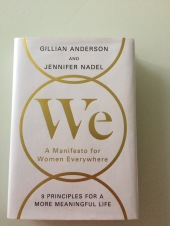
Before the summer break I also read WE: A Manifesto for Women Everywhereby Gillian Anderson and Jennifer Nadel and it caused me to reflect on the time and care I give to myself. I think it’s true to say that, as a mother, when you have young children you can often put yourself and your needs at the bottom of the priority list, well after the rest of the family. Ultimately, this often takes a great toll. Now that my children are older, (all at secondary school as of this week, my eldest now in sixth form), I find myself not so much with more time, but definitely with more mental space to tend to my own needs, pursue some of my own passions and award myself more respect. So, I am re-reading WE, slowly and deliberately, a little each day, and working through the exercises.
As a Mum I feel I have for years ricocheted between feelings of resentment at the extent of my ‘self-sacrifice’ and guilt at not doing or being enough! I hope that over the coming weeks the reading and the exercises will help to shift my mindset more towards contentment, resilience, and gratitude – the Holy Grail! I don’t find it particularly difficult to change my habits, get a better eating or fitness regime, etc, but mindset change is much harder. Wish me luck!
Are you one of those who prefer to make their resolutions in September rather than January?
If you have enjoyed this post, I would love for you to follow my blog by clicking on the button below or to the right (depending on your device).
I read this for my August reading challenge, which was to choose a book, the title or cover of which was reminiscent of summer. I chose On Chesil Beach because I love Dorset, possibly my favourite county in England, and I love Chesil Beach, which we visited on a family holiday about three years ago. Chesil Beach is one of those fascinating geographical features, dating back to Jurassic times, which reminds you that human habitation on earth is a mere blip in time. It’s an 18-mile stretch of shingle beach, separated from the mainland by a saline lake called the Fleet Lagoon, and formed thousands of years ago as deposits of sediment were plopped near to the coastline, but not on the beach, so creating a ‘barrier beach’ separated from the actual coastline. It’s a haven for wildlife as well as being one of those mysterious oddities that Wessex (yes, I’m a huge fan of Thomas Hardy!) does so well.
The front cover of On Chesil Beach shows a picture of a woman in a white dress walking along the beach at what appears to be either dawn or dusk. She is walking away from us, into a vague distance. The sky is grey-blue, twilit, with a slash of brightness from the emerging or receding sun. In the far distance are cliffs and the sea on either side of the beach is grey, somewhat forbidding. The skirt of the woman’s dress, and her hair, are blowing in towards the land; there is clearly a strong breeze coming in from the sea. This image is everything I love about the English coast. It reminds me that nature is in charge here, that the earth will prevail. This area is part of Dorset’s Jurassic coast where fossils are easily found and where there is much evidence of the prehistoric past. It is a humbling place to be.
Chesil Beach is the setting of McEwan’s moving, domestic tragedy. Set in the summer of 1962 it begins in a hotel where Edward and Florence are having dinner in their suite on their wedding night. The awkwardness, the tension and the weight of expectation are apparent from the outset, and the detail with which McEwan describes every aspect of the scene made me feel like I was living every excruciating moment of the evening in real time. It is clear very quickly that this is a book about sex. It’s 1962 so the couple have not yet experienced the benefits of the sexual liberation of the 1960s and are still victims of the much more staid post-war attitudes of the 1950s. Despite being newlyweds, and therefore supposed to be a happy young couple, it is clear very early on that each is in a very different place; it is apparent that they have had little intimacy, sexual or otherwise, prior to their wedding. Edward has been ‘patient’ assuming that all will be well once they are married, while Florence has been hoping simply for strength, that she will be able to endure what she thinks will an unpleasant duty once within the confines of marriage.
“They separately worried about the moment, some time soon after dinner, when their new maturity would be tested, when they would lie down together on the four-poster bed and reveal themselves fully to one another. For over a year, Edward had been mesmerised by the prospect that on the evening of a given date in July the most sensitive portion of himself would reside, however briefly, within a naturally formed cavity inside this cheerful, pretty, formidably intelligent woman. How this was to be achieved without absurdity, or disappointment, troubled him…..But what troubled her was unutterable, and she could barely frame it for herself. Where he merely suffered conventional first-night nerves, she experienced a visceral dread, a helpless disgust as palpable as seasickness.”
And therein lies the nub of the whole book really, how these inner truths reveal themselves, how the pleasant mask of their love begins to crumble and how the relationship is affected under the pressure of these problems.
The book is structured in five parts: the first part is the awful wedding night, subsequent parts provide the back story to Edward and Florence’s relationship, their early lives and their very different backgrounds – class difference plays a big part in the novel too and whilst this is not named as an explicit barrier between them, you get the sense as a reader of her as more refined, affluent, uptight, middle-class, while he is seen as ultimately more vulgar, preoccupied by earthier matters and that this is somehow a consequence of his socially humble background.
I don’t wish to spoil the ending for you if you haven’t read the book, but the final part, the denouement, takes place on Chesil Beach itself, as the two individuals encounter one another at the climax of their so far bitter wedding night experience. It is like a classical scene, like a game of chess as the two manoeuvre around their respective problems. It is a very fine, forensic study of a 1960s relationship that could barely be called a relationship.
A stunning read, which I didn’t expect to be so good. Highly recommended.
(Apologies for any typos I haven’t spotted – my daughter’s hamster gave me a nasty bite on the middle finger of my right hand it has badly affected my typing!)
If you have read this book, what did you think?
If you like what you read here, please follow my blog. I would love also for us to connect on social media.
I swished through my August reading challenge very quickly (a book whose cover title reminded me of summer) having selected a fairly slim volume (On Chesil Beach by Ian McEwan) that was absolutely compelling. I couldn’t put it down and since I was away visiting family at the time I decided to read it, I had plenty of opportunities to not put it down. It’s a fabulous book, so look out for my review next week.
This month, the challenge is also related very much to the time of year. I have written on here before about how I find Autumn very energising. It is probably related to the fact that I have had children at school for twelve years now (by the way, allow me a proud parent moment – we are celebrating the eldest one’s excellent GCSE results!) My year is very much determined by and planned around the ebb and flow of school term times and holidays. After a period of repose stepping off the treadmill of the daily school routine, usually a family holiday and bit of sun, the change of pace again when school returns, and the sense of new beginnings seems to give me a sense of optimism and vitality.
There is also something about the climate and the light in England in the Autumn that makes my mood reflective: the days are getting shorter so I am reminded that time is precious. The weather is usually cooler but because I don’t have kids to entertain or days out planned, my expectations are lower, so I appreciate the rain (it waters the garden), I don’t mind the wind (it dries the laundry) and I am thankful when the sun appears, not cross when it doesn’t. It’s as if my mental goalposts have moved.
For me, September is a great time to make plans, think about where I am and where I’m going. I also know that I will have more energy and fewer commitments in the next two to three months than at any other time of the year, so it’s an oppportunity to take some big steps forward. This month’s challenge is to read a self-help book.
I went browsing in my local bookshop as I did not have a very clear idea about what I wanted to read this month. The self-help section seemed to have a different sort of feel to it compared to the last time I was buying there. After years of exhortation to do better, be better, have more, look better (ideals that few of us can sustain in real life, leading to inevitable anti-climax, disappointment and feelings of failure) the general tone of most of the titles seemed to be more about acceptance, gratitude, and enjoying the smaller things in life. That has to be a good thing.
I spotted three irresistible books, and can’t decide which one to read this month. My biggest goal this season is to complete the first draft of the book I’m working on. I made some strides with NaNoWriMo in July, but I’m still only about a quarter of the way in and and I’m finding it incredibly challenging. So Elizabeth Gilbert’s Big Magic: Creative Living Beyond Fear seems appropriate, a book I’ve been meaning to read for a while. I also like the look of Quiet: the power of introverts in a world that can’t stop talking by Susan Cain, and Women Who Run with the Wolves: contacting the power of the wild woman by Clarissa Pinkola Estes. I am an introvert, and I’m also a feminist who believes all of us women have special inner resources that benefit the world, so both of these appeal.
Hmm. Decisions, decisions. What would you pick?
If you have enjoyed this post I would love for you to follow my blog. Let’s also connect on social media.
I’m on my holidays with the family in Portugal. It’s a lovely country: the people are warm and laid-back, the food is wonderful, it’s a seafood-lover’s paradise. The weather where we are, north of Lisbon on what is known as the ‘Silver Coast’, is warm and sunny, with Atlantic breezes keeping the temperature below the more intense numbers you get on, say The Algarve – mid-30s Celsius is tough on a fair-skinned Brit! When you have to take your holidays in August (school!) you have to think carefully about where you go. It’s so much more expensive before you even arrive and popular locations can be jam-packed, unbearable with children. Our location here in Portugal feels perfect just now.
The beach is stunning, vast and empty, and the ocean majestic, though cold even to paddle in for me and mostly too much undertow for swimming.
Since we arrived on Saturday I have finished reading The Power, the Bailey’s Prize-winning novel by Naomi Alderman.
I wasn’t bowled over by it I’m afraid, but will post a review in a couple of weeks.
We are staying close to the beautiful town of Obidos, which has designated itself, rather fortuitously for me, ‘City of Literature’! My book-seeking antennae were out and we found two amazing bookshops.
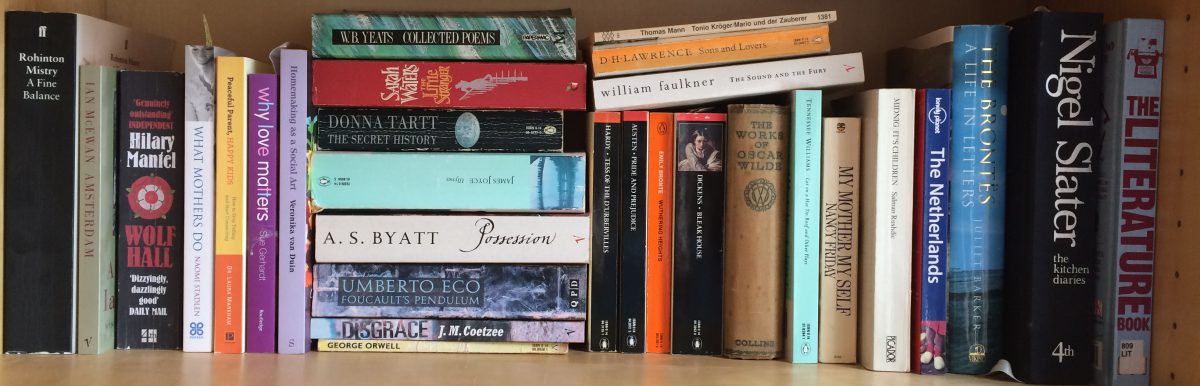
The first was a secondhand bookshop that also incorporated an organic food market – what’s not to love! Look at what I picked up from the English shelf:
Plenty of Manchester references here I expect!
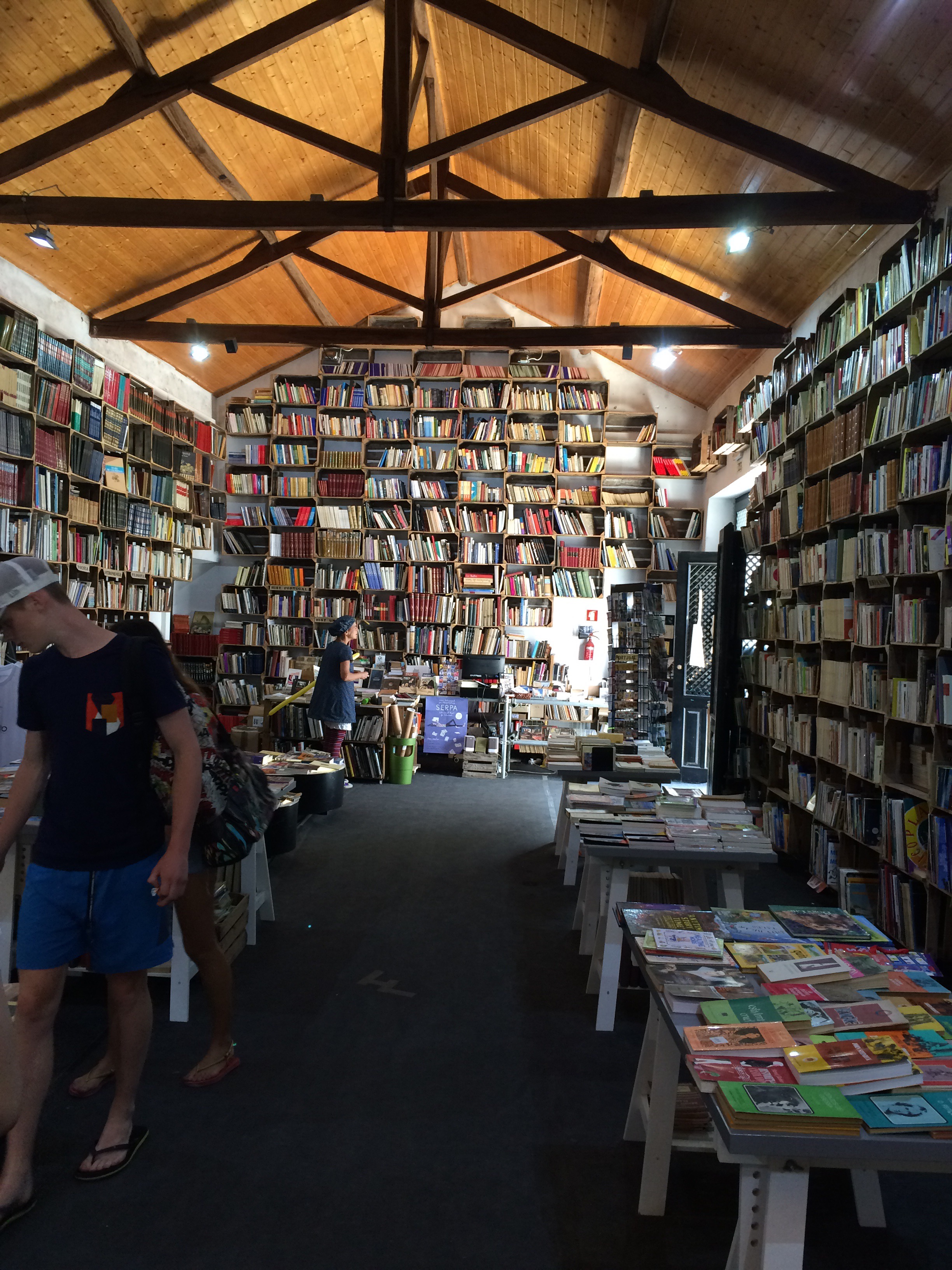
The next bookshop was in a converted church and had the most amazing structure of wooden shelving which doubled as stairs and a mezzanine.
Beautiful isn’t it?
Reading-wise I’m currently enjoying Lisa McInnerney’s The Blood Miracles, which is so far matching the quality of her first novel The Glorious Heresies.
I hope you are also enjoying the holiday season and that you’re getting plenty of R&R (reading and relaxation) in!
My elder daughter turned 13 recently. I find this fact quite extraordinary and I am filled with a new sense of responsibility. Getting three children this far has been something of a feat, of course (!), but I now feel as if I have the huge challenge of nurturing a young woman. I have an older son, but that seems different somehow. Perhaps that’s because I have never been a young man, but I do have experience of being a young woman, so I am profoundly aware of all the special ups and downs that life can present to girls.
A beautiful mother and daughter (this is not us!)My daughter is strong, talented and determined. She is also loving, conscientious and kind, and experience tells me that this can make her vulnerable. The world has yet to fully come to terms with this potent mix of feminine powers, does not yet know how best to embrace it. It seems to me the world often seems to fear it. So, as a parent, as a mother, the conundrum is how to prepare my daughter for a world that may not be fully ready to receive her for all that she is and all that she can be, whilst also fostering her single-mindedness, encouraging her independent spirit and emboldening her to stay true to herself.
I recently read We should all befeminists by Chimamanda Ngozi Adichie (look out for the review next week). This was given to me by a friend as a birthday gift. It’s a fuller version of a speech the author gave to a TEDx conference in 2012. Its context is Nigerian society, but there is much here that we can all take on board in terms of how we bring up our children and the values we attempt to instil.
I have a particular conundrum in that I have for a long time been what is disparagingly termed a ‘full-time Mum’. I took the usual maternity leave with my first child (my son) and when I went back to work he went to nursery for four long days every week (we had no family nearby to support us), a fact which haunts me to this day. My job was challenging and I was 50 miles away, so it was a difficult time. When I became pregnant with my second child not only did it make little economic sense for me to continue working but I felt my higher education job was incompatible with our circumstances. There was no way I could be the kind of parent I wanted to be whilst being committed to my career, and with no back-up it seemed impossible. My husband’s job was senior, demanding and in a relatively male-dominated industry so there was little prospect, in reality, of a shared model. So when my daughter was born I took a career break. I had another child during that time and took seven years off, which ended with voluntary redundancy.
When I recount this story I find it quite hard to believe myself – I was always very ambitious, acquired a Bachelors and a Masters degree, had a good career where I was respected, have always been a feminist, and yet as far as my children are concerned Mummy stays at home. Mummy does work of course (I have run a small business, I write and I do some occasional work for a charity) but I don’t work long hours out of the house like Daddy does so the lion’s share of the household work also falls to me. I don’t feel unhappy with this and I don’t regret any of the decisions we made and if I could do it all again I would make the same choice to stop working (I only wish I’d been there for my son sooner and not put him in nursery), but I do worry about the kind of messages this sends to both my son and my daughters about gender roles. What kind of a role-model am I?
We should all be feminists and the small companion book Dear Ijeawele have given me much food for thought. One of the first suggestions in Dear Ijeawele is that a woman should be “a full person” and not be defined by motherhood. I think in the early years I allowed this to happen, although with three young children and a husband working away every week for a number of years I had little time to define myself any other way! However…that is changing now. As my children get older and can take more responsibility for themselves I am trying to strike a balance between being there for them, but also not being therealways, if you see what I mean.
Suggestion number ten in Dear Ijeawele is to “be deliberate in how you engage with [your daughter] and her appearance”. Adichie is a beautiful woman who embraces her femininity. She is a face of No. 7 cosmetics, a fact for which she has been criticised and for which she makes no apology. I have always struggled with my femininity; I think it was handled clumsily and fearfully when I was a teenager (I don’t think I’m alone). Being feminine should not be incompatible with feminism, this much I believe, but I struggle with both my young daughters’ desires to wear make-up, for example. I feel very conflicted as I want them to be happy with their natural appearance, to know they are beautiful as they are, and not to feel influenced by the media that they have to look a certain way or that a certain beauty product is a ‘must-have’. I also worry about the pressure to wear revealing clothing, although, as Adichie says, we should never link appearance with morality.
With a teenage and a pre-teen daughter, these are all very urgent issues. I’m afraid when they were young they did play with dolls and much of their environment was pink, though trains, lego and other colours were available! I agree it is important not to provide gender-specific toys and to encourage breadth and variety. Mostly, my kids liked to paint, make things and play with water, and I never tried to stop the girls getting messy – they were worse in fact! But the issues seem to be weightier now, especially as their thoughts gradually turn to their futures and as sexuality begins to emerge. They hear the news and find that there continues to be a gender pay gap in society, that there is not parity of treatment between LGBTQ and straight people, and that women and girls continue to be abused and exploited more than their male counterparts.
There is much that we all still need to do.
I would love to hear your thoughts about raising girls in the 21st century.
If you have enjoyed this post, please subscribe to my blog by clicking on the button below or to the right, depending on your device.

 Just Fly Away is the debut novel from 1980s brat-pack actor, turned award-winning director and author Andrew McCarthy. It tells the story of fifteen year old Lucy who discovers that she has a half-brother, the result of an affair her father had, living in the same town. Like No Filter it is a novel about secrets and lies, as Lucy escapes to Maine to live with her grandfather, himself estranged from the family, and to work through the confusion and torment her discovery has left her with.
 Finally, on a different topic, there is All the Things that Could Go Wrong by Stewart Foster which concerns the relationship between two boys, initially at loggerheads, who find common cause when they are forced to spend time together. Alex suffers from OCD and worries about everything. His condition is so severe that he rarely leaves home. Dan is angry, because his older brother Alex has left home and he feels lost. Initially, he takes it out on Alex, whom he perceives as weak and ineffectual, but the boys’ mothers force them together on a garden building project and the understanding that develops between is healing for both.
 Eleanor communicates poorly with others, being rather too literal and pedantic for most people to tolerate and is therefore unable to form effective relationships. At first, she is not an easy character to love, except that we as readers know a couple of things about her that her workmates do not, and which make us more sympathetic to her. Firstly, we know she drinks herself into oblivion at the weekends: as a reader we are bound to ask what she is trying to escape from. Second, there is Eleanor’s mother, with whom she speaks every Wednesday evening; “Mummy” is controlling, manipulative, cruel, nasty. Eleanor is an adult and yet there is something disturbing about the way she always refers to her parent as a child would (never ‘Mum’ or ‘my mother’). The fact that Eleanor also receives regular monitoring visits from social workers tells us that there is something dark in Eleanor’s past that has contributed to her present quirkiness, but we are not told what.
 This is Gail Honeyman’s first novel and it is a stunning achievement. A thoroughly enjoyable read. In an era where poor mental health, social isolation and dysfunctional relationships seem to have reached epidemic proportions, this novel is both an examination of one person’s particular circumstances and an antidote. Highly recommended.
 If you are finding it hard to motivate your children to read you may find this little book helpful – Alison David’s


 However, The Power is a prize-winner and seems to have been universally lauded, most notably by Margaret Atwood (Alderman’s literary mentor) whose ground-breaking novel The Handmaid’s Tale has just enjoyed a very successful television adaptation. The premise of The Power is a subversion of current social norms where men dominate, to one where women discover that they have a physical superiority, an ability to electrocute and disable, even kill, men. The novel begins (presumably in the current time) when women begin to discover they have this power and start to use it in ways that enable them to dominate. The story is told through the experiences of a number of women and a male. First there is Roxy, the young daughter of a London gangster who, once she discovers her power, undertakes a purge of all her male foes, her father’s enemies, and her half-brothers who threaten her, to become the top gangster in her field. Then there is Margot a small-time US politician who discovers she has the power and uses it, over a period of years to eliminate her political enemies and rise to great things. Initially, Margot has to hide her power; society is initially hostile to it, and therefore those who have it, seeing at as a threat which could upset order and stability (yes, much of the novel has to be read as a deep irony). Margot, as a politician is also connected with a number of corporations who would no longer support her if they knew she was a carrier of the power. Third, there is Allie, a teenager adopted into a right-wing southern American Christian family (more irony). She is abused by her adoptive father and in one of his assaults she electrocutes and kills him. She then escapes to a convent from where she morphs into Mother Eve, the head of the cult which spreads the power worldwide. One of the followers of the cult is Tatiana Moskolev, the estranged wife of the President of Moldova, who sets up her own republic in the north of the country and establishes a brutal regime where men are mere playthings, sexually abused and murdered at will. Finally, there is Tunde, a young Nigerian, who when we first meet him is trying to seduce a young woman, unsuccessfully as it turns out, because she gives him a small but still very humiliating electric shock when he makes his move on her. It is clear the power dynamic has shifted! Tunde senses that change is about to come to the world and so he sets about travelling the globe, posting his obervations on the internet and thereby becomes an international journalistic sensation.



 So, September is my month of choice for resolutions. My
  Before the summer break I also read




 Julia's books