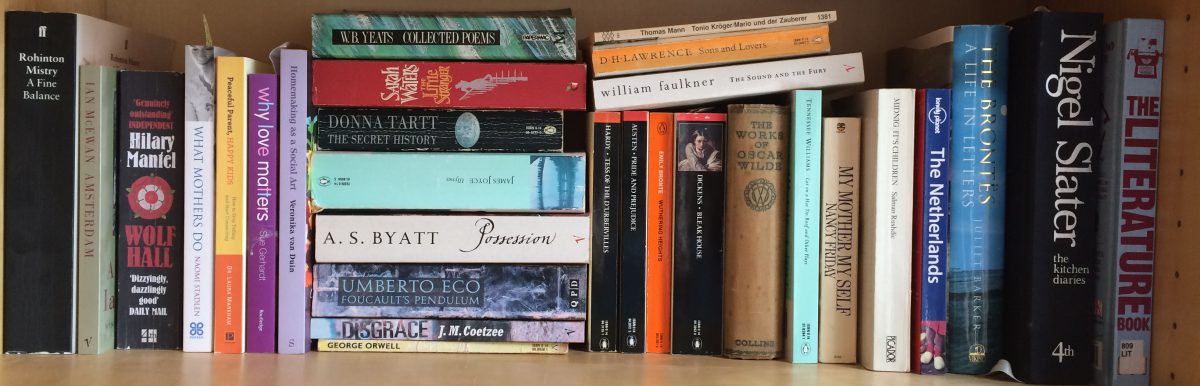

It’s been a very busy few weeks, so my reading rate has been somewhat below par. Besides half term (which, actually, was relatively low-key and relaxing) I’ve been having some further work done in the house; it was a like an ’80s museum when we bought it three years ago and we are gradually working our way through it, room by room. We have been having the final two bedrooms refurbished which has entailed complete chaos, clothes and stuff everywhere, and two weeks on a sofabed. I love it that our builder is happy to work with us in our ‘organic’ (procrastinating!) way, but we are our own worst enemy when it comes to getting the job finished! When we decorate we do so for the long-haul so it has to be right. Consequently, it was the end of October before I got around to reading an autobiography for last month’s reading challenge.
 I was really torn between Claire Tomalin, Anjelica Huston and Alan Cumming. I left it in the hands of the local library and it was Alan Cumming that became available first! I’m still waiting for Claire Tomalin, and that is probably the one I was keenest to read. I was attracted to Alan Cumming’s book, however, because its premise is not dissimilar to the book I am writing, namely family research and the uncovering of a long-held secret. There the similarity ends, however, as Alan’s book is much more about his relationship with his father.
I know very little about Alan Cumming, having seen nothing of his work that I can remember (although apparently he is in Stanley Kubrick’s Eyes Wide Shut with Tom Cruise and Nicole Kidman, a film I have seen a couple of times, though I don’t recall him in it). He now works mainly in the US and has done quite a bit of TV over there. He was born and grew up in rural Scotland, where his father managed a saw mill. Alan’s father was violent and abusive and the nature and frequency of the aggression Alan experienced is upsetting. What is clear from the outset, however, is that the young Alan can find no explanation for it.
In 2010, Alan was invited to appear on the BBC television programme Who Do You Think You Are? where the family history of a celebrity is explored and hopefully something interesting and unusual emerges. In Alan’s case, the mystery to be solved was that of his maternal grandfather, who died in mysterious circumstances as a result of a firearms ‘accident’ whilst serving in the Malaysian police force. It was during the filming of the show that Alan was told by his then terminally ill father, with whom he had had no contact for many years, that he his not in fact his son, but the product of an affair his mother had with another man. This sets Alan off on a journey of self-discovery, forcing him to face up to many of his demons.
It is an engaging and at times very moving story. I’m not sure if there was a ghost-writer involved, but it is well put-together and flows nicely. It’s a decent read, and you’ll like it if you’re a fan of Alan’s work, or if you can relate to any of the themes. What I most admired was how he managed, after such an inauspicious start, to break out of the constraints of his background and upbringing, to become a successful, globe-trotting actor, living in New York, at peace with himself. To that extent it is inspiring.
 For November, the challenge is to read a book set in or by a writer from the southern hemisphere – which is, broadly, South America, southern Africa and Australasia. As the nights draw in and it gets increasingly wintry I wanted to be reminded that in other parts of the world it is Summer! So, my choice this month is Isabel Allende’s Portrait in Sepia, a book I picked up in my local Oxfam bookshop and which has been sitting on my ‘to read’ pile for far too long. Allende is such a fine writer and I’ve read a number of her books over the years. It’s great to have an excuse to dive into this one and experience the sensuousness of her writing and the world she evokes, as the last leaves fall from the trees here and nature seems to go into hibernation.
What are you reading this month?
If you have enjoyed this post, I would love for you to subscribe to my blog by clicking on the ‘Follow’ button.
 There are a couple of titles that have been on my reading list for a while. The first is Scottish actor and comedian Alan Cumming’s Not My Father’s Son, which was published in 2014. It is linked to his appearance in BBC TV show Who Do You Think You Are? in 2010 in which the result of his research caused him to reflect on his family, his upbringing and, in particular, his relationship with an abusive father. It has received glowing reviews and has also won prizes. The theme of secrets and family research is close to the book I am writing myself so it could be helpful. Or it may just make me feel like givng up now!!!
 Finally, I saw in the bookshop recently that Claire Tomalin has written A Life of My Own, where, for a change, she is writing about herself. I admire Claire Tomalin hugely; she has written some of the finest biographies produced in recent years, covering subjects such as Jane Austen, Samuel Pepys and Mary Wollstonecraft. She has led the most astonishing life: an unhappy childhood, four children, the death of her husband, the loss of a child, and the eternal struggle between motherhood and work. I think I would find this book truly inspiring.
 Just Fly Away is the debut novel from 1980s brat-pack actor, turned award-winning director and author Andrew McCarthy. It tells the story of fifteen year old Lucy who discovers that she has a half-brother, the result of an affair her father had, living in the same town. Like No Filter it is a novel about secrets and lies, as Lucy escapes to Maine to live with her grandfather, himself estranged from the family, and to work through the confusion and torment her discovery has left her with.
 Finally, on a different topic, there is All the Things that Could Go Wrong by Stewart Foster which concerns the relationship between two boys, initially at loggerheads, who find common cause when they are forced to spend time together. Alex suffers from OCD and worries about everything. His condition is so severe that he rarely leaves home. Dan is angry, because his older brother Alex has left home and he feels lost. Initially, he takes it out on Alex, whom he perceives as weak and ineffectual, but the boys’ mothers force them together on a garden building project and the understanding that develops between is healing for both.
 Eleanor communicates poorly with others, being rather too literal and pedantic for most people to tolerate and is therefore unable to form effective relationships. At first, she is not an easy character to love, except that we as readers know a couple of things about her that her workmates do not, and which make us more sympathetic to her. Firstly, we know she drinks herself into oblivion at the weekends: as a reader we are bound to ask what she is trying to escape from. Second, there is Eleanor’s mother, with whom she speaks every Wednesday evening; “Mummy” is controlling, manipulative, cruel, nasty. Eleanor is an adult and yet there is something disturbing about the way she always refers to her parent as a child would (never ‘Mum’ or ‘my mother’). The fact that Eleanor also receives regular monitoring visits from social workers tells us that there is something dark in Eleanor’s past that has contributed to her present quirkiness, but we are not told what.
 This is Gail Honeyman’s first novel and it is a stunning achievement. A thoroughly enjoyable read. In an era where poor mental health, social isolation and dysfunctional relationships seem to have reached epidemic proportions, this novel is both an examination of one person’s particular circumstances and an antidote. Highly recommended.
 Julia's books