
I’d been reading some books about writing non-fiction (to try and improve my own writing) and I came across this book, extensively cited as a fine example of the genre. It’s a chunky book that I intended to skim read, with a view to getting an idea about structure and the concept of writing about a personal journey, but I quickly became engrossed in the incredible story of Henrietta Lacks, a black woman, mother of five from Virginia, who died in 1951 at the age of thirty-one from an aggressive form of cervical cancer. Without either her consent or knowledge, the surgeon treating Henrietta took some of her cancer cells and passed them on to a colleague who was trying to find cells which would survive long enough outside the human body to be useful for research. The idea of doing this without the patient’s consent seems shocking to a 21st century reader, but remember this occurred at a time of segregation and ethical concerns and patient rights were concepts not widely considered to be essential elements of medical practice.
 This may have been unremarkable and probably happened more than we care to imagine, but for what happened next: Henrietta’s surgeon had noticed how rapidly her cancer cells had grown, but when George Gey, the scientist to whom he had sent the cells, received them, he found that they divided and reproduced at a rapid rate, and, most remarkably, seemed extraordinarily robust outside their host, unlike all other cells he had dealt with. Gey soon forwarded cells to other colleagues working in the field and they too found the ability of these cells to thrive truly remarkable. HeLa (the name given to the cells) was born and they quickly became an essential part of research worldwide into therapies not just for cancer but for polio and HIV to name but a few. It is thought that around 50 million tonnes of HeLa cells have been cultivated since 1951.
Meanwhile, Henrietta, died and left behind a widowed husband and five young children, two still in nappies, who would never have any memory of their late mother, and one with severe disabilities who would later be committed to an institution. They were poor; Day, Henrietta’s husband, tried to scrape together a living for the family as best he could while Henrietta’s sisters helped with the children. The family would know nothing of what had happened to Henrietta’s cells.
Rebecca Skloot, the author of this book first learned about the HeLa cells in a science class, but it was not until several years later, reading a research paper that her interest was truly piqued and she decided to do a little more digging. She tried to get in touch with the family and was at first rebuffed, but she became increasingly fascinated, obsessed even about HeLa, and the woman behind the headlines, and what had happened to her family. Eventually, she built a relationship with Deborah, Henrietta’s daughter, who had been an infant when her mother died, and a woman who had never come to terms with her loss.
This book is not just the story of Henrietta and her family, and her cells, it is the author’s journey of discovery of the truth about medicine and science in the second half of the twentieth century. It is also a story about racism and health inequality, about exploitation and greed. The author put years of her life into this book and a glance at the references pages will show you the huge amount of research that went into producing it. It also raises some interesting questions about ethics and consent which may surprise you – you might think the answer to the question “who owns discarded parts of our bodies?” is obvious, but when the complexities of the proposition are explored we see that it is not quite so straightforward.
I expected to skim through this book in a few hours, but I found myself captivated by the story and by the issues it raised. Perhaps there are some bits the author could have left out, but I think it is also pretty clear why she couldn’t!
Recommended, especially if you have any interest in the world of medicine.
Have you ever found yourself becoming engrossed in a book that you didn’t expect?
If you have enjoyed this post, I would love for you to follow my blog. Let’s also connect on social media.
 By the strangest of coincidences, I have also just read two books which also explore issues of race and class. Rebecca Skloot’s non-fiction work The Immortal Life of Henrietta Lacks, and The Water Dancer by Ta-Nehisi Coates. Skloot’s book is a detailed and complex account of one woman, Henrietta Lacks, an African-American woman from Virginia who died in 1951 from aggressive cervical cancer. The cancer cells from her body were special and unique because they were the first ever cells that were able to not only survive outside their host, but were able to continue to thrive and reproduce, at a rapid rate. This perhaps accounts for the very aggressive nature of Henrietta’s disease. Scientists used these cells, known universally as HeLa cells, to create trillions and trillions more of them, which have been used ever since, worldwide and have been directly responsible for the development of life-saving drugs and treatments, for example for polio. The key to the story, however, is that Henrietta died without ever having been advised about or consenting to the use of her cells in this way, neither did her family, and none of her surviving relatives have been given any financial compensation. What makes the story all the more shocking, however, is that Henrietta died at a time of segregation, and almost certainly did not receive the same level of care and respect as a white woman would have done. I will write more about this book in a future post because it is a fascinating story.
 The other book I have been reading, The Water Dancer, concerns the story of Hiram, a black slave also in Virginia in the mid-1800s. His mother was also a slave, but his father was a slave-owner, who allowed his son some elementary education after his mother’s death and then, when he was in his teens, gave him the special status of being the personal servant to his white half-brother, Maynard, the heir to their father’s estate. Hiram is also the grandchild of legendary slave Santi-Bess, one of the original transported Africans who is said to have had magical powers (Conduction), although it does not become entirely clear what these are until towards the end of the book. The first significant glimpse of this is when, whilst chaperoning Maynard on a drunken night out, the two young men somehow end up in the river. Maynard drowns but Hiram somehow emerges alive. The events which follow Maynard’s death eventually afford Hiram the opportunity to escape slavery via the Underground and he soon becomes an agent of that cause. It is not a straightforward choice for him, though, as he is forced to confront traumatic memories of his mother, who died when he was very young, and to face the many complex facets of slavery, its consequences, its victims and what it means to be free.
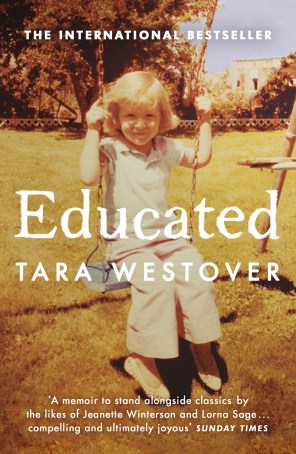 This book caused something of a sensation when it was published last year. It is the extraordinary memoir of a young woman who grew up in rural Idaho, as part of a large Mormon family. Nothing too outlandish there until the author begins telling you about the father’s survivalist beliefs (he hoards supplies of food and fuel in their bunker for when catastrophe strikes, as he believes it inevitably will), his Christian fundamentalism (quite extreme beliefs about, for example, what women should wear, that even their fellow Church members find uncomfortable) and the obsessive control he exerts over the rest of the family. The unconventional nature of the family would be enough to make this a fascinating read, but what makes it shocking is the level of violence, of almost sadistic cruelty. Some of is quite hard to read and at times I found myself gasping out loud.
 The time span of the novel is the duration of Tish’s pregnancy, during which time the couple’s two families set about trying to free Fonny, liaising with his lawyer and pulling together all the money they can to pay Fonny’s legal costs. The lion’s share of this task falls to Tish’s family, who see it as their duty to support their daughter and the father of their grandchild. Fonny’s family, on the other hand is divided; his mother and sisters are deeply confused, ambivalent and disturbed by events effectively disown him. Fonny’s father does engage, supported by Tish’s father, but it is clear he is not really strong enough to cope with the pressure. It falls to Tish’s family to take charge and her mother, Sharon even goes to Peurto Rico, to where the raped woman has fled, to appeal to her to change her testimony, the suspicion being that Fonny was simply served up to her by corrupt police officers. As Tish’s pregnancy progresses, so we follow the legal machinations, the financial pressures faced by all concerned, the effect of prison on Fonny, the artistic soul tortured by his incarceration, and the toll that events take on both families.
 Roll of Thunder, Hear My Cry is the first of three novels by Mildred D Taylor about the Logan family, black farmers in Mississippi, set in the 1930s. They are poor, but they own their own small piece of land, Grandfather Logan having bought it in the 1880s from local landowner Harlan Granger, much to the chagrin of some of the white locals who still cannot accept the social changes giving black people greater autonomy and rights. Grandfather Logan is now dead and the central character, Cassie, lives on the farm with her parents, her grandmother and three brothers. Despite owning 400 acres, the family still struggles to make ends meet, which is why Cassie’s father works away much of the year, on the railroad construction, and her mother works as a teacher at the local (black) school. All the family contributes to the running of the farm and the income it generates.
 My book club chose this for our pre-Christmas read (I’ve only just finished it!) and we all thoroughly enjoyed it. It’s long, and perhaps could have been edited somewhat, but I imagine the main buyers of this book will be Michelle-fans who want as much detail as possible. The first part of the book was, for me, the least engaging. My fellow readers and I were a little surprised to learn that Michelle Robinson did not in fact come from an affluent background. She was a ‘Southsider’ – from a part of Chicago that was fairly blue-collar and largely African-American, and became more so as she grew older and some of the white residents moved out. A picture is painted of a family with strong values around hard work, doing the right thing, caring for others and loyalty to family. Michelle excelled in school through hard work, determination and the support of her parents and attended both Princeton and Harvard Law School. She has never forgotten her humble beginnings, however, and this underpins her commitment to equality and social justice. However, I did feel this part of the book was most descriptive; in the context of the book as a whole I can see why it would have been important to her to put her politics in perspective, but it was a tiny bit…pedestrian?
 The story concerns Romy Hall, a young woman whom we first meet in a prison van en route to Stanville Women’s Correctional Facility, somewhere in California. Romy was convicted of a brutal murder and has been given two life sentences plus six years. Romy worked as a lap dancer at The Mars Room nightclub in San Francisco and it was a former customer at the nightclub that she killed. Romy is at once similar but different to her fellow convicts. For one thing she has a seven year old child, Jackson, whose welfare she becomes increasingly concerned about during her incarceration, and she also completed high school, so she is considerably more educated than many of those around her.
 My youngest daughter, a keen singer, started getting into the show a year or so ago. She has been listening to and singing along to the soundtrack almost continuously ever since. When it was her birthday earlier this year I decided to get her tickets. I was astonished to discover how difficult these were to obtain (and how expensive!), so she has been waiting patiently for almost six months to enjoy her birthday gift. Last week, during half term, we travelled to London to see the show. It was worth the wait and she promptly declared that it was the best experience of her life. For me, seeing her enjoying something so much and how she has engaged so wholeheartedly with the story, the music and the ethos of the production, has the been the greatest pleasure.
 The central character is Walker, a man from rural Nova Scotia, who fought with the Allied forces in the D-Day landings. He has seen and experienced terrible events, death and injury that most of us can barely even imagine, and he survived. After the end of the war, he goes back to the United States and finds himself living among the homeless in New York City. The book is divided into four sections: 1946, 1948, 1951 and 1953 each set in a different US city (though Los Angeles is the setting for both 1948 and 1953). As he reflects on his experiences, it becomes clear that it was impossible for him to return home to Canada. He reminisces about the quiet, gentle life he led there, where the rhythms of the seasons, the dependence on the harvests of the seas, and community events (such as village hall dances) dominate everyone’s existence. It’s as if the contrast between that life and the brutality he witnessed in the war means he fears contaminating the innocence of those he has left behind. He can never go back, never unsee what he has seen, and those he once loved will never be able to understand how he has been changed.
 Julia's books