This might be one of the strangest books I’ve ever read and certainly one of the most unsettling reads in a while. It’s the sort of book where you find yourself shifting uncomfortably in your seat as you observe some very disturbing behaviour.
 It’s basically a book about sickness, and the various forms it takes; the sickness of the troubled central character, Yeong-hye, whose decision to renounce meat from her diet is the catalyst to a catastrophic sequence of events; the sickness of some of her relatives who simply cannot accept Yeong-hye’s decision or who use it to perpetrate their own base acts; and the sickness in the society which degrades and dehumanises Yeong-hye. The insidious and malevolent control meted out to Yeong-hye over a period of many years (a control that was legitimised by social and cultural norms) leads to her attempting to starve herself in a desperate attempt to assert her autonomy, and this has explosive consequences
The novel is written in three parts (originally each was published separately). The first part is narrated by Mr Cheong, Yeong-hye’s husband. Mr Cheong is a selfish, misogynistic fool who is completely indifferent to his wife. There is no trace of affection in their relationship. Any fondness that may have existed has disappeared and Mr Cheong is now bitter that Yeong-hye makes no effort to be the good wife: she embarrasses him in front of his boss, fails to wear a bra and does not keep the house tidy. Mr Cheong rapes his wife repeatedly and sees nothing wrong in ensuring his physical needs are met in this way. And yet, so desperate is Yeong-hye’s family to save face in what in their eyes is a good marriage, they turn against her when she decides to stop eating meat, seeing it as a kind of protest which must be seen to be crushed. There is a very disturbing family dinner scene.
The second part is narrated by Yeong-hye’s brother-in-law, her sister’s husband. At first he appears more sensitive than Mr Cheong and shows some kindness towards Yeong-hye, particularly after the events at the family dinner party. He is an artist and claims he has always been fascinated by his sister-in-law’s fragility, both physical and emotional. At first he seems to be helping her, enabling her to express herself in a new way. But, ultimately, he too will exploit and damage her.
The final part concerns the relationship between Yeong-hye and her sister, In-hye. She emerges as the strongest character in the book and through her we have a reliable witness to the events of the novel. She reflects on the period since her sister became a vegetarian and how her world, and her family’s world has turned upside down. But rather than see it as her sister’s fault (as her parents do) she understands how Yeong-hye’s mental illness has been brought about by the abuse she has experienced.

This book won the Man Booker International Prize in 2016 and has had universal acclaim. It is a very poetic novel, beautifully translated by Deborah Smith; the motif of Yeong-hye’s dream and her desire to transform into a plant provides a powerful element of fantasy, although for me this was not always coherent. However, it is also deeply troubling. Not one for the faint-hearted!


 Many households up and down the UK will be like mine this summer – tiptoeing around a teenager revising for their exams. In my household, my eldest is doing his GCSEs so this is our first experience of exams that really matter. It’s so hard for them and as a parent there is not a great deal you can do to help – which makes it hard for us too! At 16 they need to be working out their own best revision and study methods (definitely not the same as mine!) so although my heart is desperate to ‘help’ my head tells me that I need to step back and avoid interfering. Also, many of my son’s chosen subjects are areas I know very little about – Spanish, Russian – or have limited interest in – physics, electronics – or remember very little about – mathematics! So, beyond providing encouragement, food and drink, and making sure they’re getting enough sleep, what more can you do as a parent?
 This was April’s choice for my book club and one of the members described it as the best book we have read – she consumed it in virtually one sitting in the middle of the night when she was wide awake with jet lag! A fine endorsement indeed. It really is a marvellous book and, as I so often say on this blog, totally unfair that one so young should exhibit this much talent in a debut novel! It has also been shortlisted for the Baileys Women’s Prize for Fiction this year (winner to be annonced on 7 June), so it’s hot.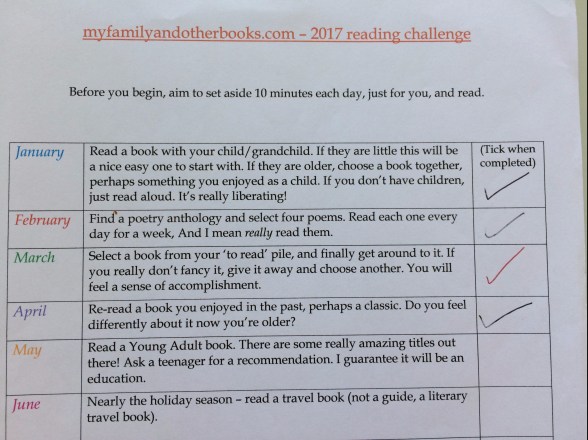
 I picked up a book for my teenage daughter the other day, Everything Everything by Nicola Yoon, which was published in 2015, but has also been turned into a movie, released later this month. It’s the story of a young woman (18 year old Maddy) who suffers from an illness which means she must live in a sterile environment. She develops a friendship with the boy next door, Olly, communicating only through windows and via text. The blurb says that they develop a deep bond and risk “everything” to be together. I’m expecting young first love and possibly a few tears, along the lines of John Green’s The Fault in our Stars.
 Julia's books