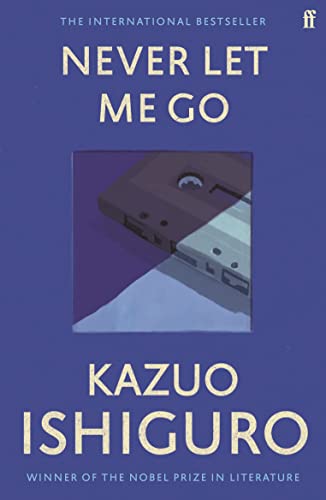
I am very happy to be at the stage in life where I read books that have been recommended to me by my children (all now adults). This is one which my elder daughter enjoyed reading over the summer last year and which she thought I would too. She was not wrong; it is hard not to be a fan of Kazuo Ishiguro, one of our finest living writers, internationally acclaimed, winner of the Booker Prize in 1989 (for The Remains of the Day) and the Nobel Prize for Literature in 2017. The Remains of the Day was adapted for screen in 1993 and turned into a highly-acclaimed film starring Emma Thompson and Anthony Hopkins. Never Let Me Go was also made into a film in 2010 (though I did not know this) with a stellar cast which included Keira Knightley, Carey Mulligan and Andrew Garfield. Ishiguro has quite the pedigree and from what I have seen seems a very nice and down to earth chap. (And a British ‘Sir’ to boot.)
[This review contains some spoilers.]
I read and reviewed Klara and the Sun when it came out in 2021, a novel about some of the potential repercussions of our obsession with technology and AI in particular (I posted about my own sense of alarm about this last month). It looked ahead to some future date when the advance was seemingly beyond our ability to arrest. The world it portrayed was at once familiar and extremely strange. Never Let Me Go bears some similarities in that it explores human cloning. Some readers may recall ‘Dolly the Sheep’ the first successfully cloned mammal who was born in Scotland in 1996 and died in 2003. At the time, there was a lot of fear-mongering about the consequences of this extraordinary achievement and some justified debate about how we as a human race should manage and control the inevitable advance of this particular field of science. In Never Let Me Go, Ishiguro imagines a world where this science is normalised into everyday life and what that means for the people involved.
The narrator of the story is Kathy, a woman still quite young when she is looking back on her life, and in particular at her childhood, from the perspective of one whose living purpose is to care for her peers, the others who share the same destiny as her. Kathy was brought up in an English boarding school (‘Hailsham’) where the staff are known to the young people as “the guardians”. This was in the late 1990s (when Dolly the sheep was all over the news?). Kathy tells us all about her life there, about the daily life of the children, about their relationships and petty differences, about the trivial things that were important to them. At first it is not clear to the reader exactly what is going on at Hailsham, but part way through, when reference is made to their future status as “donors” or “carers” it becomes increasingly and terrifyingly clear what these young people are for – their purpose is organ harvesting. They are all clones of someone on the outside (who they refer to as ‘models’ or ‘possibles’).
When we think about clones we might think about robots (rather like Klara in Klara and the Sun), but the children at Hailsham have been created and have all the usual aspects of human personality. This presents challenges to how they are raised and ‘Hailsham’ was originally conceived as a place where their lives could be made rich, where they could develop relationships with one another (including sexual relationships) and be given some purpose in life until they would be required as donors. But of course, their lives are completely pointless, as Ishiguro shows us, their future is bleak; at some point they will donate, once, twice, perhaps more, after which they will weaken and die. By showing us the human frailty of the young people (petty squabbles, jealousies and meanness) he shows how they are just like us, how we could be just like them, just a few steps away from being nothing but an organ incubator. It would be easier if they were dehumanised (like Dolly).
I found this a powerful novel that I have thought about much since I finished it a few months ago. As I have been thinking about it for this review, I have dipped back into sections of the book and seen things I did not see first time around, the pathos in Kathy, Ruth and Tommy’s trip to Norfolk for example, to search for Ruth’s “possible”, like a search for a mother, an origin story, but of course, the search is fruitless and deeply disspiriting to them all. It is a moment of realisation for them all – there is no-one out there for them.
This book has to be on a list of must-read books of the twenty-first century.


Great review. I loved this book and like you, found myself thinking about it for a long while afterwards.
LikeLike
When did you read it? It’s one of those where I wonder how on earth it passed me by! I think it’s because my kids were very young when it came out so I didn’t exactly have my finger on the pulse of the literary world!
LikeLike
I read it a few years ago now. Possibly when the film came out as I was intrigued by the idea.
LikeLike
I agree, this is a powerful novel – so heartbreaking. Together with The Remains of the Day, it is my favourite Ishiguro. I wasn’t too impressed with Klara and the Sun.
LikeLike
It’s so beautifully written too.
LikeLike
Today I finished Never Let Me Go. Or should I say, I “completed” it. Julia’s summary and analysis are accurate. The book really has no plot, no rising action, no climax, no resolution. It is dull, slow moving, full of triviality, and even the interpersonal relationships are somewhat shallow and shifting. The characters do share sex, but it is a physical act, not an intimate or emotional one. When the main characters do the occasional outing (which to them is a great adventure, sometimes entailing hardship), it turns out to be what this reader would call a mundane, ho-hum trip to see nothing and do less. But that is more or less the point, isn’t it? For these People (and make no mistake about it, they are People), even life’s high points are dull. So, no, the novel is not the “page turner” the cover promised. If there is a story line, it could well be called a “flat-line,” because that is all the characters have to look forward to. And for whatever reason, they accept it, and never question their destiny. What is surprising is that none ever rebel — I would think that some of the doomed, at least, might at least commit suicide rather than comply. The work’s value is in its warning to us now — like 1984 or Brave New World, or the movie The Island. One might console themselves by the assurance that, “This could never actually happen.” But in light of all of the other evils which have been introduced to our society and culture in the last 100 years or so, all I can say is, “Oh, yes, it could.”
LikeLiked by 1 person
I’m sorry you did not enjoy the book – I think I liked it more than you did! It is quite “Ishiguro” – have you read any of his other books? Perhaps you don’t want to now! I found “Klara and the Sun” quite similar, and also quite frightening as it addresses AI.
LikeLike