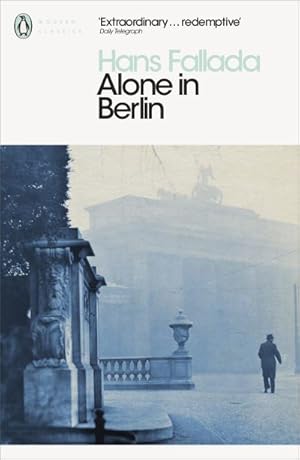
The last book review I posted was about the first volume of Marcel Proust’s In Search of Lost Time, a book I started whilst travelling in Egypt just over a year ago. My last blog post (after a long gap) was about the travelling I have been doing so far this year so I thought it might be nice to share with you some of the reading that has kept me company on my travels. On my recent trip to Turkey I read a lengthy book that I bought at the Dussmann bookshop in Berlin in February, Hans Fallada’s Alone in Berlin. Set in 1940, the book covers a period when the Nazis were at the height of their oppressive powers in Germany, through to the start of their decline and ultimate end in 1945. It was published in 1947, remarkably soon after the end of the Second World War, and is based on real events though names and details have been altered.
The story opens in an ordinary apartment block in the city and we are introduced to the residents of the block. The main body of the story concerns Anna and Otto Quangel, but the author sets the scene by telling us about the other residents and creating the social context for the story. There is one family that is committed to the cause of the Nazis and a Jewish woman who is hounded out of her apartment, but the remainder are either quietly resistant or are simply trying to get along in the new situation, make a living (legally or otherwise), and get the best for themselves. It paints a picture of a community that is largely pragmatic, sometimes selfless and sometimes callously self-interested.
The Quangels are a quiet couple who want no trouble. Otto is a foreman in a factory, a fairly good job at which he is skilled and experienced. The story opens with them receiving the sad news that their only son (also named Otto) has been killed in action. They are devastated, but their reaction to the news shows how unpracticed they are at expressions of emotion and how impotent their rage is. When they tell their son’s fiancee Trudel the news she reveals to Otto, whom she calls her father-in-law, that she is involved in some low-level resistance activity in at the factory where she works. She has betrayed a solemn secret by even telling Otto Quangel this information, but in her youth and naivety, she also does not know how to keep it to herself. Her outburst, however, gives Otto an idea of how he might, in his own small way, express his own anger and resistance towards the Nazis.
Otto and Anna begin a campaign of writing anonymous postcards containing what would be considered subversive slogans such as “Mother! The Fuhrer has murdered my son!” They plan to surreptitiously deposit their postcards in public places in the hope that others will find them and pass them on, thus setting off a chain of events where citizens will challenge the regime. The couple are aware of the grave risks they are taking and discuss their methods at length to try and minimise the dangers.
The Quangels’ campaign of placing postcards continues for some years. In the meantime we learn of the response of the police and the Gestapo, who acquire most of the postcards and are keen to track down the perpetrator. A number of senior detectives and officers take on the investigation and there is a kind of sinister comedy to their incompetence and the degree of seriousness with which they approach this relatively minor and largely futile action. Meanwhile, the breakdown of order in the society and the petty crimes of citizens which are carried out against the backdrop of the much larger grosser crimes of the regime, are set out before us.
Apart from the nasty and inhumane treatment of the elderly Jewish woman at the start of the novel at the hands of Nazi devotees on the upper floor of the apartment bulding, the Persickes, there is very little about the regime’s persecution of the Jews. The story here is about how resistance within society, even the most trivial resistance, was brutally opposed and how the society was controlled through fear and surveillance. This was indeed a powerful theme at the Gestapo museum I went to in Berlin, situated on Wilhelmstrasse, from where much of the operation of the state was controlled. The way the Gestapo operatives are portrayed in this novel is both comic and grotesque – they are extremists operating at the edge of reason, both paranoid and murderous.
This is a long novel about a chase – one of the detectives refers to the case as ‘cat and mouse’ – and the conclusion is long and drawn out, but played against the background of the regime in its declining stages. Did the postcard campaign achieve anything? Was it the only act of defiance available to grieving parents who had no power to protest? Was it symbolic of an underlying opposition within Berlin society that meant the regime was destined ultimately to fail, albeit at monstrous cost? These are all questions I found myself asking as I read this very powerful book.
Highly recommended.


This sounds interesting, a side that we don’t hear about, ordinary people living with the regime and published in 1947 too!
LikeLiked by 1 person
Indeed!
LikeLiked by 1 person