In my final book review of last year I wrote of my delight that Douglas Stuart’s Shuggie Bain won the 2020 Booker Prize. It was one of only two of the shortlisted books I managed to complete before the prize winner was announced (the other one I read, Burnt Sugar, I liked somewhat less and have also reviewed here). I had another of the shortlisted books ‘in progress’ at the time the winner was announced, The New Wilderness by first-time author Diane Cook, which I listened to on audio. It was utterly compelling and was beautifully read by Stacey Glemboski. It reminded me very much of a previously shortlisted book, The Overstory, by Richard Power, which was nominated in 2018 and remains one of the best books I have read in recent years.
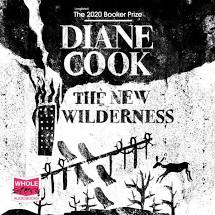
The New Wilderness is set in what seems, frighteningly, a not too distant future in America. Environmental decline has wreaked havoc on ordinary life, such that urban living is barely sustainable, and there are few alternative spaces left for citizens to inhabit. The government has authorised a research project to allow a small group of twenty people to inhabit one of the last remaining wild areas, but there are strict rules that they must observe, including having no contact with the outside world, and leaving no trace of their habitation on the environment, which means not staying in one place too long or building a camp. (The irony is not lost.) The group is closely monitored by Rangers, who enforce the regulations, and the group is required to attend stations every few months to register births, deaths and significant events. The story is told through the eyes of the leading character, Bea, whose partner Glen was one of the academics leading the research. Bea had volunteered for the project in order to remove her daughter Agnes from the city which was killing her slowly. Agnes suffered from a range of unnamed conditions which have been cured by life in the wilderness. Agnes is about ten or eleven when we meet her although no-one has really been keeping track; time is marked by seasonal change not the calendar.
When the book opens the group has already been living in the wilderness for some years. It opens dramatically with the deaths of two members of the group in a hazardous river crossing, in which a valuable rope is also lost. What is immediately striking to the reader is how the loss of the rope is mourned nearly as much as the loss of the companions, indicating how the group has become more focused on survival than finer human emotions. Further death occurs early on when Bea gives birth, alone in the forest, to a dead baby, which she buries quietly and away from the rest of the group. The dead child will be a recurring motif throughout the book; Bea left the city to save her daughter, and lost another because she was in the wilderness.
Life is extremely challenging and there are clearly tensions in the group, which the author takes great care to illustrate in skilful detail, particularly over ‘leadership’ – Glen, as one of the project’s initiators, was once looked to as a kind of informal leader. Glen becomes sick, however, and another of the group members, the strong more dominant alpha male-type, Carl, sees an opportunity to weigh in. Bea has also emerged as a strong leader in the group and Carl, in an attempt to fully oust Glen from his unofficial position, goes about bringing her to his side as well. Here the community is disintegrating; it’s like Lord of the Flies with grown-ups. Further chaos ensues when a small group of newcomers – city refugees who were on a ‘waiting list’ to join the original group in the wilderness – is encountered. To anyone who knows anything about group psychology – forming, storming, norming and all that – this is fascinating. It is also fascinating to see the way the two distinct groups spar with one another, with whom individual members place their loyalties, and how readily the original population integrates with the ‘immigrants’. There are also more young people among the newcomers, teenagers, and Agnes, now a teenager herself, has the opportunity the develop relationships with people her own age for the first time. But the differences between them in terms of their life experiences to date makes it difficult for Agnes to navigate her way among them. With the teenagers a further faction in the group emerges.

What the author creates in The New Wilderness is a microcosm of our problematic human society, where Utopia cannot exist, where the human condition leads to inevitable decline. The wilderness is not the ideal society that the participants hoped it would be; yes, it is ‘natural’ and (mostly) unpolluted, but it is also brutal, and even the most idealistic among them hanker after a shower, some easy food, a haircut. Most strikingly however, is the failure of the community, socially, although the strict policing of the rules by the overweening and power-drunk Rangers (some more than others) does not help.
I have only scratched the surface of the book in this review – it is a highly complex novel and I fear I have not done it justice. It is a dystopian novel, which predicts a bleak future (do not read this if you want something uplifting!) where the opportunity to influence climate change has passed. It is also a novel about motherhood; Bea left the city to save her daughter’s life. In the middle of the novel she also flees the wilderness for a time (abandoning her daughter) when she learns that her own mother has died. The mother who begged her not to go.
All of the Booker-shortlisted novels I have read so far are about mothers or motherhood. Is that a coincidence?
Highly recommended.