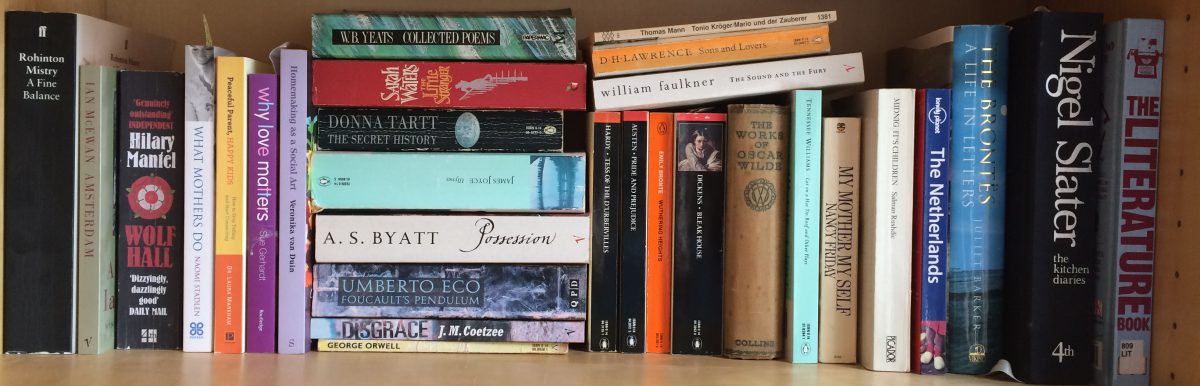
When I announced that this book was May’s choice for my Facebook reading challenge (theme, a 20th century classic), there were mixed feelings – it seems a few of our participants had studied it at school for their ‘O’ level English Literature (predecessor to the GCSE for anyone young enough not to know!). Some were delighted…others less so! I did not study this at school, but I read it at University (I did an English degree). My childhood home was not one filled with books, though I spent a great deal of time at my local library, so when I went to University I had a lot of catching up to do on many of the classics. Golding’s book is one of those and is widely considered to be one of the all-time great novels.
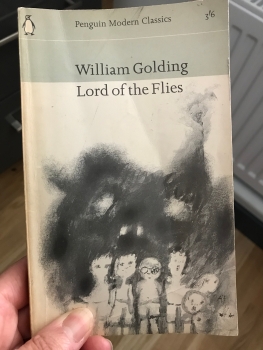
Lord of the Flies was Golding’s first novel, published in 1954. I doubt many people could name any of his other works (I couldn’t!), although he won the Booker Prize in 1980 for his novel Rites of Passage, and the Nobel Prize for Literature in 1983. He died in 1993 at the age of 81. Lord of the Flies has been adapted three times for the big screen, and several times for stage and radio.
The basic plot is that a group of boys (thought to number about thirty, but it’s not entirely clear) are marooned on a Pacific island following a wartime evacuation attempt that ends in a plane crash. There are no adult survivors and the boys, ranging in age from perhaps nine to thirteen years, must learn quickly to survive. Three main characters emerge: Ralph and Jack are the two alpha-males of the group, but have very different instincts about the priorities, and Piggy, an overweight, severely near-sighted boy, probably of lower class than Ralph and Jack, who proves to be the most thoughtful, sensible and self-aware but who lacks the leadership skills to wield any power.
Initially, the boys attempt to organise, with Ralph at the helm. His primary concern is that they should get rescued and stay alive and safe until then. He meets resistance in the form of Jack, who is less keen on the rules and disciplines that Ralph wants to impose. His priorities are “fun” and hunting animals so that they can eat meat. As the days and weeks pass morale drops, particularly among the younger boys, many of whom are clearly terrified. They fear the darkness and the heavy forest on the island and what may be lurking within it – they imagine a terrible beast. Order begins to break down and powerful instincts surface. There is a terrible power struggle between Jack and Ralph which intensifies as the novel progresses. Factions form around the two leaders and the behaviours become increasingly reckless. Simon, one of the other older boys, and a sensitive soul, is killed in a case of mistaken identity, the now savage and adrenalin-fuelled group around Jack believing in his night-time approach to the camp, that he is in fact the much-feared “beast” they imagine stalks them.
Simon’s death at the hands of those who were once his schoolmates, unleashes further savagery, like the genie is out of the bottle. There is also, however, a kind of denial; it seems only Piggy recognises and is able to articulate the danger they are in – from themselves! It seems inevitable that Piggy should also die, brutally; Roger crashes a boulder onto him during a fight between Ralph and Jack in which Piggy is trying to intervene. Jack’s group would have killed Ralph too had it not been for the timely arrival of a rescue ship.
Although it was written in the early 1950s, this is very much a post-war book for me in which the author is reflecting on the base levels human beings can reach. If you simply scratch the surface of society you will find some instincts most of us would rather not admit to. A modern reading of the novel might also see the hazards of excessive masculinity and how lust for power can easily corrupt. You can also look at how easy it is for followers to forget their own moral codes and normal standards of behaviour when seduced by charismatic or persuasive leadership. The younger boys are unable to face the reality of their situation, stranded on a remote island, with an unknown chance of rescue, and the picture of excitement that Jack offers, playing at hunting, escapism from their problems, leads them to follow him down a dangerous path.
Whilst re-reading this book, I couldn’t help thinking about the current political turmoil we are in, both in the UK and globally. Some social norms seem to me to be breaking down. And when it came to the Jack/Ralph power struggle the Conservative party leadership contest came to mind! The only thing I couldn’t decide – who in our current crop of politicians is Piggy?!
A must-read for anyone wanting to gain a serious understanding of English literature.
Did you read Lord of the Flies as a teenager – can you remember what you thought of it?
If you have enjoyed this post, I would love for you to follow my blog. Let’s also connect on social media.
 So my reading time has been severely curtailed. I managed to finish Why Mummy Drinks just after the book club meeting, just as well it was a quick read and did not require too much mental investment. My other big read for last month, however, did. Colin Thubron’s To A Mountain in Tibet was the April title for my
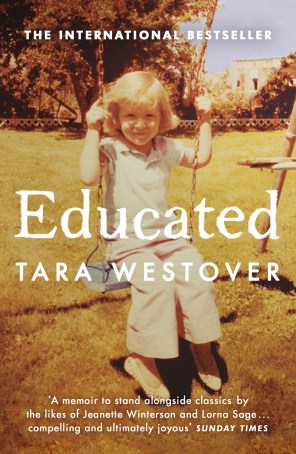 This book caused something of a sensation when it was published last year. It is the extraordinary memoir of a young woman who grew up in rural Idaho, as part of a large Mormon family. Nothing too outlandish there until the author begins telling you about the father’s survivalist beliefs (he hoards supplies of food and fuel in their bunker for when catastrophe strikes, as he believes it inevitably will), his Christian fundamentalism (quite extreme beliefs about, for example, what women should wear, that even their fellow Church members find uncomfortable) and the obsessive control he exerts over the rest of the family. The unconventional nature of the family would be enough to make this a fascinating read, but what makes it shocking is the level of violence, of almost sadistic cruelty. Some of is quite hard to read and at times I found myself gasping out loud.
 The book begins in mid-eighteenth century Paris when the central character, Jean-Baptiste Grenouille, is born beneath a fish stall, to an indigent mother. She pauses her work briefly in order to give birth to him but then, believing or perhaps wishing him to be yet another of the many stillbirths she is said to have had, she leaves him for dead amongst the discarded fish guts. When he is discovered alive, his mother is tried for infanticide and executed. He is left to the mercy of the church, but proves a demanding and difficult baby, who, despite his unpromising start, appears to enjoy rude health. So much so that the wet-nurse hired to take care of him, returns him as he is drinking too much of her milk, making it impossible for her to take on any other infants and therefore make a living. The sense of his insatiable appetite and how he sucks the life out of those around him is established. As he goes through life, we learn that those who come into contact with him invariably meet a tragic end.
 This month, I would like to recommend Catherine Doyle’s The Storm Keeper’s Island, published last year by Bloomsbury, as a fantastic choice for any young people you know who like modern adventure stories where the good guy wins. Catherine Doyle is a young writer (just 29 years old) and has published several YA novels already; The Storm Keeper’s Island is her first novel for what is called the “middle grade”, ie about 9-12 years, and it was a barn-storming debut, winning several prizes and accolades from established authors in this genre. A second novel, following the further adventures of the main character Fionn Boyle, is planned for this summer and I would expect it to feature heavily in recommended holiday reading lists in advance of the Summer Reading Challenge.
 The time span of the novel is the duration of Tish’s pregnancy, during which time the couple’s two families set about trying to free Fonny, liaising with his lawyer and pulling together all the money they can to pay Fonny’s legal costs. The lion’s share of this task falls to Tish’s family, who see it as their duty to support their daughter and the father of their grandchild. Fonny’s family, on the other hand is divided; his mother and sisters are deeply confused, ambivalent and disturbed by events effectively disown him. Fonny’s father does engage, supported by Tish’s father, but it is clear he is not really strong enough to cope with the pressure. It falls to Tish’s family to take charge and her mother, Sharon even goes to Peurto Rico, to where the raped woman has fled, to appeal to her to change her testimony, the suspicion being that Fonny was simply served up to her by corrupt police officers. As Tish’s pregnancy progresses, so we follow the legal machinations, the financial pressures faced by all concerned, the effect of prison on Fonny, the artistic soul tortured by his incarceration, and the toll that events take on both families.
 A dear friend gave me Helen Dunmore’s final novel, published posthumously, Birdcage Walk, for my birthday last year and I have only just got around to reading it. I had read some quite mixed reactions, some feeling it wasn’t her best or that it had not been as well edited as it might have been, which is understandable. I am not familiar with Dunmore’s other novels so don’t have a view on how it compares. It meant I approached it with some trepidation, however.
 Julia's books