 This book has been on my to-read list for some time now, ever since it caught my eye over a year ago when it was published. I recommended it as a hot new read for Spring last year, in fact! Following in my footsteps (he must have read my blog post!) Barack Obama recommended it as one of his Summer reads last year and he is quoted on the cover as saying this is “A moving portrayal of the effects of a wrongful conviction on a young African-American couple.” Notably, it also won the Women’s Prize for Fiction in June.
Let me get my cards on the table straight away – I loved this book, and it completely lived up to the hype it has had. It is such an interesting topic for a novel and yet one in which very little actually ‘happens’. It is a tender account of a relationship and the effect that one single event has upon them. It does not once get sentimental, does not set out actively to campaign about the injustice of the one event, and does not take sides. It just lays everything bare for the reader to draw their own conclusions. It will break your heart and fill you with hope at the same time.
Roy and Celestial are a young African-American couple, living in Atlanta, Georgia and their lives are on the up. They come from rather different backgrounds: Celestial is the daughter of a teacher and an academic, and is hoping to forge a career as an artist. Roy is the only son of Olive and Big Roy (who is not his biological father), decidedly more blue-collar but with strong values, pride, and deep Christian faith. They met through a mutual friend, Andre, who has lived next door to Celestial’s parents since they were children. Roy and Celestial are very much in love, but it is still early days in their marriage and they have their ups and downs.
They visit Roy’s parents in Louisiana one weekend and decide to stay in a motel; Olive has a slight suspicion about her daughter-in-law’s commitment to her son and it is more comfortable for both women if the couple do not stay in the family home. Roy and Celestial have an argument and Roy storms out of their motel room. He meets with a white woman whilst fetching ice and the two get talking. He tells her about the argument with his wife. Later that night, the police storm Roy and Celestial’s room whilst they are sleeping and arrest Roy on suspicion of rape of the woman he had chatted with earlier in the evening. At the trial, the woman testifies with certainty against Roy and it is quite apparent that Roy has little chance of escaping a guilty verdict, even though his innocence is clear to all who know him. Roy is sentenced to twelve years in prison.
The early chapters set the scene, switching between first person accounts by Roy and Celestial of their backgrounds, how they met and their recollections of the fateful night. The following chapters are an exchange of letters between the couple whilst Roy is in jail. Although Celestial visits him every month from Atlanta, the letters are an important way for them to keep their love alive. Just a couple of years into Roy’s sentence, however (and only 80 pages into the book), Celestial tells Roy that she can no longer go on being his wife, that they have spent longer apart than they were together, and that the situation is intolerable for her. We learn that Celestial was pregnant at the time of Roy’s trial but that they decided she should have an abortion as neither wanted their child to grow up with its father in prison. It is a metaphor for the doomed future of their marriage. Their correspondence ceases, and the remaining letters in this section are between Roy and his lawyer, Robert Banks, a family friend of Celestial’s parents, both about Roy’s appeal, which seems futile at this stage, and the status of his marriage.
This might seem the like the end of the thing. What we know about the couple at this stage is that Celestial is a strong-willed, independent woman who knows her own mind, and that Roy is proud, stubborn and conservative. The situation seems hopeless.
Roy spends five years in jail altogether, during which time he learns things about the status of African-Americans in the penal system he had no concept of before. He also, by chance, meets and shares a cell with his biological father, Walter. Also, Roy’s mother, Olive dies of lung cancer, never to see her son walk free. Eventually, Roy’s appeal succeeds and he is released, but he is by now broken, alone, his career in ruins. The remainder of the book is about Roy’s reunion with his old life, his hometown, Big Roy, and most importantly, with Celestial. Can their relationship be salvaged?
I don’t want to give any spoilers here, but I would just suggest that if you are looking for a romantic ending this book, thankfully, chooses not go (entirely!) down that route. It is a fine and up-close examination of the real human impact of judicial complacency, institutional racism, social prejudice and how some sectors of American society just get fewer life chances. It is also about a clash of values, between the more conservative older generation and the younger, educated, more metropolitan groups who assume there is equality.
This book is fascinating, beautiful, gripping and challenging and I recommend it highly.
If you have already read this book I would love to know your thoughts.
Follow my blog if you have enjoyed this review, and get regular updates on my posts.
 The story begins when 15 year-old Michael, off school for many months after contracting hepatitis, seeks out Hanna Schmitz, a woman who had been passing when he found himself being sick in the street and who had helped him. Once he is well again, Michael’s mother sends him off to find the mystery good Samaritan in order that he can thank her. Hanna is twenty years Michael’s senior and employed as a bus conductor, but despite the social and age gap between them, they begin a passionate affair, both parties equally consenting. One of the more intimate aspects of their relationship is that Michael reads aloud to Hanna, after sex and in the bath mainly, although never the other way around. Michael never questions Hanna’s desire to have him read to her, he just accepts it. This makes up the first part of the book and perhaps it is a testament to events that have occurred since the time of its writing that all of us (mothers of teenagers!) found the prose rather discomfiting, and not a little implausible. Hanna disappears mysteriously out of Michael’s life, leaving him heartbroken and perhaps also rather damaged.
 This book is Angie Thomas’s debut novel and it caused a sensation when it was first published in the United States in February 2017. It enjoyed both critical and popular acclaim, remaining at the top of the New York Times YA best seller list for almost a year. It was made into a film which was released last Autumn. The novel came out of a short story Thomas wrote in college following the police shooting of a young black man in 2009.
 So my reading time has been severely curtailed. I managed to finish Why Mummy Drinks just after the book club meeting, just as well it was a quick read and did not require too much mental investment. My other big read for last month, however, did. Colin Thubron’s To A Mountain in Tibet was the April title for my
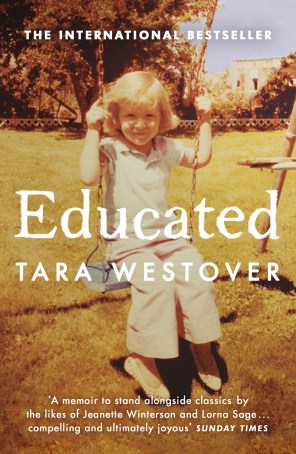 This book caused something of a sensation when it was published last year. It is the extraordinary memoir of a young woman who grew up in rural Idaho, as part of a large Mormon family. Nothing too outlandish there until the author begins telling you about the father’s survivalist beliefs (he hoards supplies of food and fuel in their bunker for when catastrophe strikes, as he believes it inevitably will), his Christian fundamentalism (quite extreme beliefs about, for example, what women should wear, that even their fellow Church members find uncomfortable) and the obsessive control he exerts over the rest of the family. The unconventional nature of the family would be enough to make this a fascinating read, but what makes it shocking is the level of violence, of almost sadistic cruelty. Some of is quite hard to read and at times I found myself gasping out loud.
 The book begins in mid-eighteenth century Paris when the central character, Jean-Baptiste Grenouille, is born beneath a fish stall, to an indigent mother. She pauses her work briefly in order to give birth to him but then, believing or perhaps wishing him to be yet another of the many stillbirths she is said to have had, she leaves him for dead amongst the discarded fish guts. When he is discovered alive, his mother is tried for infanticide and executed. He is left to the mercy of the church, but proves a demanding and difficult baby, who, despite his unpromising start, appears to enjoy rude health. So much so that the wet-nurse hired to take care of him, returns him as he is drinking too much of her milk, making it impossible for her to take on any other infants and therefore make a living. The sense of his insatiable appetite and how he sucks the life out of those around him is established. As he goes through life, we learn that those who come into contact with him invariably meet a tragic end.
 This month, I would like to recommend Catherine Doyle’s The Storm Keeper’s Island, published last year by Bloomsbury, as a fantastic choice for any young people you know who like modern adventure stories where the good guy wins. Catherine Doyle is a young writer (just 29 years old) and has published several YA novels already; The Storm Keeper’s Island is her first novel for what is called the “middle grade”, ie about 9-12 years, and it was a barn-storming debut, winning several prizes and accolades from established authors in this genre. A second novel, following the further adventures of the main character Fionn Boyle, is planned for this summer and I would expect it to feature heavily in recommended holiday reading lists in advance of the Summer Reading Challenge.
