A little light reading

I usually have two or three books on the go at any one time – at the moment it’s my book club book and a children’s book, and then I usually have one other. Sometimes this ‘other’ is necessary as a bit of light relief! Many people tell me that they love to read, but can’t find the time, so they read in bed…and fall asleep after a few pages. I know that feeling! It makes reading anything at the more challenging end of the spectrum very frustrating because you can easily lose the flow.

In this grave hour imgI have learnt my lesson and carve-out reading time for myself in the day. My bedtime reading is usually reserved for lighter books, entertainment. I have recently discovered the Maisie Dobbs series by British-American writer Jacqueline Winspear. I picked up In This Grave Hour whilst browsing at the local library. Set in London in 1939, at the time of the outbreak of World War Two, my principal interest in it was as background for a book I am currently working on. I ended up enjoying the book far more than I expected.
Maisie Dobbs is a private detective, working in London. She is titled, due to marriage, but hails from a humble background herself, though she clearly has many high level Establishment connections. Maisie is a widow, her husband having been killed in the First World War. There is clearly a sadness to her life, as there seems always to be with great literary detectives.

The mystery Maisie solves in this book concerns the violent murders of three Belgians, all of whom escaped Europe and the Nazis as they began to make their way across the continent. Maisie uncovers links between the incidents that the police have been unable to find. At the same time, war preparations are being made in London and children are beginning to be evacuated from the city, including to her own father and stepmother in Kent. Maisie finds herself particularly drawn to a young girl who goes to live with them, whose identity is unknown and who refuses to speak. Another, parallel, mystery that Maisie has to get to the bottom of.

Once I had got past my snobbery about the “this kind of book”, I must say I thoroughly enjoyed it. It was easy to read, a good story, competently written and with easy likeable characters. In This Grave Hour is the thirteenth book in the series, (the fourteenth was published earlier this year), and the author seems to have produced one a year pretty consistently. The first book is set, I believe, at the end of the First World War. It reminded me of a couple of books I have read in the past, the Kate Shackleton Mysteries by Frances Brody. Set in the 1920s, the heroine is a widowed private detective, based in Yorkshire. I read Murder in the Afternoon and Murder on a Summer’s Day, which I have reviewed on here, and enjoyed them both. There are nine Kate Shackleton books altogether.

So, if you’re looking for some light reading, for bedtime, or perhaps for a forthcoming holiday, I would recommend either Maisie Dobbs or Kate Shackleton. You could do a lot worse and you may actually find they keep you awake!

What is your recommended ‘light reading’?

If you have enjoyed this post, please follow my blog and connect with me on social media.

Audiobook review: “A Life of My Own” by Claire Tomalin

I first became aware of Claire Tomalin a few years ago when her biography of Samuel Pepys (Samuel Pepys: the unequalled self) won the Whitbread Book Award (predecessor to the Costa Book Award) in 2002. I remember the story was quite newsworthy because her husband, the novelist and playwright Michael Frayn, was also shortlisted the same year for his novel Spies. He won the prize for the novel. She won the biography prize plus the overall best book. Tomalin has written a number of well-received biographies, including of Jane Austen, Mary Wollstonecraft and Thomas Hardy. Her most recent was Charles Dickens: A Life, published in 2011.

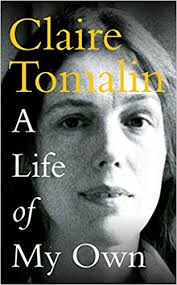
A life of my own imgBrowsing in the bookshop last year, I noticed that she had published her own autobiography, at the age of 83 – I note with some pleasure that her 84th birthday is in fact today! Many happy returns! Reading the blurb whetted my appetite – I was not aware of her life as a groundbreaking Literary Editor at the Sunday Times, or that she had five children, including one boy who died as a baby, and another son who was born with severe disabilities, nor that her first husband, fellow journalist Nicholas Tomalin, was killed in 1973, when her children were still very young. It sounded like a very interesting read.

Anticipating some long drives, I got hold of the audiobook (the reserve list at the library was long and I knew it would be many weeks before I got it), and the fact that it was narrated by Dame Penelope Wilton was a bonus.

At first, I’m afraid to say, I did not enjoy it; I found it quite irritating. Claire was born in 1933. Her father was French and her mother from Liverpool, a talented composer. Her early life was troubled, not least because her parents divorced when she was still quite young. However, she still secured a very good education, first at Hitchin Girls Grammar School and then at the progressive Dartington boarding school in Devon, before going to Cambridge. Through her parents she came into contact with very many high-profile artists, writers and musicians, so though there may have been a shortage of material wealth (though I can only imagine this is relative) there was no shortage of cultural wealth. And I’m afraid this is what I found irritating. I don’t think the author wants us to feel sorry for her, but I found myself with the sense that she really had no idea what the lives of her working class contemporaries, many of whom would have no less ability,  were like compared to her own.

The book became less irritating. Once she had graduated, I found the young adult Claire more interesting, although there was still way too much name-dropping for my liking. I think I expect biographies, and in particular autobiographies, to provide insight, reflection and self-awareness; I have, for example, enjoyed Patti Smith’s Just Kids and Anjelica Huston’s A Story Lately Told: Coming of Age in Ireland very much. However, for me this just did not happen with Claire Tomalin until the final quarter or so of the book. As we learn about the death of her husband Nick (he was hit by a shell whilst reporting on the Yom Kippur War in 1973) and how she had to cope with life as a widowed mother of four children, I found I became more sympathetic. She also faced challenges that most will never have to, thankfully, in relation to her children and these parts were both incredibly touching and immensely readable. She lived in a house in Gloucester Crescent, north London, and mentions neighbour Nina Stibbe, whose tales of nannying to the editor of the London Review of Books in the 1980s are recorded in another book I’ve reviewed here, Love, Nina. It was quite a bohemian lifestyle and engaging to read about.

There is much to enjoy in this book, and the last few chapters are poignant, but overall, I was disappointed. Although it was not smug or self-congratulatory, there were certainly parts which lacked a sense of the privileged life the author had led and that for me was a flaw. You will recognize many of the names mentioned, the anecdotes about Andrew Neil and Rupert Murdoch and the industrial disputes that beset The Times provide a fascinating perspective, and here is a life that has been long-lived, so it spans a vast range of time. For me, though, the book was little too much chronological account and not quite enough personal insight.

Recommended if you’re an admirer of the author or have an interest in the mid-20th century cultural life of London.

Which biographies or autobiographies have you enjoyed recently?

If you have enjoyed this post, do subscribe to my blog and connect with me on social media.

Book review: “The Birth of Venus” by Sarah Dunant

I first knew Sarah Dunant as a broadcaster on late-night arts shows in the late 1990s. It’s funny how you remember some people – she always had very distinctive glasses. I was conscious that she seemed to disappear off the scene and for a while there I got her mixed up with Sarah Waters…until I saw Sarah W speak at the Manchester Literature Festival a few years ago and realised they were not the same! But Sarah D had in fact reinvented herself as an author, as I was to discover a year or so ago when I saw her speak at a writer’s conference. (I should add that 2000-2012 were lean reading years for me – I was knee-deep in children and totally out of the literary loop).

I’ve read a few historical novels, notably Deborah Moggach and Tracy Chevalier, and loved them, though it’s not a genre I often choose. I decided on this as a theme for my Facebook Reading Challenge 2018, and when I saw The Birth of Venus in my local Oxfam bookshop it seemed an obvious choice. It’s wonderful, I loved it, and it seems to have gone down pretty well with the other participants on the Reading Challenge.

The Birth of Venus imgThe novel is set in Renaissance Florence; the sense of time and place is profound. You can almost smell the streets wafting from the pages! Dunant is a meticulous researcher and the novel feels very authentic. The central character is Alessandra, the fifteen year-old daughter of a wealthy cloth merchant. Much to the frustration of her family Alessandra is a precociously intelligent young woman, a talented artist, a strong personality and has a deep desire to be out in the world. These are all traits which are highly inconvenient for the family and not compatible with the kind of life she will be expected to lead.

As a mark of their wealth, Alessandro’s parents commission a Flemish artist to paint the chapel in their home, incorporating the family’s portraits. Though she has very limited opportunity to communicate with him, his presence produces a stirring effect in Alessandra. She is attracted both by his artistic ability and his mysterious nocturnal wanderings into the city.

Alessandra is destined to be married off as soon as she starts menstruating and the husband selected for her is an older man, a long-standing family acquaintance. At first it seems the marriage will set Alessandra on the same path that her mother and sister before her have followed – moving from one zone of subjugation to another and endless child-bearing. In fact, Alessandra’s husband, Cristoforo, is the lover of her brother Tomaso and the marriage is merely one of convenience to provide him with the cover of a wife and child. At first, Alessandra is distraught and feels betrayed, but it soon becomes apparent that this frees her more than she could ever have imagined, to pursue some of her own dreams, to be more sexually liberated, and to be mistress of her own time and activity. In the background to the domestic tumult is the political upheaval in the city; first, the invasion of the French, then the rule of Savonarola, a fierce reactionary monk who preaches a severe brand of Christianity. The old certainties of corruption, sleaze and vice in the Church and politics are being brutally flushed out in favour of a strict religious fervour, and a new atmosphere of fear, surveillance, severe torture and punishment for misdemeanours has replaced it.

I will say no more as it’s a cracking story and events unfold dramatically. The plot is so well thought-through and maintains momentum right to the end. The characters are well-rounded and believable, not just Alessandra, but her mother and husband, her brother and sister, the painter and her loyal maid, African slave Erila.

The book is ambitious in scope, in its portrayal of the period and the way it weaves the political upheavals and realities of the era into what is essentially one young woman’s story of coming of age, of emotional and sexual maturing and of finding fulfilment in the most constrained of circumstances.

Highly recommended, great for any holidays you might have coming up and I’ll certainly be looking out for more Sarah Dunant for future reads.

Do you enjoy historical fiction? What are your recommendations?

If you have enjoyed this post, please subscribe to my blog by clicking the ‘Follow’ button. You can also follow me on social media.

Book Review: “Three Things About Elsie” by Joanna Cannon

I was fortunate to be given a signed copy of Joanna Cannon’s second book by friends for my birthday back in January. (Her first book, The Trouble with Goats and Sheep, is on the list of books I want to read, but I haven’t managed it yet.) My book club picked this for our most recent read, and we all loved it! It’s the best thing I’ve read in ages, the most human, the most touching and the most interesting and unusual plot. It’s beautifully written, the dialogue and characters are authentic and wholly recognisable and it’s an engaging and compelling read.

three things about else imgThe central character of the novel is Florence Claybourne, elderly resident at the Cherry Tree sheltered housing development. Each of the residents has their own apartment, but the block is warden-controlled by Miss Bissell and Miss Ambrose, and there is a Day Room where communal activities are held. Some of the residents are frailer than others and there is the sense that this is the feeder facility for the local residential care home, Greenbank. The eponymous Elsie is Florence’s best friend, that’s the first ‘thing’ about Elsie; they have known each other since they were at school. The second ‘thing’ is that Elsie ‘always knows what to say to make me feel better’; Elsie always sounds a note of calm and reassurance whenever Florence becomes tense or upset, as she does frequently when the events of the novel unfold. Elsie and Florence are constant companions.

In the opening chapter of the novel, entitled ‘4.48pm’ we meet Florence lying on the floor in her apartment. She has had a fall and finds she is unable to reach her emergency cord, wondering who will find her and when. Florence’s abandonment on the floor proceeds almost in real time (at the end of the novel it is 11.12pm and she has still not been discovered, don’t worry that’s not a spoiler!) and whilst she is lying there she has flashbacks about recent events at Cherry Tree and the connection with her past life and her relationship with Elsie. It is through these flashbacks that the story of the novel unfolds. It’s a clever structure and works very well.

Life at Cherry Tree was predictable and dull until the arrival of a new resident. Florence immediately recognises him as a figure from her and Elsie’s past, a former boyfriend of Elsie’s sister Beryl, who appears to have had an abusive relationship with her and was somehow connected with Beryl’s mysterious death, though nothing was ever proved. Florence is convinced this new resident is Beryl’s former lover, Ronnie Butler, but unfortunately, this resident is called Gabriel Price and Ronnie’s body was allegedly found in the canal a little after Beryl’s death. Florence manages to convince Elsie and another friend and fellow resident, Jack, that Gabriel is Ronnie and has some sinister intent in seeking them out after all these years. Certain odd things start happening, such as items in Florence’s flat being moved, the sudden appearance in her kitchen of a cupboard full of Battenburg cakes, and a fire averted in Florence’s flat after an iron was left on while she was out. These events set Florence up against Miss Ambrose, Cherry Tree’s manager, who has been charmed by the amiable and charismatic Mr Price, and who already finds Florence rebellious and truculent, and now feels she may be declining into dementia. She puts Florence ‘on probation’, warning her that if her behaviour continues in this vein she will have no choice but to send her to the dreaded Greenbank.

The rest of the novel is about Florence, Jack and Elsie’s quest to uncover the truth about Gabriel Price and his involvement with Elsie’s family, and particularly the circumstances of Beryl’s death. It is at times laugh out loud, as the intrepid trio grapple with the challenges of old age, but it is always poignant. It is a moving and sobering tale about how often elderly people in our society are lonely and disempowered, shuffled off to care homes to await the end of their lives, and not always with respect.

“’How can you talk to somebody when even their eyes aren’t listening.’”

Florence and her friends reflect on the futility of possessions as you approach the end of life, and the greater importance of love and relationships. It is not just in old age that this happens, however; some of the employees at Cherry Tree lead equally unsatisfying lives without meaningful human connection.

As the book progresses, the Ronnie Butler/Gabriel Price mystery unfolds and we learn more about Florence and Elsie and Jack, about Handy Simon, Cherry Tree’s resident maintenance man, Miss Ambrose, and the events of their earlier lives. There is a stunning denouement at the end, when we find out the third thing about Elsie, which I absolutely did not see coming! The book is wonderful as an observation of old age, and that alone would have been enough, but coupled with a sophisticated and brilliantly worked plot it is a tour de force, truly a novel for our time.

There are some really powerful and moving observations in this book, beautifully expressed in some wonderful passages – I wish I could quote them all. So, unusually, I’ll end with some extracts that I hope will give you a flavour of the novel.

I recommend this book highly.

Florence reflects on the death of a fellow Cherry Tree resident:

“The skip was filled with her life – Brenda’s, or Barbara’s, or perhaps Betty’s. There were ornaments she had loved and paintings she had chosen. Books she’d read, or would never finish; photographs that had smashed from their frames as they’d hit against the metal. Photographs she had dusted and cared for, of people who were clearly no longer here to claim themselves from the debris. It was so quickly disposed of, so easily dismantled. A small existence, disappeared. There was nothing left to say she’d ever been there.”

“When your days are small, routine is the only scaffolding that holds you together.”

Florence reflects on the changes to the high street:

“’And every other shop is a hairdressers. I never realised people had so much hair.’”

Florence on the swift passage of time:

“’You always think “one day”, don’t you, and then you realise you’ve reached the point when you’ve run out of them.’”

“It’s only when you get old that you realise whichever direction you choose to face, you find yourself confronted with a landscape filled up with loss.”

If you have enjoyed this post, I would love for you to subscribe to my blog by clicking on the ‘Follow’ button. Let’s also connect on social media.


Audiobooks can be a great way to access books if you’re time-poor

I know so many people who love reading, but find it hard to find the time to do so – when you have a family, work and find yourself under pressure to provide taxi services, help with homework, cook interesting and nutritious meals, check emails….the list goes on. Reading often drops off the list. And how many of you do your reading at bedtime and find you fall asleep before you’ve even finished a chapter?

It’s a common problem. I am a great believer in two things, however. First, if you want your kids to read they have to see you doing it too – so you’re actually being a good parent by finding time to read. Second, reading can be a wonderful way of escaping all the chores and pressures of life, so you will benefit from even 10-15 minutes here and there.

glass-2557577_1920I’m a big fan of audiobooks as a way of passing otherwise dead time in a more constructive way  – for me it’s car journeys, or whilst exercising. It might also be while you’re waiting for swimming lessons to finish or at the supermarket. You have to choose your titles carefully though, because it’s not just about what you listen to, but the narrator is really key to the enjoyment. For example, audiobooks I have enjoyed have been Holding, narrated brilliantly by the author Graham Norton, Frankenstein, narrated by Derek Jacobi and 1984, narrated by Andrew Wincott (Adam from The Archers). Their reading styles enhanced my enjoyment. A title I enjoyed less because of the narration was The Girl on the Train, where I felt the male voices were not done well.

the story of a new nameI have recently finished listening to The Story of a New Name by Elena Ferrante, Book Two in her Neapolitan Novels series. I have listened to and reviewed here, Book One, My Brilliant Friend, and the narration by American actor Hilary Huber is sublime. The Story of a New Name continues where Book One left off, with Lila marrying the grocery-store owner Stefano Caracci. Lila acquires a new social standing and some material wealth, but it is a loveless affair, and the marriage soon deteriorates into violence and enmity.

Lila’s childhood friend Elena, chooses a different path; she continues her education and though at first she barely scrapes through with adequate grades, she eventually graduates and is accepted at the university in Pisa. While Lila’s life is coming apart (despite her many talents, her beauty and her magnetic appeal), Elena’s eventually triumphant academic trajectory comes as a surprise to many as her abilities and potential were not thought to be as great (especially by herself).

This book has the same wonderful setting, 1960s Naples, the same cast of fascinating characters, mostly sinister and flawed, and develops the themes of friendship, and its many complex facets, jealousy, family feuds, conflict, love, hatred and the position of women in society.

The book is long (over eighteen hours worth of listening, or nearly 500 pages in paperback), but it is epic in scale and epic in achievement. On my audiobook app you can select a faster reading speed; I tried listening at 1.25 speed, but I went back to standard speed, because Hilary Huber’s American drawl is a treat for the ears and brilliantly suited to the story.

I would highly recommend this audiobook – the cast of characters is complicated and sometimes I forgot who was who, especially when shortened or ‘pet’ names are used in the dialogue. I found it helpful to look up a cast of characters online so I could keep track. There are two more books in the series – Those Who Leave and Those Who Stay and The Story of the Lost Child. I will certainly stick with the series and get both of these – even though it might take another year to get through listening to them!

Does the narration style affect your enjoyment of an audiobook?

If you have enjoyed this post, keep up to date with my blog by clicking on the Follow button. Let’s also connect on social media.

Science writing: “Catching Breath: the making and unmaking of tuberculosis” by Kathryn Lougheed

Regular readers of this blog will know that I have been working on my first book for just under a year now. It’s a long process! I finished my first draft just before Easter, but even though it was gratifying to reach that milestone, to be able to type “The End” I was aware that, in many ways it was just that – a milestone, not the end. It was the end of the beginning.

In the last few weeks of writing I had begun to build up a list of gaps, things I still needed to research, passages or chapters that I knew would not read the way I wanted and tweaks that may be necessary with the structure. I conducted my first full read through a couple of weeks ago and found it reassuring that I was indeed right – there were gaps, bits that did not flow and the non-linear structure I was so excited about, well, perhaps that did not work as well as I thought. I wasn’t down about it though. I have a long list of tasks again, but feel generally positive.

Emily Bronte, John Keats and George Orwell are among the many artists who died young from TB, giving the disease a ‘romantic’ image

An area where I felt I needed more information was in understanding tuberculosis (TB). This disease was rife in Britain in the nineteenth and early twentieth centuries. The numbers are astonishing: in England and Wales about four million people are thought to have died from TB between 1851 and 1910. TB-related deaths began to fall from this point onwards but were still shocking: in 1913, there were 36,500 deaths from TB in England and Wales (reaching a peak of 46,200 in 1918, at the time of the European Spanish ‘flu pandemic). By 2013, there were just 280, down from a rate of almost 100 per 100,000 population in 1913, to 0.5 per 100,000 a century later. (Source: Office for National Statistics)

The decline in the mortality rate for the disease can be put down to a number of factors: mainly improved living conditions and sanitation, but also better understanding of the disease (it was once thought to be hereditary, not contagious), the discovery of an effective antibiotic treatment in the late 1940s and, latterly, a nationwide vaccination programme (remember the BCG?). The virtual eradication of the disease in this country is a cause for celebration, but, worldwide, it remains a devastating killer: 1.4 million people a year die from TB.

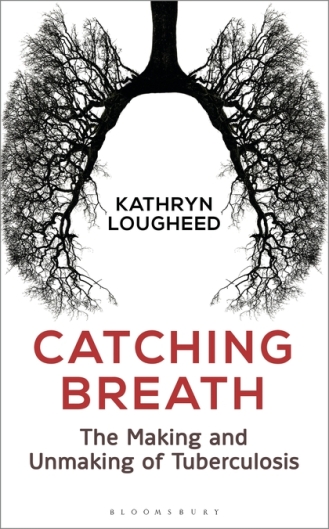
Catching Breath imgOne of the books I consulted as part of my research into understanding more about the disease, its symptoms and its effects, was published very recently, in 2017. It’s called Catching Breath: the making and unmaking of tuberculosis by Kathryn Lougheed. The author is a former scientific researcher and is now a journalist and science writer. The book is excellent. It is fantastically well-written, even funny in parts (the author has an interesting sense of humour – her Twitter handle is @ilovebacteria!). She is out to make some serious points, however, about this, one of the oldest diseases known to humanity, which has so successfully mutated, crossed species and diversified and which just keeps on winning. Her main argument is that TB remains a disease of poverty and inequality. Globally, it affects the weakest – the young, the old, the poor or those who are already sick.  She argues that, although it is a complex disease, if there was sufficient political will, many more lives could be saved. If there was as much resource and international effort put into tackling TB as there has been, say, to addressing AIDS, there would have been far greater success to date. In 2015 the World Health Organisation (WHO) announced its ‘End TB strategy‘, which set a goal to reduce worldwide deaths from the disease by 95% by 2035, although it would seem that nothing short of a heroic research effort will be required to meet this.
If you are at all interested in the politics of health and disease, inequality between the developed and the developing world, and about humanity’s ongoing battles with diseases old and new, this is a fascinating and engaging read. I had intended merely to dip into the bits that interested me for my own research, but I have ended up reading the whole book. In Kathryn Lougheed, science’s loss is the publishing world’s gain. I hope this book gets nominated for some non-fiction or science-writing prizes.

Have you read any good science or non-fiction books recently?

If you have enjoyed this post, do subscribe to my blog by clicking the ‘Follow’ button. Let’s also connect on social media.

Book review: “Memoirs of a Polar Bear” by Yoko Tawada

This was April’s book in my Facebook reading challenge – I had mistakenly assumed it was a children’s book, as that was our theme for the month. It quickly became apparent to me that it definitely was not! This raises an interesting question in itself, however: why are we enchanted by our children’s books, with their talking animals, cross-species interaction, and animals mixing, seemingly without comment, in the human world, and yet, for our ‘adult’ books, we find this difficult to accept? Don’t get me wrong, I did indeed find this a really challenging read, and I’m still not really sure what I think about it, but it has made me realise that the genre of magical realism, into which I think this book falls, requires a certain openness of mind that we have to be really ready for. I think part of my problem, particularly with the opening section of the book, is that it really wasn’t what I was expecting. I felt somewhat thrown and it inhibited my engagement with the book.

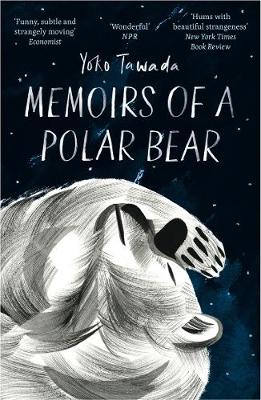
Memoirs of a Polar Bear imgI’ll summarise the basic story of the novel. Part one is the most surreal and the most difficult. It is narrated by the nameless ‘grandmother polar bear’ (grandparent to Knut, star of part three). She has been reared as an attraction in the Soviet Union, by a cruel master, who, among other things, teaches her to stand on her back legs using what we would now regard as unethical methods. I think that by getting the bear to stand like a human the author justifies the morphing of her subject into something less animal. Throughout this part we are asked to suspend our disbelief: the bear escapes Soviet Russia, writes her memoirs, and flees to Germany, where she is ‘protected’ by an unscrupulous agent who simply wants to exploit her because her book has been so popular. The bear visits bookshops, makes human friends and animal enemies (the sea-lion publisher who makes ever more unreasonable demands). It’s all very tricky for us as adult readers.
I think part one is the most overtly political: there is the comment on the dehumanisation of life in the Soviet Union (thus the blurring of the boundaries between the animal and the human?), the bear as outcast (because she is foreign not because she is a bear), the futility of administrative and management practices, and about the impact of climate change – there are frequent references throughout the book to the threat to the species from the disappearance of its natural Arctic habitat. I think as a reader you just have to accept its surreal qualities.

Part two is about the polar bear’s daughter Tosca, who is a circus performer in East Germany. It is narrated by Tosca’s trainer, Barbara (although there is an interesting twist at the end of this part which I won’t spoil), and as such it feels more ‘normal’ to us as readers. Tosca and Barbara develop a very deep connection, which results in extraordinary performances, driving the greedy circus managers to demand ever more dramatic stunts. Her relationship with the polar bear leads Barbara to reflect deeply on the relationship between humans and animals and the author exposes the hypocrisy of the humans, who for example, see polar bears as aggressive and unpredictable whilst prosecuting violent wars themselves. There is also an exploration of gender inequality in this part as the trainer Barbara is as exploited as her animal charge.

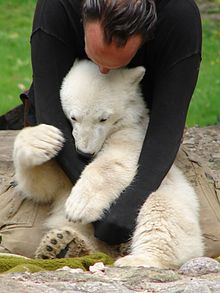
knut the polar bear
Knut the polar bear (2006-2011) with his keeper at Berlin Zoo

The final part of the book is about Knut, Tosca’s son, and is based on real events. Tosca says that she gave Knut away (in reality he was rejected by his mother, the inference being that reproduction in captivity drives unnatural behaviours), and he is raised by a human keeper, with whom, once again, he develops a very deep bond. I found this part the most moving and it is definitely more rooted in realism, even though it is narrated by the bear. I have read a little bit about Knut subsequently and it has made my reading of this part of the book more poignant. (Knut died suddenly in Berlin Zoo in 2011, aged only four years, from a brain disease). This part of the book truly challenges our attitude to animals and our use of them in captivity for entertainment, amusement and commercial gain. It also exposes most starkly our attitudes to climate change, habitat loss and species decline: we claim to raise animals in captivity (with all the inherent cruelty that entails) so that we can protect the species, without doing anything about the underlying causes of species decline.


Overall, I found this book quite difficult to engage with – I wish I’d known a bit more about it before I started it, but all the reviews I read didn’t really give much away about what the book was about. That is normal for book reviews – no-one wants to give away a spoiler. But there isn’t much to spoil in this book because there is no ‘plot’ as such. I think I could also have engaged with it more if someone had told me to read with a very open mind! That’s a lesson for me as a reader. I have enjoyed this book more in retrospect, as I have reflected on its subject matter and themes, and I am glad I have read it, even if it didn’t always keep me awake at bedtime!

Recommended if you like these themes and can be open to the surreal!

How did you get on with the surreal aspects of this novel?

If you have enjoyed this post, please subscribe to my blog by clicking on the ‘Follow’ button, and let’s connect on social media.

YA book review: “The Nowhere Girls” by Amy Reed

The Nowhere Girls imgThis is a very hard-hitting YA novel for older teens. It is an important book, dealing with a very current issue, misogyny, sexual violence and rape, but as a parent I found it extremely challenging to read. The story is set in Prescott, Oregon, a medium sized-town in the northwest United States. It centres on a group of three girls in high school (so about 17 or 18 years old) Grace, Erin and Rosina. Grace has moved to Prescott after her mother (an evangelical preacher) was forced out of her position in their previous home in the southern US because of hostility from the congregation towards her views. Grace finds, in her bedroom in their new home, some cryptic words scratched into the woodwork. She discovers that the previous occupant of the room was a girl called Lucy who alleged that she was raped by fellow students. No charges were brought and Lucy and her family left the town.

Grace struggles to make friends in her new school, because of her southern accent and her newness, but eventually connects up with Erin and Rosina, relative misfits in the school community. Erin has Asperger’s and her mother is over-protective and a zealous moderator of various social media groups and forums. Her obsession with this activity and her over-anxious concern to do all the right things, inhibits her from having a truly meaningful relationship with her daughter. Rosina comes from a large extended South American immigrant family and has a tempestuous relationship with her mother and her other relatives for whom she has to work for little or no pay, babysitting and waitressing.

The three girls are thrown together and Grace learns about what happened to Lucy, the author of the words scratched into the woodwork. Like her mother, Grace is earnest and a campaigner and she vows to do something about this unresolved issue. She sets up a secret group, calling it The Nowhere Girls, with a view to the young women at the school sharing their experiences and, Grace hopes, banding together to do something about the widespread misogyny. The group takes off in ways that none of its three founders could have anticipated; their secret meetings, held after dark in abandoned or remote locations, are well-attended and the young women share stories of widespread rape, and violent or coercive sexual encounters. The girls decide to go on a sex strike, to teach the boys a lesson, and as news of this spreads, the school authorities become increasingly angered and concerned about the reputation of the school and about the effect it is having on the stability of the school community.

As the book progresses events take on increasingly sinister turns. As the meetings of the Nowhere Girls expand it becomes clear that whilst misogyny and taking girls’ sexual availability for granted are widespread, the worst offences seem to have been committed by a small group of boys. Also, the Principal of the school becomes ever more extreme in her determination to stamp out the disruption caused by the Nowhere Girls, engaging in the kinds of blackmail and threats and that are effectively colluding with the perpetrators of the sexual crimes. The book is hinting at a wider social acceptance of rape and sexual violence as inevitable and quietly endorsed by those with vested interests in a storm not being created.

Once I had got past my initial doubts about the book’s basic premise, I found it a real page-turner. As a parent of teenagers I also found it a useful insight into a world I no longer know, not the sexual violence side of things, but the feelings of young women about their relationships with their parents, their relationships with each other and their hopes and desires around romantic partners. Coming back to the book’s premise, that rape and sexual violence are pretty common in high schools, accuse me of living under a rock if you like, but I found this difficult to accept as a phenomenon. Remember this is set in the US, so things may be different over there, but it painted a much more extreme view of a middle class high school community than was familiar to me. Perhaps I’m out of touch, but…

There are some sub-plots in the book, which help to lighten the load, for example, the relationships all three central characters have with their mothers, and the rather nicer romantic attachments they develop, including, in Rosina’s case, an exploration of her burgeoning homosexuality. But there is no doubt the book is at times graphic and disturbing, and therefore, I would suggest, suitable for older teens only. I think there are many important issues handled here, and they are sensitively done, but I would suggest it should be read by parents first before handing to under 18s. It may also form a useful basis for discussing these sorts of issues with your teens.

Do you think parents should ‘vet’ books before their teens read them?

If you have enjoyed this post, do subscribe to my blog by clicking ‘Follow’, and let’s connect on social media. 

Book Review: “Madame Bovary” by Gustave Flaubert

My Facebook Reading Challenge 2018 is well underway and March’s theme was a classic. I chose Madame Bovary, Gustave Flaubert’s 1857 classic, because it seemed to fit well with a lot of the women’s issues around and being discussed at the moment, particularly gender equality and sexual exploitation. It is fair to say that it had a mixed reception among the readers on the Facebook group!

2018-02-22 14.12.54I had read this book previously, but many years ago as an undergraduate, so whilst I had remembered the basic story, I had forgotten much of the detail. I had forgotten for example just how brilliant the writing is and how very like Jane Austen Flaubert can be in his use of irony. By all accounts, Flaubert was a perfectionist and spent years on this book; it is certainly masterful and for me the writing was sublime. I had also forgotten how unlikeable all the characters are! Even Emma, our supposed “heroine”, is at times unpleasant, childish, selfish, superficial and self-obsessed. When I discussed it with my husband (who speaks fluent French and read it in the original) he was surprised that I did not find Charles Bovary, Emma’s husband, sympathetic. Interesting that he felt affection for the long-suffering, betrayed husband who loved his wife to the death, despite her many faults, whereas I found him ineffectual and basically unable to connect with his wife on any level, and that was part of the problem in their marriage.

I don’t think even Flaubert liked his characters and I think it was the intention of the author that we stand with him and examine the people he puts before us, with all their flaws. I believe he wants us also to dig a little deeper and examine the French provincial society that gave rise to Emma. As a young woman she lives a dull and uninteresting life with her widowed father on a farm, until the day she marries Charles, a physician in a neighbouring town, and goes to live a dull and uninteresting life with him. Passed from one man’s home to the next. Emma would not have had expectations, but she was an intelligent woman and the kind of life she was forced to lead did not fulfil her deeper needs. She is a woman of deep passions, but there is no outlet for them, apart from the romantic novels she devours. Certainly, Charles does not really do it for her! “Charles’s conversation was as flat as any pavement.”

Flaubert hints that Emma’s lack of fulfilment may be dangerous when he observes, after she and Charles were invited to an aristocratic ball, where she glimpses how the other half live and begins to fantasise:

“This life of hers was as cold as an attic that looks north; and boredom, quiet as the spider, was spinning its web in the shadowy places of her heart.”

What a sentence! Emma is naïve and inexperienced, however. Her life has been limited and she sees events in the most superficial of ways:

“She confused in her desire, sensual luxury with true joy, elegance of manners with delicacy of sentiment.”

Flaubert doesn’t expect us to like Emma very much, but I think he wants us to see her as a product of a time and a place, not as wilful and malicious.

Seduced by romantic fantasy, Emma takes lovers, both of whom are equally selfish and unpleasant. Whilst she is clearly a willing participant in her adultery, there is no doubt that both Leon and Rodolphe exploit Emma. When Emma’s reckless behaviour leads her to run up unsustainable debts, the town’s notary, from whom she has been borrowing money, also exploits her. When he requests sexual favours in return for his continued discretion we can see how deeply lost Emma’s situation is and how as a woman she has almost no power or autonomy. Her response to him, is when we begin to see for the first time something more admirable in her spirit:

“You are taking insolent advantage of my distress, monsieur. I may be in a pitiful state, but I am not up for sale!”

Parts of the book are heavy going, but it is in Part Three that we see the tragic coming-together of events, the closing-in on Emma of all the consequences of her misguided actions, her falsehoods, and the tremendous dislike she accrued. She is not a nice woman – she betrayed her husband, who did not understand her, but loved her in his own way, rejected her daughter and treated those about her with contempt. She was the architect of her own downfall, but she was also a victim of heartless men, of social norms and conventions that failed women like her and gave them no outlet.

She is a difficult heroine for us, but one who makes us think, for sure. Recommended because it’s just one of those books you have to read!

Do you find it hard to connect with the classics? What is your favourite?

If you have enjoyed this post, do subscribe to my blog by clicking on the ‘Follow’ button, and let’s connect on social media.

Book and theatre review: “Frankenstein” by Mary Shelley

I had my fill of Frankenstein last week – I read the book, saw the play and listened to Derek Jacobi narrating the audio book! My book club selected it as we were looking to read a classic, and, as it happens to be the 200th anniversary of the novel’s publication, it was also showing at the Manchester Royal Exchange Theatre in a new adaptation by April de Angelis.

2018-04-19 11.30.32It is extraordinary to think that this remarkable novel, still as popular and as shocking today as ever, was written when Mary was just 19 years old. The fact that she was such a literary talent is not surprising given that she was the offspring of the two famous intellectuals, Mary Wollstonecraft, philosopher and author of the seminal feminist work A Vindication of the Rights of Woman, and William Godwin, the radical political philosopher. In her lifetime, she was highly regarded as a radical writer and intellectual, as well as being the wife of the poet Percy Bysshe Shelley, whom she met and fell passionately in love with at the age of 17. Her reputation since her death, however, has been overshadowed by that of her husband’s, with whom she bore four children (three died in infancy), whose affairs and financial troubles she endured, and whose poems she edited both before and after his death. Percy Bysshe Shelley drowned at sea in 1822, just six years into their marriage when she was 25. She died at the age of 53 in London from a suspected brain tumour.

Mary ShelleyBy any standards her life was remarkable and in the last few years her reputation has been revived and she has begun to be more widely considered as a formidable talent in her own right, rather than just a ‘one-book author’. Frankenstein has been a staple of English literature GCSE and A level syllabuses for years, but most of her other works have fallen out of print. A new biography, In Search of Mary Shelley: The girl who wrote Frankenstein, by Fiona Sampson was published earlier this year, some of which I caught when it was serialised in Radio 4 recently. What I heard sounded fascinating. Sadly it is not available on the BBC iPlayer at the moment.

Frankenstein is a brilliant book. It’s not particularly long so if you are not accustomed to the classics it is not too daunting. It is extraordinarily sophisticated in the themes it explores, from ideas about religion and creation, the vanity of man (men) and moral relativism. Its structure is also interesting: it is narrated initially by Robert Walton in letters to his sister. Walton is the Captain of a ship which he is sailing to the Arctic in the hopes of making a great discovery about the North Pole. He describes his ambitions, but also his loneliness and need for companionship. He meets an unexpected friend in the form of Victor Frankenstein who is on an unlikely pursuit of a mysterious giant figure which Walton and his crew had previously spotted. Frankenstein takes over the narration and we learn about the terrible events that preceded this chase, from his early family life in Switzerland and tragic death of his mother, his relationship with his cousin Elizabeth, to his university life in Ingolstadt. It was in Ingolstadt that he first felt the pain of academic embarrassment, when his naïve ideas were exposed, and he set out on the extraordinary task of creating a human. Unfortunately for Frankenstein, he did not think it through, and once he realised the horror of what he had done, quite soon after he brought his creation to life, he disowns it and leaves to its own fate while he spends the next few years wringing his hands. Frankenstein’s procrastination is fatal.

For a time there is also narration from the ‘monster’ (relayed by Frankenstein) who manages initially to survive on vegetation whilst concealed in a hovel, from which he is able to spy on a once wealthy but now fallen French family in a small village. From them he learns language and the ways of humans, and hopes that he will be able to become friends with them, as he longs for company. Unfortunately, when he introduces himself to them, his hopes are shattered; they assume from his, presumably horrific appearance, that he means them harm and they beat him and drive him out of the cottage. Disappointed and infuriated, the monster goes in search of Frankenstein, with the intention of demanding that he make him a female companion, with the threat of death and destruction if he refuses.

I will say no more. Though the story is well known, I do not wish to give away any further spoilers for anyone unfamiliar with it. I wanted to finish the book before seeing the play, so I mixed reading it with listening to the audiobook narrated by Derek Jacobi. This was read brilliantly, as you would expect, though I have to say it gives you the impression that both Walton and Frankenstein are older, wiser men when in fact it is their naivety and youthful impetuosity that is partly responsible for the grave decisions both make.

Frankenstein play
Copyright –  Royal Exchange Theatre, Manchester

The play was also wonderful and provided a rewarding extra-curricular outing for the book club! It was visceral, shocking, truly gruesome in parts. I loved the way the complex narrative structure, and the jumping back and forth in time was handled. I also loved the way it was interpreted for a 21st century audience, particularly in drawing out the feminist undertones (Elizabeth is played more strongly than in the book, while Frankenstein is often exposed as foolish). It had thrills, spills and lots of action, and stayed very true to the book, leaving out remarkably little and using some of the really powerful passages (particularly those spoken by the monster) verbatim. It will have been a fantastic bonus for any young people studying it for exams this year.

A thoroughly enjoyable monstrous week!